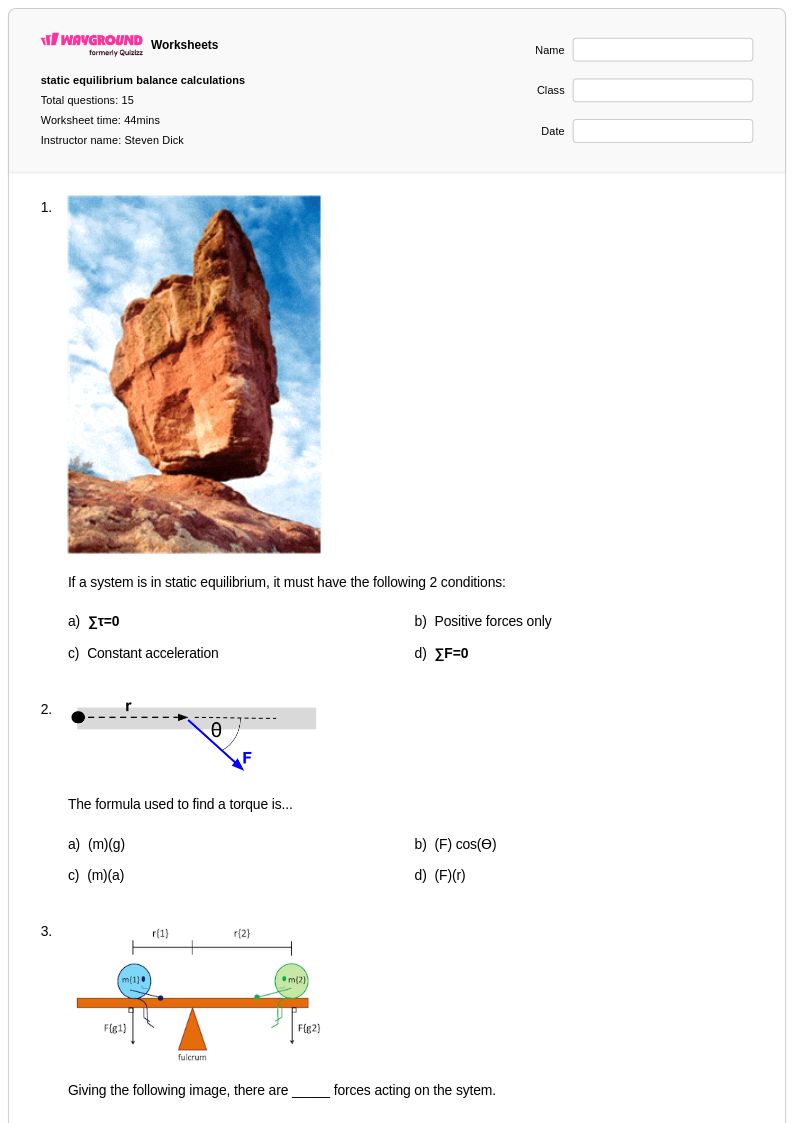
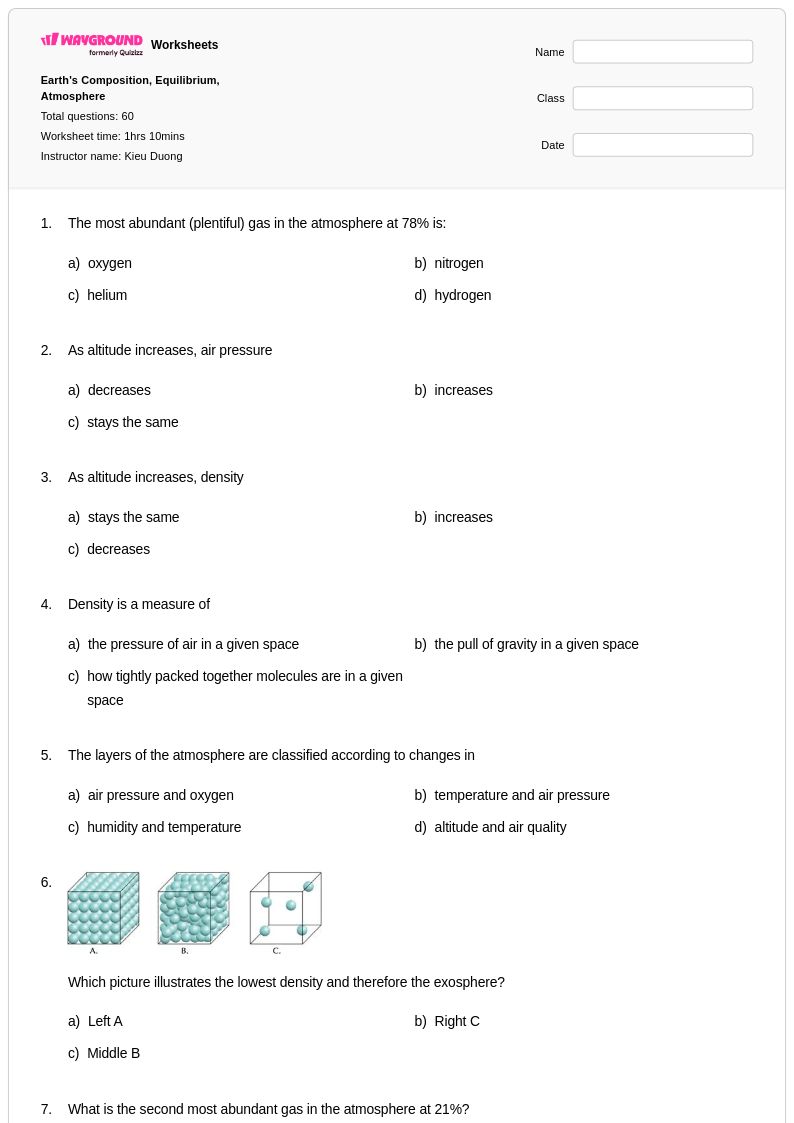
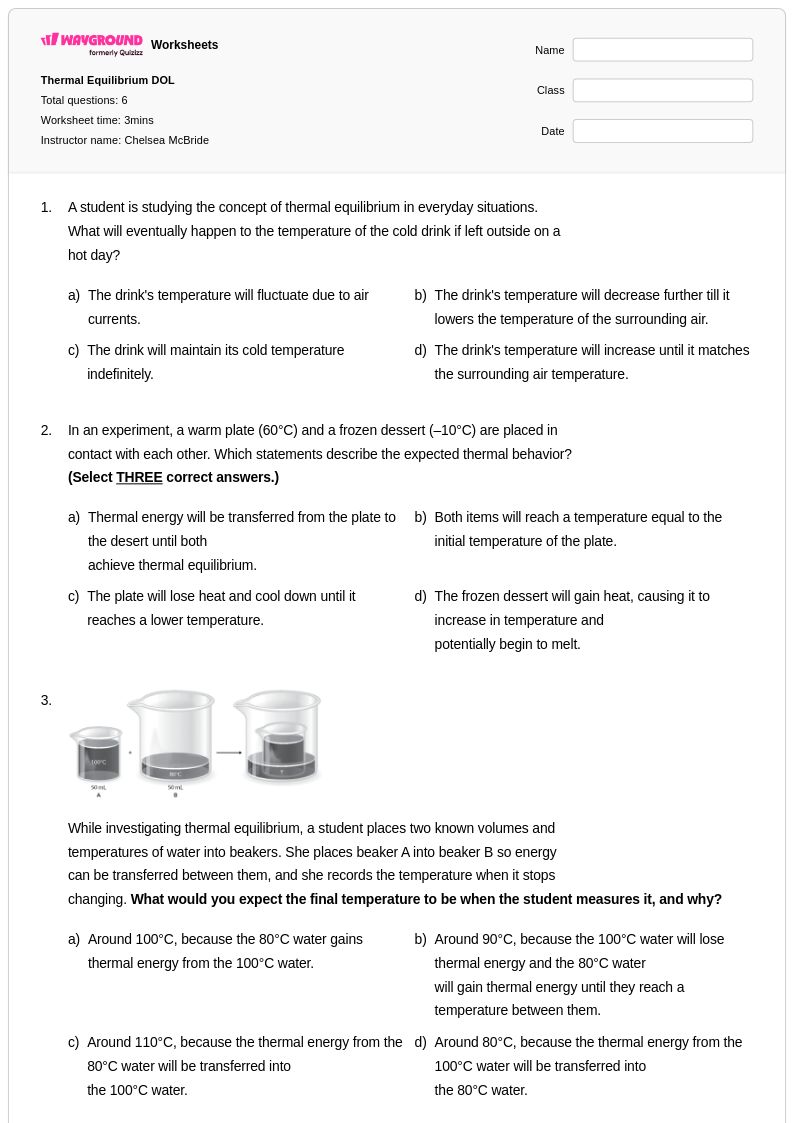
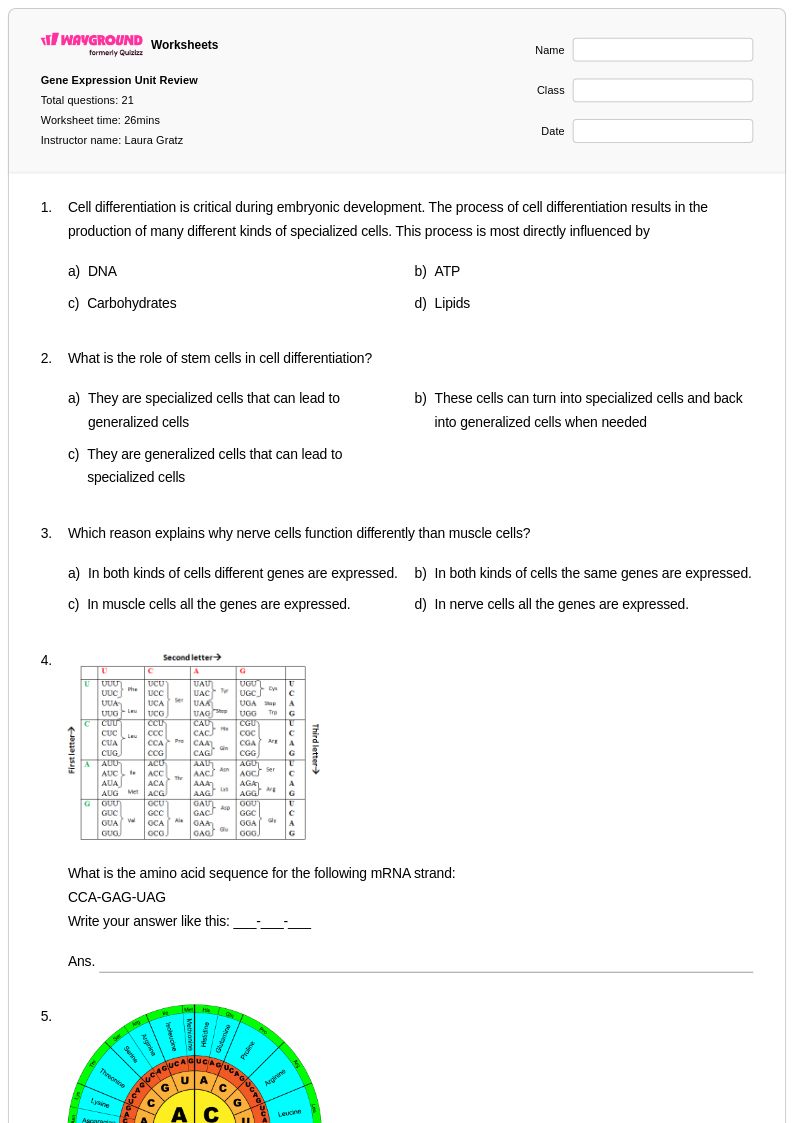
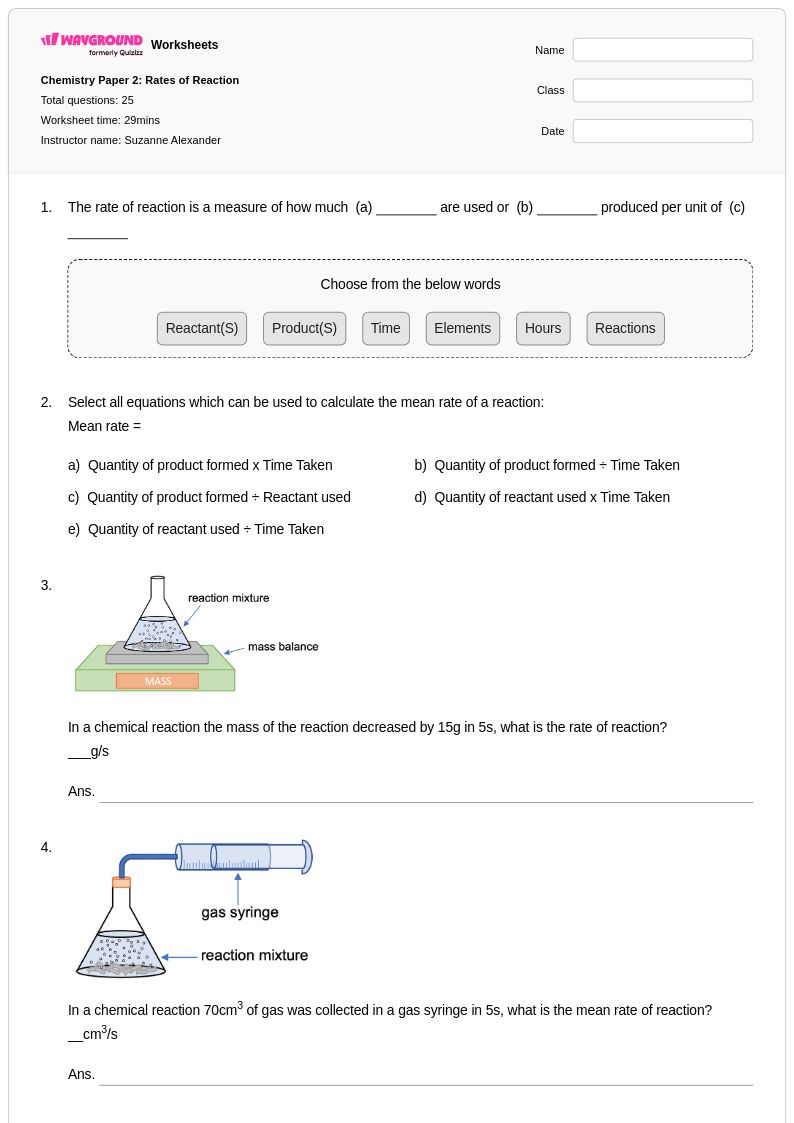
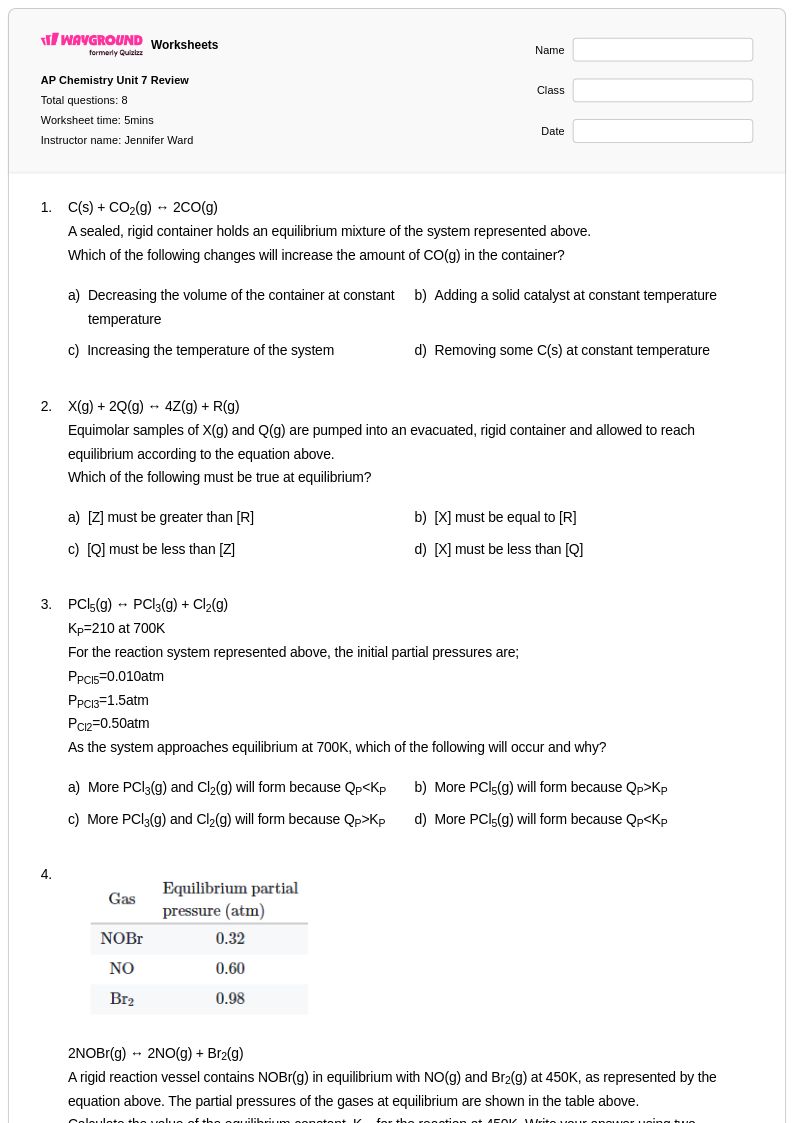
Access free equilibrium expressions worksheets and printables with comprehensive practice problems and answer keys to help students master writing and interpreting chemical equilibrium expressions in science.
Equilibrium expressions represent a fundamental concept in chemical equilibrium, requiring students to master the mathematical relationships that describe reaction dynamics at equilibrium. Wayground's comprehensive collection of equilibrium expressions worksheets provides targeted practice with writing and interpreting equilibrium constant expressions, calculating Kc and Kp values, and understanding the relationship between reaction quotients and equilibrium constants. These carefully designed practice problems strengthen students' ability to analyze chemical systems, apply Le Chatelier's principle through quantitative analysis, and solve complex equilibrium calculations. Each worksheet includes a complete answer key and is available as a free printable pdf, allowing students to work through progressively challenging scenarios that build confidence in manipulating equilibrium expressions and interpreting their chemical significance.
Wayground's platform, formerly known as Quizizz, empowers educators with access to millions of teacher-created resources specifically focused on equilibrium expressions and related chemical equilibrium concepts. The platform's advanced search and filtering capabilities enable teachers to locate worksheets that align with specific curriculum standards and match their students' skill levels, while built-in differentiation tools support both remediation for struggling learners and enrichment opportunities for advanced students. Teachers can customize existing worksheets or create entirely new practice sets, with all materials available in both printable pdf format and interactive digital versions. This flexibility streamlines lesson planning while providing educators with the resources needed to deliver targeted skill practice, assess student understanding of equilibrium calculations, and ensure mastery of these critical chemical principles through repeated, varied exposure to equilibrium expression problems.
FAQs
How do I teach students to write equilibrium constant expressions?
Start by ensuring students understand the law of mass action: products appear in the numerator and reactants in the denominator, each raised to the power of their stoichiometric coefficients. Emphasize that pure solids and pure liquids are excluded from equilibrium expressions because their concentrations are constant. Walking students through a series of increasingly complex reactions, from simple binary reactions to heterogeneous equilibria, helps build the pattern recognition they need to write expressions independently.
What exercises help students practice writing and calculating equilibrium expressions?
Practice should move from identification tasks (labeling reactants and products) to writing Kc and Kp expressions, then to calculating equilibrium constant values from given concentrations or pressures. Problems that require students to convert between Kc and Kp using the relationship Kp = Kc(RT)^Δn are especially effective for reinforcing conceptual understanding alongside calculation skills. Mixing straightforward stoichiometry-based problems with scenarios involving reaction quotients (Q) helps students understand how to predict the direction a system will shift to reach equilibrium.
What mistakes do students commonly make when writing equilibrium expressions?
The most frequent error is including pure solids or pure liquids in the equilibrium expression, which incorrectly changes the value of K. Students also commonly invert the expression, placing reactants in the numerator, or forget to apply stoichiometric coefficients as exponents. A related misconception is confusing the equilibrium constant K with the reaction quotient Q, leading students to misinterpret whether a system has reached equilibrium or which direction it will shift.
How does Le Chatelier's principle connect to equilibrium expressions?
Le Chatelier's principle predicts how a system at equilibrium responds to a stress such as a change in concentration, pressure, or temperature, but equilibrium expressions provide the quantitative framework that explains why. When a stress is applied, comparing the reaction quotient Q to the equilibrium constant K tells students precisely which direction the reaction will shift to restore equilibrium. Teaching these two concepts together, rather than in isolation, helps students move from qualitative prediction to quantitative analysis.
How can I use equilibrium expressions worksheets from Wayground in my classroom?
Wayground's equilibrium expressions worksheets are available as free printable PDFs for traditional classroom use and in digital formats for technology-integrated environments, including the option to host them as a quiz directly on Wayground. Teachers can use printable versions for in-class practice or homework and assign the digital version for self-paced review or formative assessment. Wayground also supports student-level accommodations such as read aloud, extended time, and reduced answer choices, which can be applied individually so that differentiation happens seamlessly without disrupting the rest of the class.
How do I differentiate equilibrium expression practice for students at different skill levels?
For students who are still developing foundational skills, begin with simple homogeneous reactions and focus on correctly identifying which species belong in the expression before introducing calculations. Advanced students benefit from multi-step problems that combine writing expressions with ICE table calculations, Kp-to-Kc conversions, and Le Chatelier's principle analysis. On Wayground, teachers can apply accommodations such as reduced answer choices for students who need additional scaffolding, while enrichment-level problems are available for students who are ready for more complex equilibrium scenarios.