Free Printable Geometric Optics Worksheets for Grade 10
Free Grade 10 geometric optics worksheets and printables help students master light reflection, refraction, and lens behavior through engaging practice problems with comprehensive answer keys and downloadable PDFs.
Explore printable Geometric Optics worksheets for Grade 10
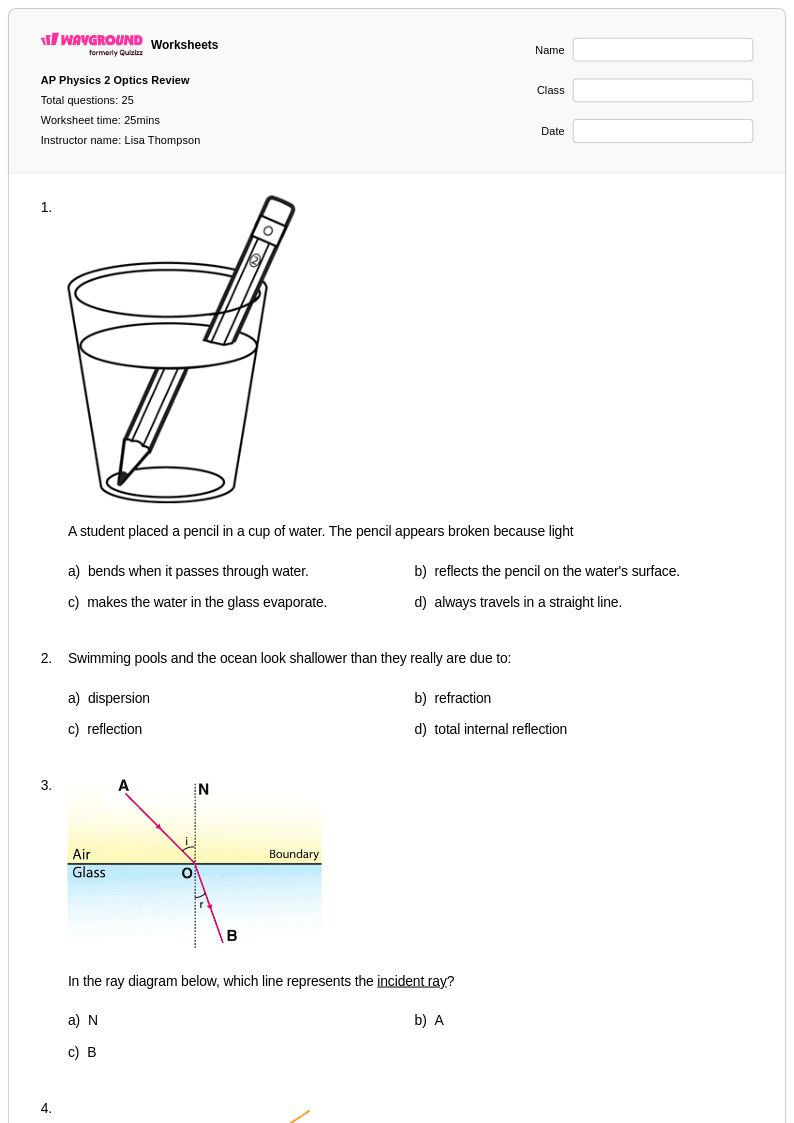
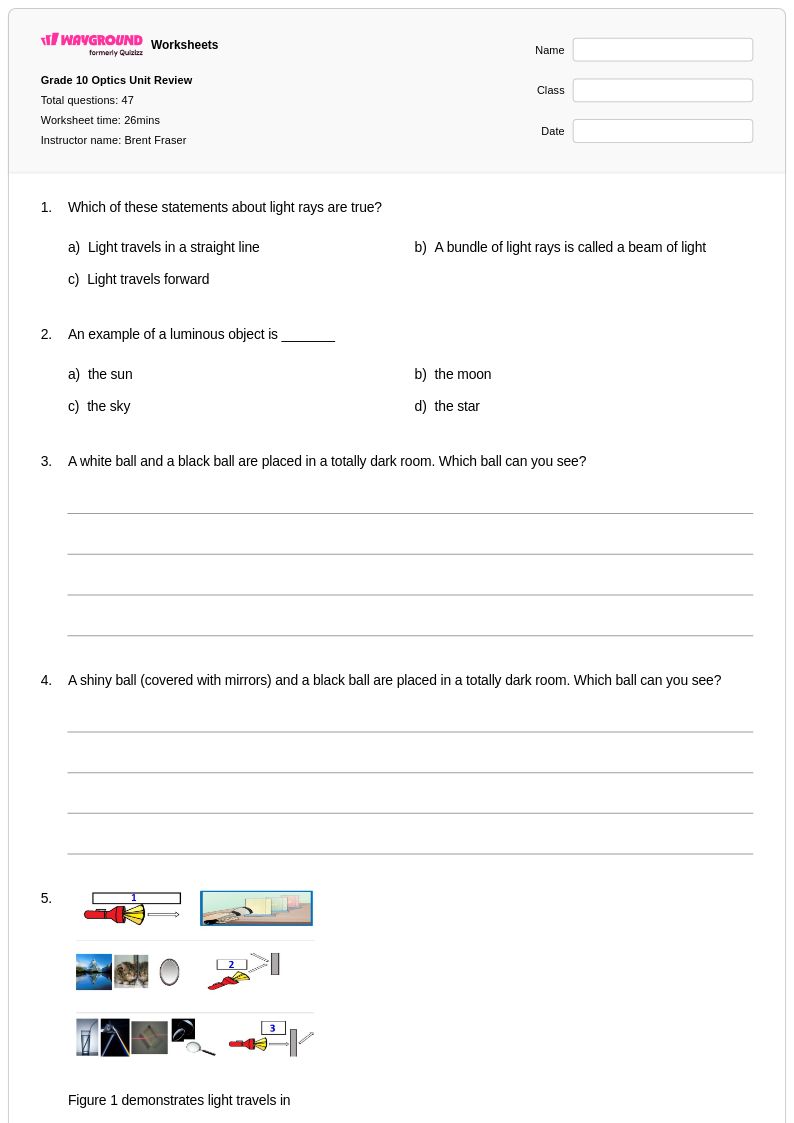
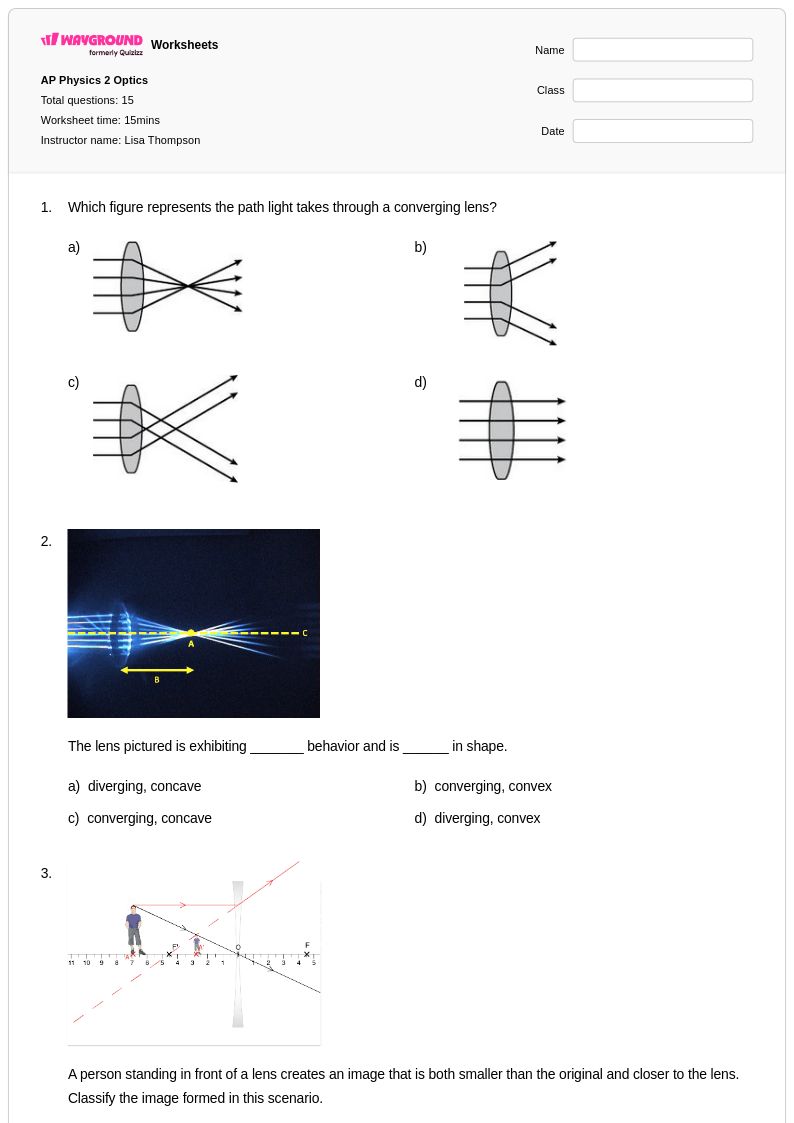
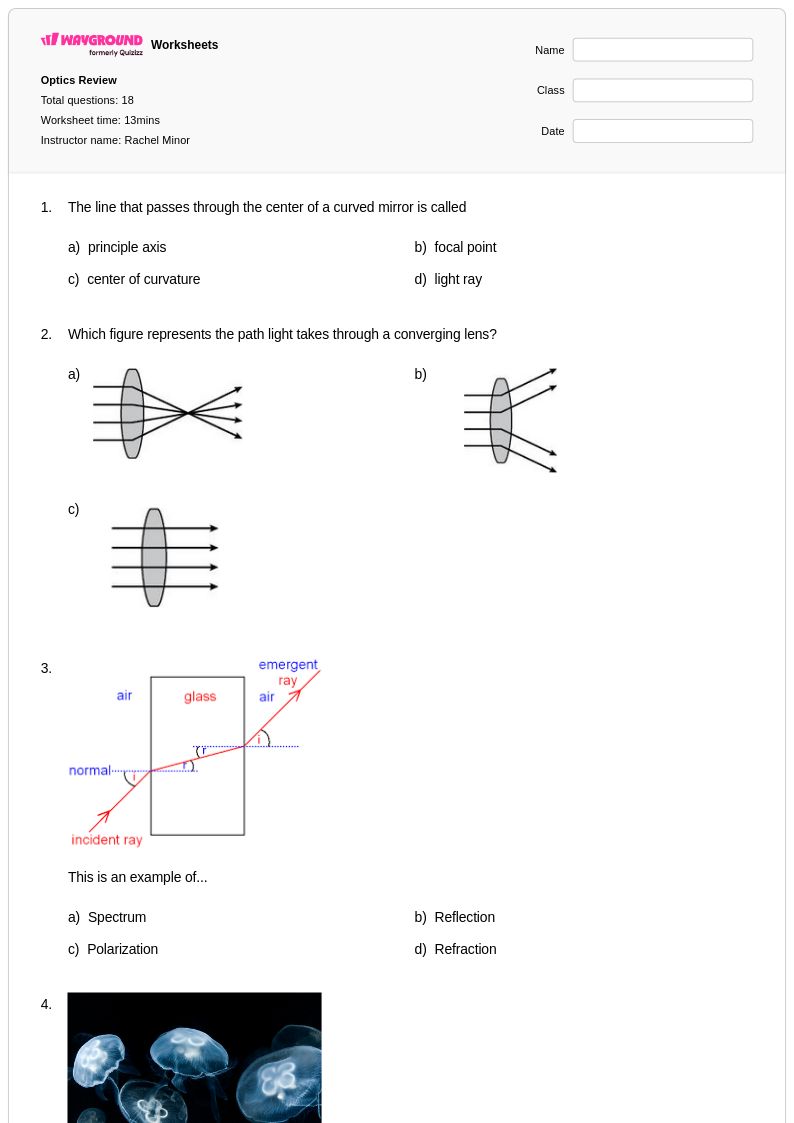
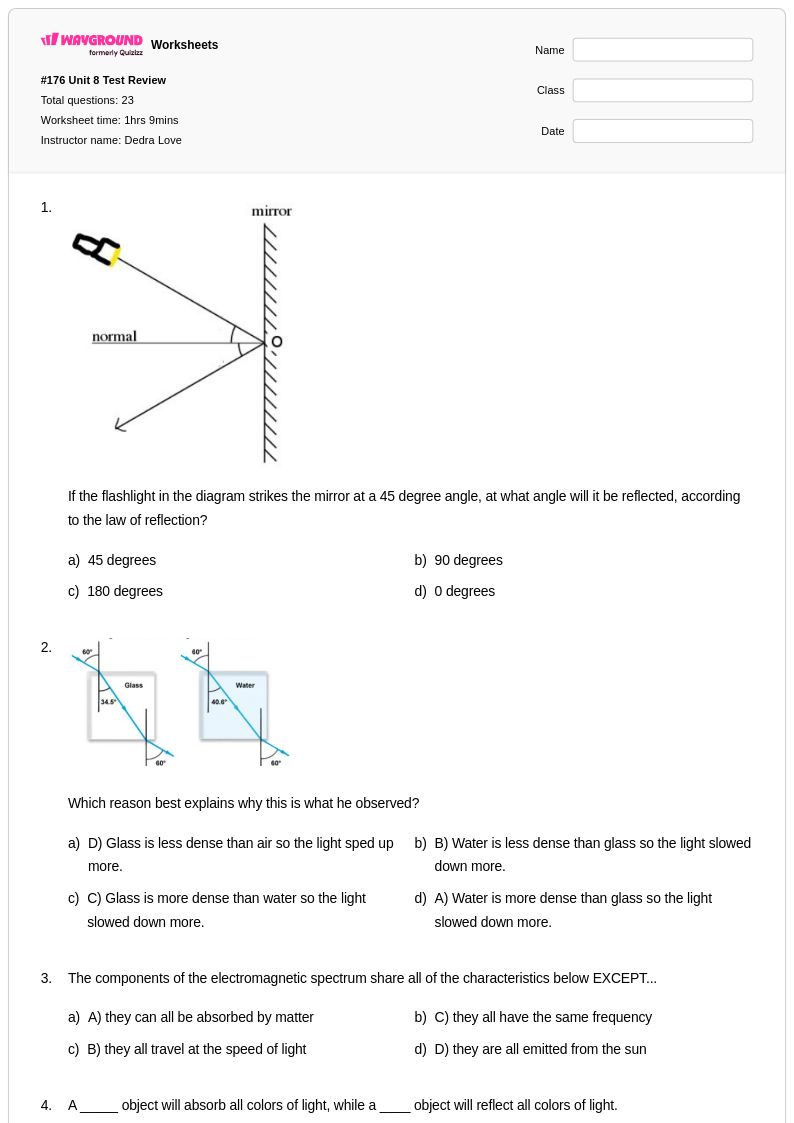
Geometric optics worksheets for Grade 10 students available through Wayground provide comprehensive practice with light behavior, ray diagrams, and optical systems that form the foundation of advanced physics study. These carefully designed resources strengthen students' understanding of reflection and refraction laws, mirror and lens calculations, and image formation principles through structured practice problems that progress from basic concepts to complex applications. Students work with ray tracing exercises, focal length calculations, and magnification problems while developing critical analytical skills needed for optical physics. The collection includes detailed answer keys that support independent learning and self-assessment, with free printables available in convenient pdf format for classroom distribution and homework assignments.
Wayground's extensive collection of geometric optics resources supports Grade 10 physics teachers with millions of educator-created worksheets that align with curriculum standards and accommodate diverse learning needs. The platform's robust search and filtering capabilities allow teachers to quickly locate materials targeting specific optical concepts, from plane mirrors to compound lens systems, while differentiation tools enable customization for various skill levels within the same classroom. These resources are available in both printable pdf format and interactive digital versions, providing flexibility for traditional worksheet distribution or technology-integrated instruction. Teachers utilize these comprehensive materials for lesson planning, targeted remediation of challenging concepts like critical angle calculations, enrichment activities for advanced learners exploring optical instruments, and ongoing skill practice that reinforces geometric optics principles throughout the academic year.
FAQs
How do I teach geometric optics to high school physics students?
Start by building students' intuition with ray diagrams before introducing equations. Use physical demonstrations with mirrors and lenses to anchor abstract concepts like focal length and image formation, then connect those observations to Snell's law and the mirror/lens equations. Progressing from qualitative ray tracing to quantitative problem-solving helps students develop both conceptual understanding and mathematical fluency.
What types of practice problems help students learn geometric optics?
Effective geometric optics practice includes drawing and interpreting ray diagrams for converging and diverging lenses and mirrors, applying the thin lens equation and mirror equation to find image distance and magnification, and solving Snell's law problems involving refraction at different media boundaries. Problems that connect these calculations to real-world optical devices, such as cameras, telescopes, and eyeglasses, reinforce why the math matters.
What mistakes do students commonly make when solving geometric optics problems?
Students frequently mix up sign conventions, especially when determining whether image distances and focal lengths are positive or negative for concave versus convex mirrors and lenses. Another common error is drawing ray diagrams without following the three principal rays correctly, which leads to incorrect conclusions about image type and orientation. Students also confuse the conditions for real versus virtual images and struggle to connect their mathematical results back to what those values mean physically.
How do I help students who struggle with ray diagrams for mirrors and lenses?
Break ray diagrams into a strict three-step process: draw the parallel ray, the focal ray, and the center ray separately before combining them to locate the image. Color-coding each ray type helps students track their work and catch errors. For students who need additional support, Wayground allows teachers to apply read-aloud and reduced answer choice accommodations individually, so struggling students receive scaffolding without disrupting the rest of the class.
How can I use Wayground's geometric optics worksheets in my classroom?
Wayground's geometric optics worksheets are available as printable PDFs for traditional classroom use and in digital formats for technology-integrated environments, including the option to host them as a quiz directly on Wayground. Teachers can use them for guided practice, homework, or formative assessment, and each worksheet includes a complete answer key to support self-assessment and efficient grading. The digital format also allows teachers to configure student-level accommodations such as extended time or read-aloud for individual learners.
How do I differentiate geometric optics instruction for advanced and struggling students?
For advanced students, assign multi-step problems that combine Snell's law with lens equations or require analysis of compound optical systems. For students who are struggling, return to ray diagram basics and use problems with single, clearly labeled optical elements before introducing equations. On Wayground, teachers can adjust difficulty levels and problem types per student, and accommodations like reduced answer choices or adjustable font sizes through reading mode can be configured individually without other students being notified.