Free Printable Polarity of Bonds Worksheets for Grade 12
Grade 12 chemistry students can master polarity of bonds through Wayground's comprehensive collection of free worksheets, featuring practice problems, printables, and detailed answer keys to reinforce molecular polarity concepts.
Explore printable Polarity of Bonds worksheets for Grade 12
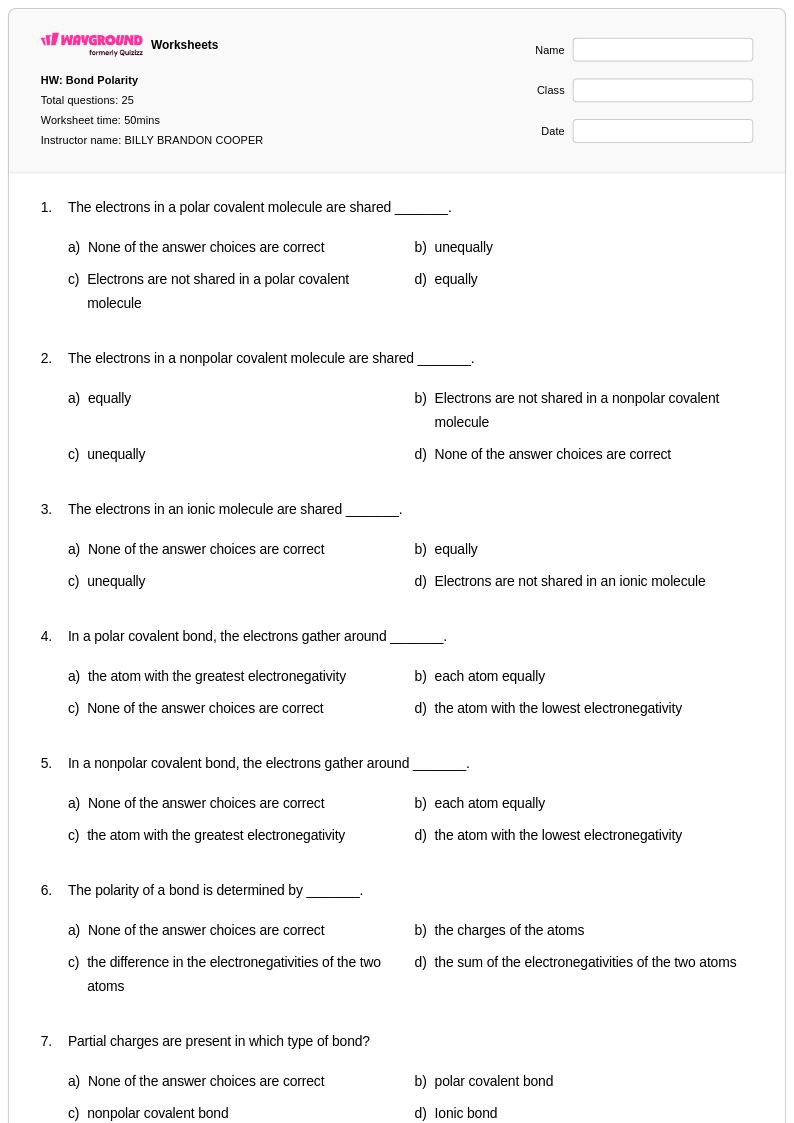
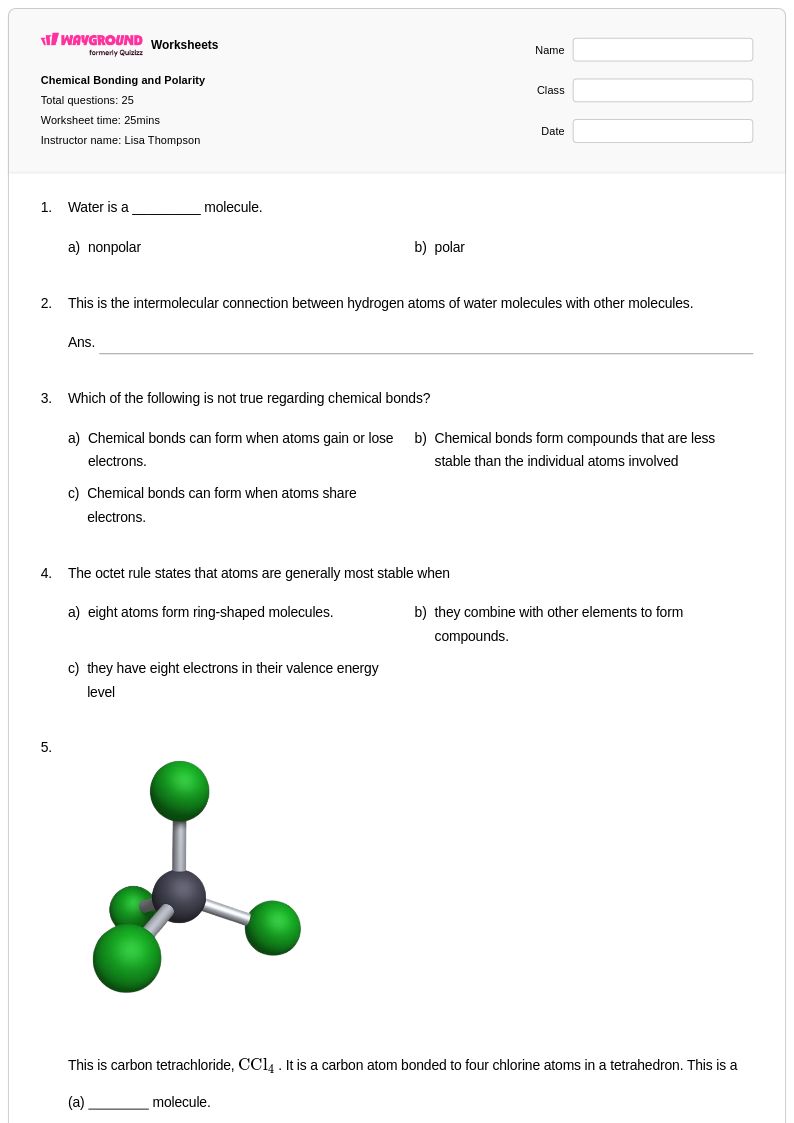
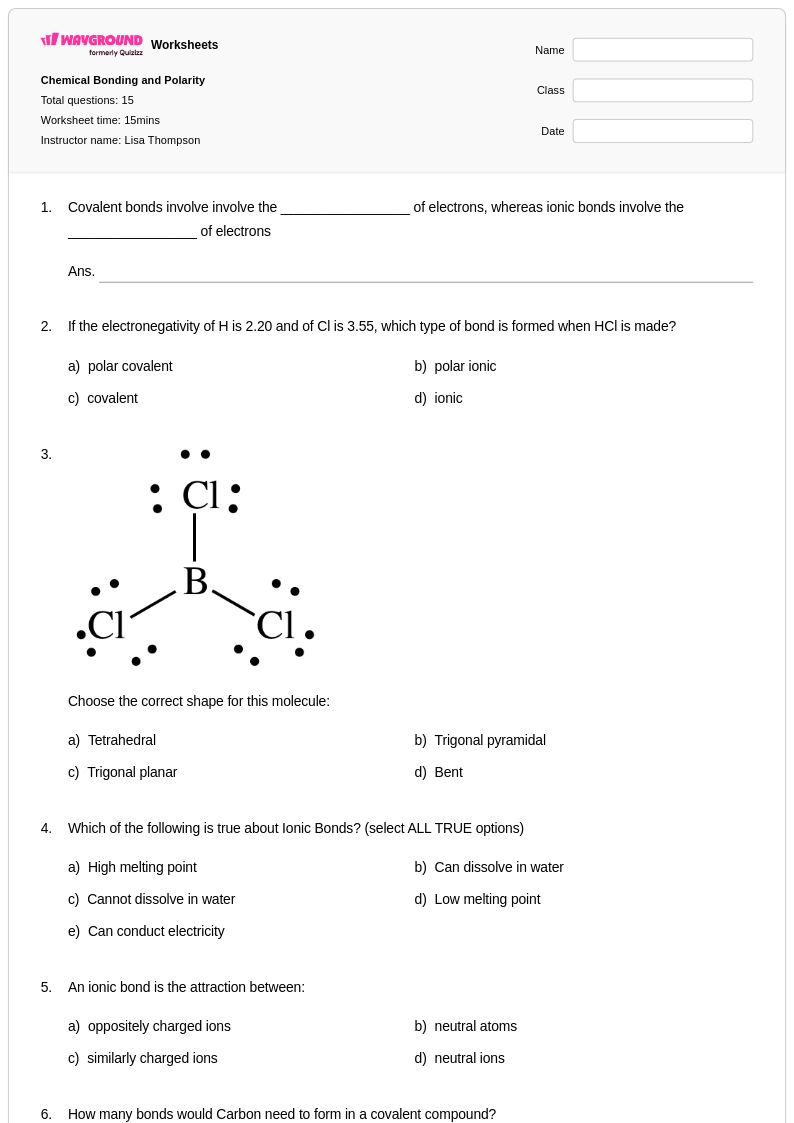
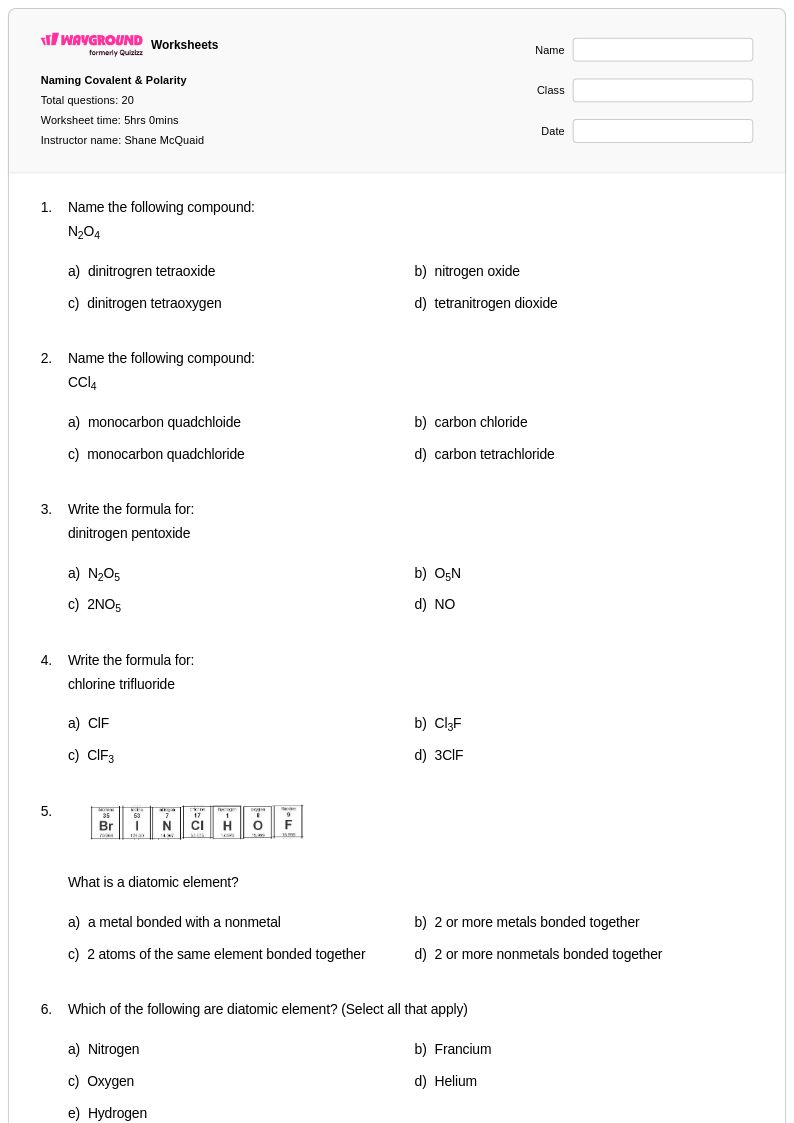
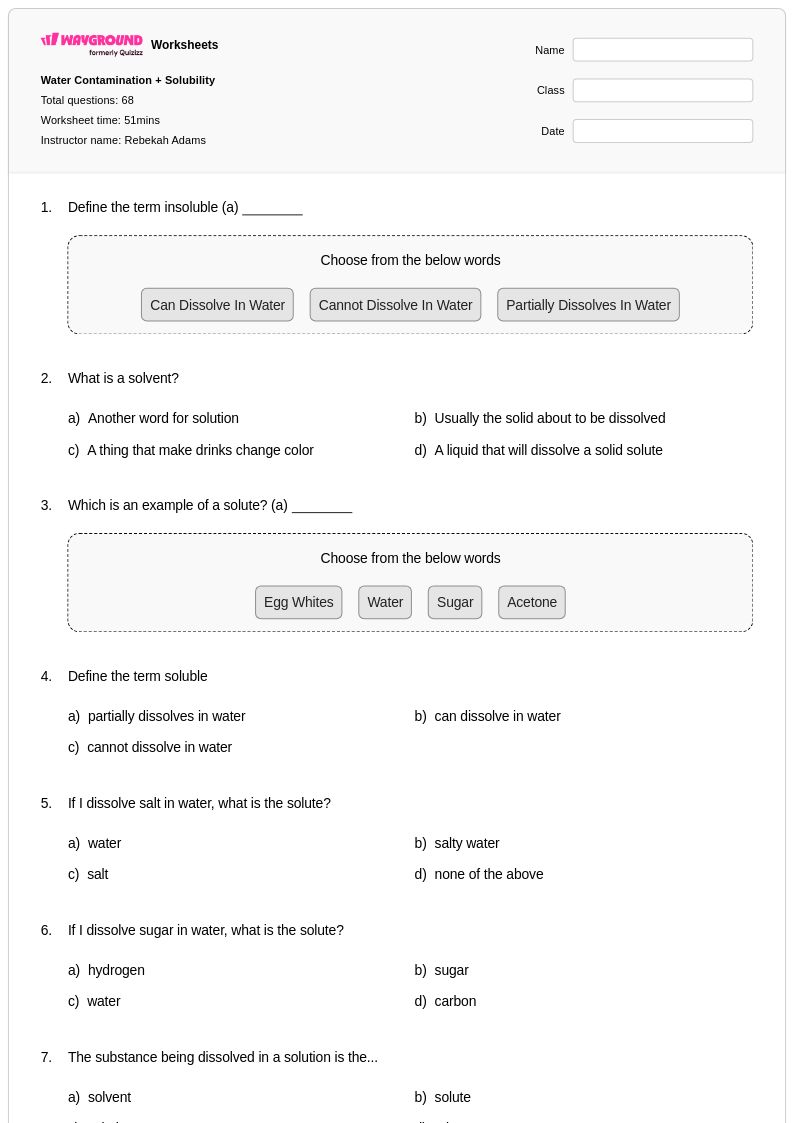
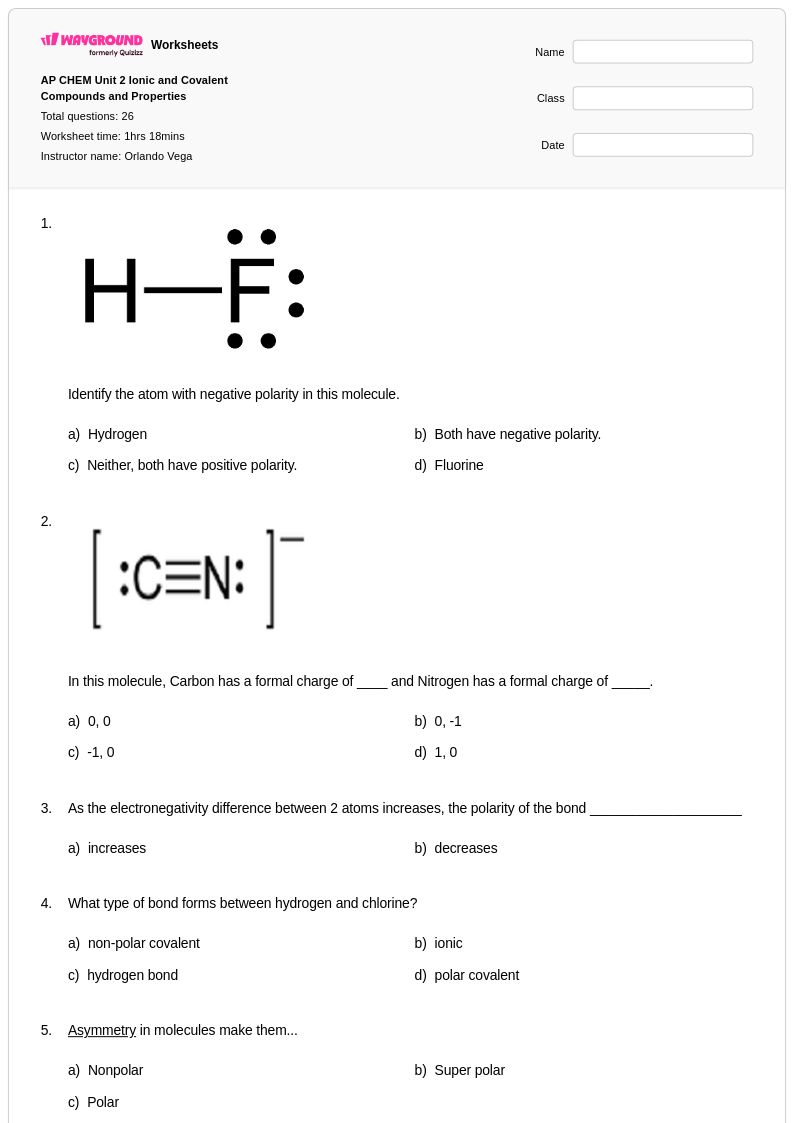
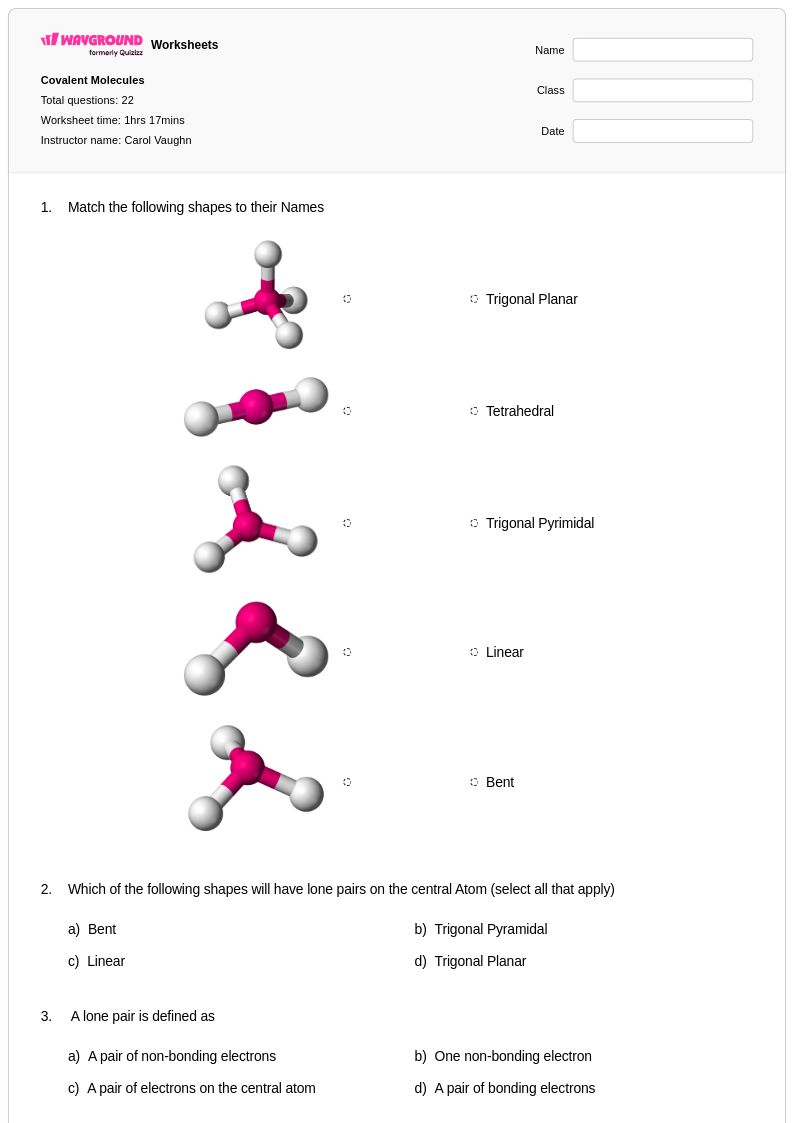
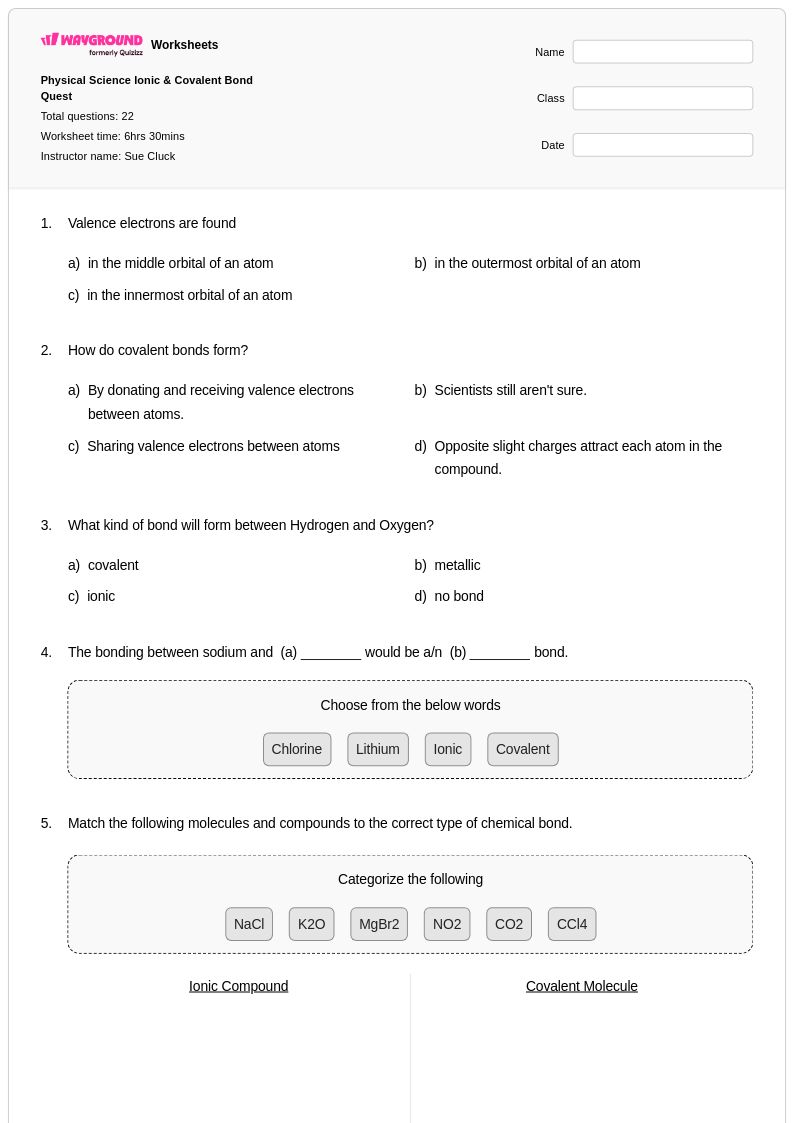
Grade 12 polarity of bonds worksheets available through Wayground (formerly Quizizz) provide comprehensive practice materials that help students master the fundamental concepts of molecular polarity and electronegativity differences. These expertly crafted worksheets strengthen critical skills including determining bond polarity using electronegativity values, predicting molecular geometry and overall polarity, and analyzing the relationship between molecular structure and intermolecular forces. Students engage with practice problems that cover polar and nonpolar covalent bonds, dipole moments, and the impact of molecular shape on polarity, with each worksheet including a detailed answer key to support independent learning and self-assessment. The collection features both printable pdf formats and digital versions, ensuring accessibility for diverse classroom environments while providing free resources that align with advanced chemistry curriculum standards.
Wayground (formerly Quizizz) empowers educators with access to millions of teacher-created polarity of bonds worksheets specifically designed for Grade 12 chemistry instruction. The platform's robust search and filtering capabilities allow teachers to quickly locate materials that match their specific curriculum requirements and standards alignment needs, while differentiation tools enable customization for students with varying skill levels and learning styles. Teachers can seamlessly adapt worksheets for remediation by focusing on fundamental electronegativity concepts, or enhance them for enrichment by incorporating advanced molecular modeling and real-world applications. The flexible format options, including both printable and digital pdf versions, streamline lesson planning and provide versatile resources for in-class instruction, homework assignments, and assessment preparation, ultimately supporting comprehensive skill practice in this essential area of chemical bonding theory.
FAQs
How do I teach polarity of bonds to high school chemistry students?
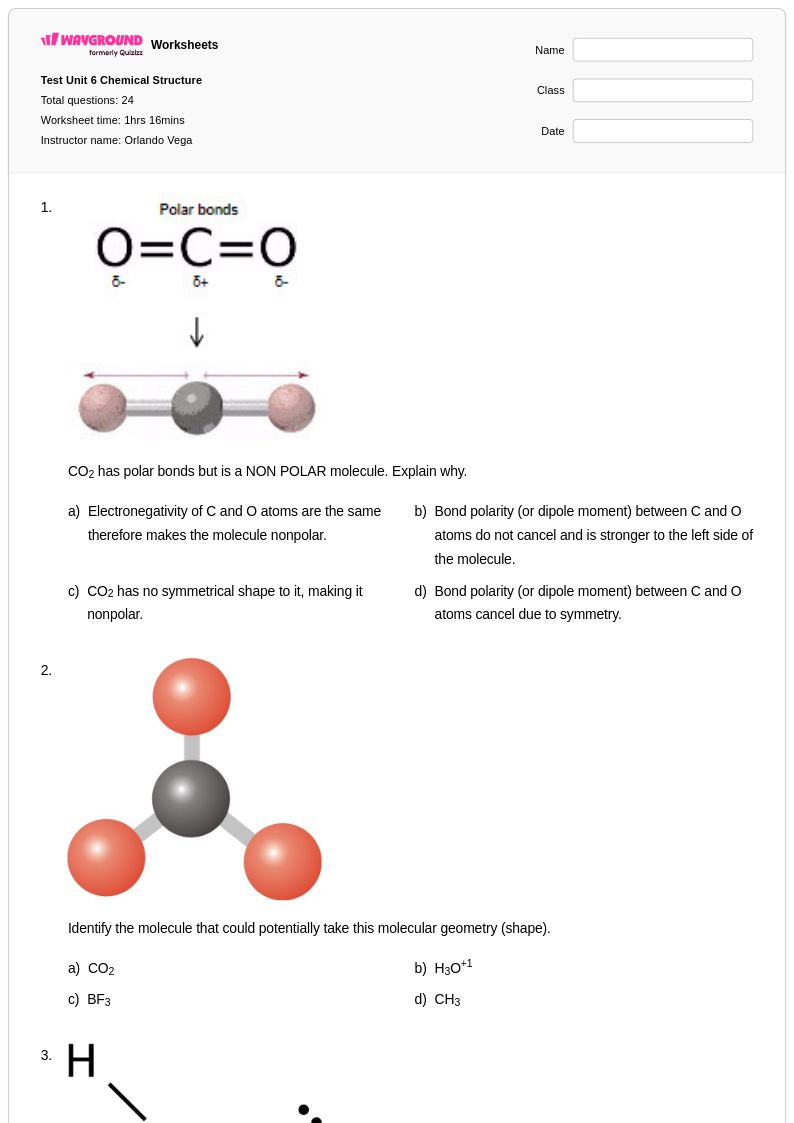
Start by grounding students in electronegativity values using the periodic table, then introduce the concept that unequal electron sharing between atoms of different electronegativities creates a partial charge distribution across the bond. From there, connect bond polarity to molecular geometry so students understand why a molecule can contain polar bonds yet still be nonpolar overall, as with CO₂. Using Lewis structures as a visual scaffold throughout helps students move from individual bond analysis to whole-molecule polarity prediction more reliably.
What exercises help students practice identifying polar vs nonpolar bonds?
Effective practice exercises include calculating electronegativity differences for given atom pairs and classifying bonds as nonpolar covalent, polar covalent, or ionic based on defined thresholds. Students should also practice labeling partial charges (δ+ and δ−) on bond diagrams and drawing dipole arrows to show electron displacement. Worksheet problems that progress from diatomic molecules to polyatomic compounds with multiple bond types build the analytical skills students need to handle more complex polarity questions.
What mistakes do students commonly make when determining molecular polarity?
The most common error is concluding that a molecule is polar simply because it contains polar bonds, without accounting for molecular geometry. For example, students frequently misclassify CO₂ or CCl₄ as polar because the individual bonds are polar, failing to recognize that symmetrical arrangements cancel the bond dipoles. Another frequent misconception is conflating bond polarity with ionic character — students sometimes assume any large electronegativity difference makes a bond ionic rather than highly polar covalent.
How does bond polarity connect to other chemistry concepts students need to know?
Bond polarity is foundational to understanding intermolecular forces, solubility, and reactivity. Polar molecules experience dipole-dipole interactions and, when hydrogen is bonded to F, O, or N, hydrogen bonding — both of which directly affect boiling points and miscibility. Teaching bond polarity as a gateway concept rather than an isolated topic helps students build a coherent mental model of chemical behavior across thermodynamics and reaction chemistry.
How can I use Wayground's polarity of bonds worksheets in my classroom?
Wayground's polarity of bonds worksheets are available as printable PDFs for traditional classroom use and in digital formats for technology-integrated learning environments, and can also be hosted as a quiz directly on Wayground. All worksheets include complete answer keys, making them practical for independent practice, homework assignments, remediation sessions, and in-class review. The platform also supports student-level accommodations such as extended time, read aloud, and reduced answer choices, so teachers can differentiate the same assignment for students with varying learning needs without creating separate materials.
How do I help students who struggle with electronegativity difference calculations?
Students who struggle often need a concrete decision framework: provide a reference table of electronegativity values and a clear threshold chart (0–0.4 nonpolar covalent, 0.5–1.7 polar covalent, above 1.7 ionic) so the classification becomes a lookup-and-calculate routine rather than a judgment call. Worked examples that show the subtraction step explicitly, followed by graduated practice problems moving from simple to complex pairs, build the procedural fluency students need before applying the concept to molecular geometry.