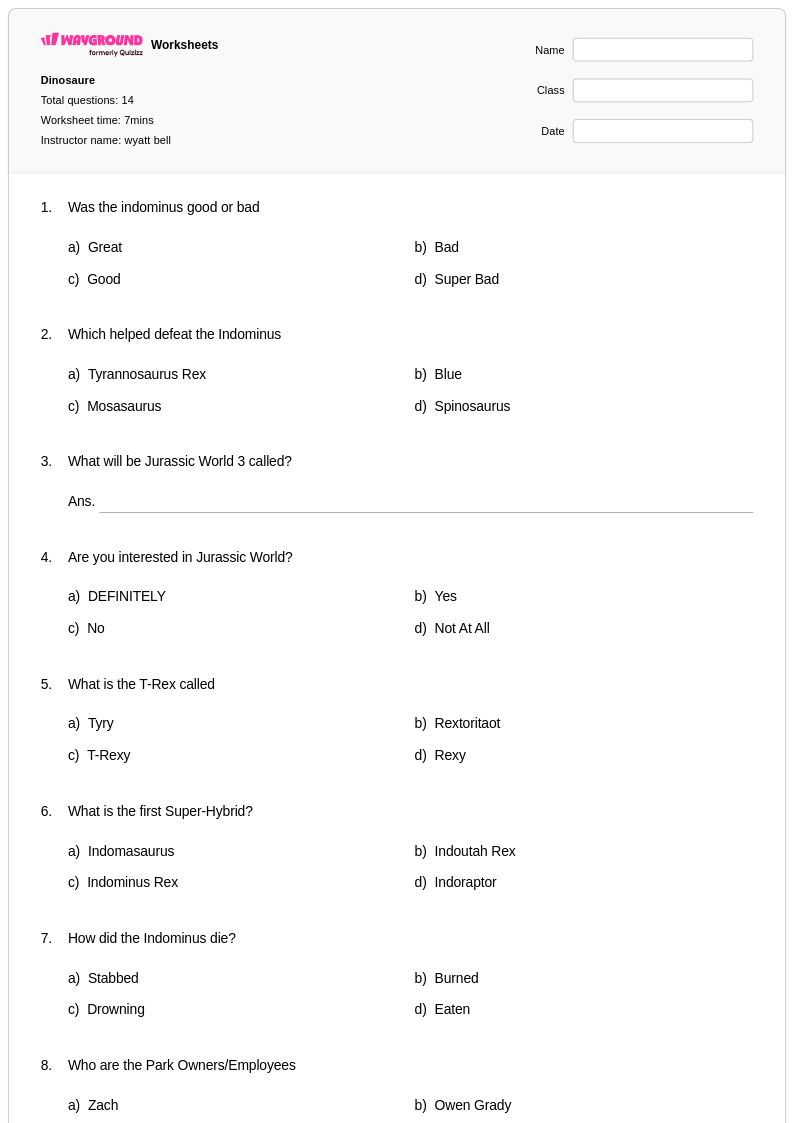
Explore Wayground's free dinosaur worksheets and printables that help students discover prehistoric life, fossil formation, and Earth's ancient history through engaging practice problems with complete answer keys.
Dinosaurs worksheets available through Wayground (formerly Quizizz) provide comprehensive educational resources that engage students in exploring prehistoric life through scientific inquiry and discovery. These expertly crafted materials strengthen critical thinking skills by challenging students to analyze fossil evidence, compare anatomical structures across different dinosaur species, and understand evolutionary relationships within the context of Earth's geological timeline. The collection includes diverse practice problems that cover dinosaur classification, habitat reconstruction, extinction theories, and the process of fossilization, with each worksheet featuring detailed answer keys to support both independent learning and guided instruction. Teachers can access these free printables in convenient PDF format, making it easy to integrate hands-on paleontology activities into earth and space science curricula while building students' understanding of how scientists use evidence to reconstruct ancient ecosystems.
Wayground (formerly Quizizz) empowers educators with millions of teacher-created dinosaur resources that transform complex paleontological concepts into accessible learning experiences. The platform's robust search and filtering capabilities allow teachers to quickly locate materials aligned with specific standards and learning objectives, while built-in differentiation tools ensure that worksheets can be customized to meet diverse student needs and ability levels. These flexible resources are available in both printable and digital formats, including downloadable PDFs, enabling seamless integration into classroom instruction, homework assignments, and assessment activities. Whether used for initial skill-building, targeted remediation, or enrichment opportunities, these dinosaur-focused materials support comprehensive lesson planning by providing scientifically accurate content that helps students develop essential skills in observation, data analysis, and scientific reasoning within the fascinating context of prehistoric life.
FAQs
How do I teach dinosaurs and prehistoric life in an engaging way?
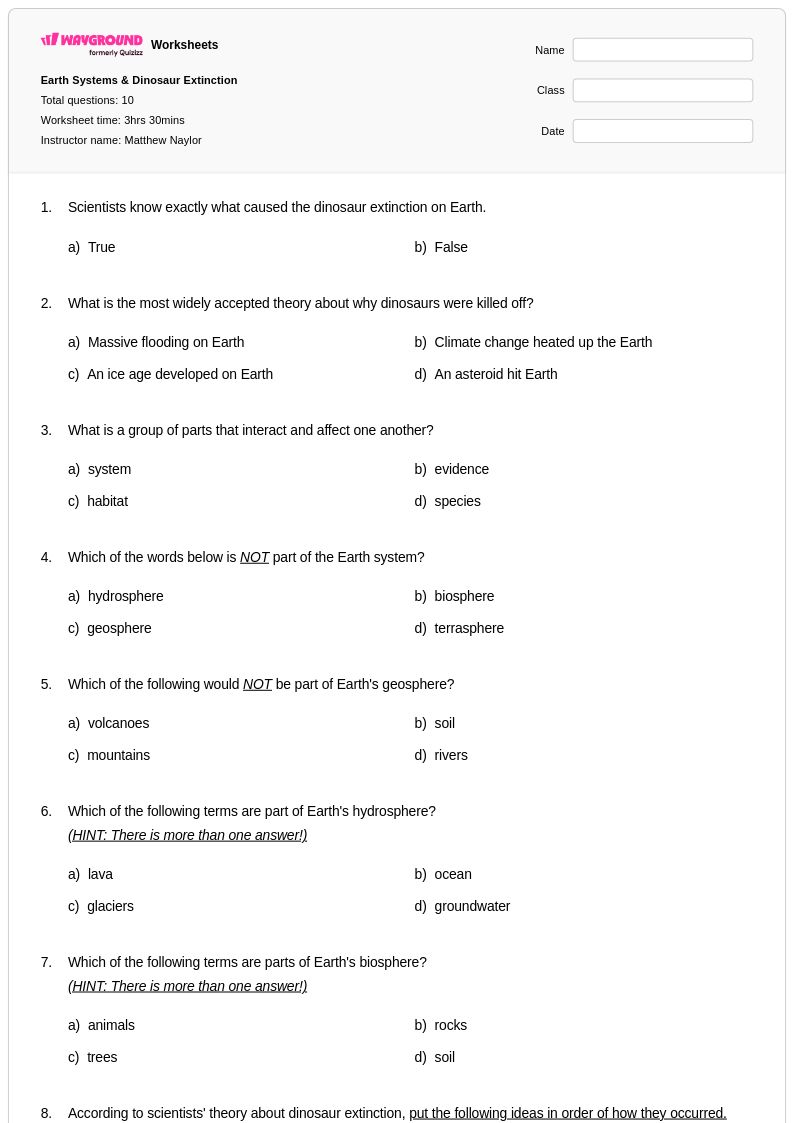
Teaching dinosaurs effectively means anchoring lessons in scientific inquiry rather than just memorization of names and facts. Start by introducing fossil evidence as the primary tool scientists use to reconstruct prehistoric life, then build outward to topics like classification, habitat reconstruction, and extinction theories. Connecting dinosaur content to Earth's geological timeline gives students a framework for understanding deep time, which is often the most challenging conceptual leap at this level.
What topics should a dinosaur worksheet cover?
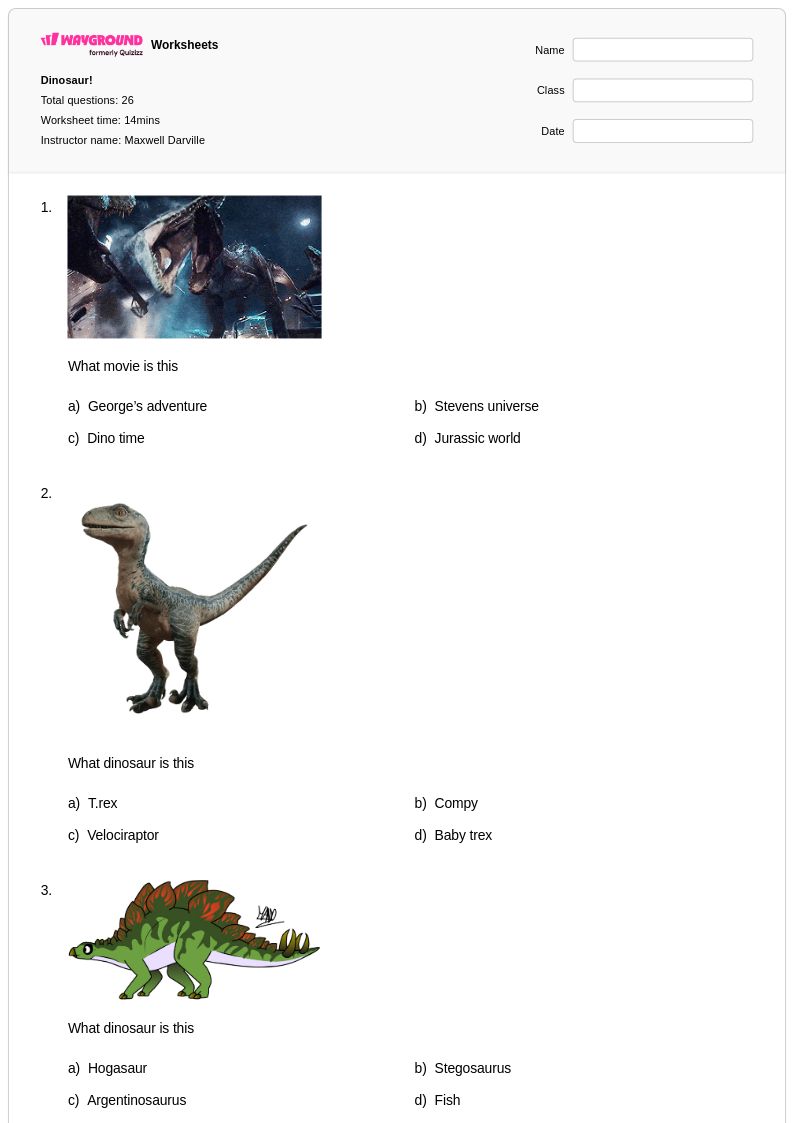
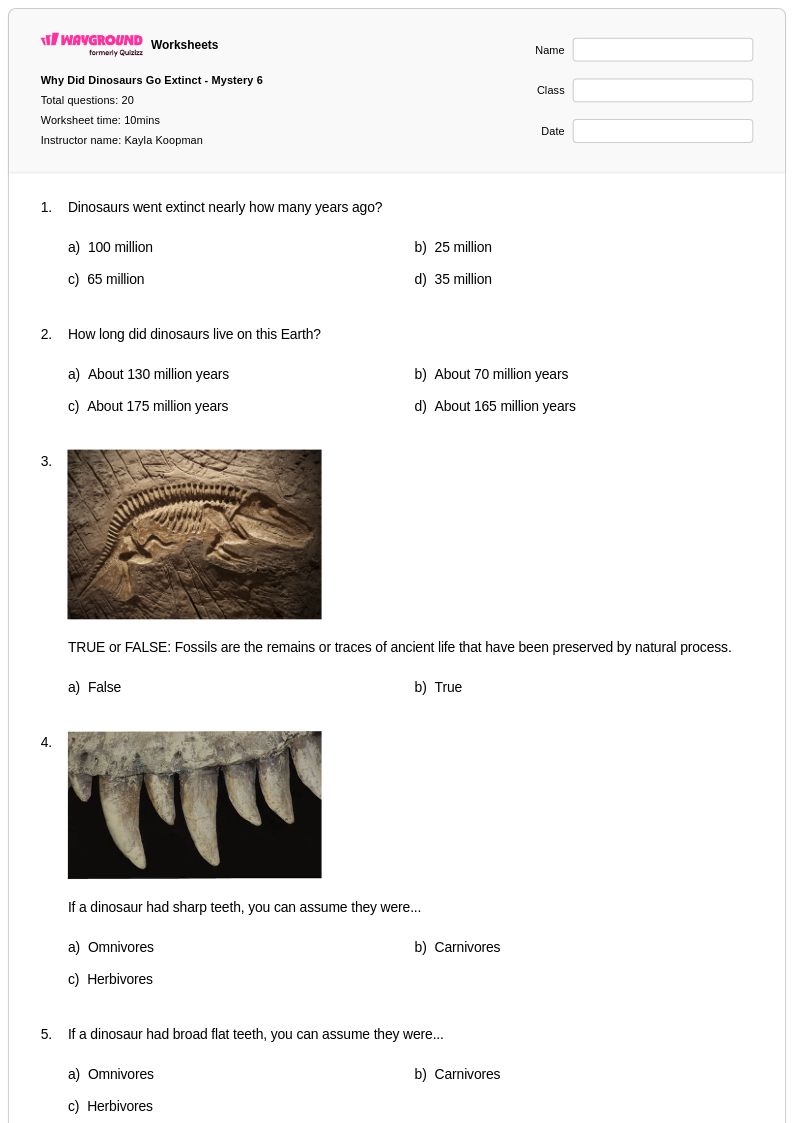
A well-rounded dinosaur worksheet should address dinosaur classification, anatomical comparisons across species, habitat reconstruction, extinction theories, and the process of fossilization. Covering these together helps students see paleontology as a connected discipline rather than isolated facts. Worksheets that ask students to analyze fossil evidence and draw conclusions build the same scientific reasoning skills used across earth and life science.
What exercises help students practice analyzing fossil evidence?
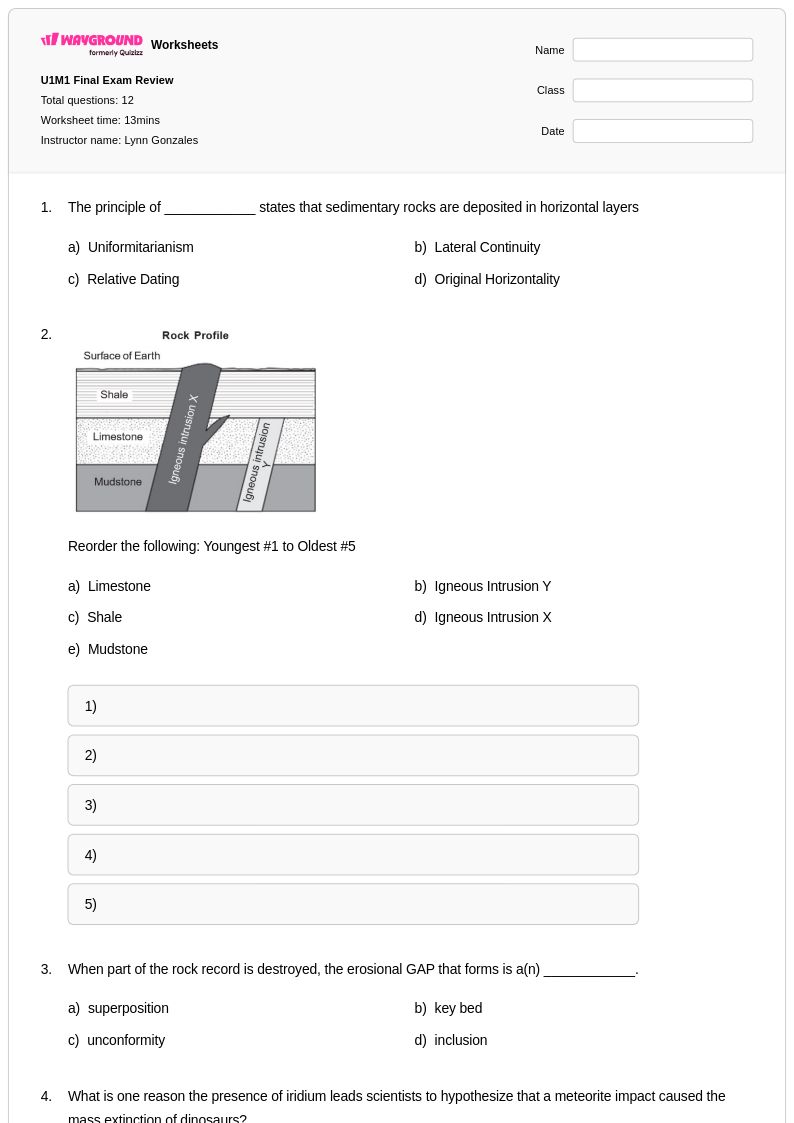
Practice exercises that work well for fossil analysis include comparing skeletal structures across species, sequencing the stages of fossilization, and interpreting stratigraphic diagrams to place dinosaurs within geological time. These tasks move students from passive recall to active reasoning, which is critical for building scientific literacy. Including questions that ask students to explain what evidence supports a given conclusion mirrors real paleontological thinking.
What misconceptions do students commonly have about dinosaurs?
Students frequently conflate all prehistoric animals with dinosaurs, placing marine reptiles like plesiosaurs and flying reptiles like pterosaurs in the same category. Another common error is treating extinction as a single catastrophic event without understanding the layered geological and biological evidence scientists use to reconstruct what happened. Students also tend to misunderstand fossilization, often assuming any dead organism becomes a fossil rather than recognizing it as a rare, condition-dependent process.
How can I differentiate dinosaur worksheets for students with different learning needs?
Differentiation for dinosaur content can include adjusting the complexity of fossil analysis tasks, providing visual scaffolds like labeled diagrams for students who need support, and offering extension prompts for students ready to explore evolutionary relationships in greater depth. On Wayground, teachers can apply individual accommodations such as read aloud for students who need audio support, reduced answer choices to lower cognitive load, and extended time per question. These settings can be assigned per student without other students being notified, making differentiation seamless in a mixed-ability classroom.
How do I use Wayground's dinosaur worksheets in my classroom?
Wayground's dinosaur worksheets are available as printable PDFs for traditional classroom use and in digital formats for technology-integrated environments, so they fit comfortably into both in-person and remote instruction. Teachers can also host worksheets as a live quiz directly on Wayground, which allows for real-time student response and immediate feedback. The included answer keys support independent student work as well as teacher-led guided instruction, making these materials flexible enough for direct instruction, homework, or enrichment activities.

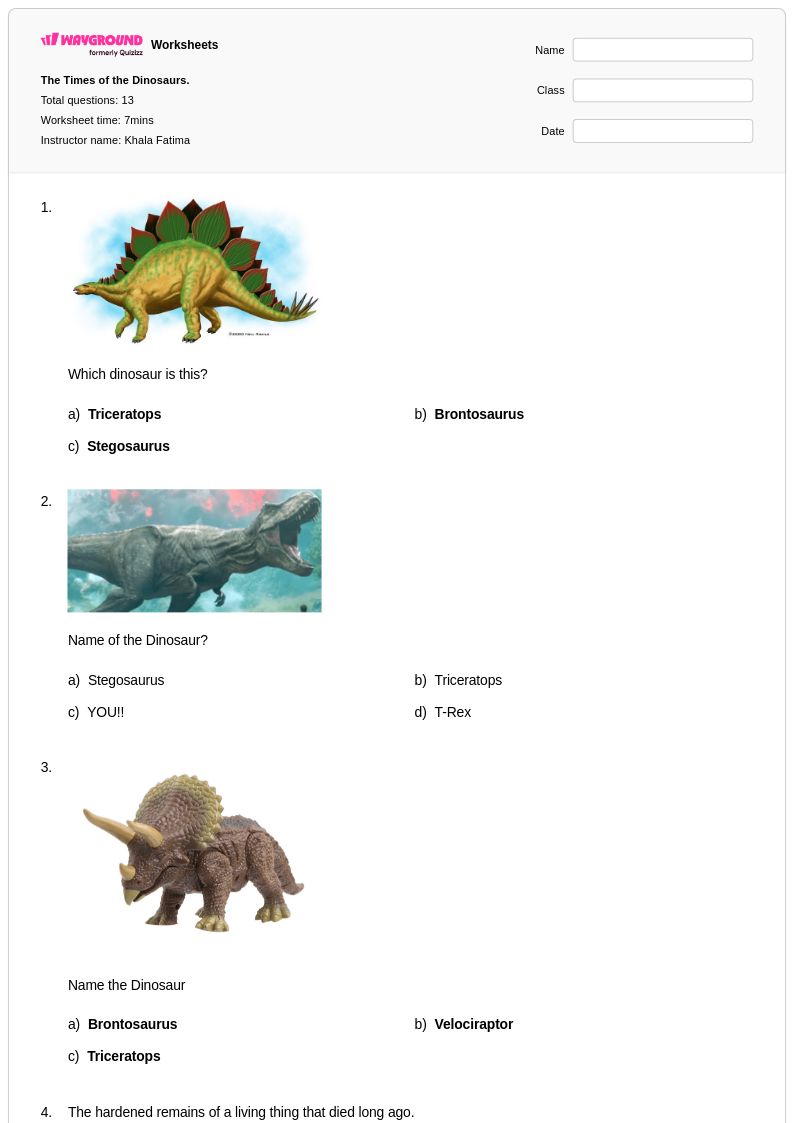
![dinosaurs [surprise] - Imprimible Dinosaurs Worksheets - Wayground](https://quizizz-static.s3.amazonaws.com/_media/worksheets-new/669f8f246c196e4039051466-dinosaurs-surprise)