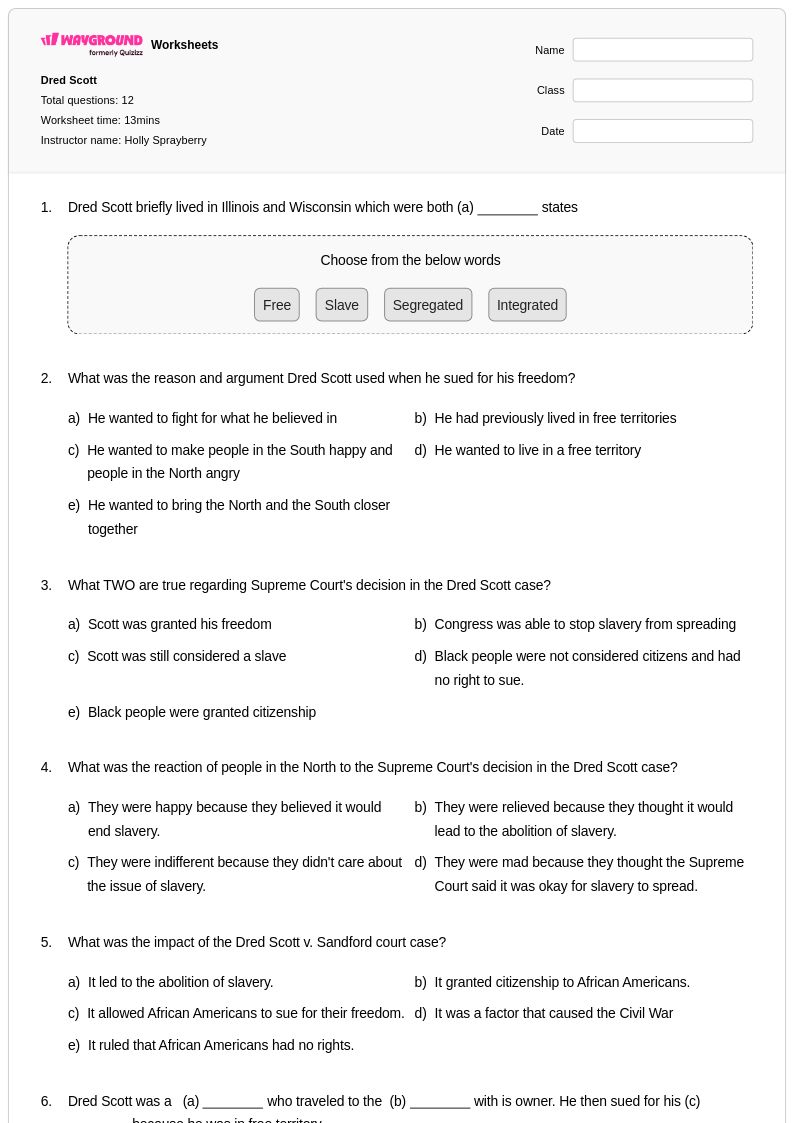
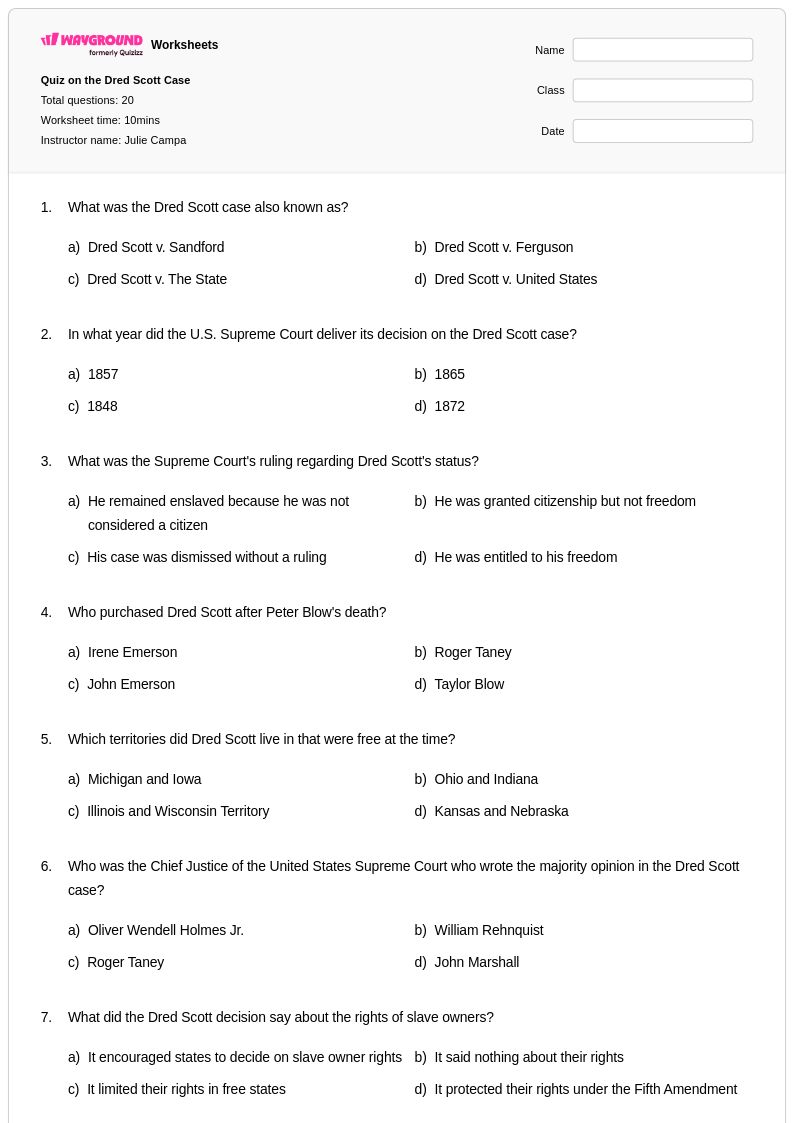
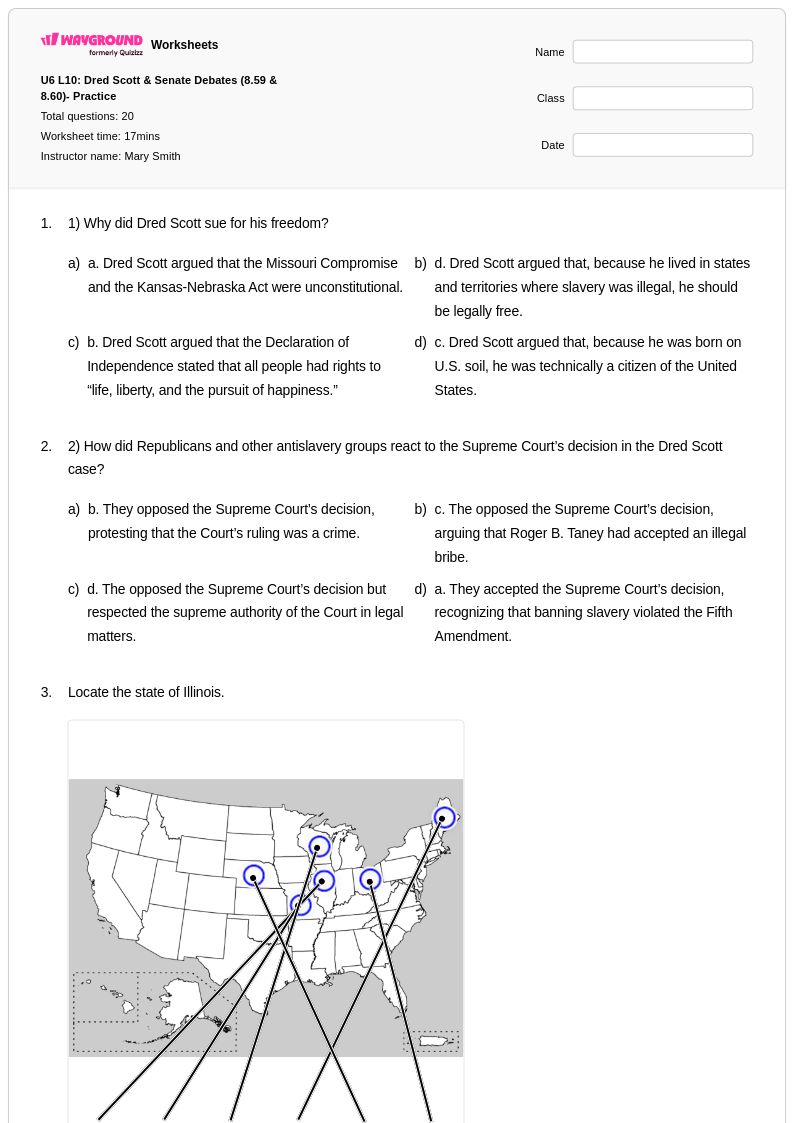
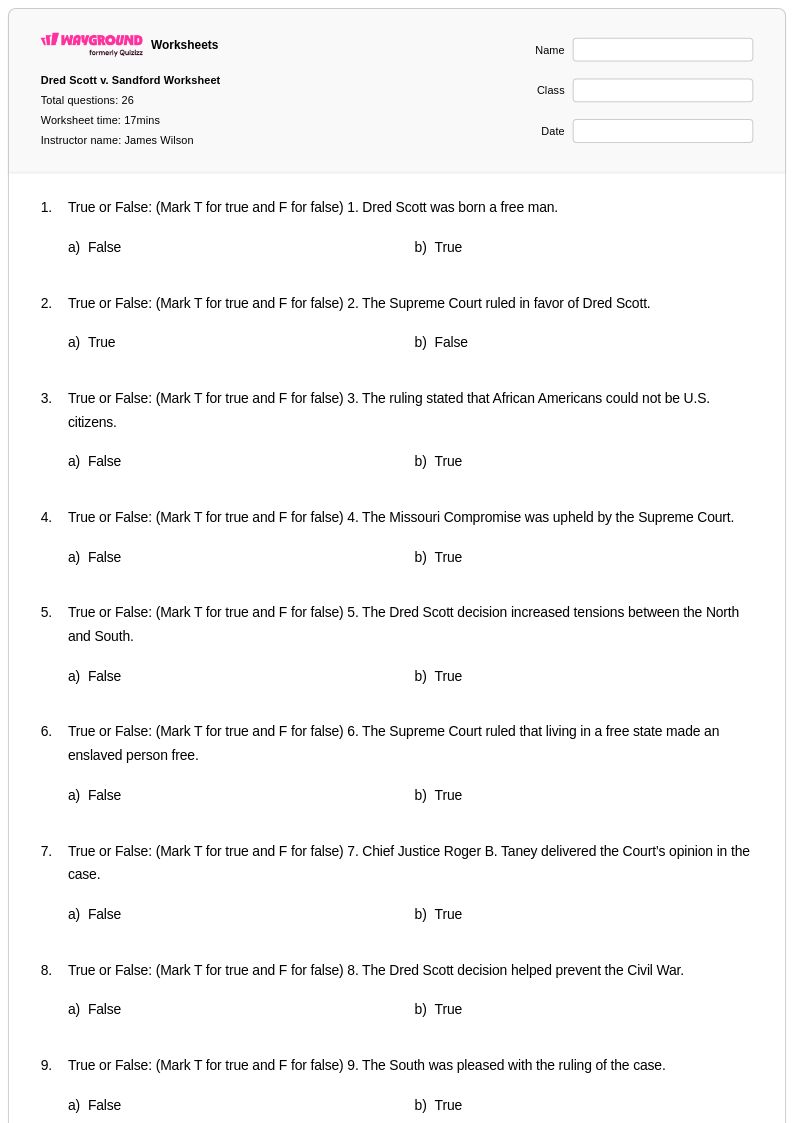
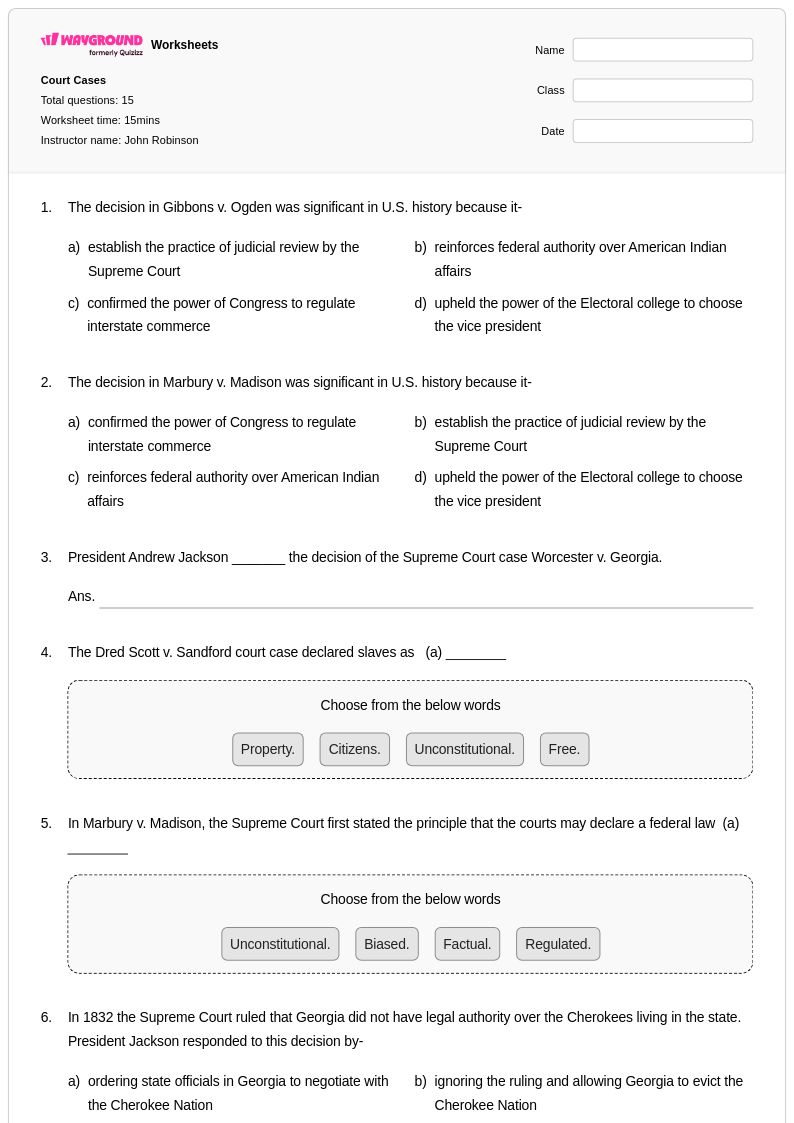
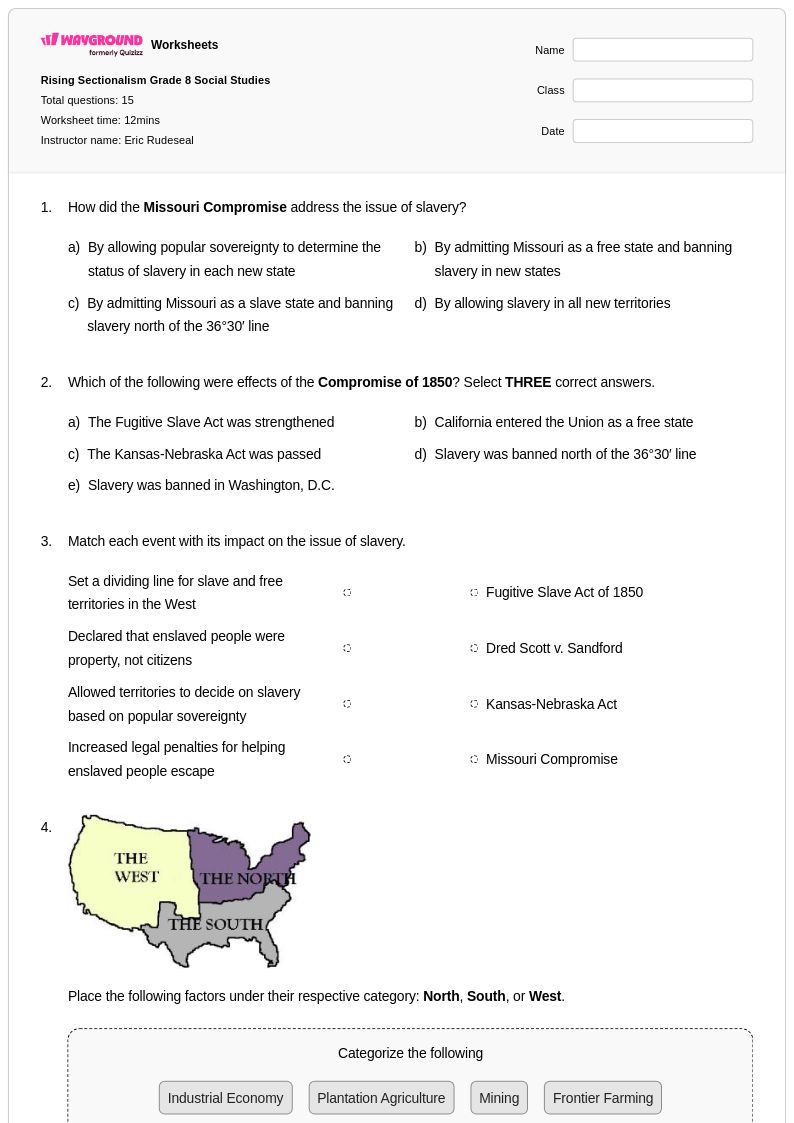
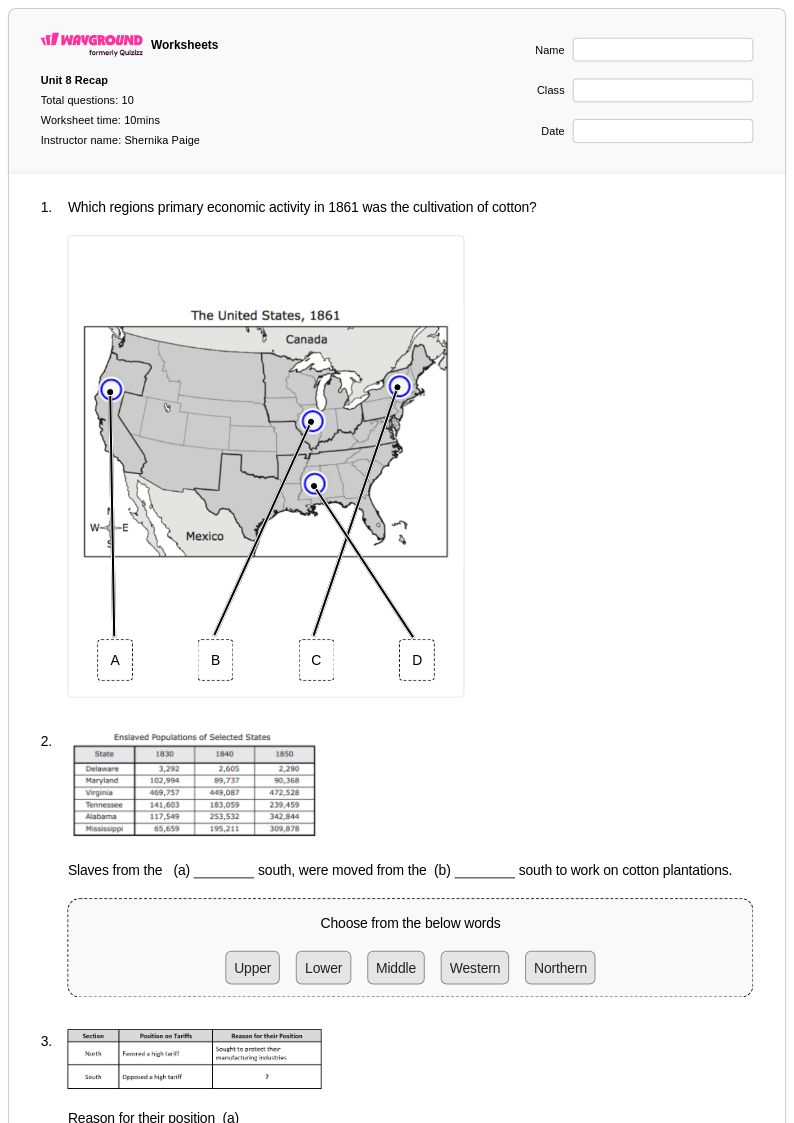
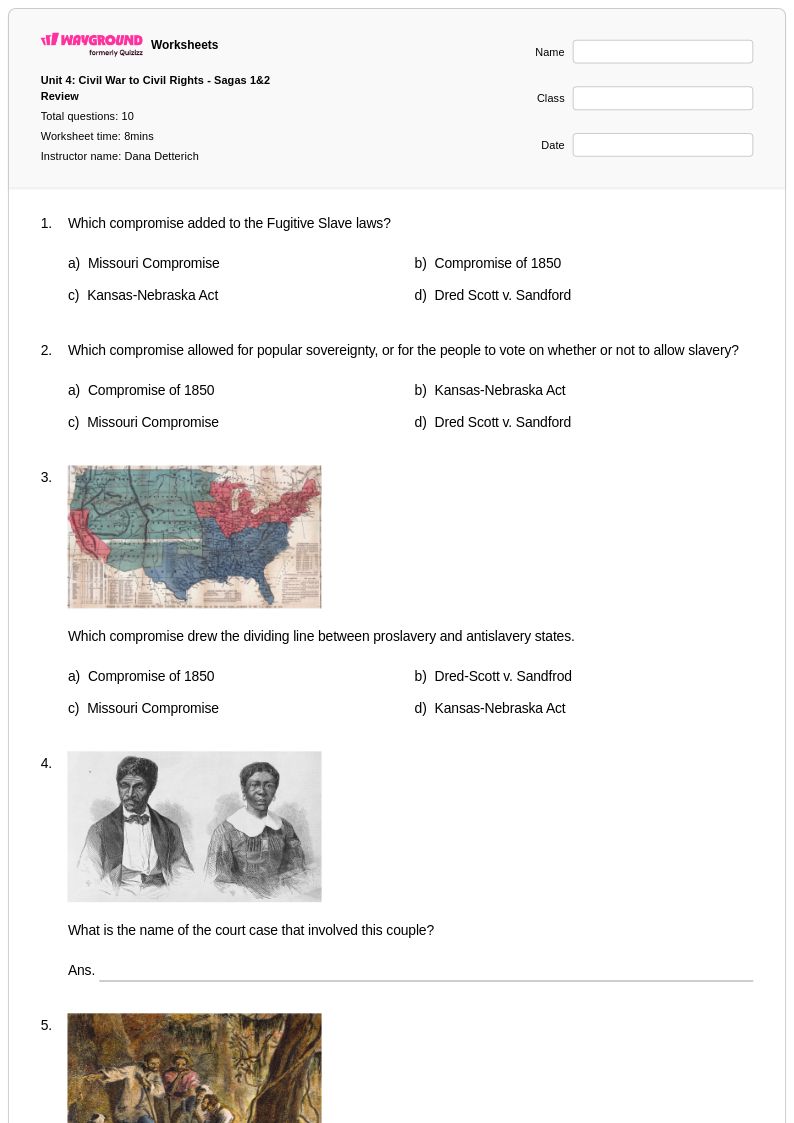
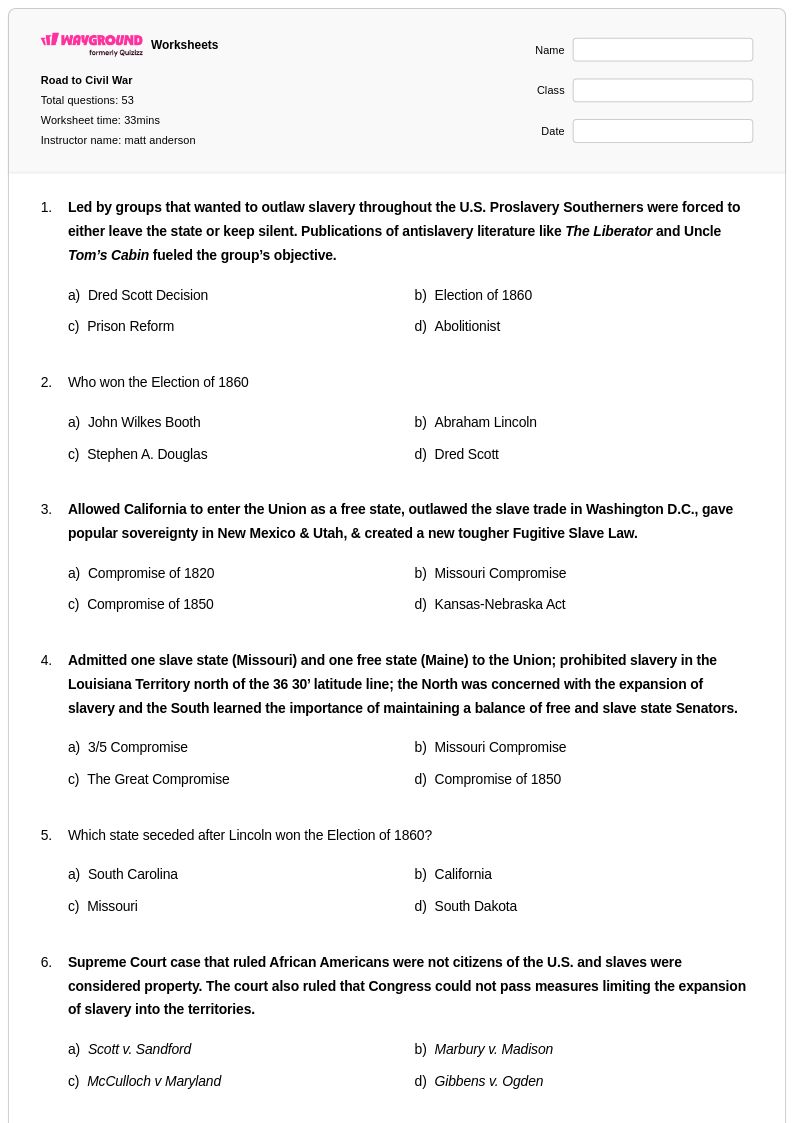
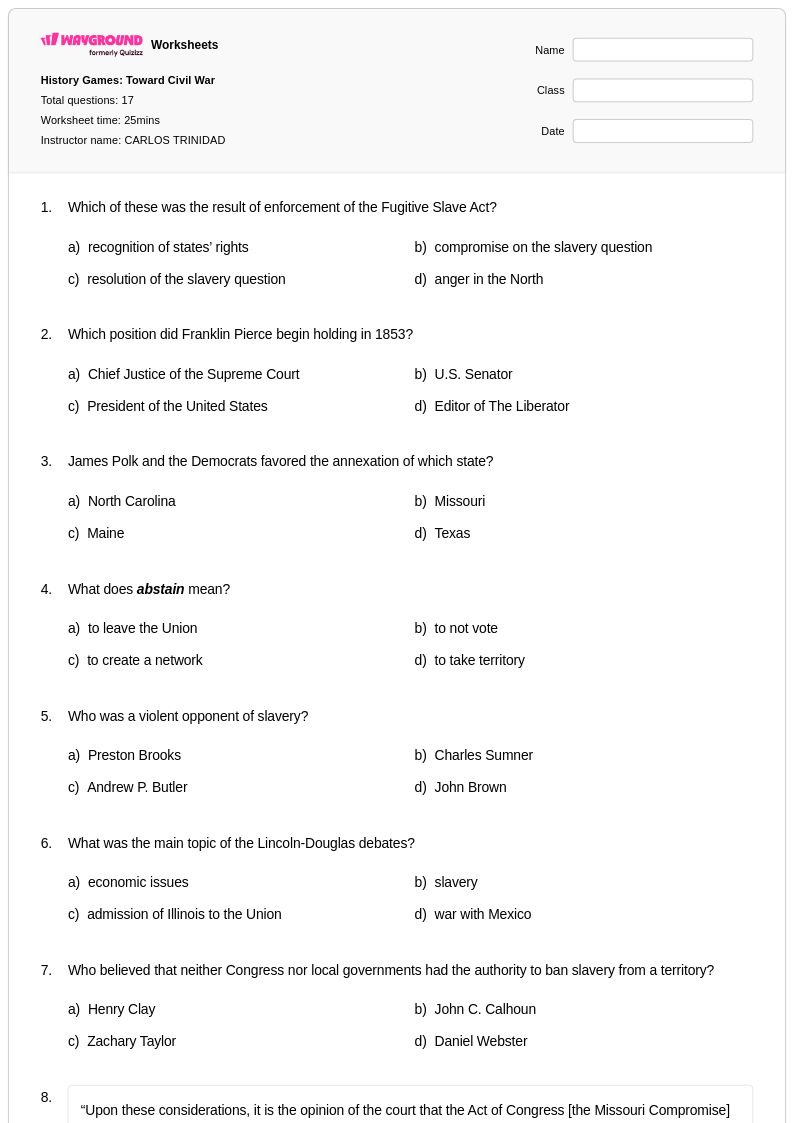
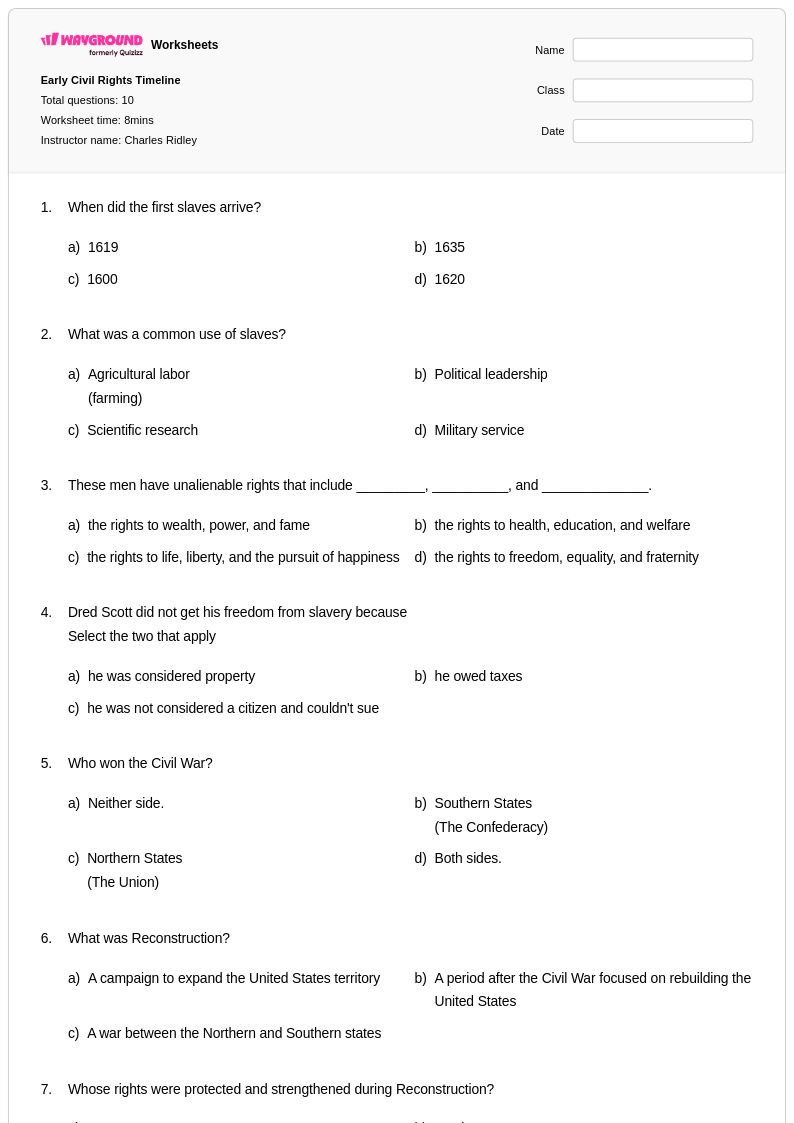
Explore Wayground's free Dred Scott v. Sandford worksheets and printables that help students analyze this pivotal Supreme Court case through engaging practice problems, comprehensive PDFs, and detailed answer keys.
Explore printable Dred Scott V. Sandford worksheets
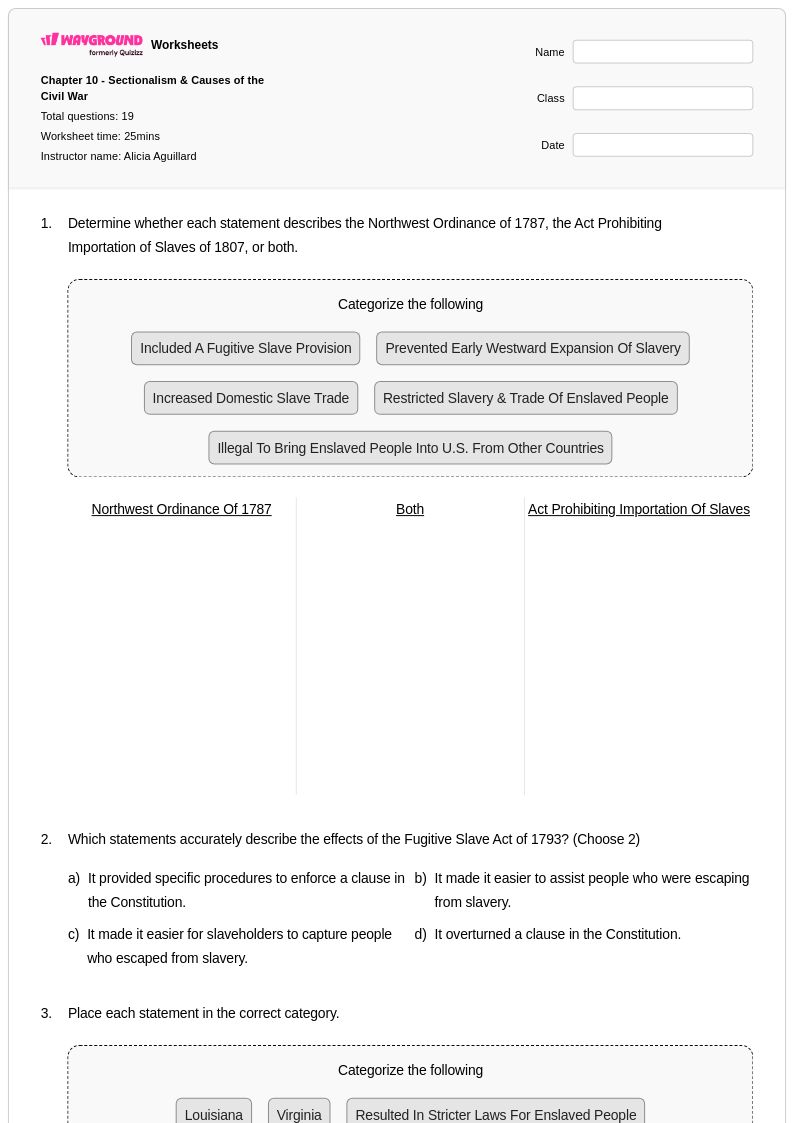
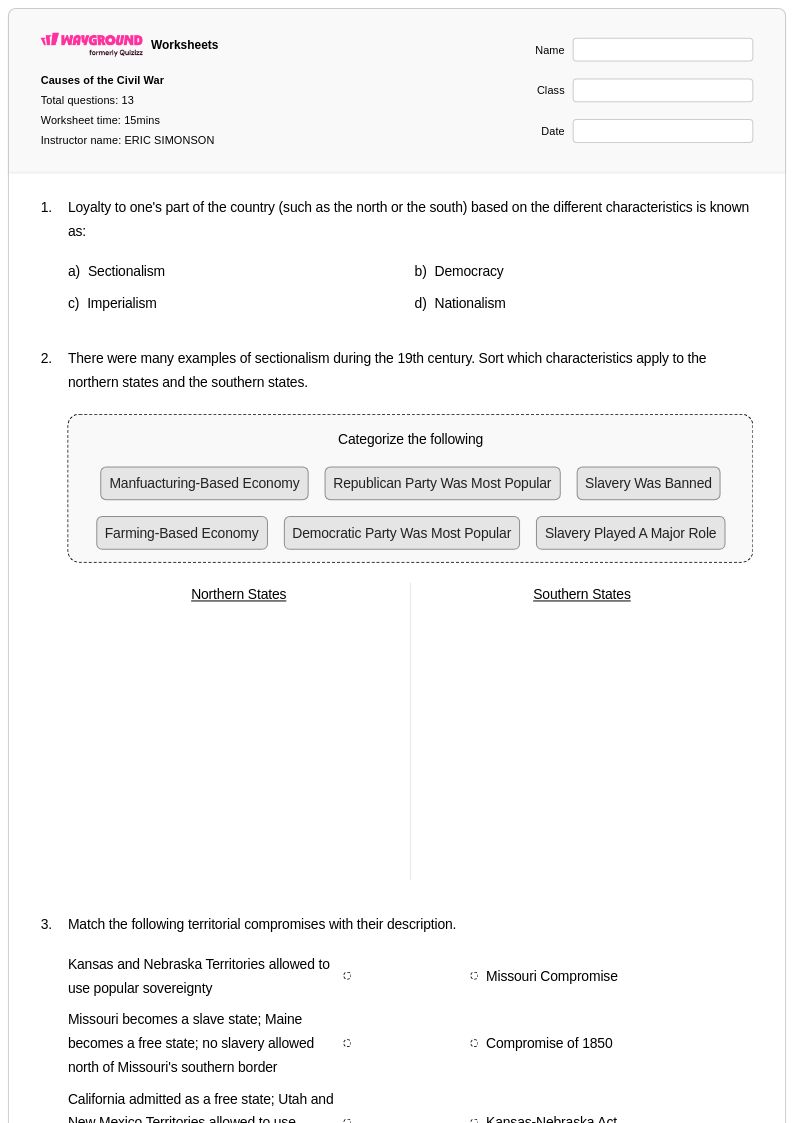
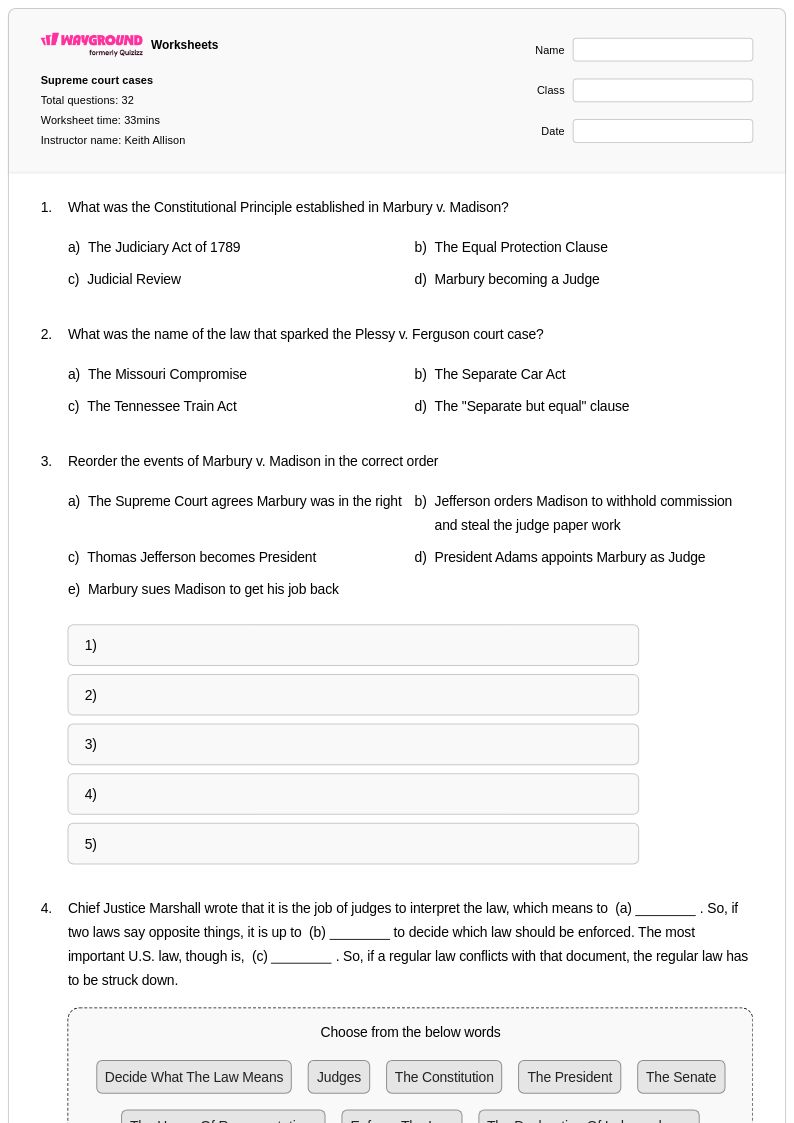
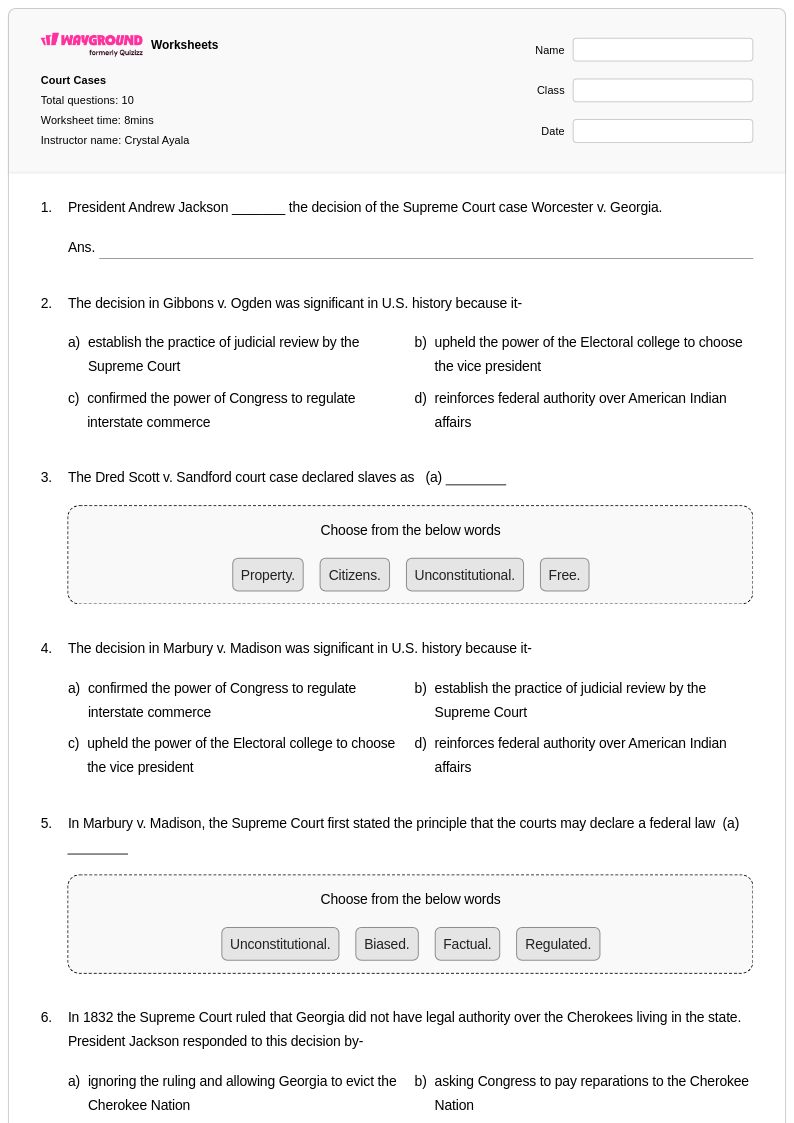
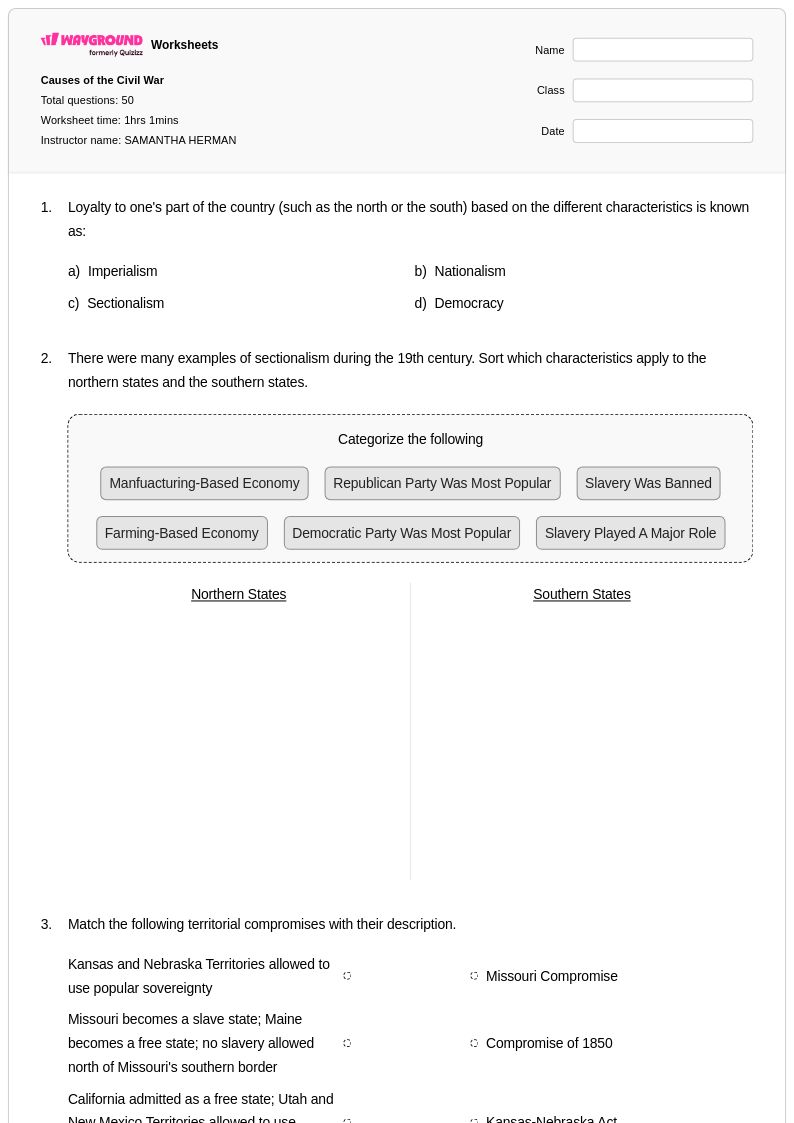
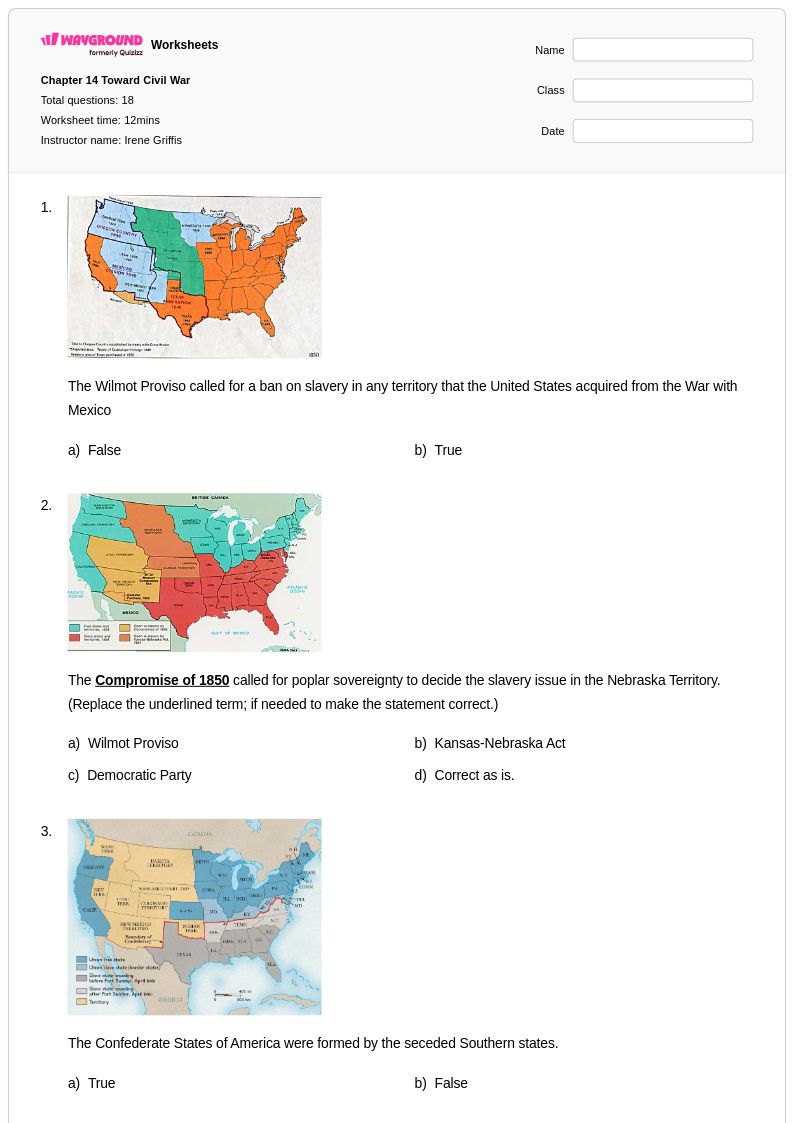
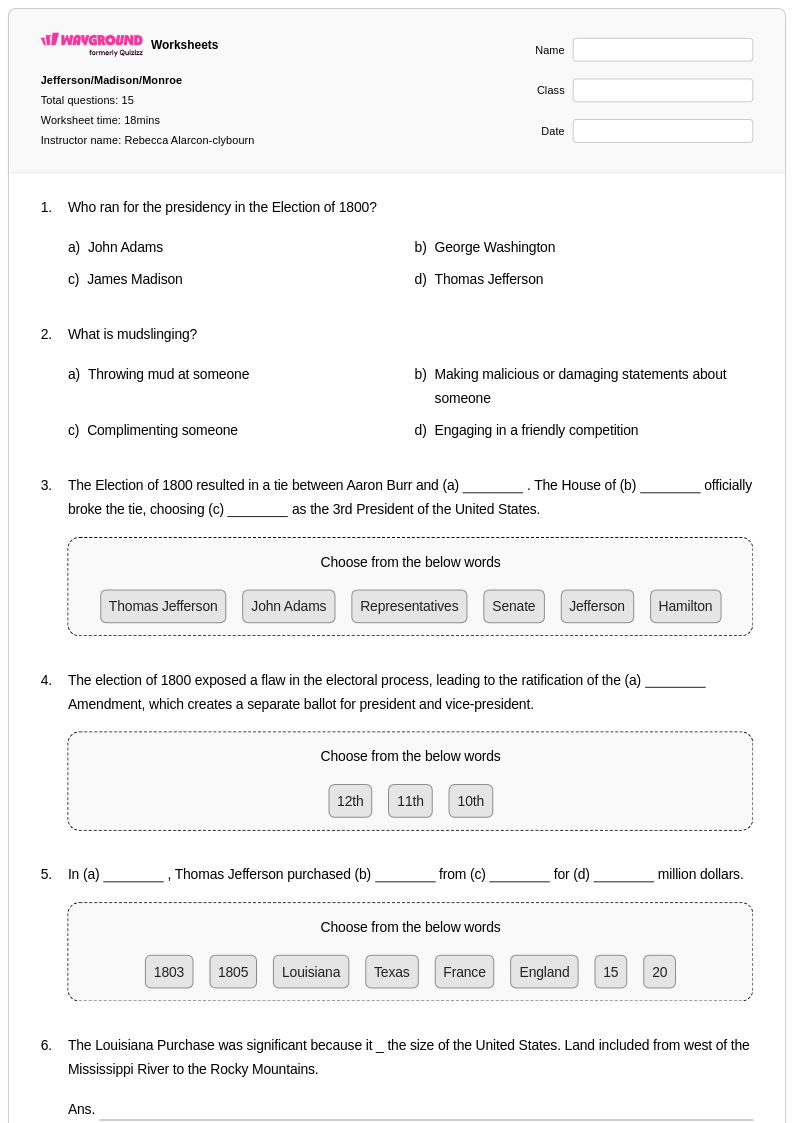
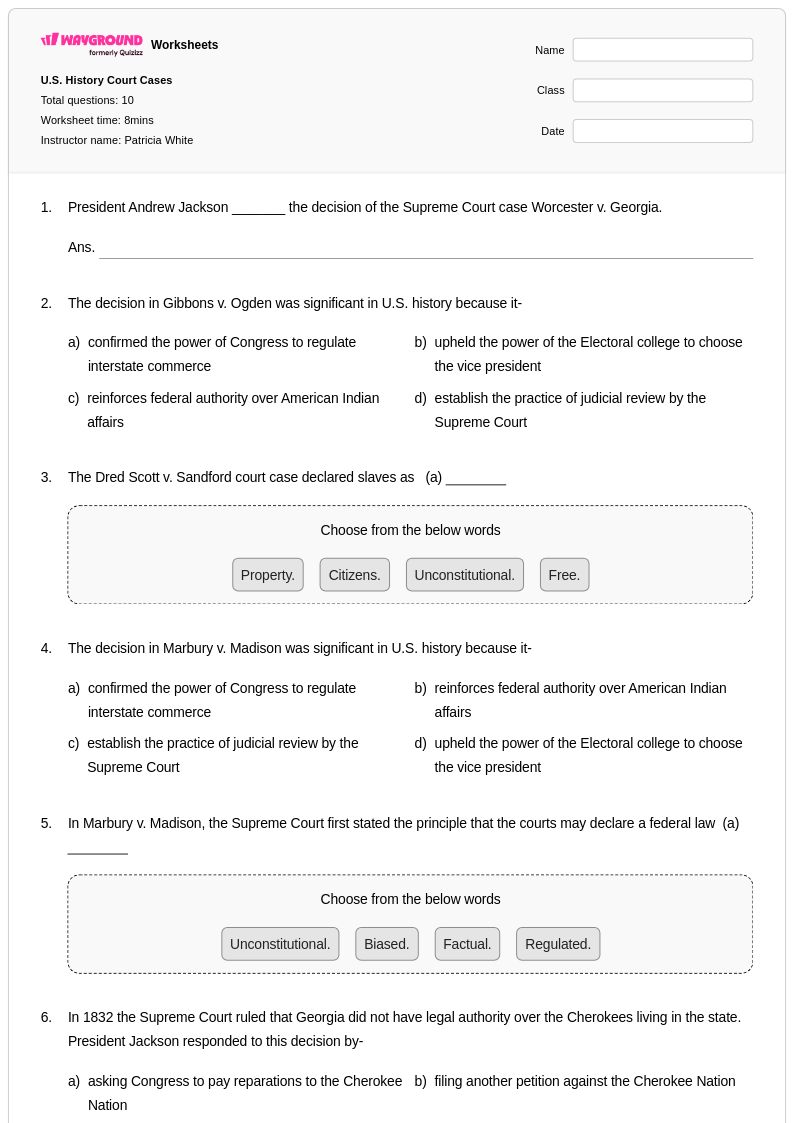
Dred Scott v. Sandford worksheets available through Wayground (formerly Quizizz) provide comprehensive educational resources that examine one of the most significant and controversial Supreme Court cases in American history. These expertly crafted materials guide students through the complex legal, social, and political dimensions of the 1857 decision that declared African Americans could not be citizens and ruled the Missouri Compromise unconstitutional. The worksheets strengthen critical thinking skills by challenging students to analyze primary source documents, evaluate the constitutional arguments presented by both sides, and assess the far-reaching consequences of Chief Justice Roger Taney's majority opinion. Students engage with practice problems that explore the case's impact on the slavery debate, its role in escalating tensions between North and South, and its ultimate contribution to the outbreak of the Civil War. Each worksheet includes detailed answer keys and is available as free printables in convenient PDF format, making it easy for educators to implement these resources in their classrooms.
Wayground (formerly Quizizz) supports teachers with an extensive collection of Dred Scott v. Sandford worksheets drawn from millions of teacher-created resources that have been carefully curated and organized for maximum educational impact. The platform's robust search and filtering capabilities allow educators to quickly locate materials that align with specific curriculum standards and match their students' academic needs. Teachers can take advantage of powerful differentiation tools to modify worksheet content for diverse learners, ensuring that both struggling students and advanced learners can engage meaningfully with this pivotal Supreme Court case. The flexible customization features enable educators to adapt existing materials or create new variations, while the availability of both printable and digital formats, including downloadable PDFs, provides versatility for different classroom environments. These comprehensive tools streamline lesson planning while offering targeted resources for remediation, enrichment, and skill practice that deepen students' understanding of constitutional law, civil rights, and the historical forces that shaped antebellum America.
FAQs
How do I teach Dred Scott v. Sandford in a history class?
Teaching Dred Scott v. Sandford effectively requires grounding students in the legal and political context of 1857, including the Missouri Compromise, the expansion of slavery into new territories, and the composition of the Supreme Court at the time. Start by introducing the personal story of Dred Scott before moving into the constitutional arguments, so students understand the human stakes behind the legal questions. From there, guide students through Chief Justice Taney's majority opinion, focusing on the two core rulings: that African Americans were not citizens and therefore had no standing to sue, and that Congress lacked the authority to ban slavery in the territories. Connecting the decision to its aftermath, including its role in accelerating sectional tensions and contributing to the Civil War, helps students see why this case remains one of the most consequential in Supreme Court history.
What are the most common misconceptions students have about the Dred Scott decision?
A frequent misconception is that the Dred Scott ruling was a narrow or procedural decision — in reality, Chief Justice Taney's opinion went far beyond dismissing Scott's standing and made sweeping constitutional claims about citizenship and congressional authority. Students also often conflate the Missouri Compromise with the Kansas-Nebraska Act, leading to confusion about what exactly the Court struck down and when. Another common error is assuming the decision resolved the national debate over slavery; in practice, it intensified the conflict by stripping Congress of a key tool for compromise and galvanizing antislavery sentiment in the North.
What primary source documents should students analyze when studying Dred Scott v. Sandford?
The most essential primary source is Taney's majority opinion itself, which students should read in excerpts to identify the specific constitutional reasoning used to deny Scott's citizenship and invalidate the Missouri Compromise. Justice Benjamin Curtis's dissent is equally valuable because it provides a direct counterargument and models how to evaluate competing constitutional interpretations. Supplementary sources like newspaper editorials from 1857, Abraham Lincoln's speeches responding to the decision, and Frederick Douglass's public address on the ruling help students assess the decision's immediate political impact from multiple perspectives.
What exercises help students practice analyzing the Dred Scott case?
Effective practice exercises include structured document analysis tasks where students identify the claim, evidence, and reasoning in excerpts from Taney's opinion and Curtis's dissent. Cause-and-effect graphic organizers that map the decision's consequences, from the collapse of political compromise to the rise of the Republican Party, help students build analytical frameworks rather than just memorize facts. Argument-evaluation questions that ask students to assess the constitutional logic on both sides deepen critical thinking and prepare them for essay-style assessments on constitutional law and civil rights history.
How can I use Dred Scott v. Sandford worksheets in my classroom?
Dred Scott v. Sandford worksheets on Wayground are available as printable PDFs for traditional classroom use and in digital formats for technology-integrated learning environments, including the option to host them as a quiz directly on Wayground. Printable versions work well for close-reading and annotation activities, while digital formats support self-paced review or formative assessment. Each worksheet includes a detailed answer key, so teachers can use them for guided instruction, independent practice, or homework without additional preparation.
How does Dred Scott v. Sandford connect to broader U.S. history standards?
The Dred Scott decision sits at the intersection of several major U.S. history standards, including the causes of the Civil War, the limits of congressional authority, the legal status of enslaved people, and the development of civil rights in America. It also connects directly to the 14th Amendment, which was ratified in 1868 specifically to overturn the citizenship ruling in Dred Scott, making the case a foundational reference point for any unit on Reconstruction. Teachers covering constitutional law, antebellum America, or the road to the Civil War will find the case relevant across multiple instructional units.
How can I support struggling students when teaching the Dred Scott case?
The legal language and historical complexity of Dred Scott v. Sandford can be challenging for struggling readers, so scaffolding with simplified excerpts and vocabulary pre-teaching is essential before students engage with primary sources. On Wayground, teachers can enable accommodations such as Read Aloud so that questions and content are read to students who need it, and Reduced Answer Choices to lower cognitive load for selected students during digital practice. These settings can be applied individually, meaning students who need support receive it while the rest of the class works with standard materials, and the settings are saved for future sessions.