Free Printable Electron Energy and Light Worksheets for Class 9
Explore Class 9 electron energy and light worksheets with free printables and answer keys that help students master how electrons absorb and emit energy to produce electromagnetic radiation.
Explore printable Electron Energy and Light worksheets for Class 9
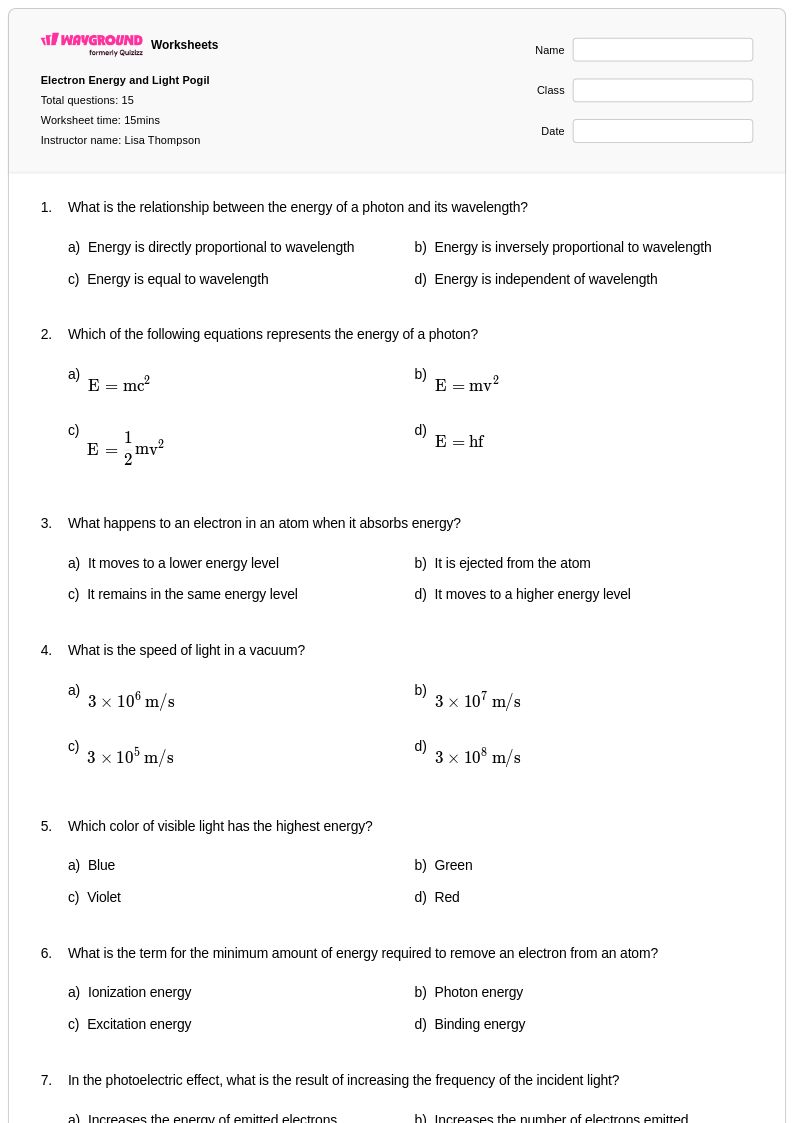
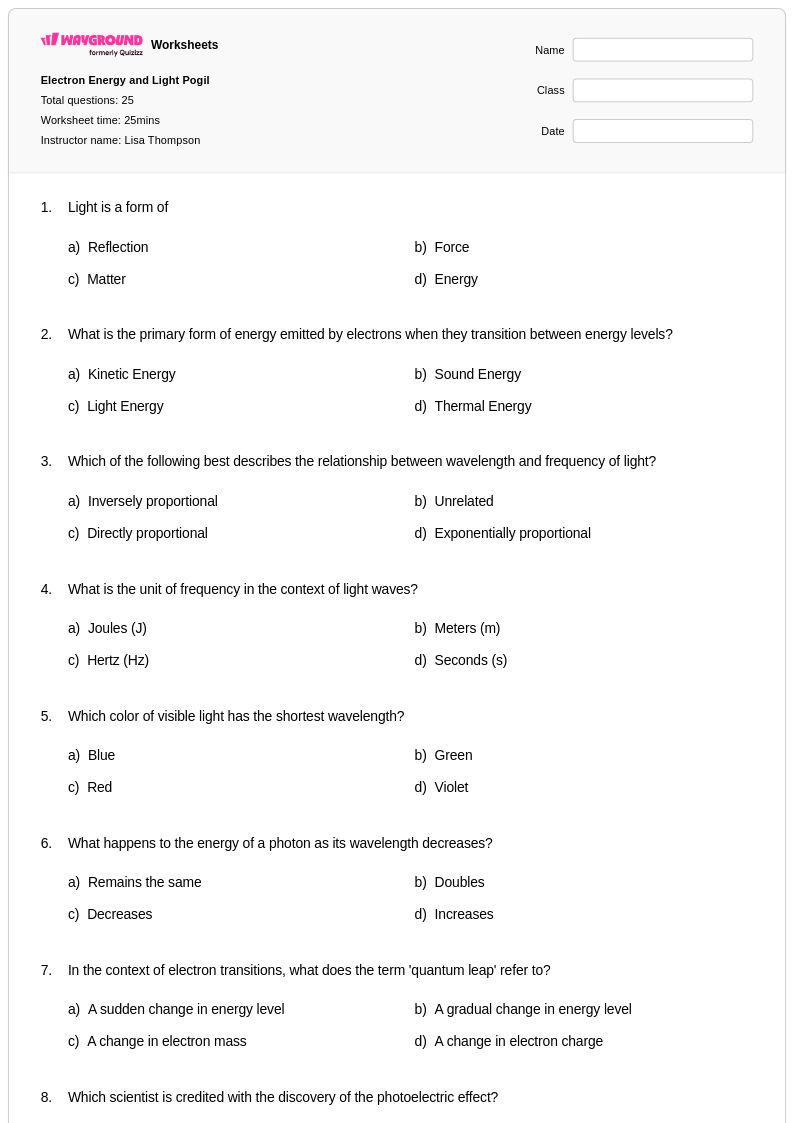
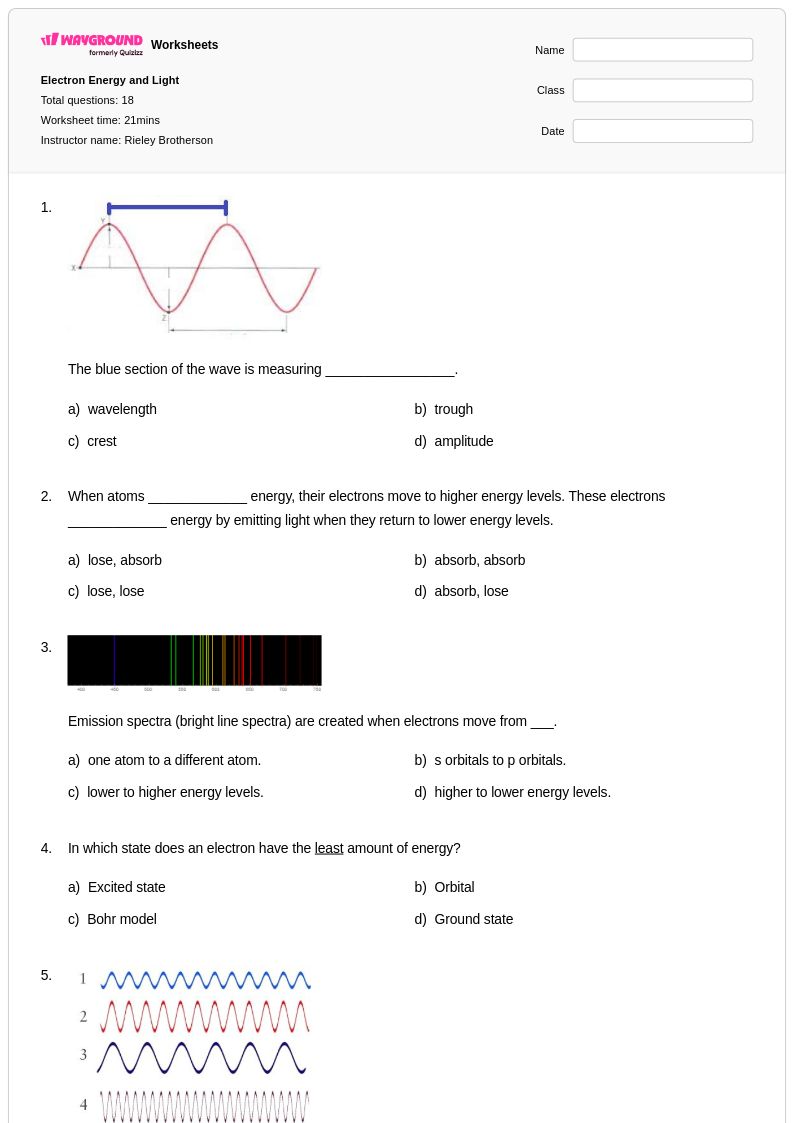
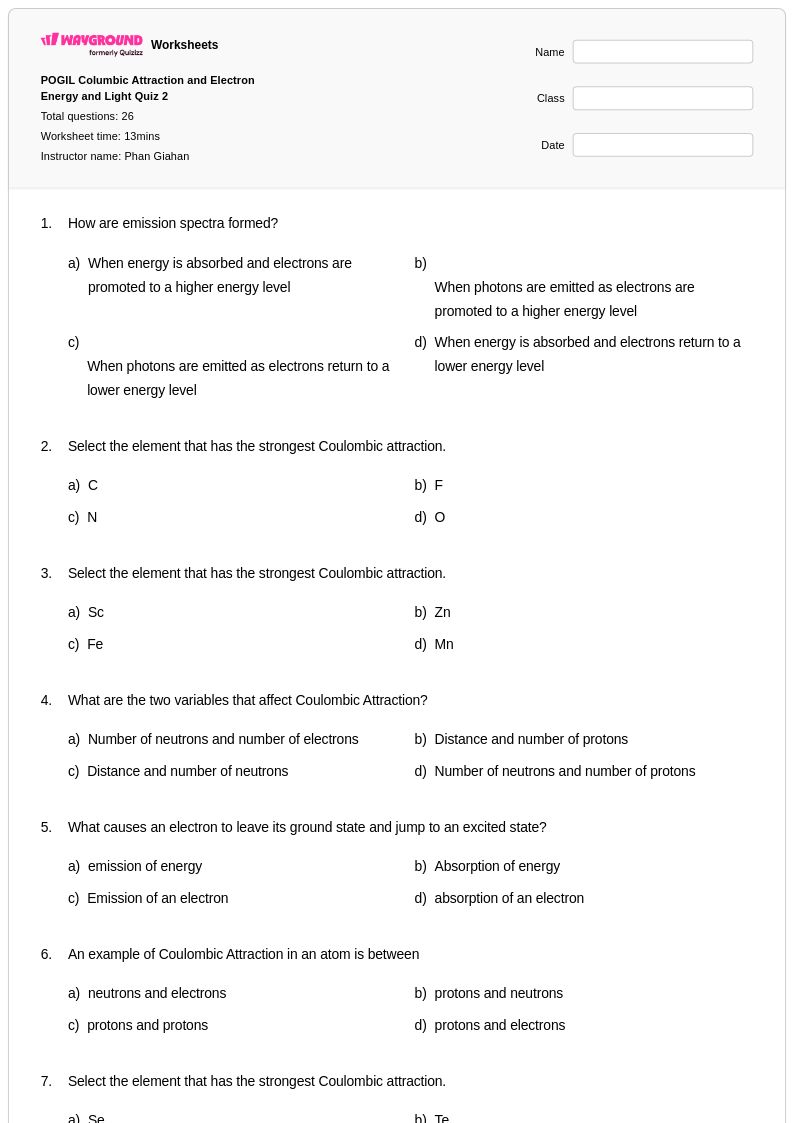
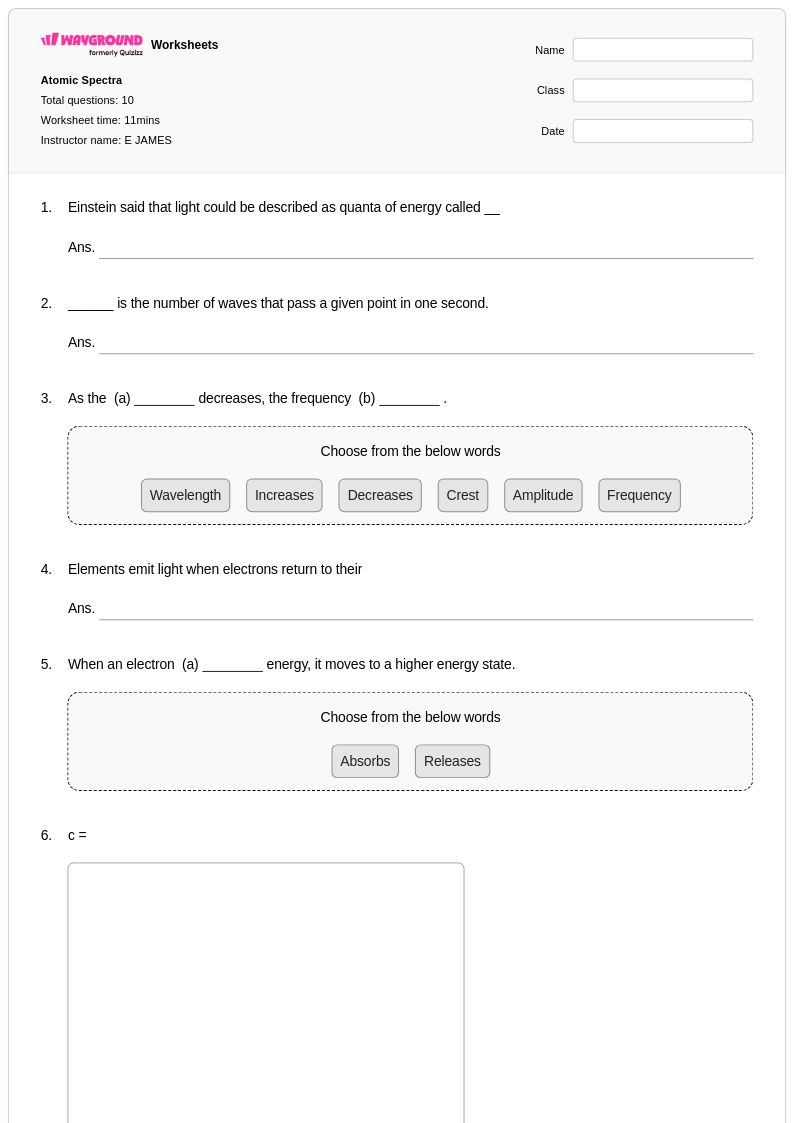
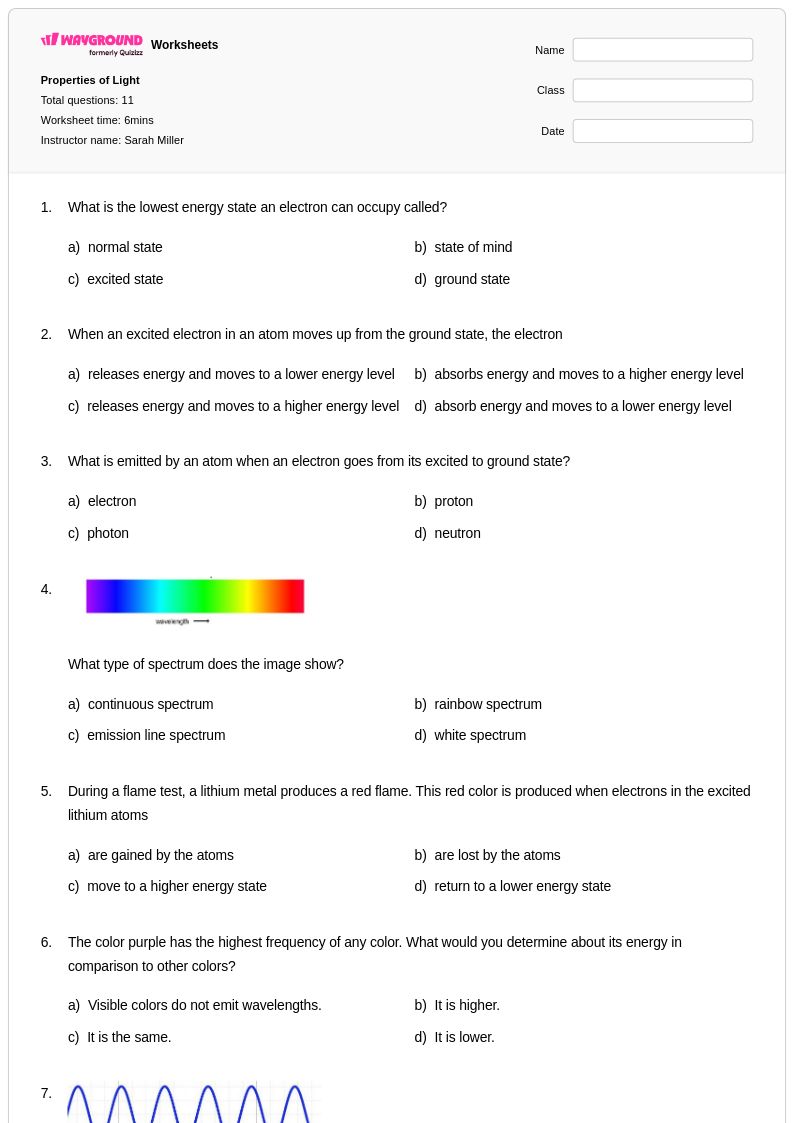
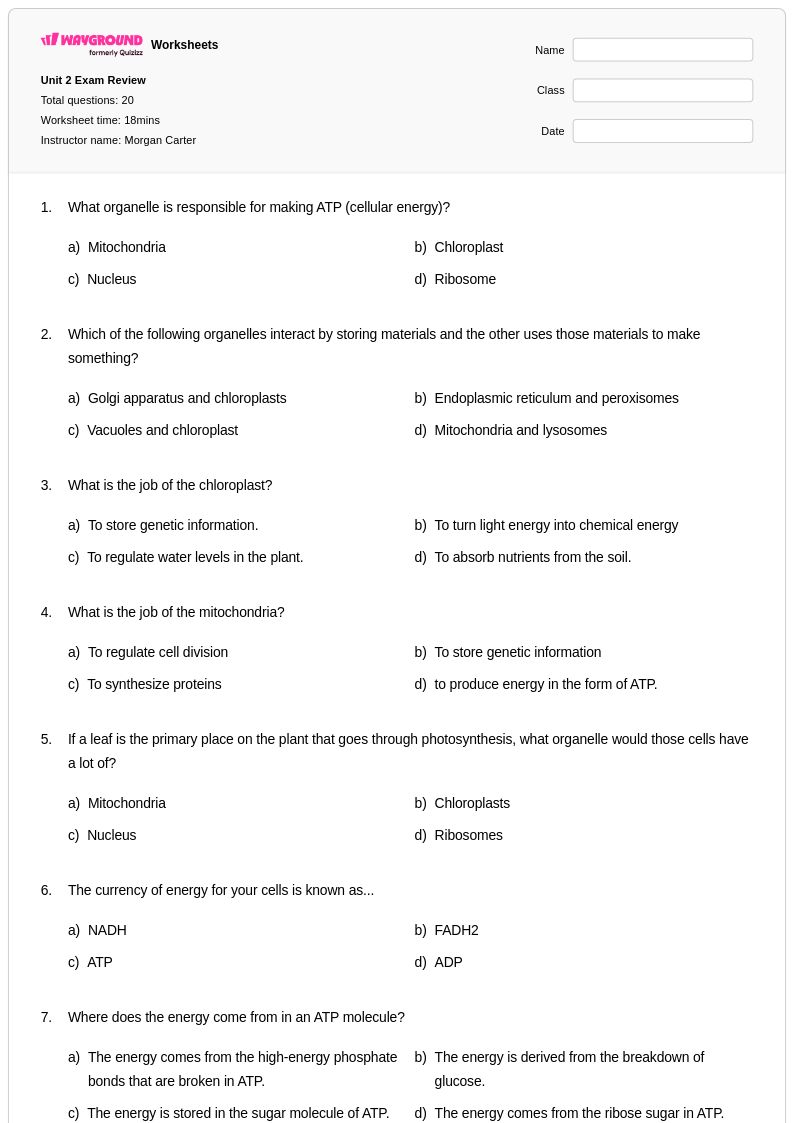
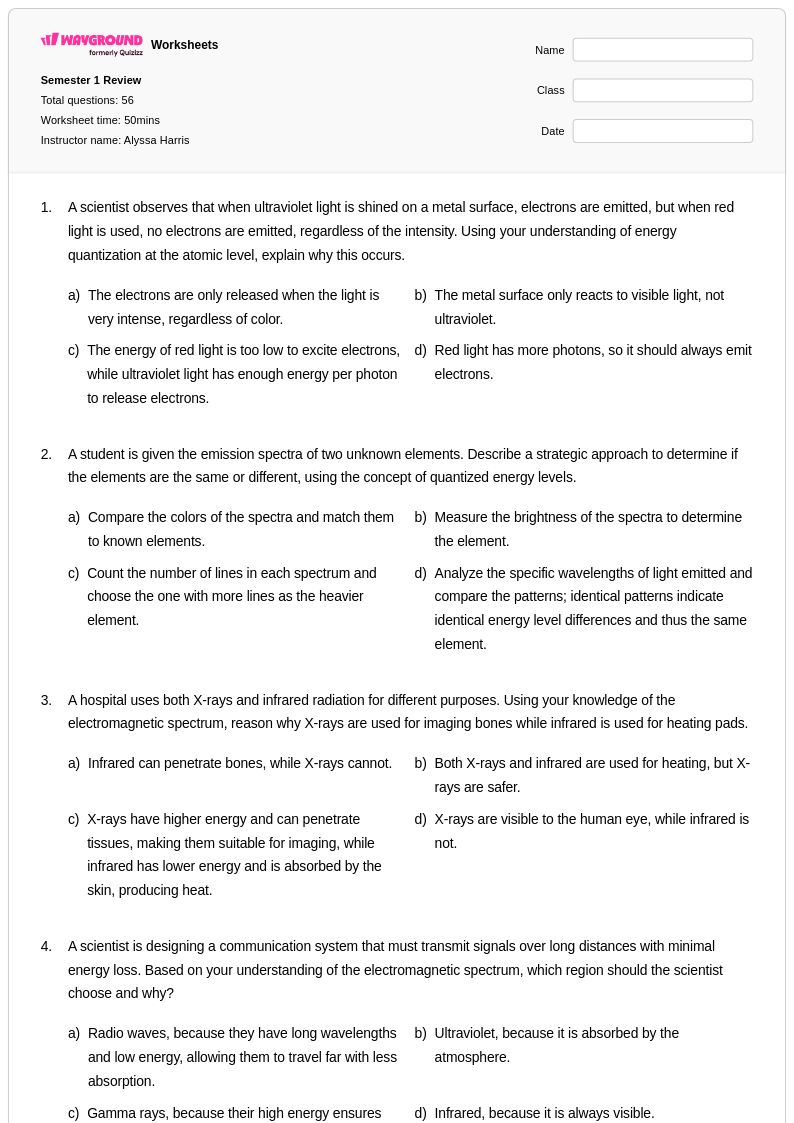
Electron Energy and Light worksheets for Class 9 students available through Wayground (formerly Quizizz) provide comprehensive practice with the fundamental principles governing how electrons interact with electromagnetic radiation. These carefully designed printable resources help students master critical concepts including electron energy levels, photon emission and absorption, the relationship between wavelength and energy, and the quantum nature of light. Students work through practice problems that strengthen their understanding of how electrons transition between energy states, calculate photon energies using Planck's equation, and analyze emission spectra from different elements. Each worksheet comes with a detailed answer key that supports independent learning and enables students to check their progress as they develop proficiency with these essential physics concepts in both free pdf formats and interactive digital versions.
Wayground (formerly Quizizz) empowers educators with millions of teacher-created Electron Energy and Light resources specifically aligned with Class 9 physics standards, offering robust search and filtering capabilities that make finding the perfect worksheet effortless. Teachers can easily differentiate instruction by accessing materials at various complexity levels, customize existing worksheets to match their specific classroom needs, and choose between printable pdf formats for traditional assignments or digital formats for technology-integrated learning environments. These versatile tools support comprehensive lesson planning while providing targeted options for remediation when students struggle with quantum concepts, enrichment activities for advanced learners ready to explore atomic spectra in greater depth, and consistent skill practice that reinforces the mathematical relationships between electron energy states and electromagnetic radiation wavelengths.
FAQs
How do I teach electron energy and light transitions in physics?
Start by grounding students in the Bohr model and the concept of discrete energy levels before introducing photon emission and absorption. Use energy level diagrams to make electron transitions visual — students need to see that an electron dropping from a higher to lower level releases a photon with energy equal to the difference between those levels. From there, connect the energy equation E = hf to wavelength using c = fλ, so students can trace a transition all the way to a spectral line color. Building this conceptual chain before introducing calculations significantly reduces confusion when students encounter atomic spectra problems.
What practice problems help students master photon energy calculations?
Students benefit most from problems that require them to move fluently between energy, frequency, and wavelength using E = hf and c = fλ. Effective practice sets include identifying which region of the electromagnetic spectrum a photon belongs to based on calculated wavelength, working backward from a known spectral line to determine the energy transition, and comparing photon energies across different electron transitions in hydrogen. Problems that incorporate energy level diagrams alongside calculation prompts reinforce the conceptual and quantitative dimensions simultaneously, which is critical for retention.
What are the most common mistakes students make with the photoelectric effect?
The most persistent misconception is that increasing light intensity will eject electrons regardless of frequency — students conflate brightness with energy per photon. A second common error is treating the threshold frequency as adjustable rather than as a fixed property of the metal's work function. Students also frequently confuse kinetic energy of ejected electrons with total photon energy, forgetting to subtract the work function. Targeted practice problems that force students to evaluate scenarios where intensity increases but frequency stays below threshold are the most effective way to correct these misunderstandings.
How can I use these worksheets to support students at different skill levels?
Wayground's differentiation tools allow teachers to customize electron energy and light worksheets for varying skill levels, so the same topic can be scaffolded differently for students who are still building foundational understanding versus those ready for advanced spectroscopy and quantum mechanical applications. For students who need additional support, Wayground's Read Aloud accommodation can audio-read questions aloud, and the reduced answer choices setting lowers cognitive load on multiple-choice problems. Extended time can be assigned per student without alerting the rest of the class, keeping accommodations discreet. These settings are saved and reusable across future sessions.
How do I use Wayground's electron energy and light worksheets in my classroom?
Wayground's electron energy and light worksheets are available as printable PDFs for traditional classroom use and in digital formats for technology-integrated learning environments, giving teachers flexibility depending on their setup. Digital versions can also be hosted as a quiz directly on Wayground, which is useful for formative assessment or structured independent practice. Each worksheet includes detailed answer keys and step-by-step solutions, so they work equally well for in-class instruction, independent study, or remediation without requiring additional prep from the teacher.
How does spectral line formation connect to electron transitions in the classroom?
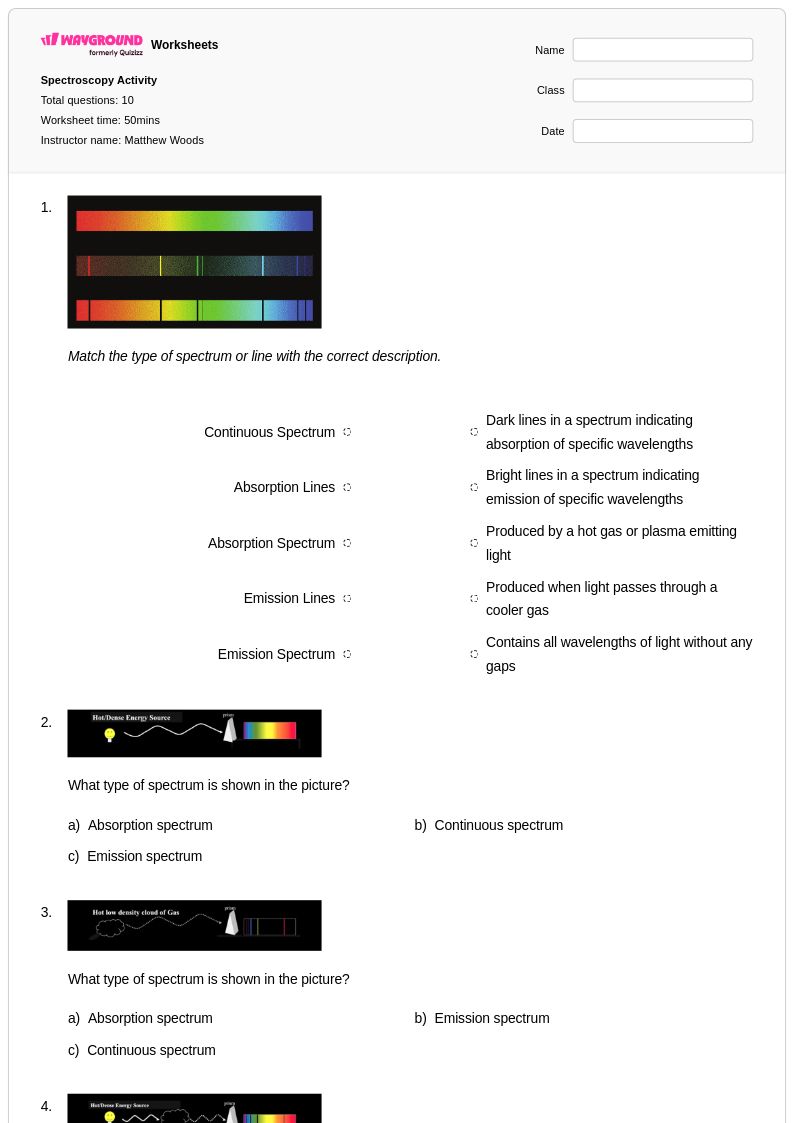
Spectral lines are the observable result of electrons in an atom releasing photons of specific energies as they fall from excited states to lower energy levels — each line corresponds to a precise transition unique to that element. Teaching spectral line formation is an effective anchor for the broader unit because it makes the abstract concept of quantized energy levels concrete and visually distinct. Having students calculate the wavelengths of hydrogen's Balmer series lines and then match them to the visible spectrum bridges the math and the physical phenomenon in a single exercise.