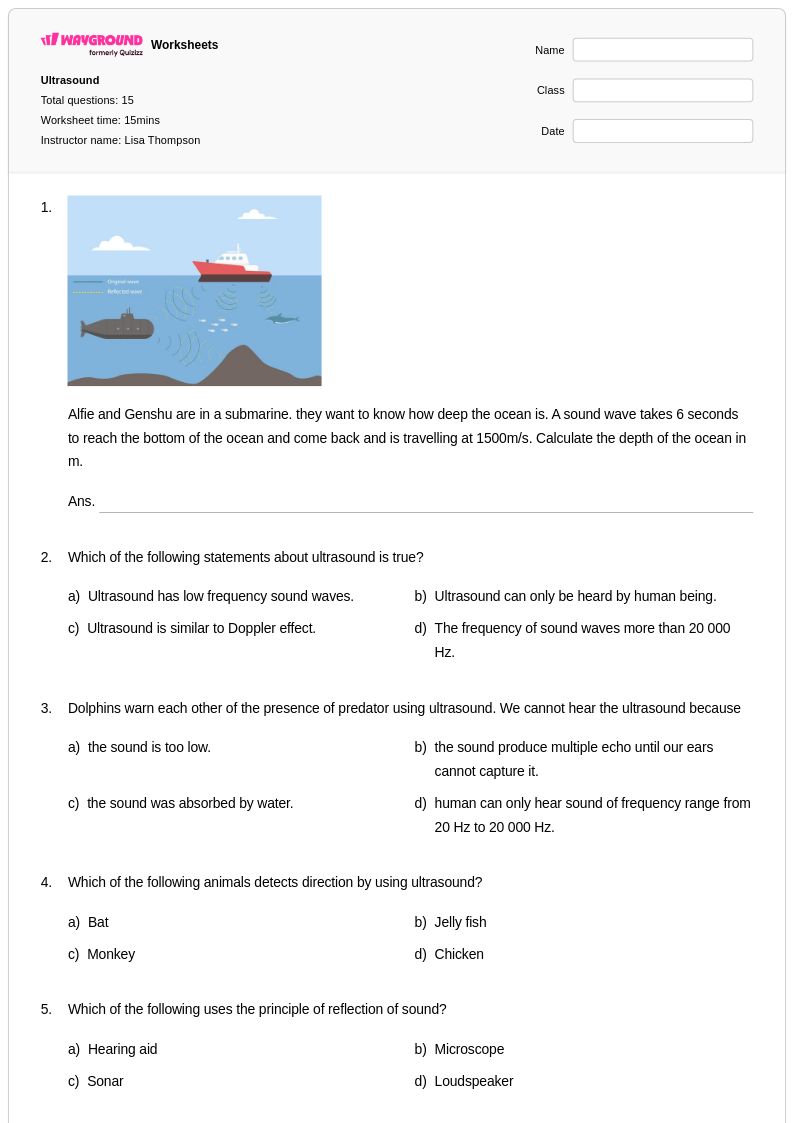
Explore Class 9 ultrasound worksheets and printables from Wayground that help students master sound wave properties, medical imaging applications, and physics principles through engaging practice problems, free PDFs, and comprehensive answer keys.
Explore printable Ultrasound worksheets for Class 9
Ultrasound worksheets for Class 9 physics students available through Wayground (formerly Quizizz) provide comprehensive coverage of high-frequency sound waves and their practical applications in medical imaging, industrial testing, and scientific research. These expertly crafted worksheets strengthen students' understanding of wave properties, frequency calculations, and the principles behind ultrasonic technology while developing critical thinking skills through real-world problem-solving scenarios. Students engage with practice problems that explore how ultrasound waves interact with different materials, calculate wavelengths and frequencies beyond human hearing range, and analyze the physics behind echolocation and medical sonography. Each worksheet collection includes detailed answer keys and is available as free printables in pdf format, enabling teachers to seamlessly integrate these resources into their wave physics curriculum and provide students with structured practice opportunities.
Wayground (formerly Quizizz) supports physics educators with millions of teacher-created ultrasound worksheets that can be easily discovered through robust search and filtering capabilities, allowing instructors to locate resources that align with specific learning standards and grade-level expectations. The platform's differentiation tools enable teachers to customize worksheet difficulty levels and content focus areas, ensuring that both struggling learners and advanced students receive appropriate challenges when studying wave phenomena and acoustic principles. These versatile resources are available in both printable and digital formats, including downloadable pdf versions, making them ideal for classroom instruction, homework assignments, remediation sessions, and enrichment activities. Teachers can efficiently plan comprehensive ultrasound units by accessing worksheets that cover theoretical concepts, mathematical calculations, and practical applications, while the platform's organizational features streamline lesson preparation and enable targeted skill practice based on individual student needs.
FAQs
How do I teach ultrasound physics to high school students?
Start by grounding students in foundational wave properties — frequency, wavelength, and wave speed — before introducing the specific characteristics that distinguish ultrasound (frequencies above 20,000 Hz) from audible sound. From there, build toward applied concepts like the piezoelectric effect, acoustic impedance, and how these properties make ultrasound useful in medical imaging and industrial testing. Using real-world examples such as prenatal scans or sonar helps students connect abstract physics to tangible applications, which significantly improves retention and engagement.
What practice problems are most effective for reinforcing ultrasound concepts?
The most effective practice problems for ultrasound combine quantitative calculation with conceptual reasoning. Problems that ask students to calculate wave speed using frequency and wavelength, determine acoustic impedance, or apply the Doppler effect to medical imaging scenarios address the core skills students need. Including problems that require students to interpret what happens at tissue boundaries — such as reflection versus transmission — reinforces why acoustic impedance matching matters in diagnostic ultrasound.
What common mistakes do students make when learning ultrasound physics?
One of the most frequent misconceptions is that ultrasound is a form of electromagnetic radiation similar to X-rays; students need explicit reinforcement that ultrasound is a mechanical wave requiring a medium to travel. Students also commonly confuse frequency with amplitude, conflating pitch with volume, which leads to errors in Doppler shift calculations. A third common error is misapplying the wave speed equation — students often forget that wave speed in ultrasound depends on the medium's properties, not the frequency of the source.
How can I use ultrasound worksheets to support students with different learning needs?
Ultrasound worksheets on Wayground can be assigned digitally, which allows teachers to apply individual accommodations such as extended time per question, read-aloud support for students who benefit from audio delivery, and reduced answer choices to lower cognitive load for students who need it. These settings can be configured per student without other students being notified, making differentiation seamless in a mixed-ability physics class. For students who need additional scaffolding, pairing the digital worksheet with the read-aloud feature is especially useful for dense physics terminology like 'piezoelectric effect' or 'acoustic impedance.'
How do I incorporate ultrasound worksheets into a physics unit on waves?
Ultrasound worksheets work best when introduced after students have a working understanding of general wave properties and before or alongside lab-based activities on sound. Use calculation-based problems early in the unit to reinforce frequency and wavelength relationships, then transition to application problems involving the Doppler effect and medical imaging in the latter half. These worksheets are available as both printable PDFs for traditional classroom use and in digital formats, including the option to host them as a quiz on Wayground, giving teachers flexibility for in-class practice, homework, or formative assessment.
How does the Doppler effect apply to ultrasound in medical imaging?
In medical ultrasound, the Doppler effect is used to measure blood flow velocity by detecting the frequency shift between emitted and reflected ultrasound waves as they bounce off moving red blood cells. When blood moves toward the transducer, the reflected frequency is higher than the emitted frequency; when blood moves away, it is lower. This principle underlies Doppler echocardiography and vascular ultrasound, making it a critical concept for students studying both physics and biomedical applications.