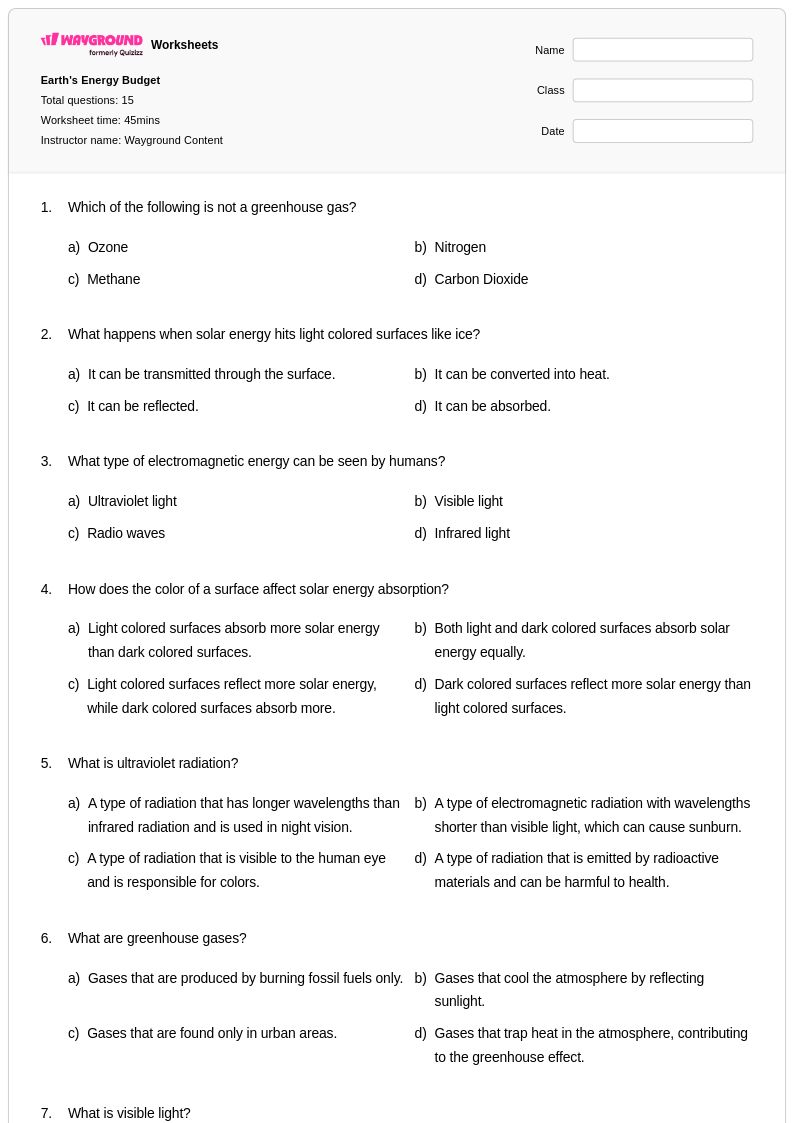
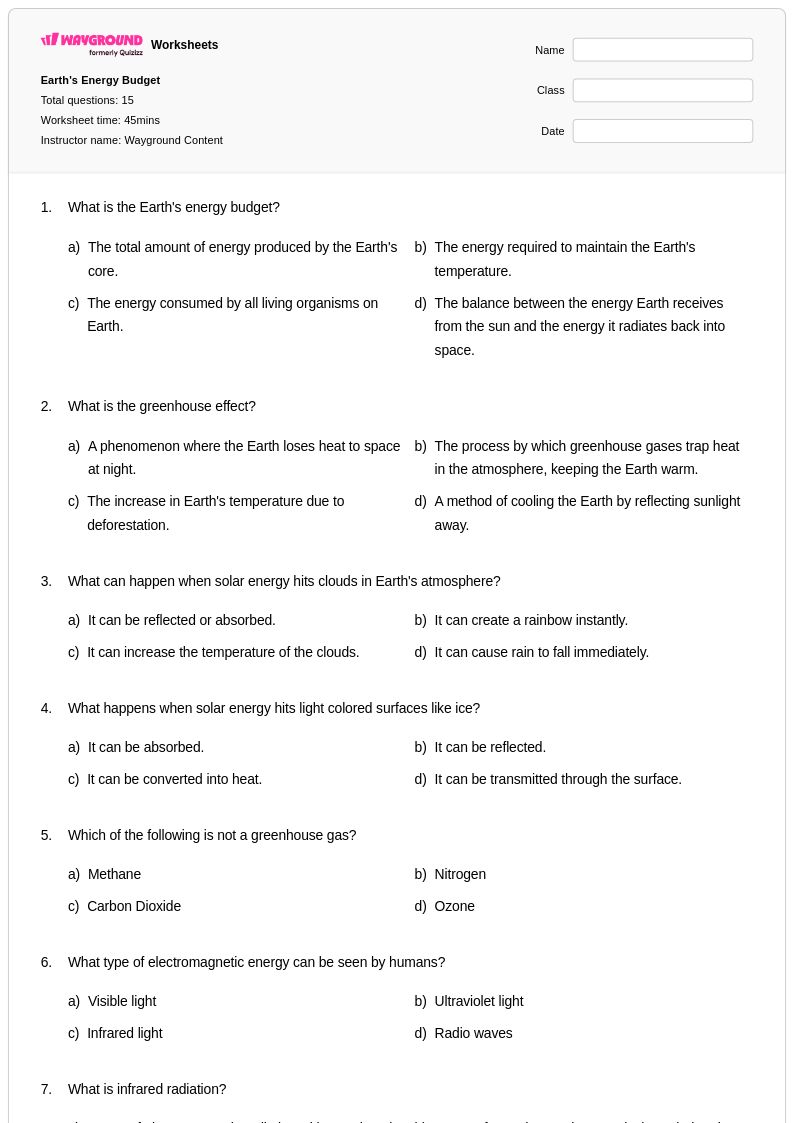
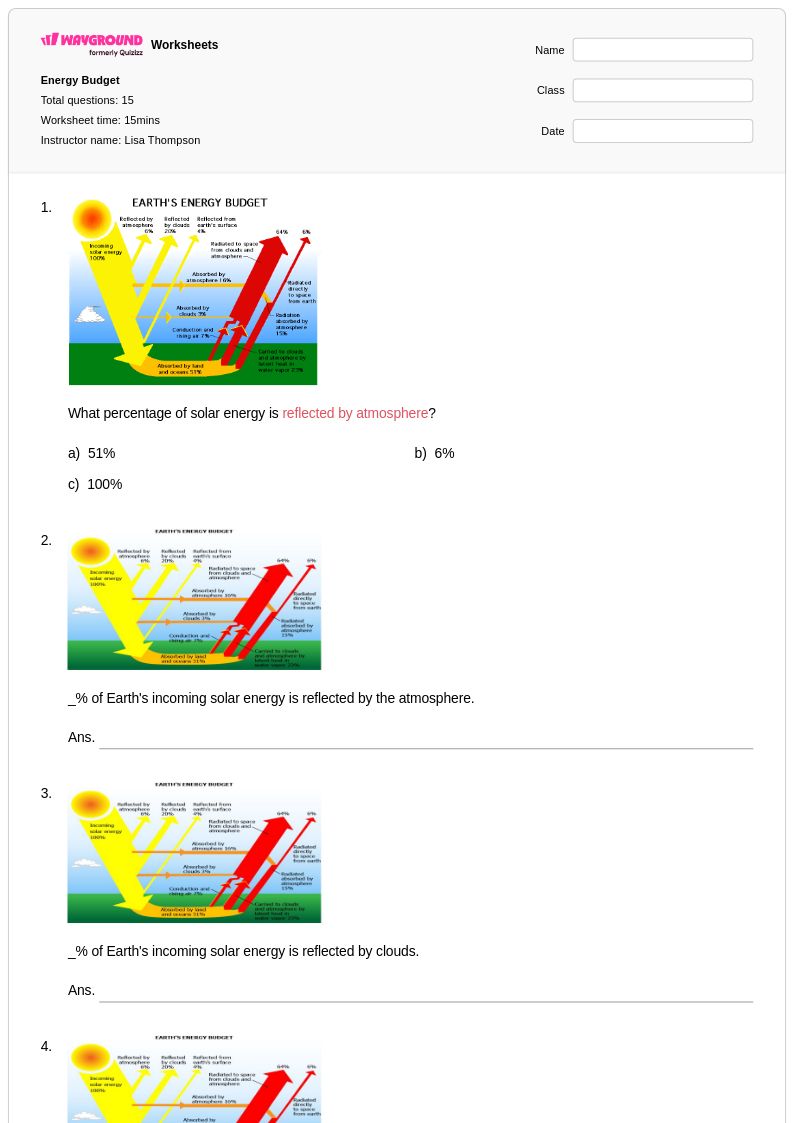
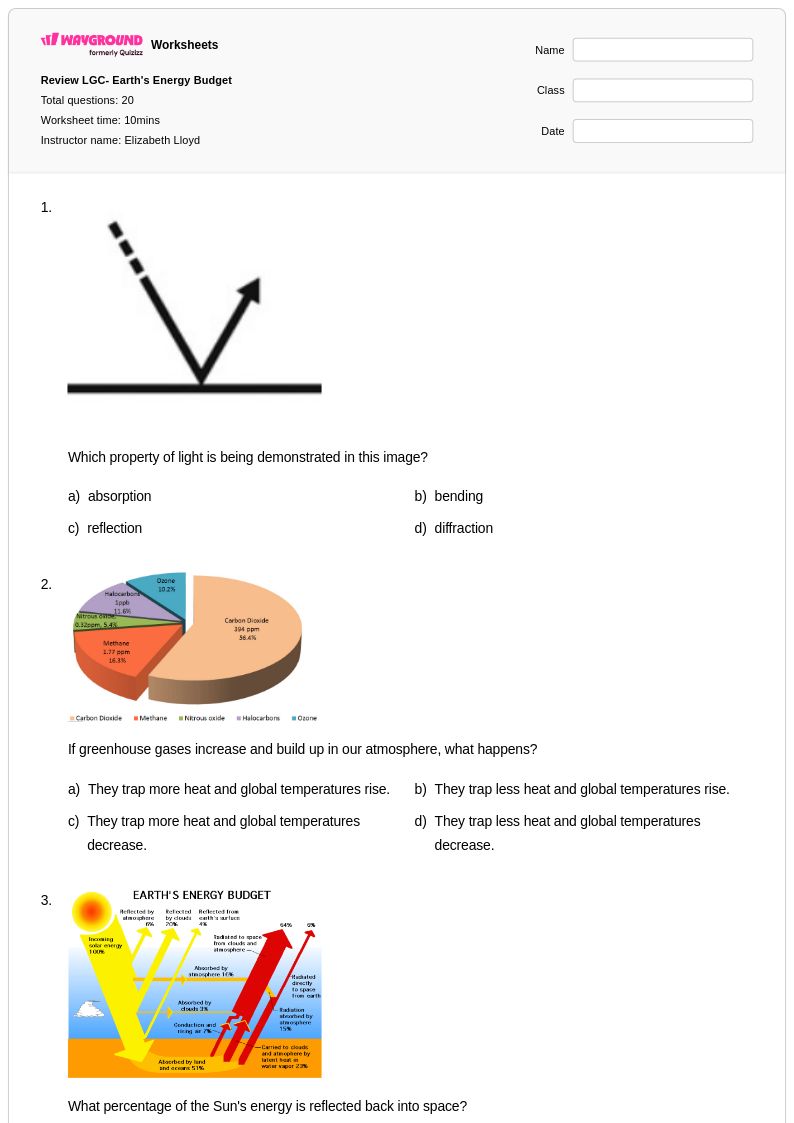
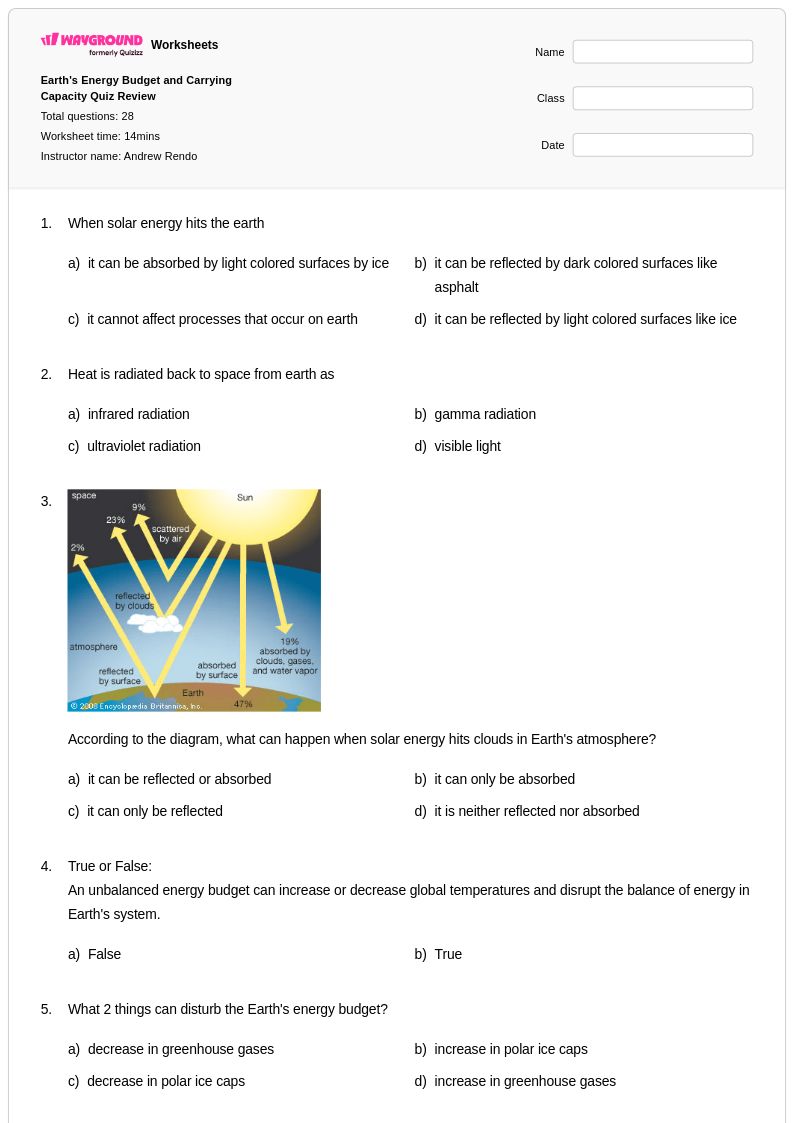
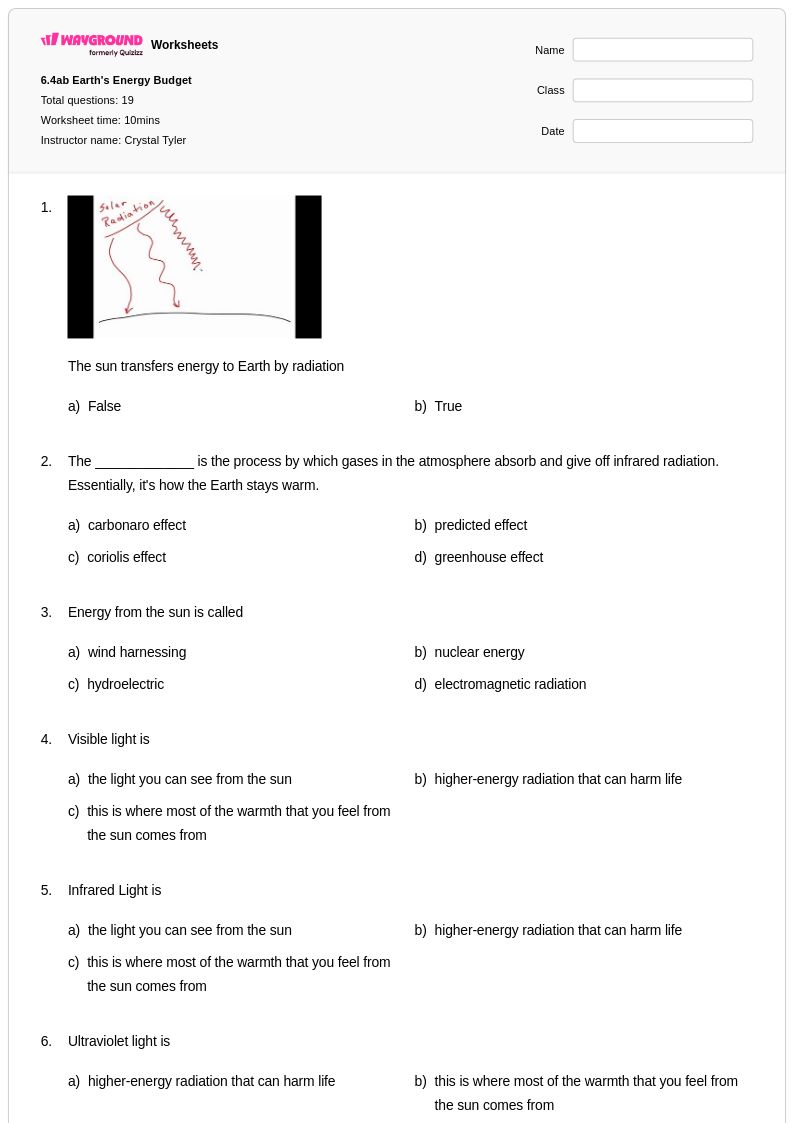
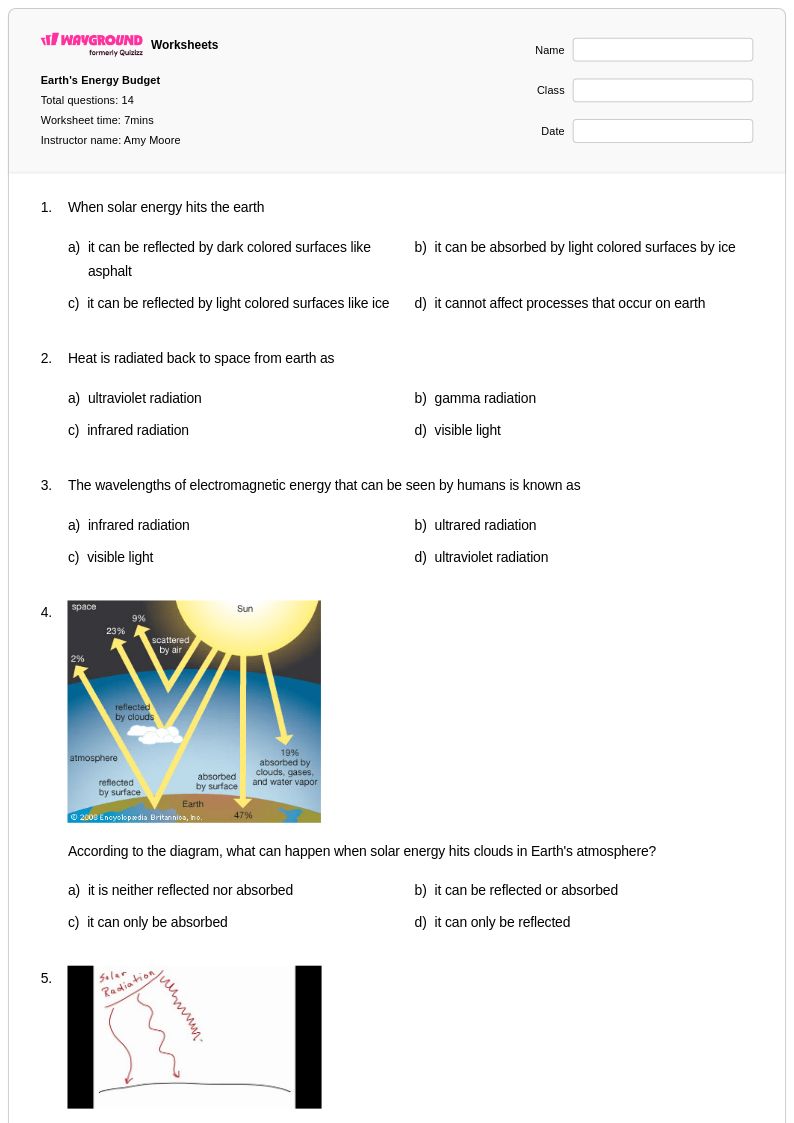
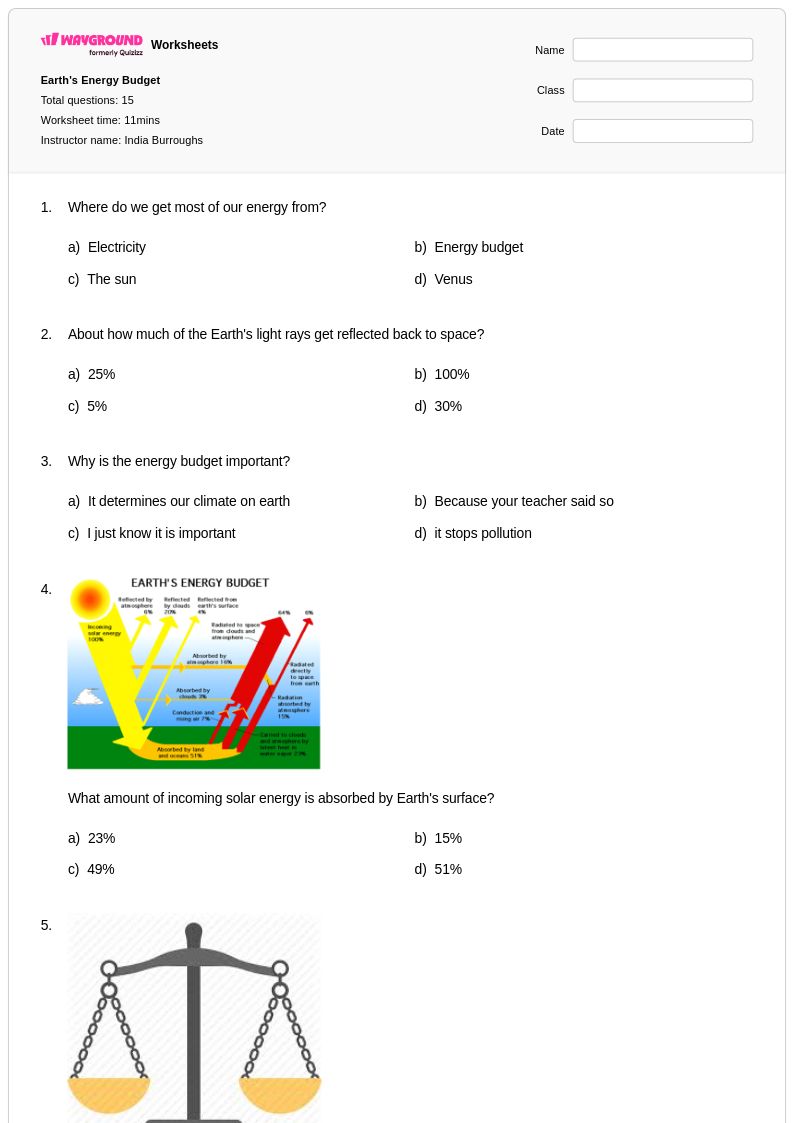
Explore Wayground's comprehensive collection of free Energy Budget worksheets and printables that help students master Earth's energy systems through engaging practice problems and detailed answer keys in convenient PDF format.
Energy budget worksheets available through Wayground (formerly Quizizz) provide comprehensive practice problems that help students understand how Earth receives, absorbs, reflects, and radiates energy from the Sun. These educational resources strengthen critical thinking skills as students analyze the balance between incoming solar radiation and outgoing terrestrial radiation, exploring concepts such as albedo, greenhouse effects, and energy transfer mechanisms. The worksheets feature detailed answer keys that support independent learning and self-assessment, while the free printable format makes these resources accessible for classroom instruction, homework assignments, and test preparation. Students engage with real-world applications of energy budget principles, examining how factors like cloud cover, surface materials, and atmospheric composition influence Earth's energy balance.
Wayground (formerly Quizizz) empowers educators with millions of teacher-created energy budget resources that can be easily discovered through robust search and filtering capabilities aligned with science education standards. Teachers benefit from differentiation tools that allow customization of worksheet difficulty levels, enabling targeted support for remediation activities while providing enrichment opportunities for advanced learners. The platform's flexible format options include both printable pdf versions for traditional classroom use and digital formats that integrate seamlessly with modern teaching environments. These comprehensive worksheet collections streamline lesson planning by offering ready-to-use materials that address various aspects of Earth's energy systems, from radiation balance calculations to climate impact analysis, ensuring educators can effectively support student mastery of fundamental Earth and Space Science concepts through structured skill practice.
FAQs
How do I teach Earth's energy budget to students?
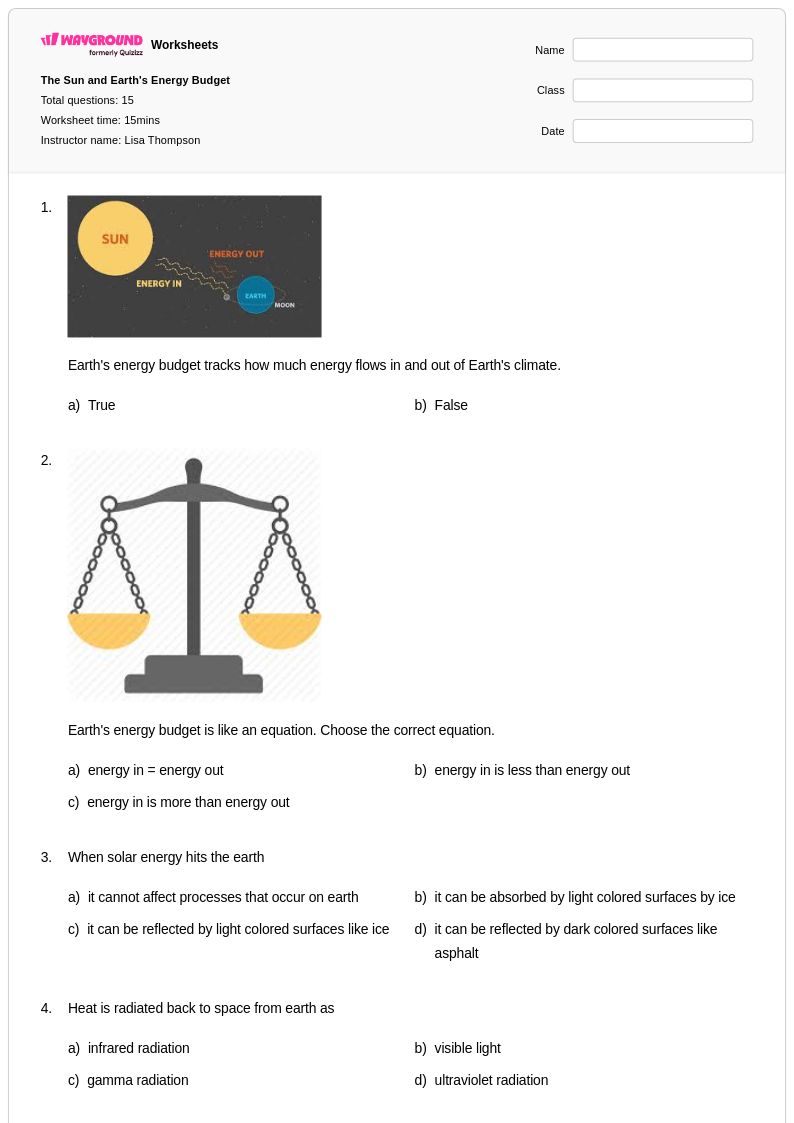
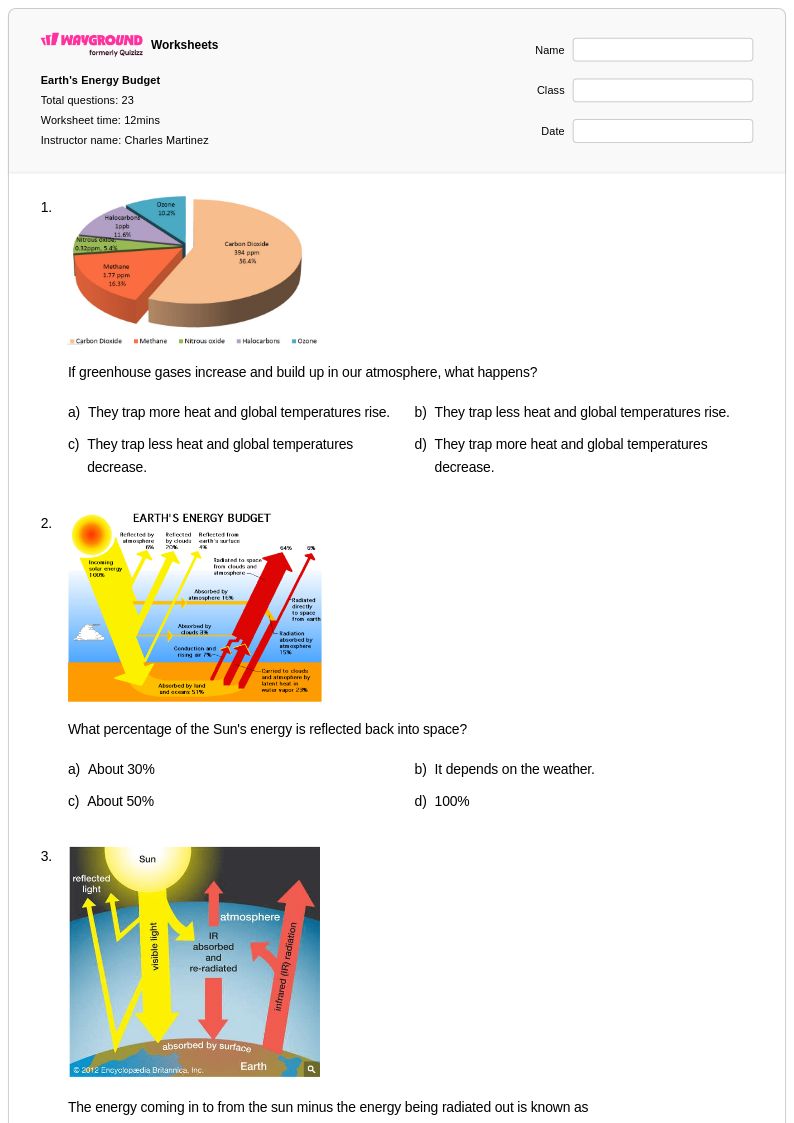
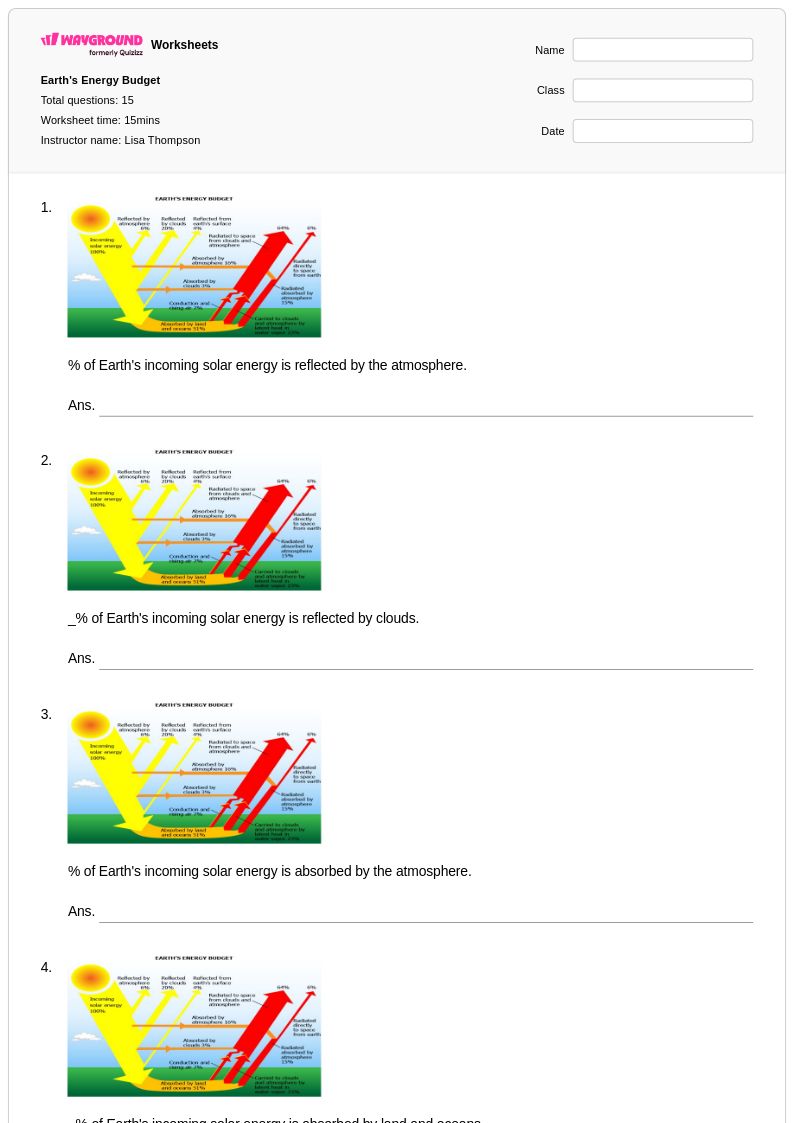
Teaching Earth's energy budget effectively starts with establishing the concept of balance: the energy Earth receives from the Sun must equal the energy Earth radiates back to space over time. Begin with incoming solar radiation, then walk students through absorption, reflection, and re-emission, introducing terms like albedo and terrestrial radiation in sequence. Using labeled diagrams of the energy flow cycle alongside quantitative practice problems helps students move from conceptual understanding to numerical reasoning. Grounding each concept in real-world examples, such as how ice sheets affect albedo or how clouds trap outgoing radiation, reinforces why the balance matters for climate.
What exercises help students practice energy budget concepts?
Practice exercises that work well for the energy budget include radiation balance calculations, albedo comparison problems, and scenario-based questions where students analyze how changes in cloud cover or surface materials shift the energy balance. Graphing incoming versus outgoing radiation over time helps students visualize equilibrium and identify imbalances. Worksheets that pair data interpretation with short-answer explanations push students to connect numerical results to physical reasoning, which is essential for mastering this topic.
What misconceptions do students commonly have about Earth's energy budget?
A frequent misconception is that Earth simply absorbs all incoming solar energy, when in reality a significant portion is reflected back to space by clouds, ice, and bright surfaces. Students also commonly conflate the greenhouse effect with ozone depletion, treating them as the same phenomenon rather than distinct atmospheric processes. Another persistent error is assuming that energy budget imbalances are immediately visible as temperature changes, rather than understanding that the system can absorb excess energy gradually over time. Addressing these misconceptions early with targeted practice problems reduces confusion during assessments.
How do I differentiate energy budget instruction for students at different levels?
For students who need additional support, focus on single-step problems involving one form of energy transfer before introducing multi-step radiation balance calculations. Advanced learners can engage with more complex scenarios involving feedback loops, such as the ice-albedo feedback or water vapor amplification. On Wayground, teachers can apply accommodations at the individual student level, including reduced answer choices to lower cognitive load for struggling learners and extended time settings, while other students receive standard worksheet versions without any disruption to the class.
How do I use Wayground's energy budget worksheets in my classroom?
Wayground's energy budget worksheets are available as printable PDFs, making them straightforward to distribute for in-class practice, homework, or test preparation in a traditional classroom setting. They are also available in digital formats for technology-integrated environments, and teachers can host them directly as a quiz on Wayground for instant student engagement and automatic scoring. Each worksheet includes a complete answer key, which supports independent student self-assessment and reduces grading time for teachers.
How does Earth's energy budget connect to climate change topics?
Earth's energy budget is the foundational framework for understanding climate change: when greenhouse gases increase, they reduce the efficiency of outgoing terrestrial radiation, creating a positive energy imbalance that causes warming. Students who understand energy budget principles can reason through why rising CO2 concentrations, melting ice, and changing cloud patterns all influence global temperatures. This connection makes energy budget worksheets particularly valuable as a bridge between Earth science content and environmental science units.