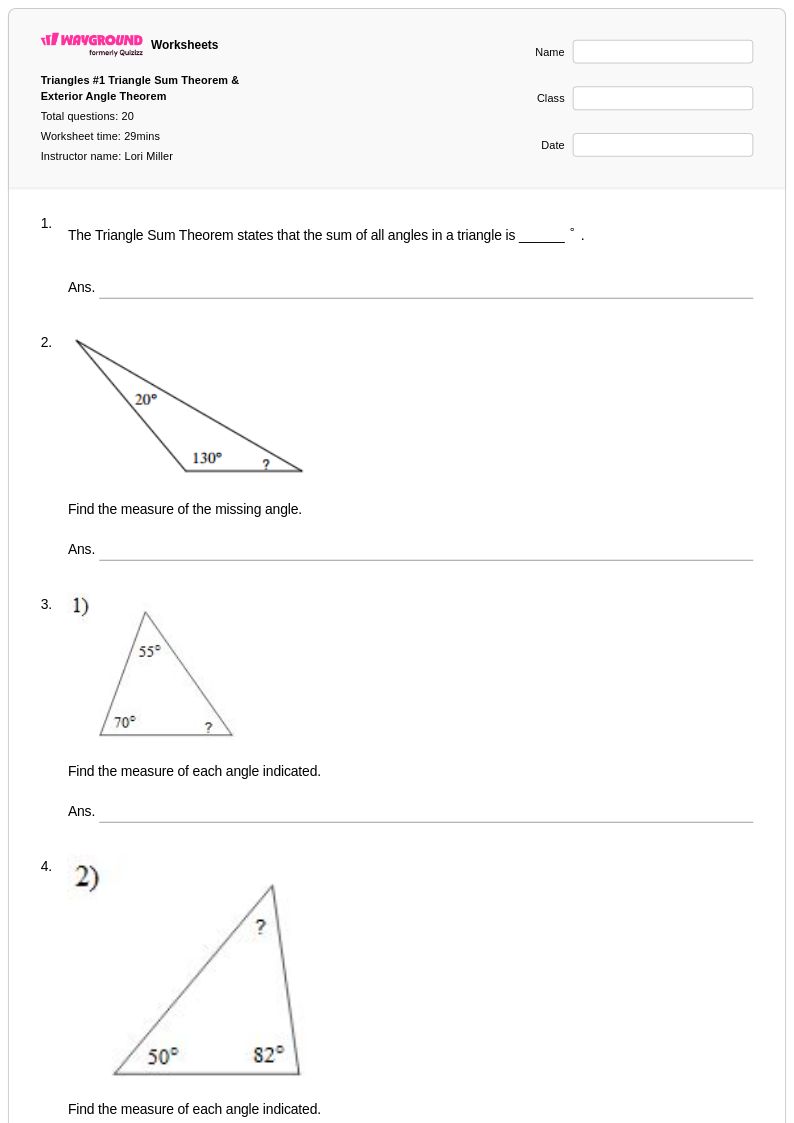
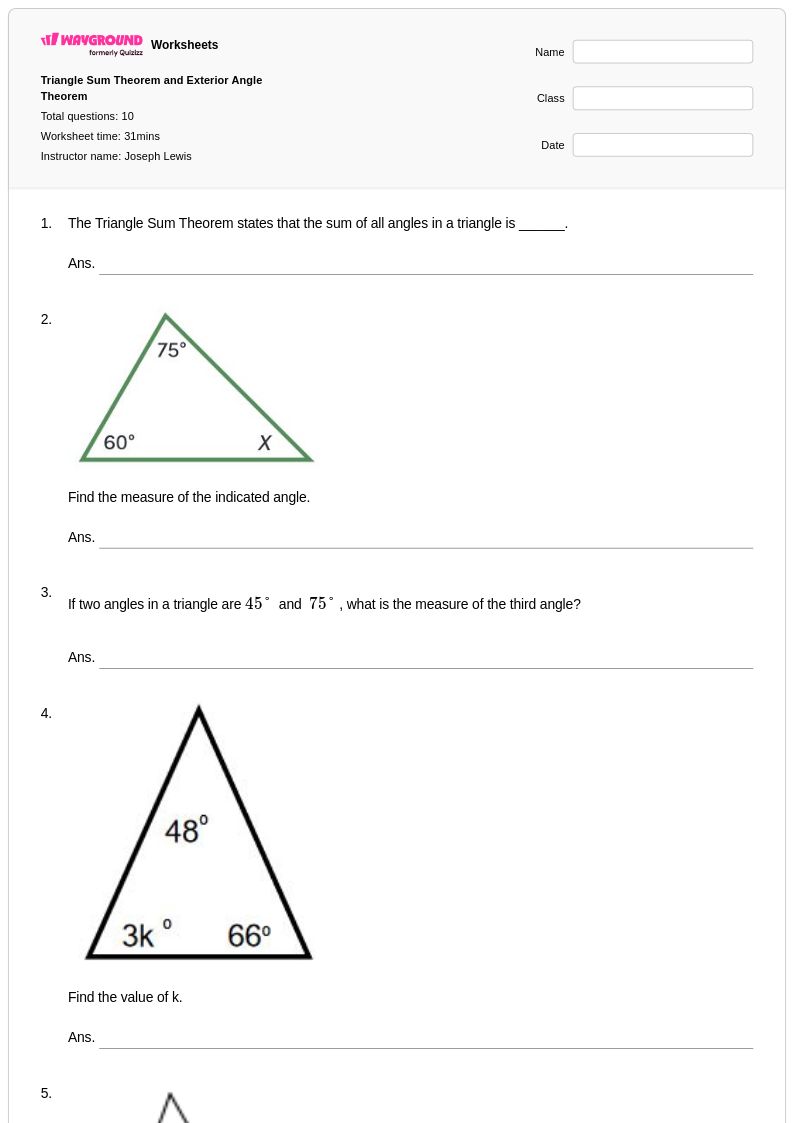
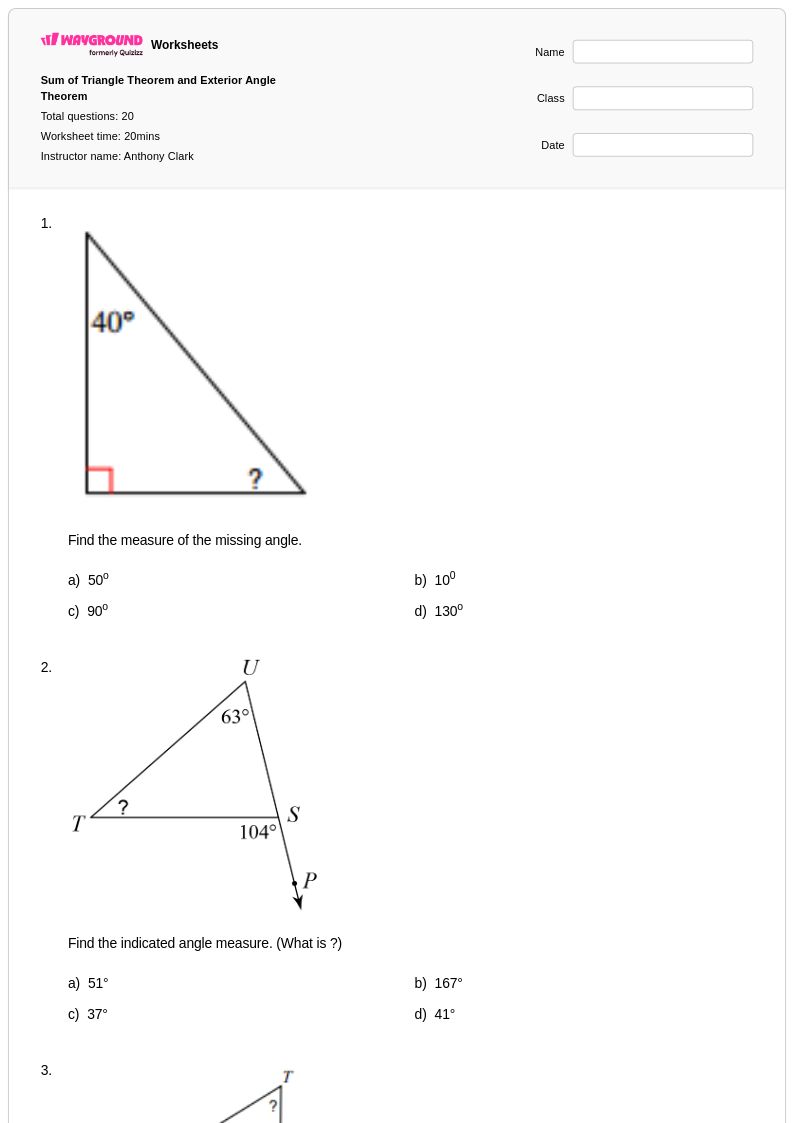
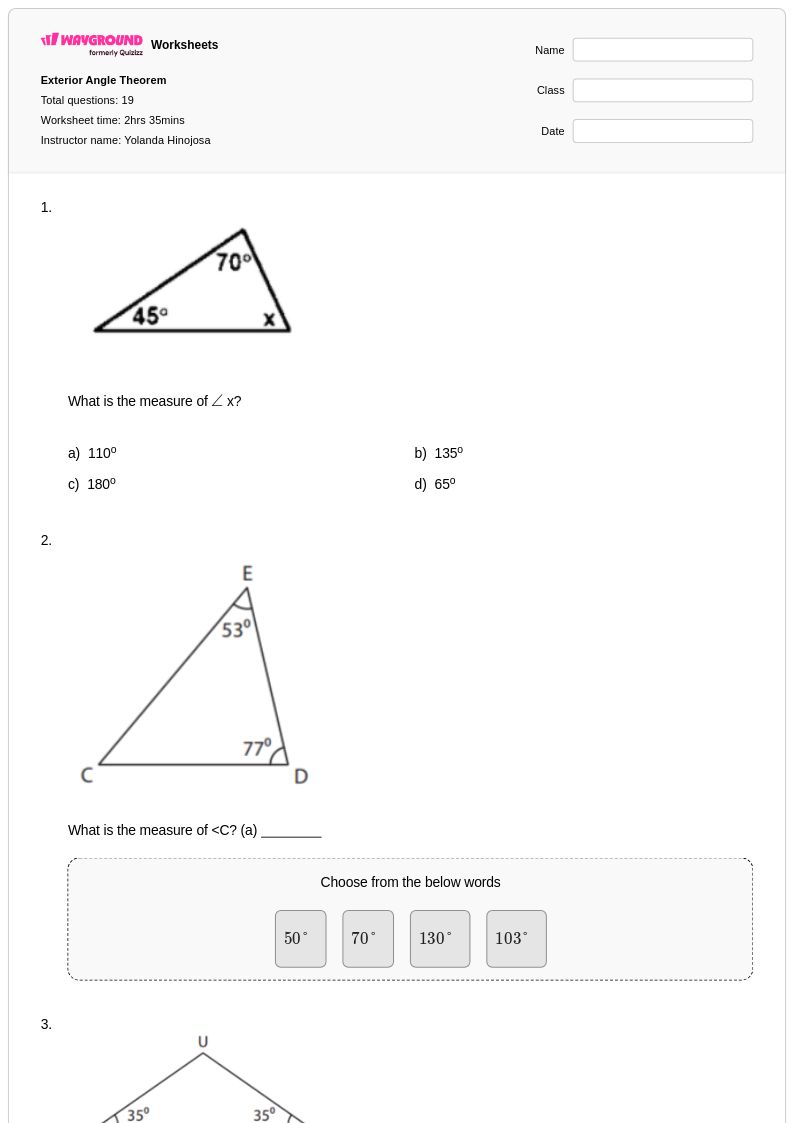
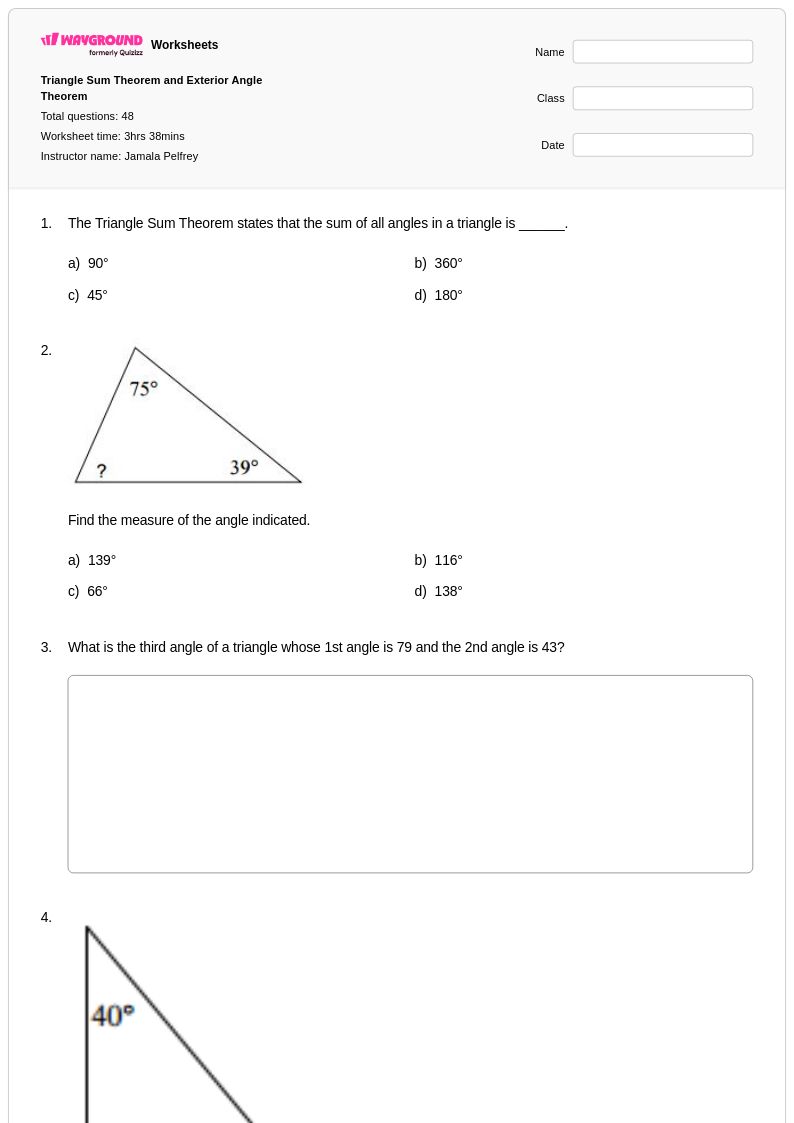
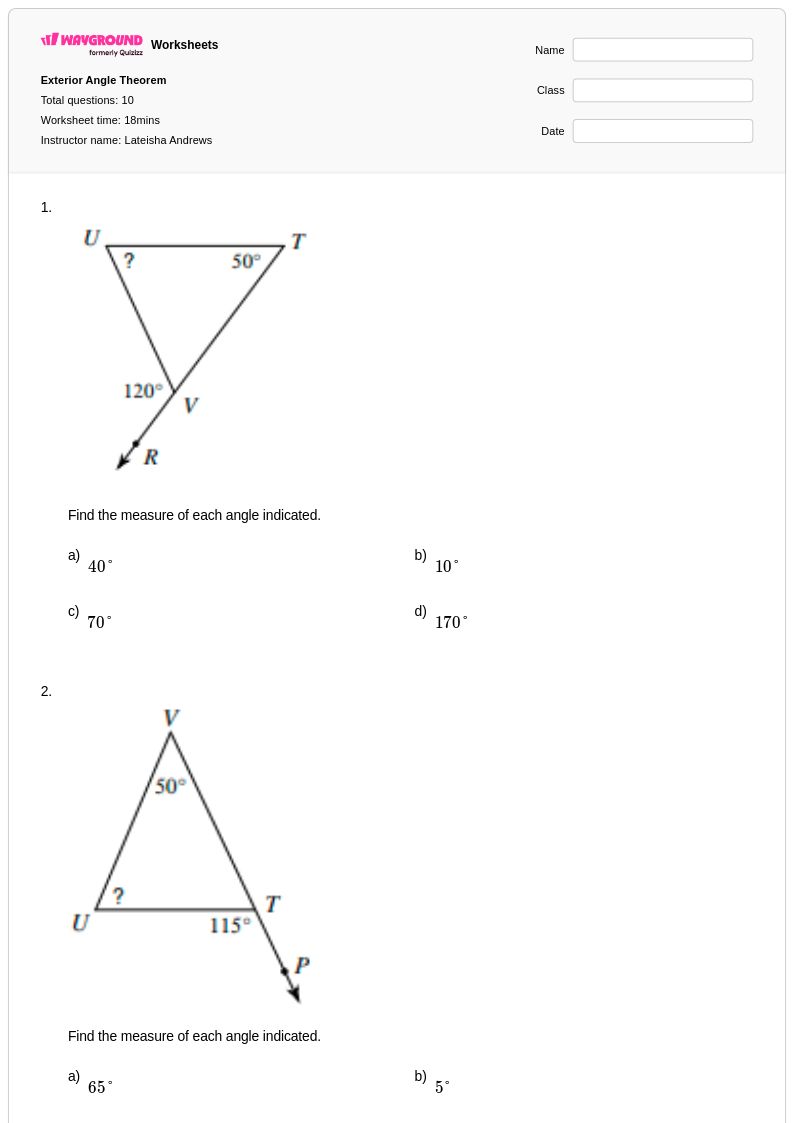
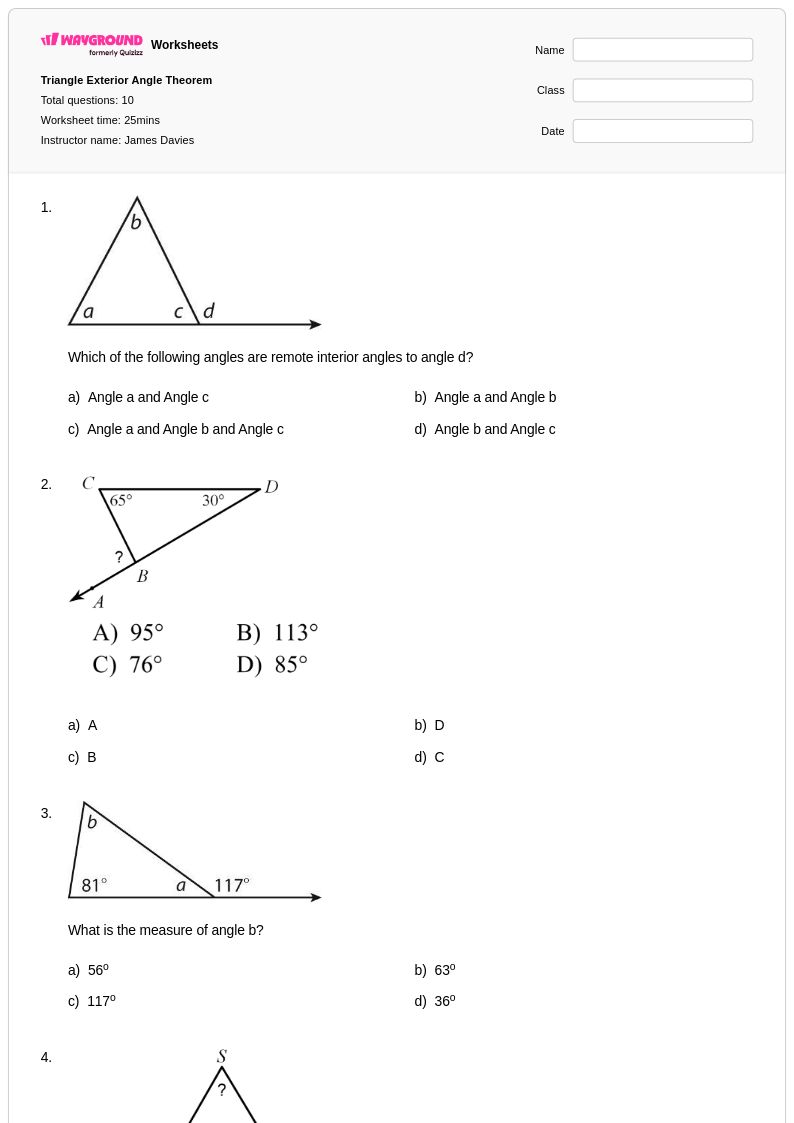
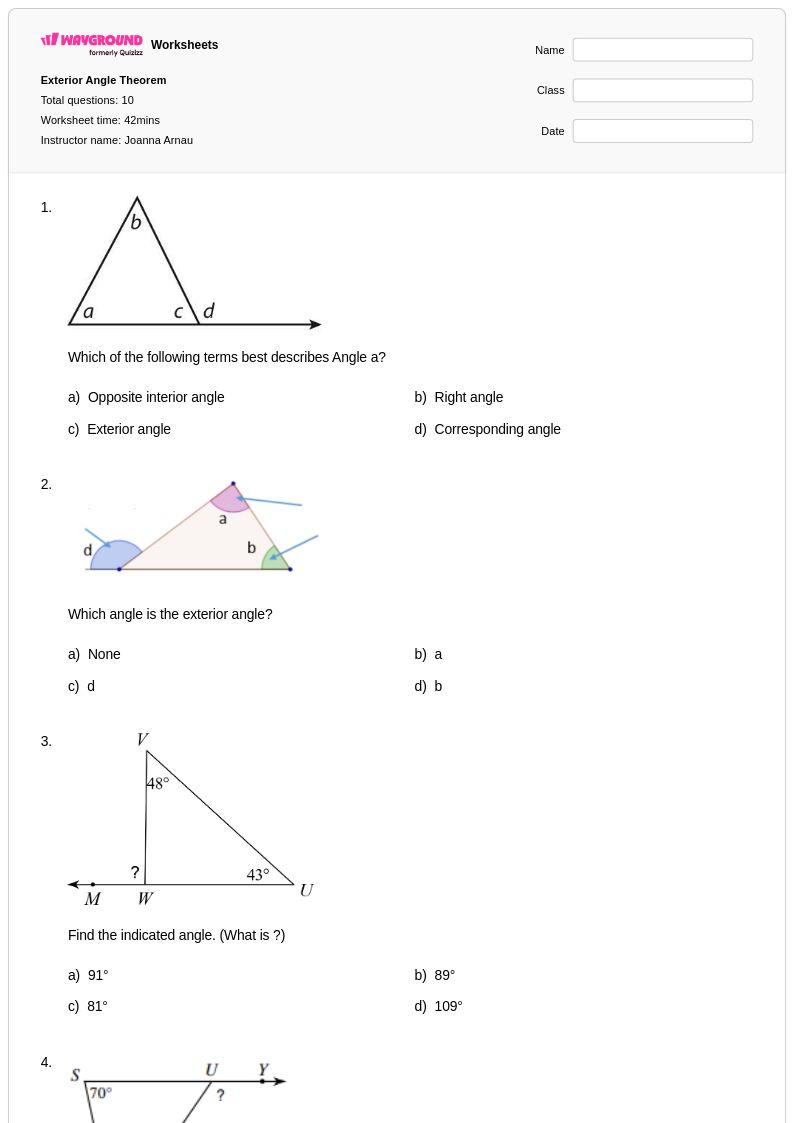
Explore Wayground's free Exterior Angle Theorem worksheets and printables with comprehensive practice problems and answer keys to help students master this essential geometry concept through structured PDF exercises.
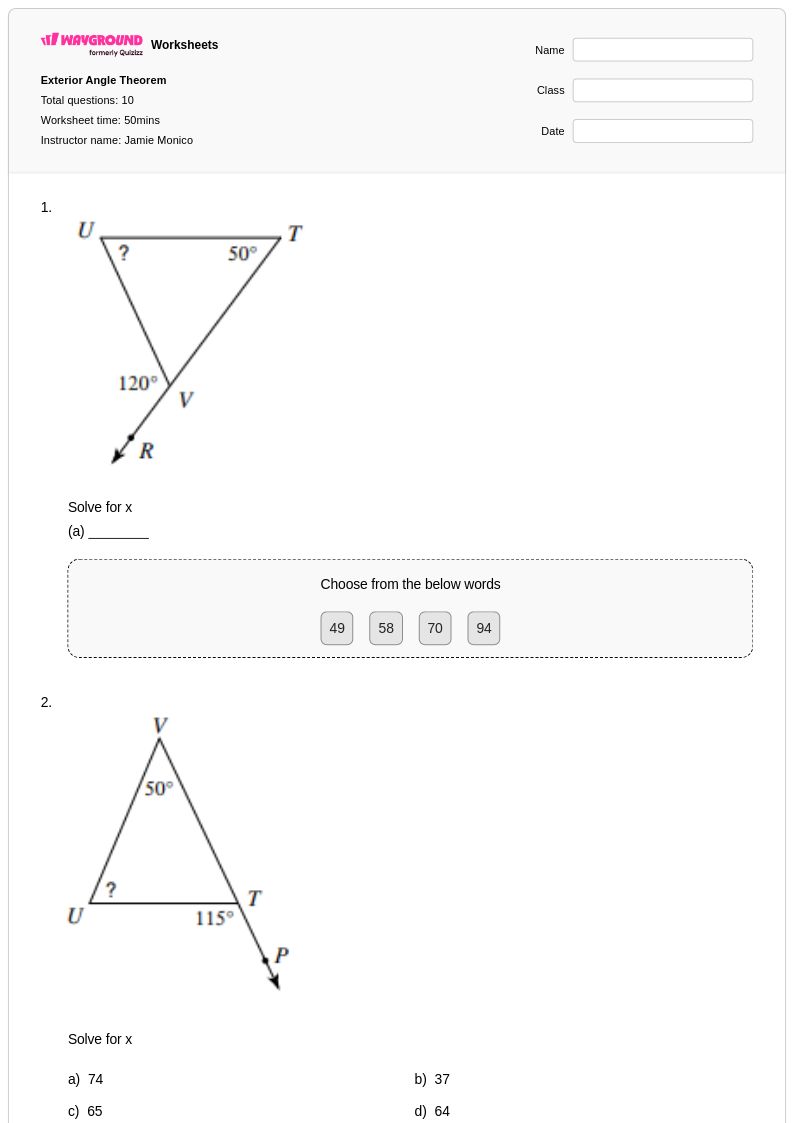
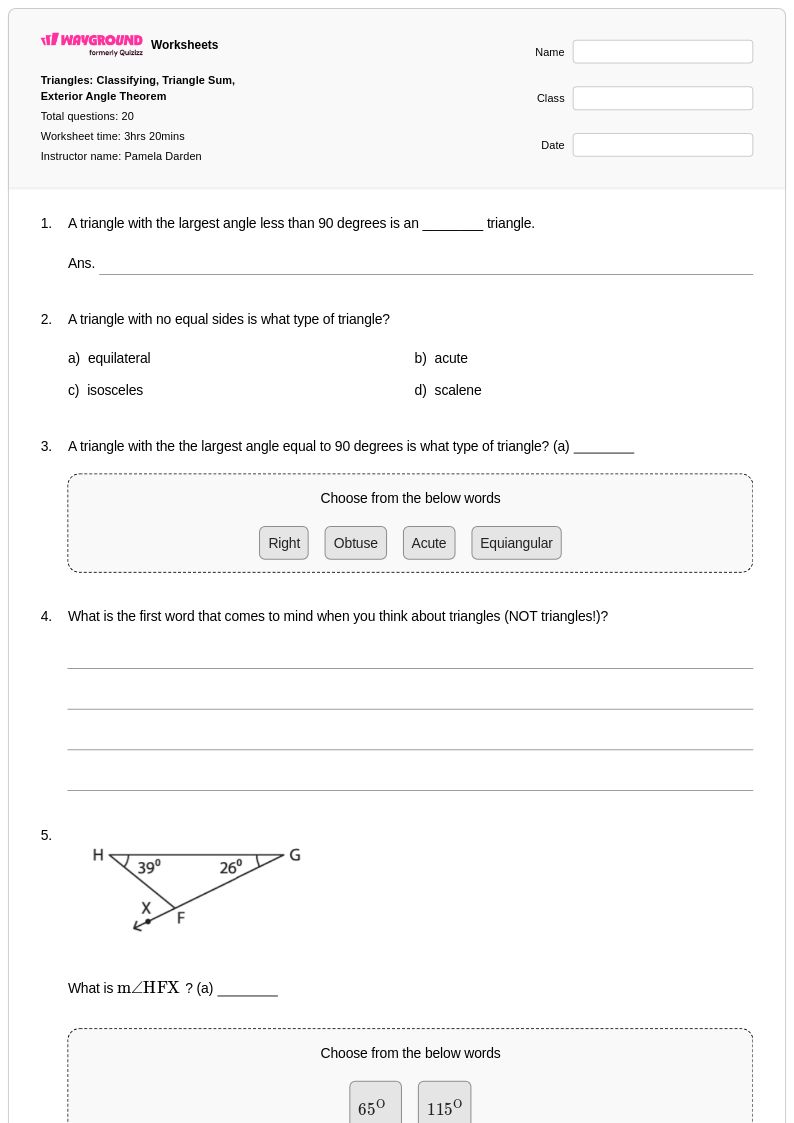
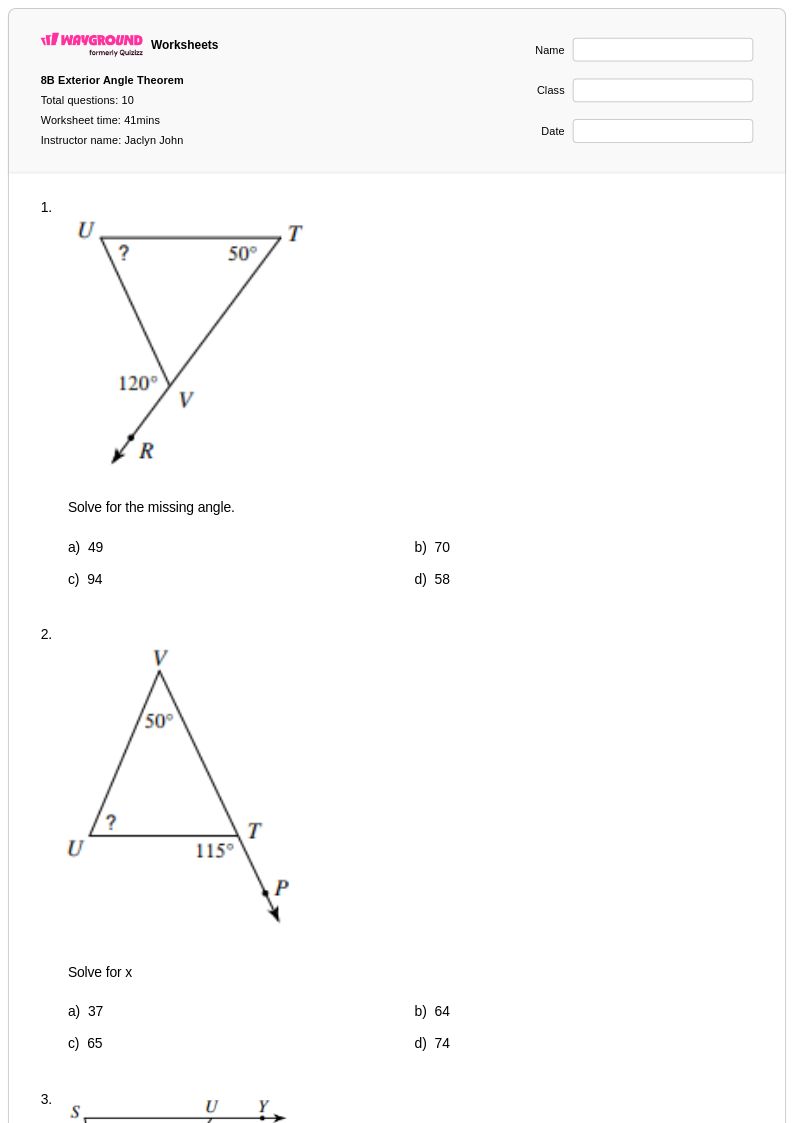
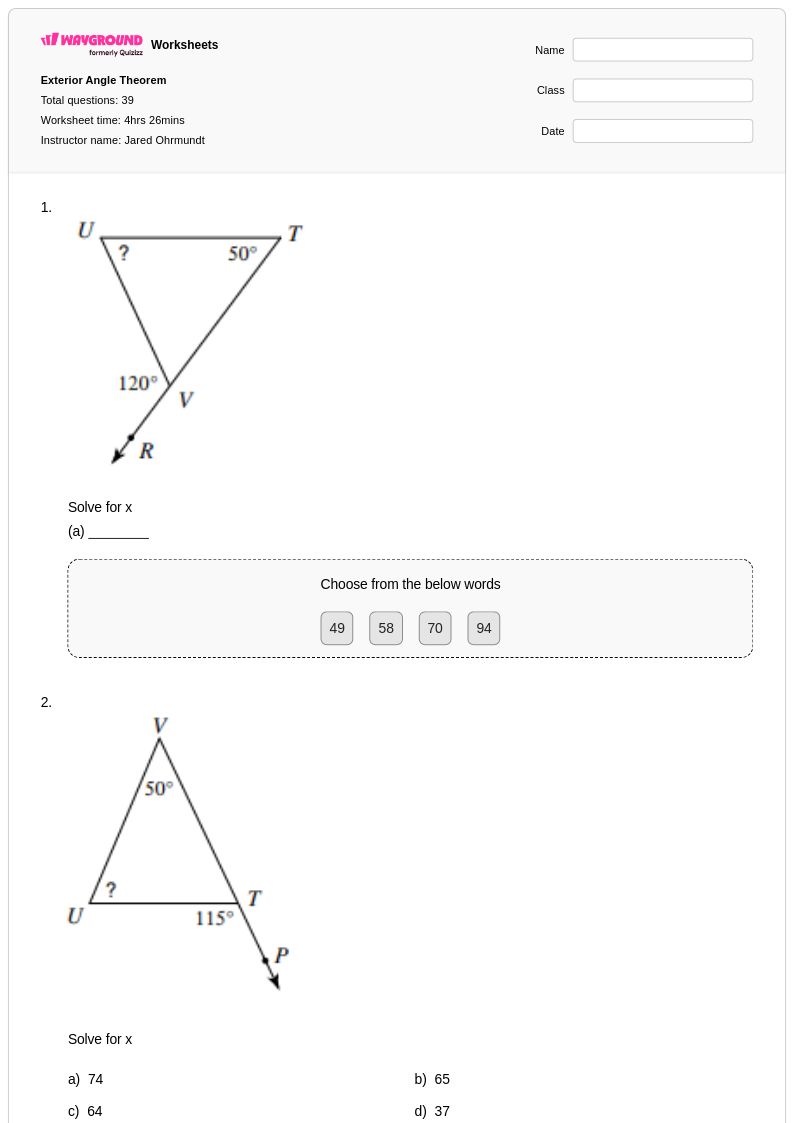
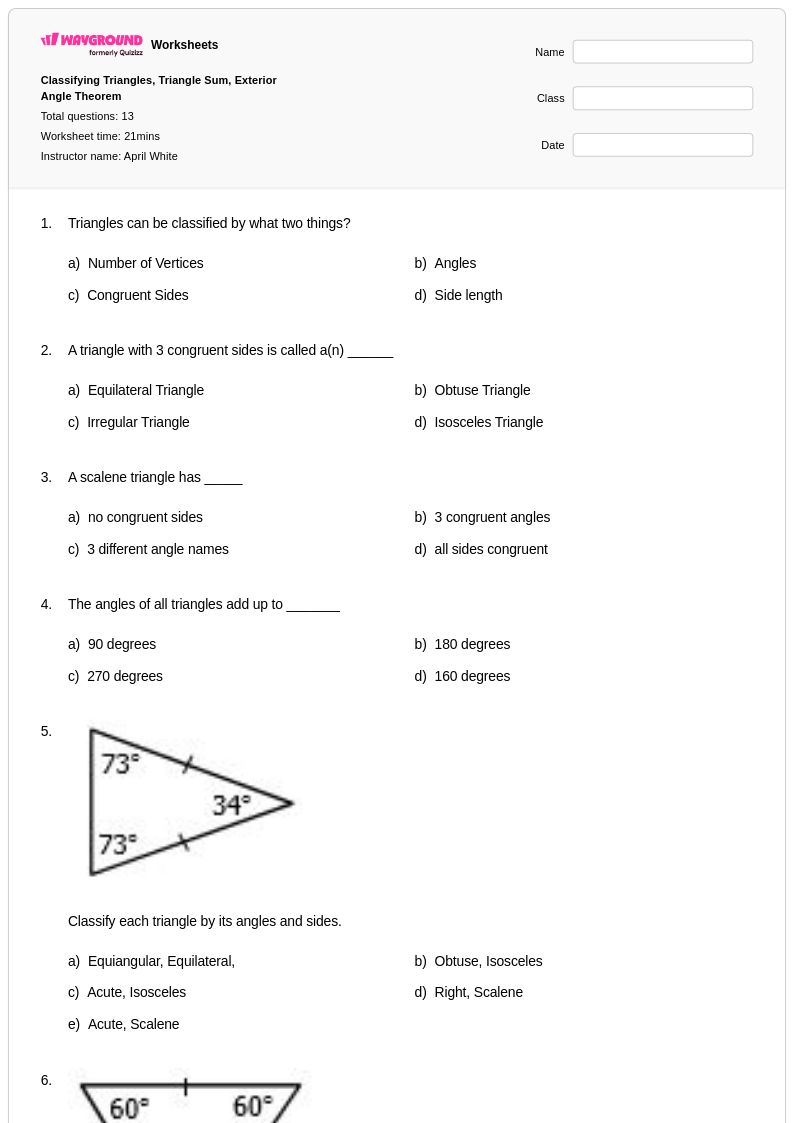
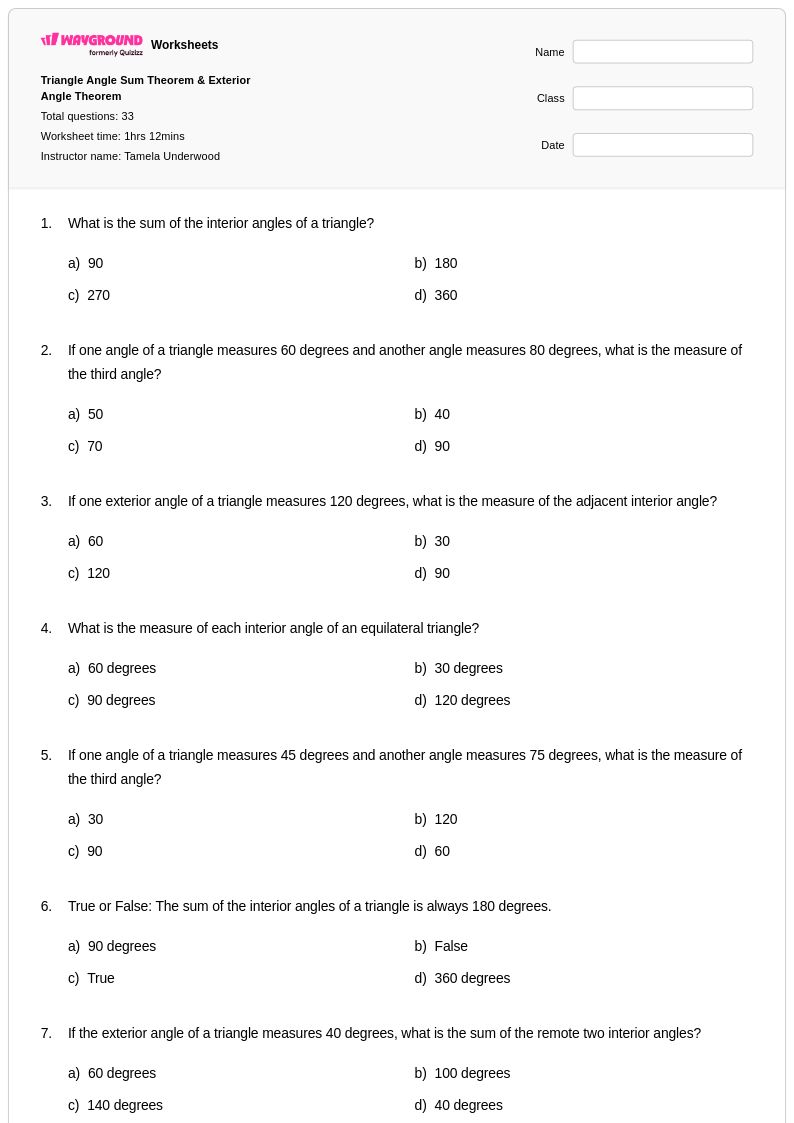
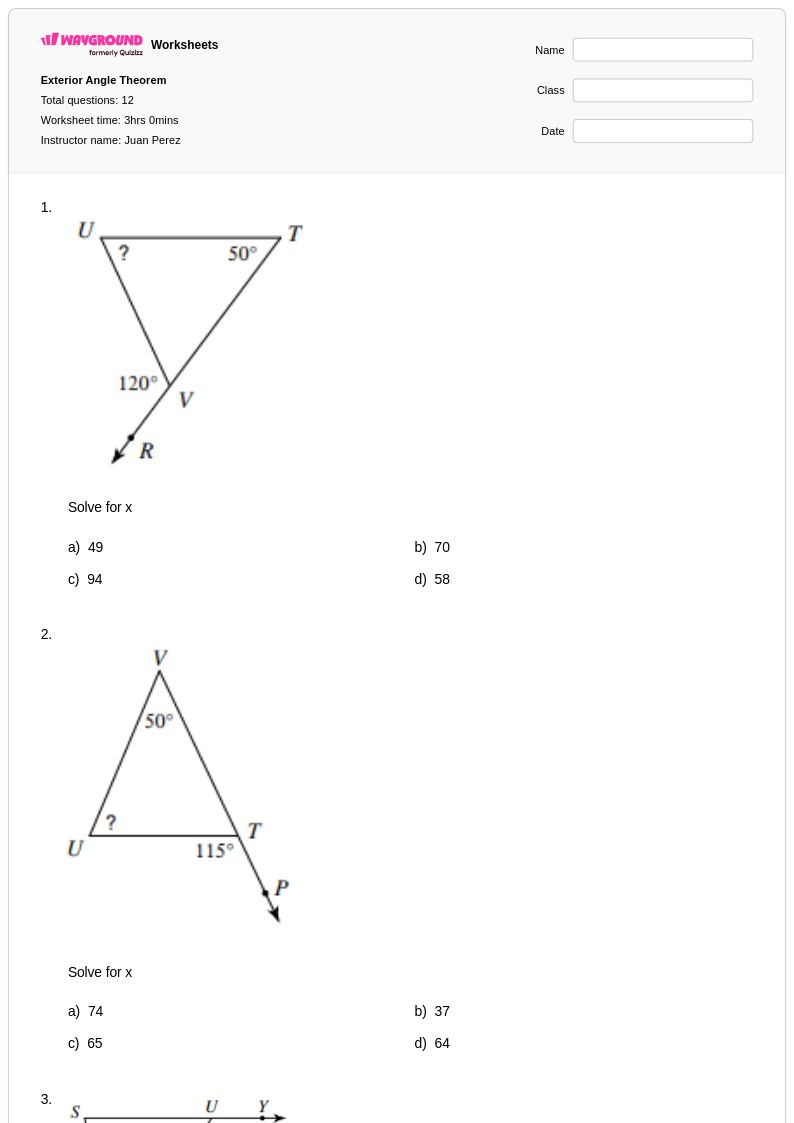
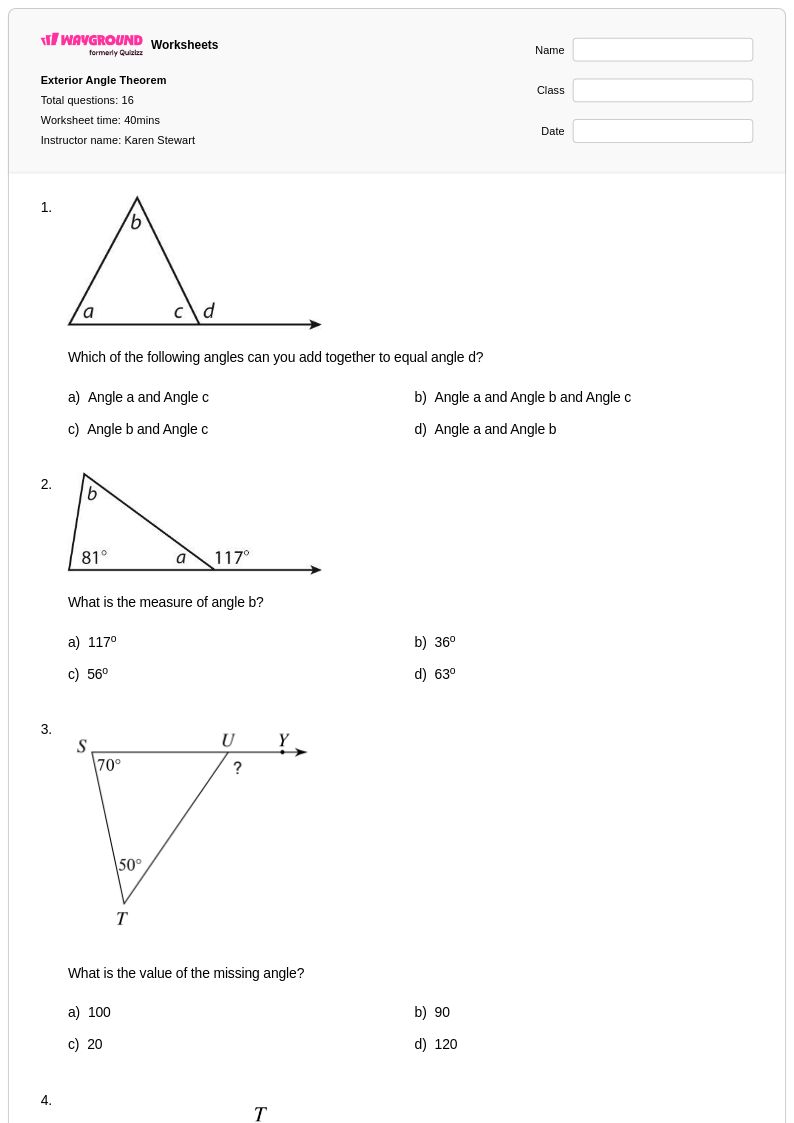
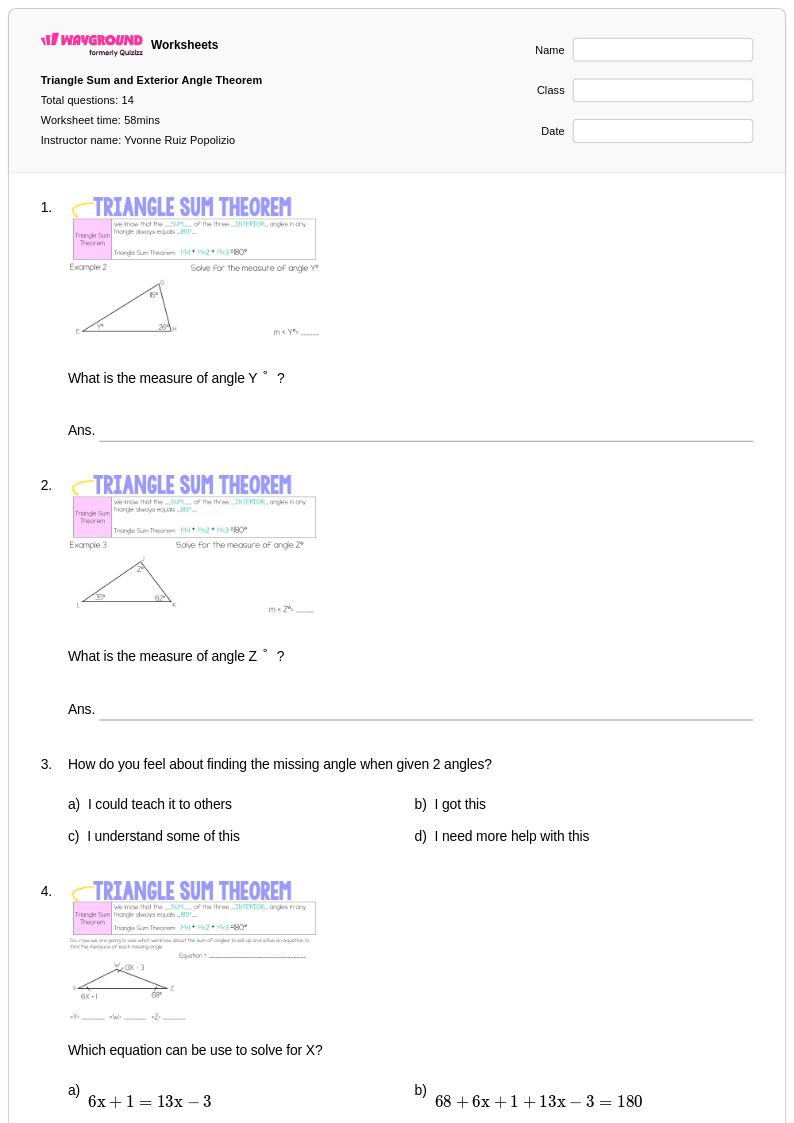
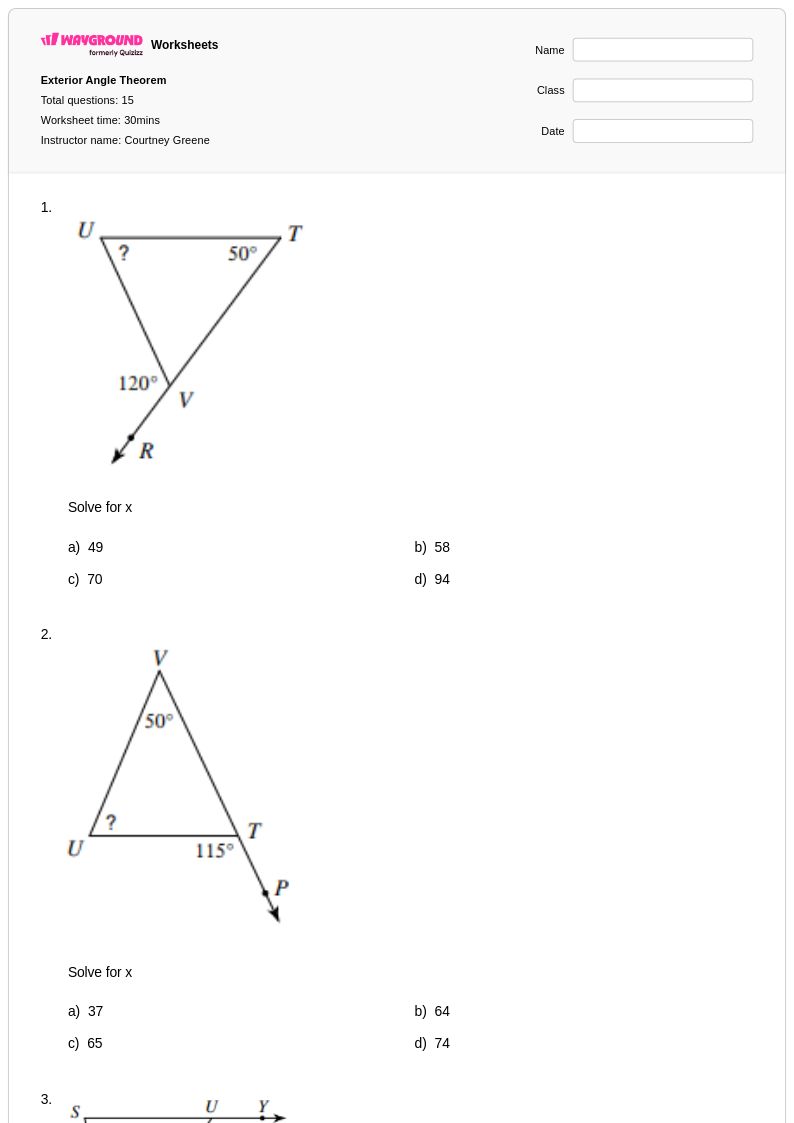
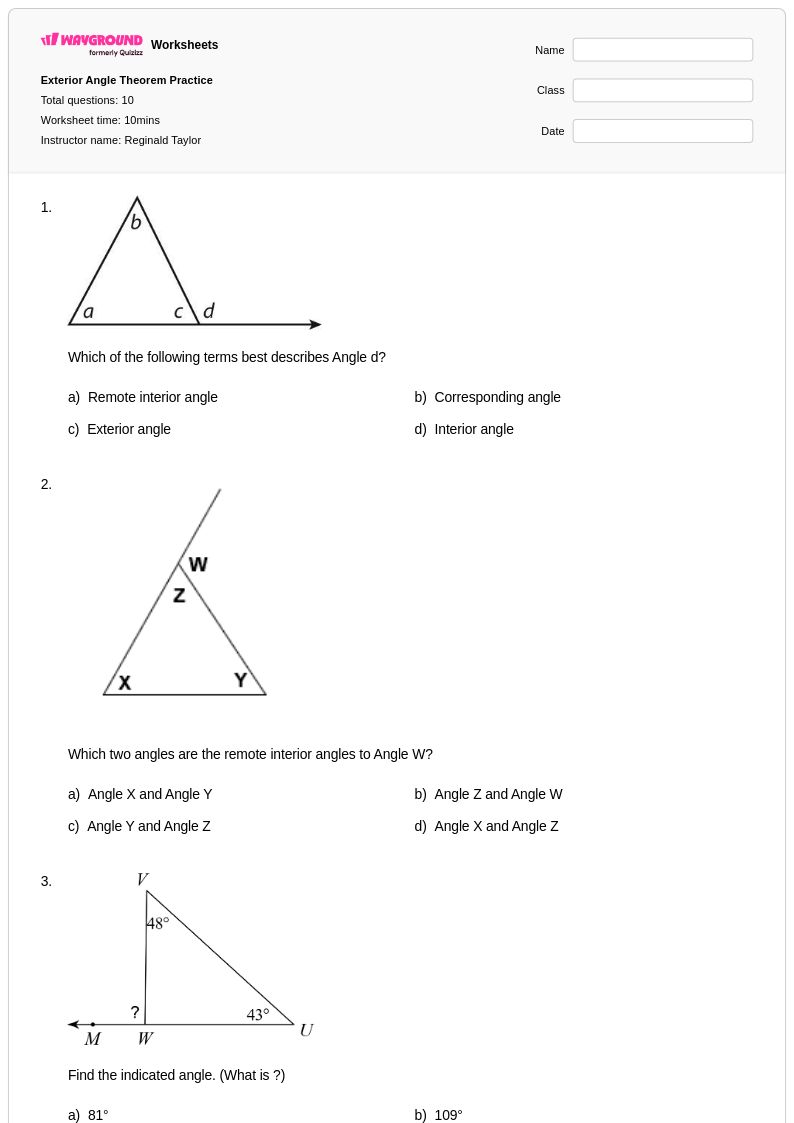
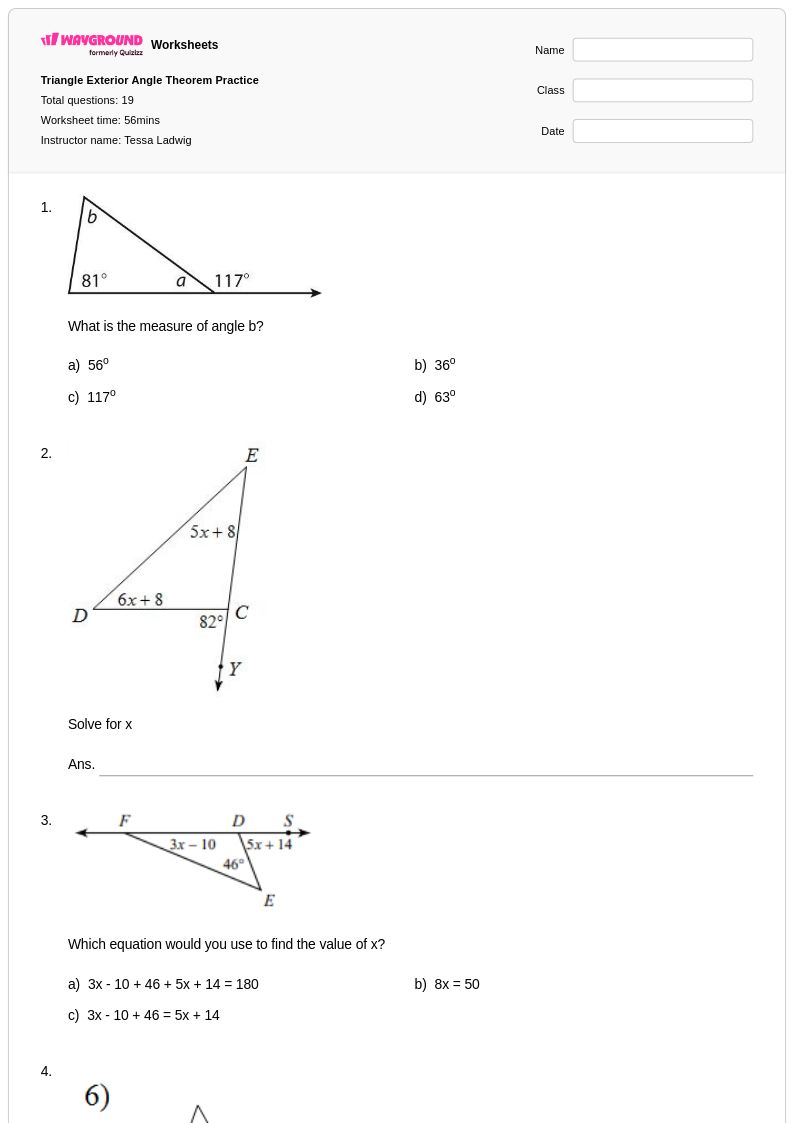
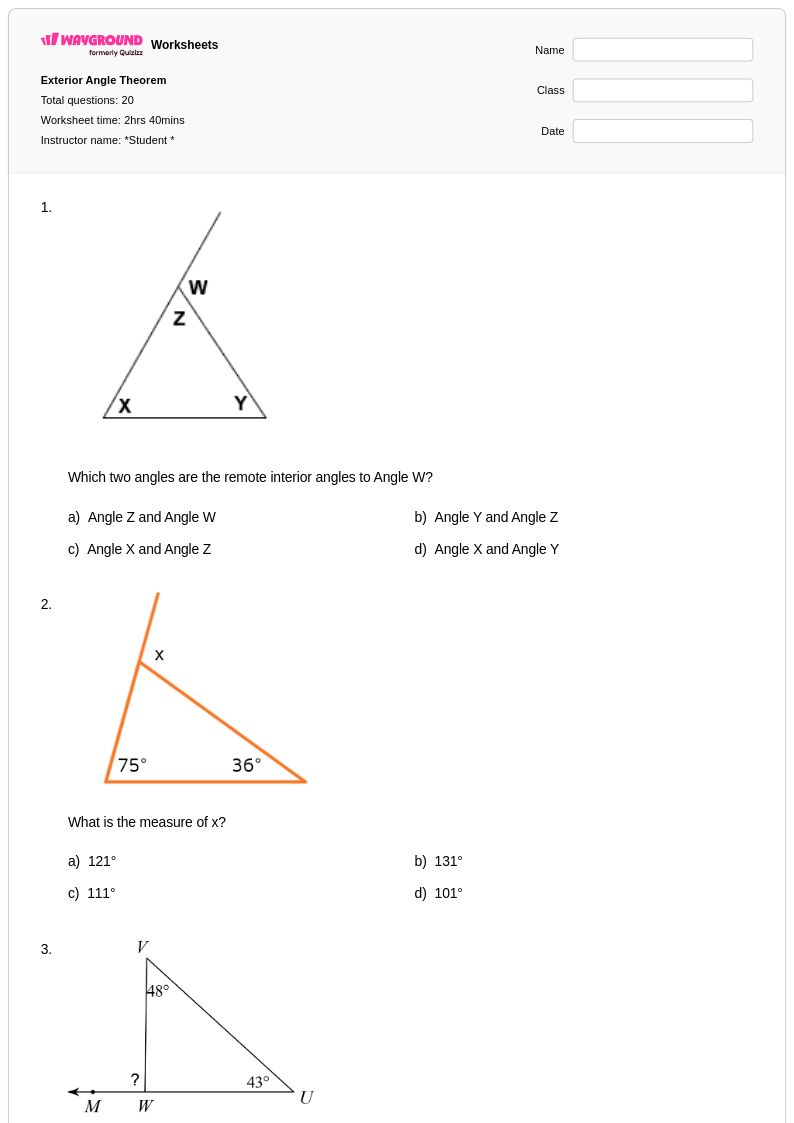
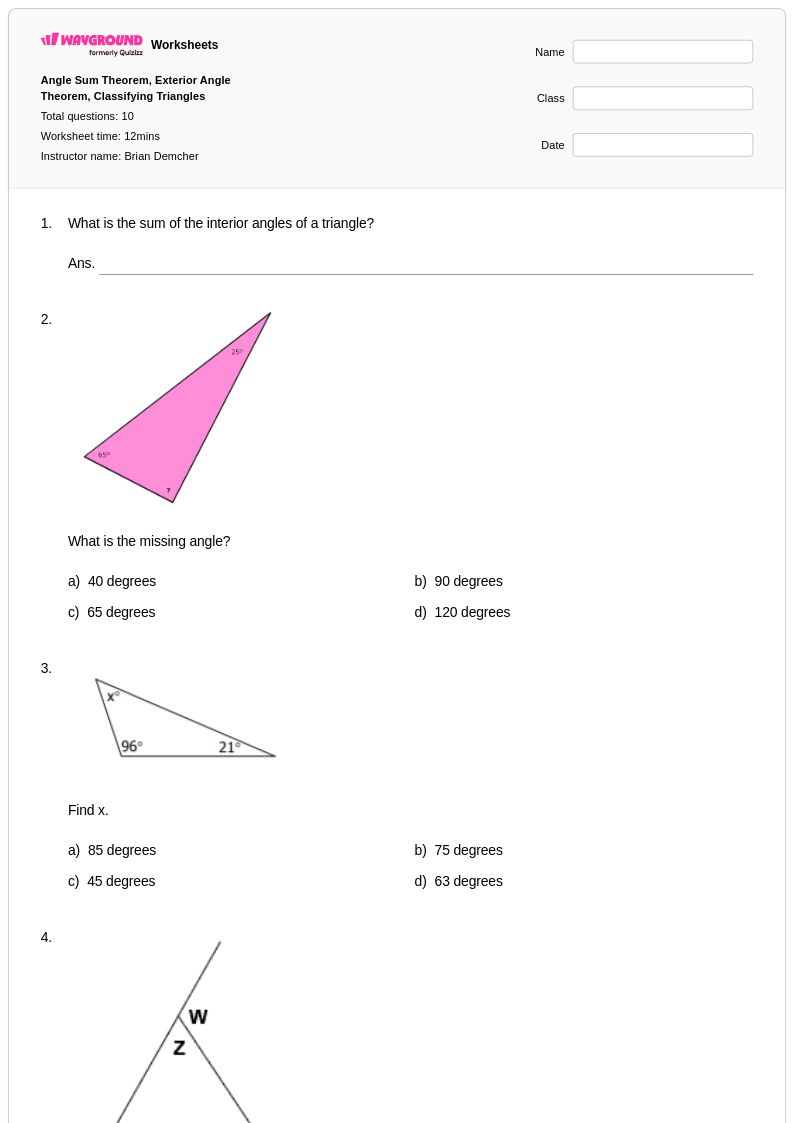
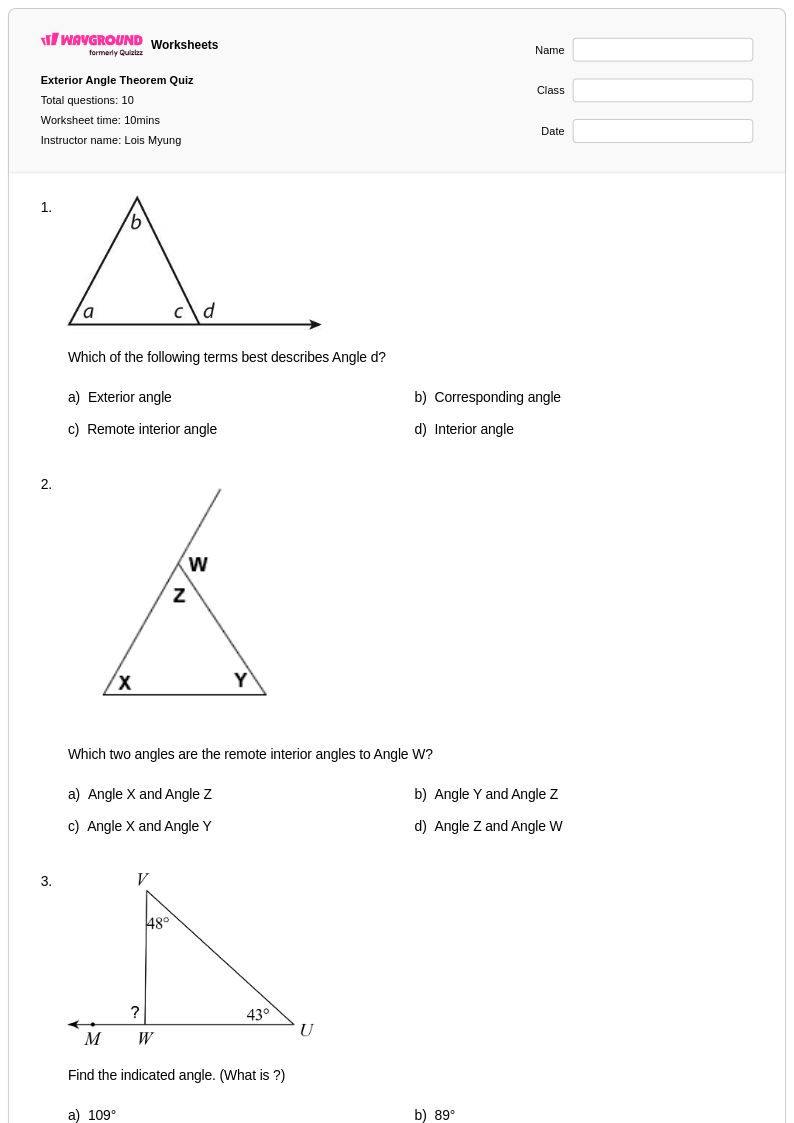
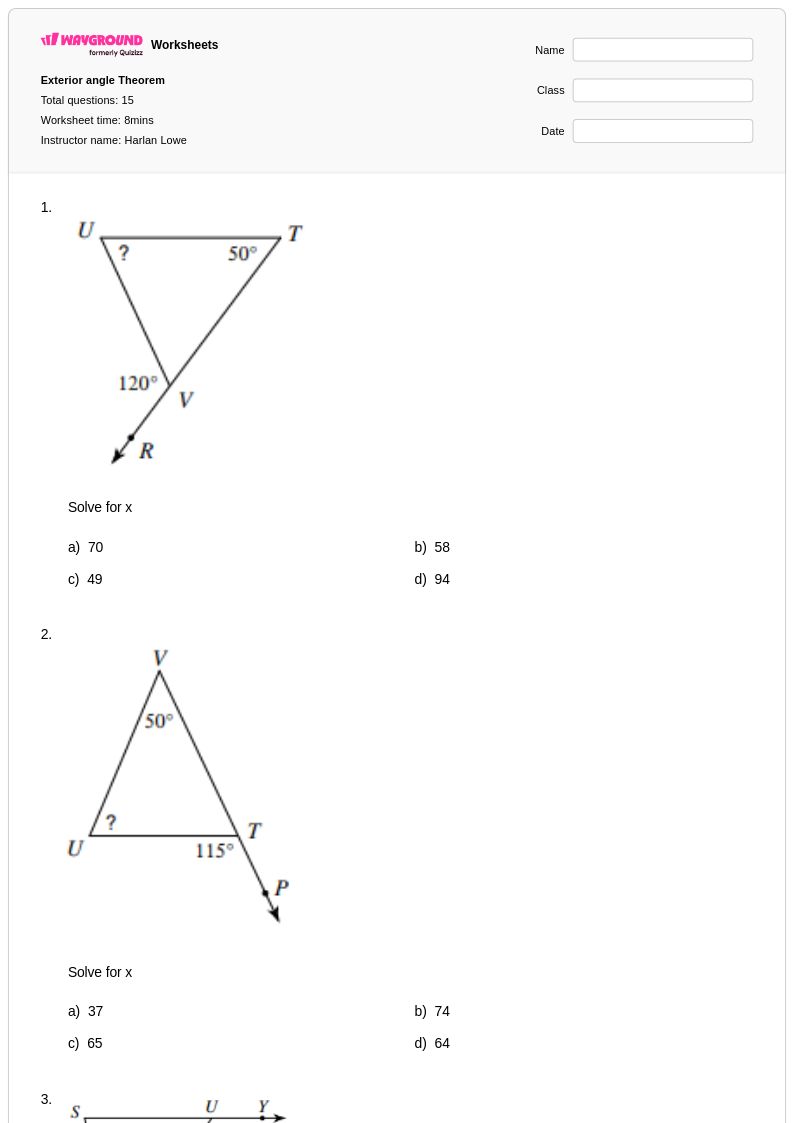
Exterior Angle Theorem worksheets available through Wayground (formerly Quizizz) provide comprehensive practice materials that help students master this fundamental geometric principle. These worksheets focus on developing students' understanding that an exterior angle of a triangle equals the sum of the two non-adjacent interior angles, strengthening critical reasoning skills in geometric proofs and angle calculations. The collection includes varied practice problems that progress from basic identification exercises to complex multi-step applications, with each worksheet featuring detailed answer keys that support independent learning and self-assessment. Students work through carefully scaffolded problems involving triangle angle relationships, algebraic expressions with variables, and real-world geometric scenarios, while teachers benefit from ready-to-use printables available in convenient pdf format that require no additional preparation time.
Wayground (formerly Quizizz) empowers educators with millions of teacher-created Exterior Angle Theorem resources that feature robust search and filtering capabilities, enabling quick location of materials that match specific learning objectives and standards alignment requirements. The platform's differentiation tools allow teachers to customize worksheet difficulty levels and problem types, ensuring appropriate challenge levels for diverse learners while supporting both remediation for struggling students and enrichment opportunities for advanced mathematicians. These versatile worksheet collections are available in both printable and digital formats, including downloadable pdf versions, making them ideal for traditional classroom instruction, homework assignments, test preparation, and flexible learning environments. Teachers can efficiently plan geometry lessons, target specific skill gaps, and provide consistent practice opportunities that build student confidence in applying the Exterior Angle Theorem across various mathematical contexts.
FAQs
How do I teach the Exterior Angle Theorem?
Start with a concrete discovery activity: have students draw a triangle, extend one side to form an exterior angle, then measure all four angles and notice that the exterior angle equals the sum of the two non-adjacent interior angles. Once students see the pattern themselves, formalize it with the theorem statement. From there, progress to problems where they set up and solve equations — for example, if the exterior angle is 110° and one remote interior angle is 65°, what is the other? This algebraic step is where the theorem becomes genuinely useful and where most practice time should go.
What exercises help students practice the Exterior Angle Theorem?
The most effective sequence moves from recognition to calculation to algebra. Begin with labeled diagrams where students simply identify which angle is the exterior angle and which two are the remote interior angles. Then give numerical problems where one or two angle measures are missing. Finally, introduce problems with algebraic expressions — setting up equations like (3x + 10) = (x + 40) + 50 and solving for x. Wayground's worksheets follow this progression, so you can assign earlier problems for initial practice and later ones once students are ready for multi-step work.
What mistakes do students commonly make with the Exterior Angle Theorem?
The most common error is confusing the exterior angle with the adjacent interior angle — students add the wrong pair of angles, or subtract instead of add. A second frequent mistake is misidentifying which interior angles are "non-adjacent": students sometimes include the angle that shares a side with the exterior angle rather than the two remote ones. When you see answers that are off by a consistent amount, or that equal 180° minus the correct answer, those two errors are almost always the cause.
How do I use Wayground's Exterior Angle Theorem worksheets in my class?
Every worksheet includes a complete answer key, so students can check their own work during independent practice or you can use it for quick grading. For in-class or homework use, download the printable PDF and distribute on paper — if you're grading physical submissions, the Wayground for Teachers app lets you scan or capture student work directly. If you prefer a digital assignment, you can host the same worksheet as an interactive quiz on Wayground, which works well for remote or hybrid settings.
Is the Exterior Angle Theorem aligned to Common Core standards?
Yes. Common Core addresses triangle angle relationships in the middle school geometry progression, where students are expected to understand and use the properties of triangles — including the relationship between exterior and interior angles — before moving into formal proof-based geometry in high school. The Exterior Angle Theorem sits at the bridge between that informal reasoning stage and the more rigorous work of writing geometric proofs, where students must justify each step rather than simply calculate a missing angle.
How can I differentiate Exterior Angle Theorem practice for mixed-ability classes?
For students who struggle with the algebraic problems, Wayground's reduced answer choices accommodation lowers the cognitive load while they're still building confidence with the theorem itself. The Read Aloud feature helps students who have difficulty parsing multi-step word problems independently. On the worksheet side, you can generate alternate versions with larger font sizes or a dyslexia-friendly font for students who need it — same problems, adjusted presentation — without creating a separate assignment from scratch.
What grade level is the Exterior Angle Theorem taught?
The Exterior Angle Theorem is typically introduced in grades 7–8, when students are working through triangle properties and angle relationships in middle school geometry. It reappears in grade 9 or 10 in the context of formal geometric proofs, where students are expected to justify the theorem rather than just apply it.