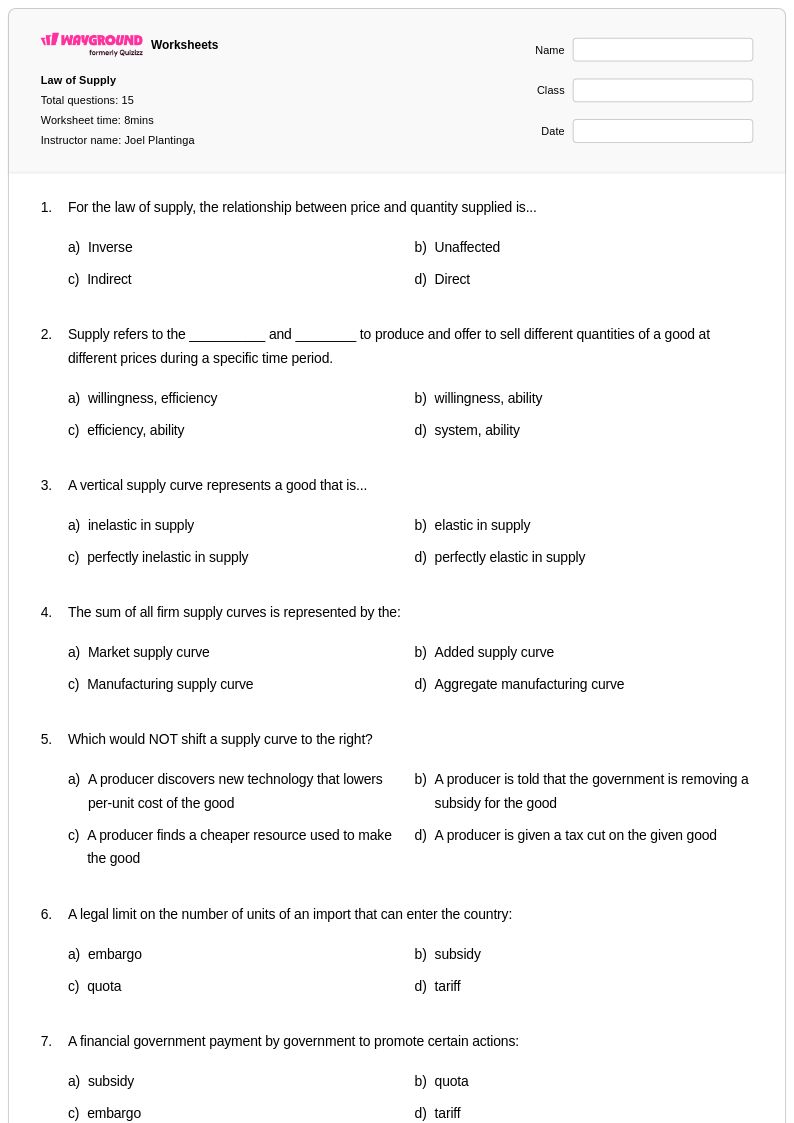
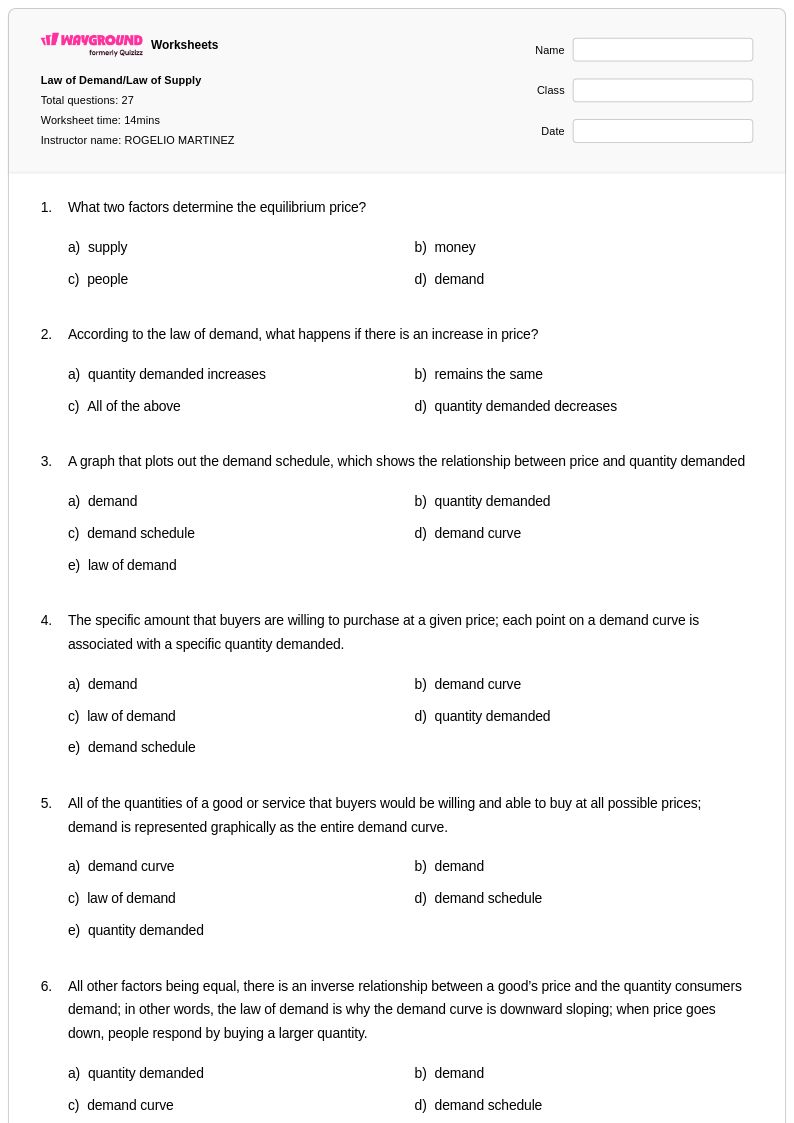
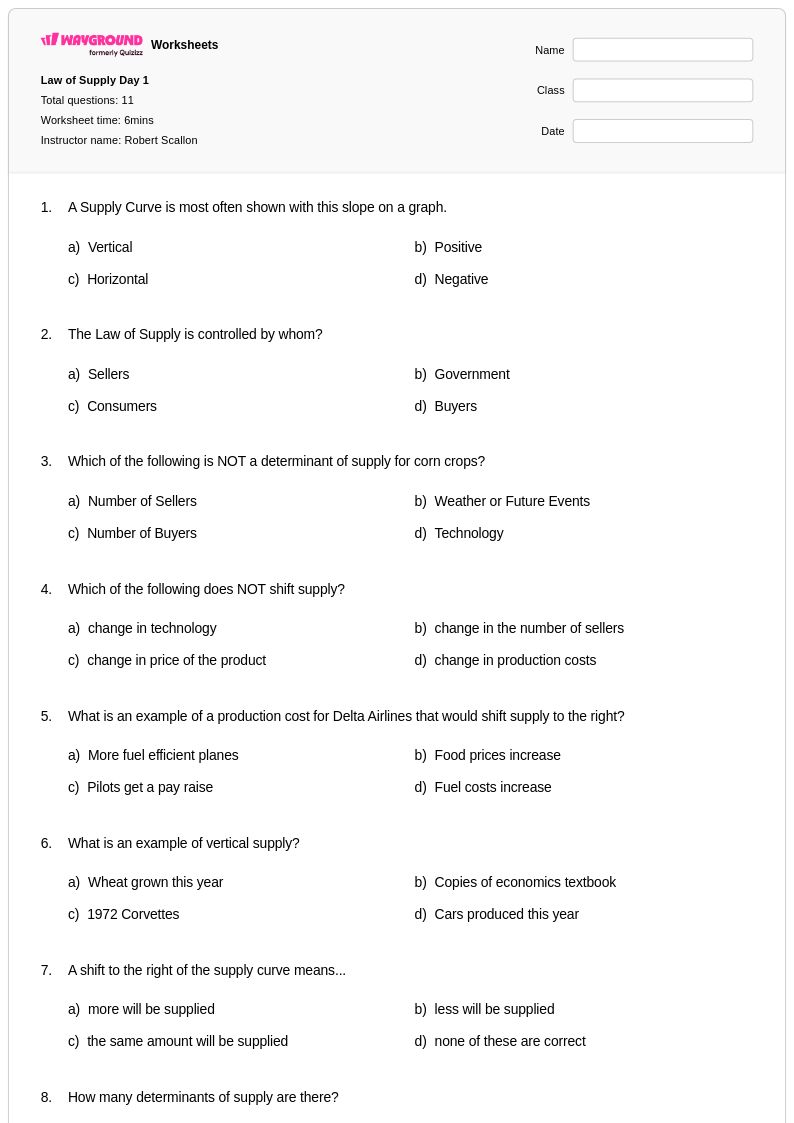
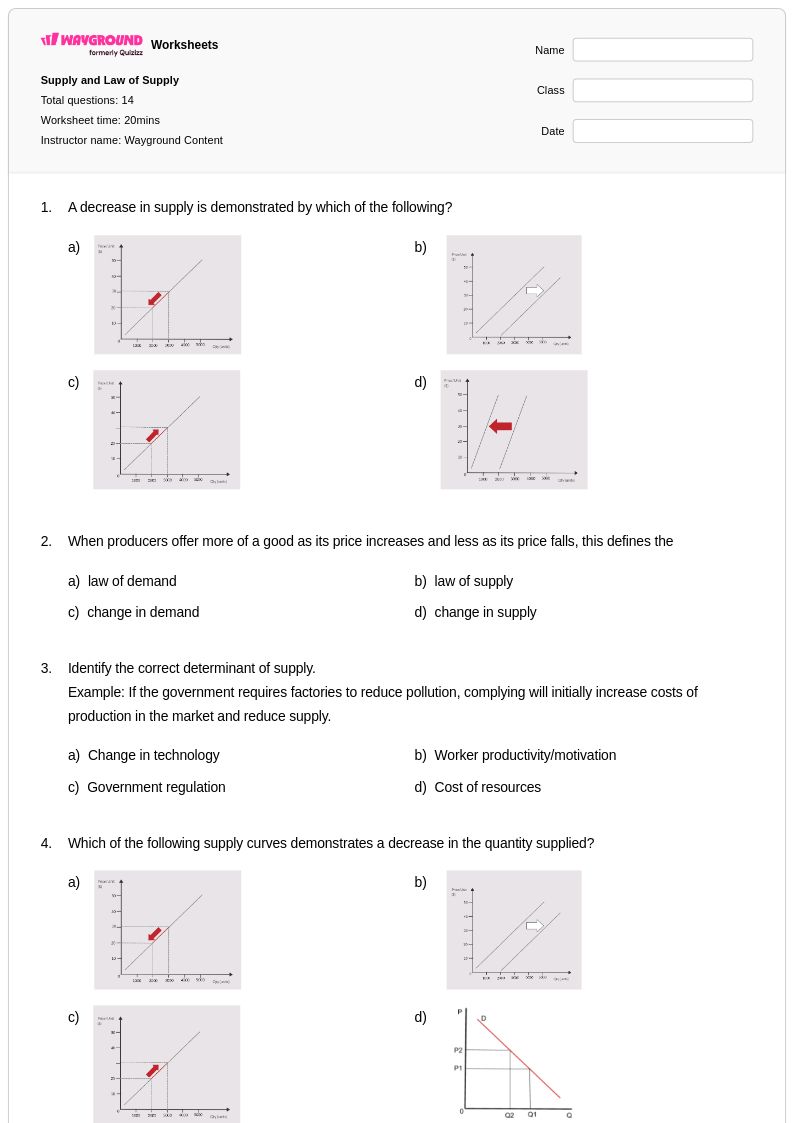
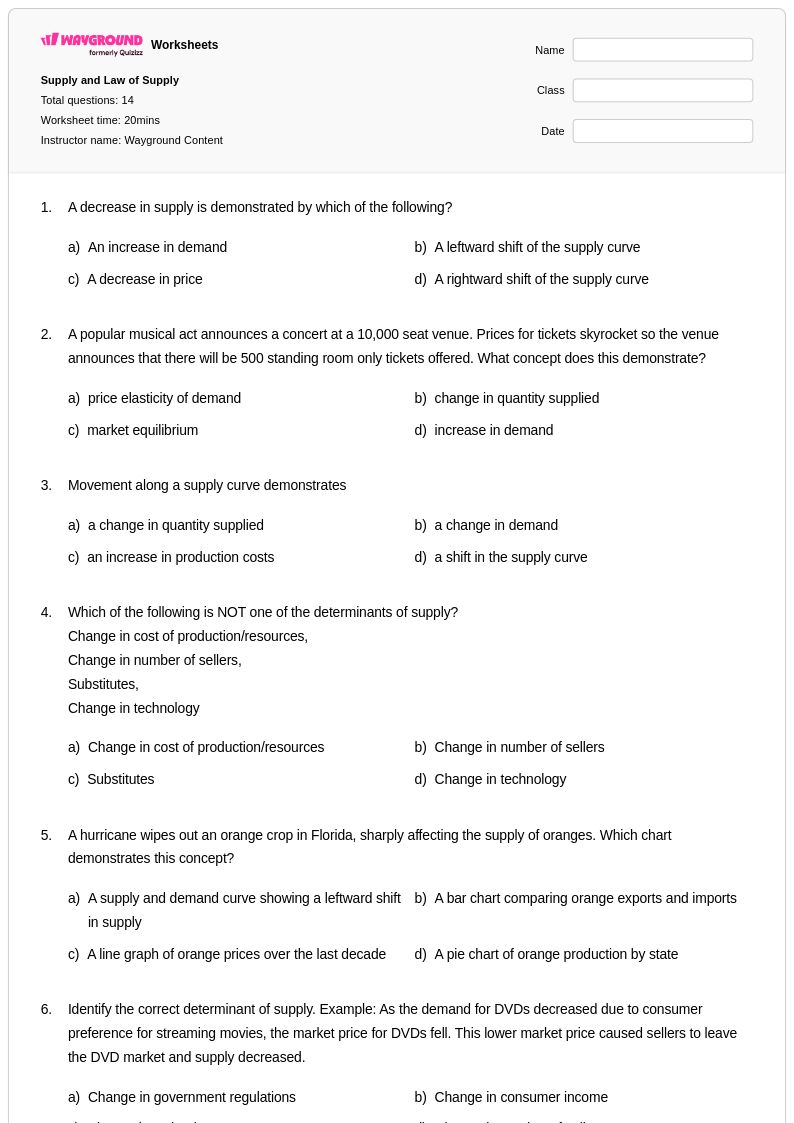
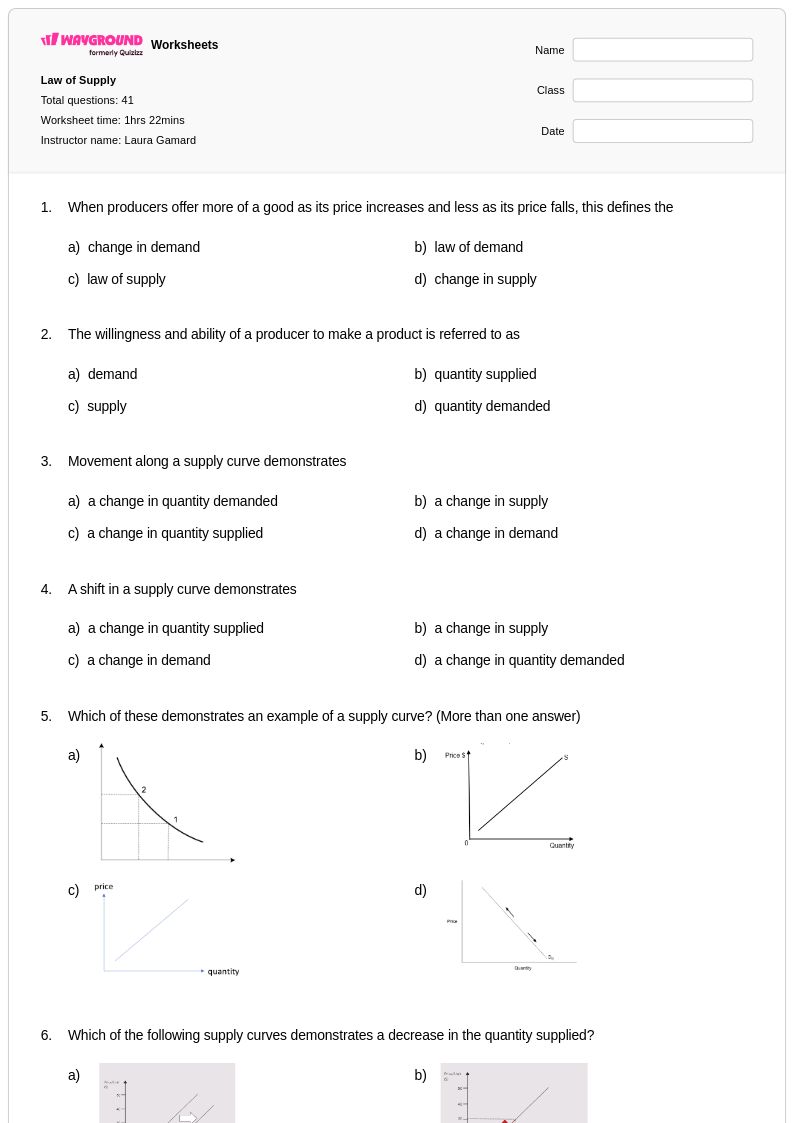
Explore Wayground's free Law of Supply worksheets and printables that help students master economic principles through engaging practice problems and comprehensive answer keys in PDF format.
Law of Supply worksheets available through Wayground (formerly Quizizz) provide comprehensive resources for students to master this fundamental economic principle that describes the positive relationship between price and quantity supplied. These carefully designed worksheets strengthen critical analytical skills by guiding students through practice problems that demonstrate how producers respond to price changes, helping them understand why supply curves slope upward and how market forces influence production decisions. Each worksheet includes detailed answer keys and explanations that reinforce learning objectives, while the free printable pdf format ensures accessibility for diverse classroom environments and study situations.
Wayground (formerly Quizizz) empowers educators with millions of teacher-created Law of Supply resources that feature robust search and filtering capabilities, making it simple to locate materials aligned with specific curriculum standards and learning objectives. The platform's differentiation tools enable teachers to customize worksheets for various skill levels, supporting both remediation for struggling students and enrichment opportunities for advanced learners. Available in both printable and digital pdf formats, these resources offer exceptional flexibility for lesson planning, homework assignments, test preparation, and targeted skill practice, while the comprehensive collection ensures teachers can find appropriate materials regardless of their specific pedagogical approach or classroom needs.
FAQs
How do I teach the law of supply to students?
Start by grounding students in the core relationship: as price increases, quantity supplied increases, because producers have stronger profit incentives to produce more. Use real-world examples like coffee farmers or sneaker manufacturers to make the concept concrete before introducing the supply curve. Once students can explain why the supply curve slopes upward in plain language, move them into graphing practice and scenario-based problems where they identify shifts versus movements along the curve.
What practice exercises help students understand the law of supply?
Effective practice for the law of supply includes interpreting supply schedules, plotting supply curves from data tables, and responding to scenario prompts that ask students to predict how producers will react to price changes. Problems that require students to distinguish between a change in quantity supplied and a shift in supply are especially valuable because this distinction is a consistent source of confusion. Structured worksheets with guided answer keys help students self-check their reasoning at each step.
What mistakes do students commonly make when learning the law of supply?
The most common error is confusing a movement along the supply curve with a shift of the entire curve. Students often apply non-price factors like input costs or technology changes as if they simply raise or lower quantity supplied rather than shift the curve entirely. Another frequent mistake is reversing the direction of the supply relationship, conflating it with demand by assuming higher prices reduce supply. Targeted practice problems that isolate each scenario help students correct these misunderstandings before assessments.
How can I use law of supply worksheets to differentiate instruction in my classroom?
Differentiation for law of supply instruction means providing scaffolded versions of the same core concept: struggling students benefit from partially completed supply schedules and guided graphing steps, while advanced learners can tackle multi-market scenarios or problems involving simultaneous shifts in supply and demand. On Wayground, teachers can apply accommodations at the individual student level, including reduced answer choices to lower cognitive load, read-aloud support for students who need it, and extended time per question, without other students being notified of these adjustments.
How do I use Wayground's law of supply worksheets in my class?
Wayground's law of supply worksheets are available as printable PDFs for traditional classroom use and in digital formats for technology-integrated environments, making them suitable for in-class practice, homework, or test prep. Teachers can also host any worksheet as a live quiz directly on Wayground, which allows for real-time student responses and automatic grading. Each worksheet includes a complete answer key, so teachers can use them for independent practice, peer review, or guided instruction with minimal prep time.
How do I help students understand why the supply curve slopes upward?
The upward slope of the supply curve reflects producer incentive: at higher prices, selling additional units becomes more profitable, so producers are willing and able to supply more. Connecting this to familiar business logic, such as a bakery that bakes more loaves when bread prices rise, helps students internalize the principle rather than memorize it. Follow up with practice problems that ask students to explain the slope in their own words before asking them to graph it, which reinforces conceptual understanding alongside procedural skill.