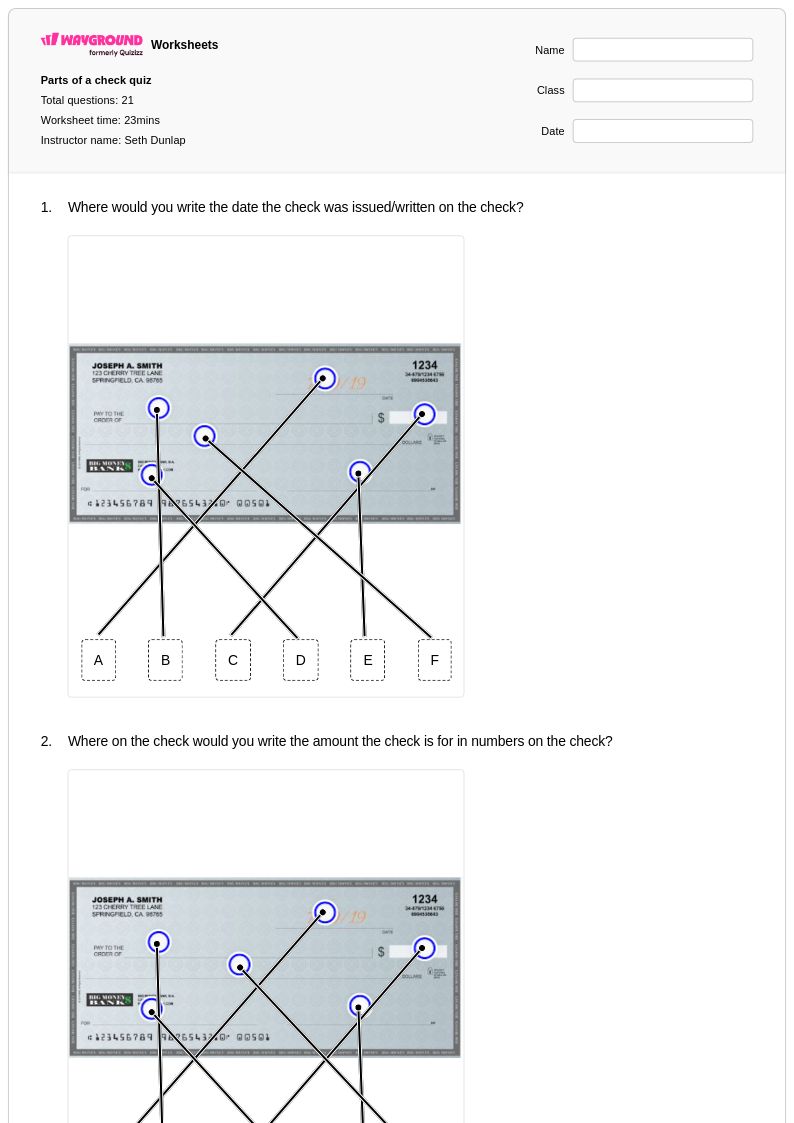
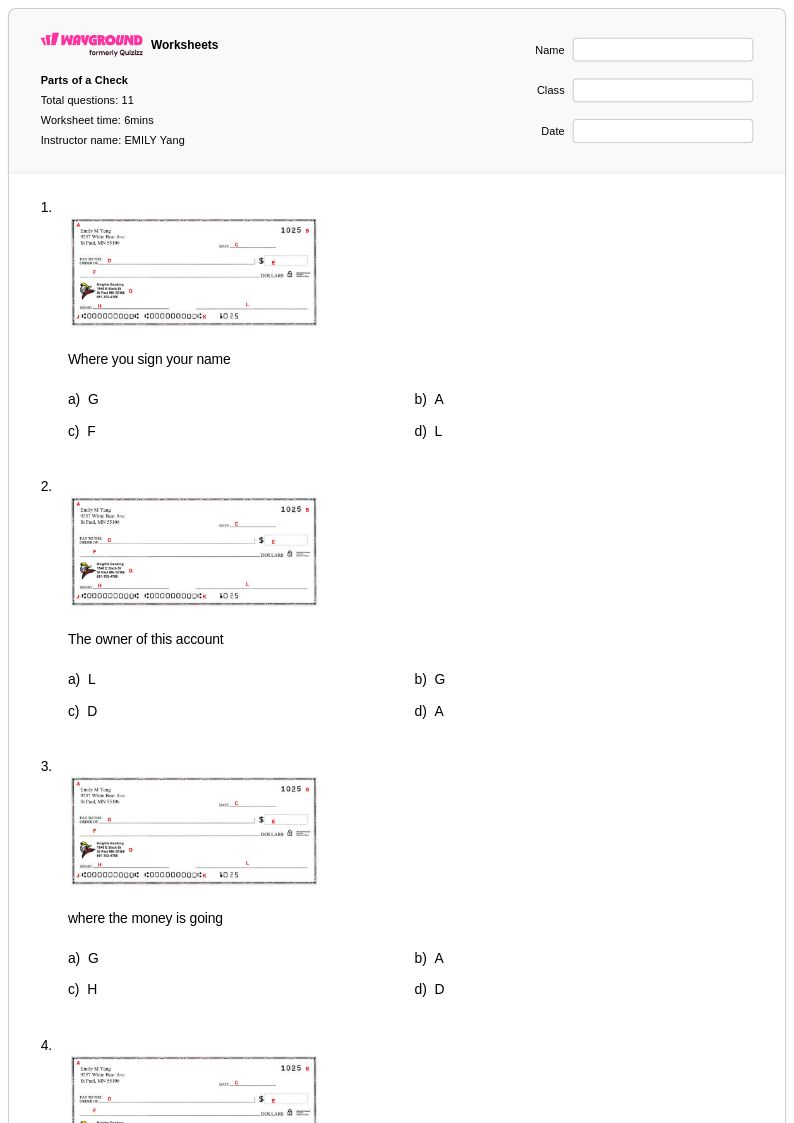
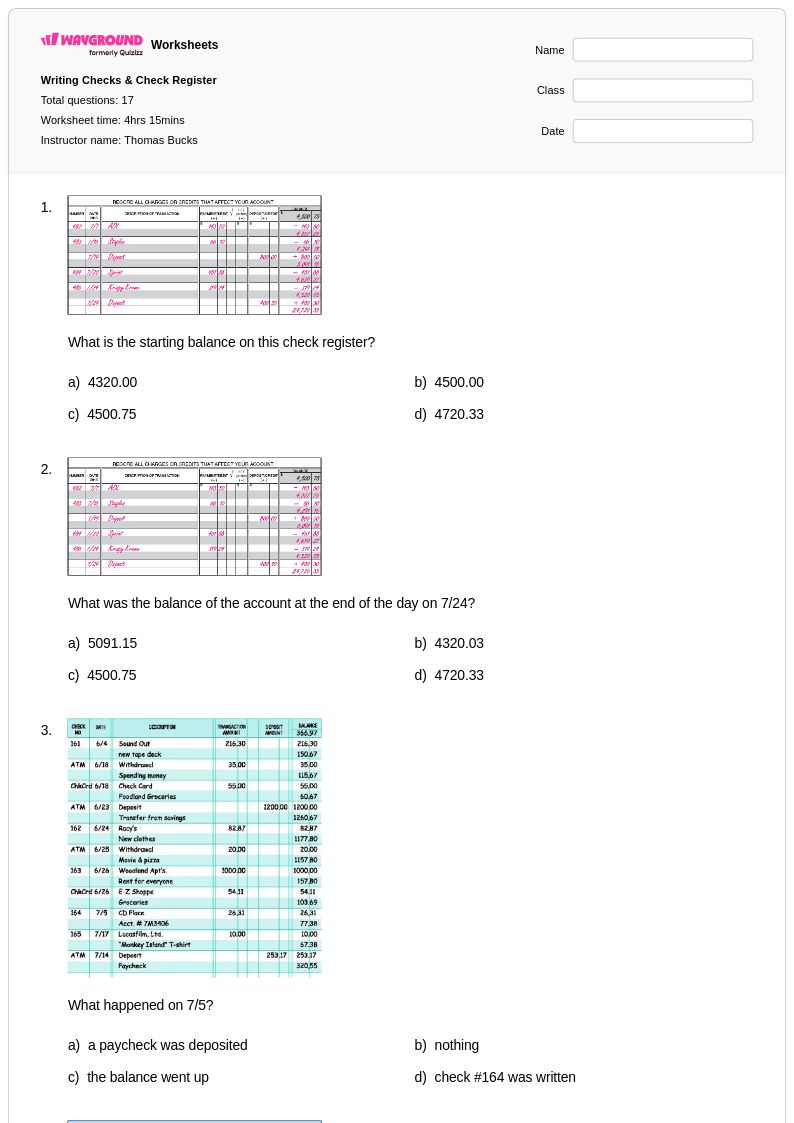
Discover free printable worksheets and practice problems that help students master the parts of a check, including essential components like payee, memo line, and signature areas with comprehensive answer keys.
Parts of a check worksheets available through Wayground (formerly Quizizz) provide students with essential financial literacy skills by teaching them to identify and understand the various components of personal checks. These comprehensive worksheets guide learners through recognizing critical elements such as the date line, payee field, numerical and written amount sections, memo line, signature area, routing number, account number, and check number. Students develop practical money management skills as they complete practice problems that simulate real-world banking scenarios, learning to properly fill out checks while understanding the security features and legal implications of each component. The collection includes printable resources with detailed answer keys, allowing educators to assess student comprehension of this fundamental economic concept through structured exercises and free pdf materials that reinforce proper check-writing procedures.
Wayground (formerly Quizizz) supports educators with an extensive library of millions of teacher-created resources focused on parts of a check instruction, featuring robust search and filtering capabilities that help instructors quickly locate age-appropriate materials aligned with financial literacy standards. The platform's differentiation tools enable teachers to customize worksheets based on individual student needs, offering both printable pdf formats for traditional classroom use and digital versions for interactive learning experiences. These flexible resources facilitate comprehensive lesson planning while providing targeted practice opportunities for remediation and enrichment, ensuring students master the fundamental skills needed to navigate personal banking responsibilities. Teachers can seamlessly integrate these materials into broader economics curricula, using the variety of worksheet formats to reinforce learning through repetitive practice and real-world application scenarios.
FAQs
How do I teach students the parts of a check?
Start by displaying a labeled sample check and walking students through each component in order: the date line, payee field, numerical and written dollar amount sections, memo line, signature area, and the routing, account, and check numbers along the bottom. Connecting each field to its real-world purpose, such as explaining why the routing number identifies the bank while the account number identifies the individual, helps students build meaningful understanding rather than rote memorization. Practice by having students fill out blank check templates with fictional scenarios before assessing comprehension.
What exercises help students practice filling out a check correctly?
The most effective exercises present students with realistic banking scenarios, such as writing a check to pay a utility bill or a landlord, and require them to complete every field accurately. Practice problems should specifically target common trouble spots: writing the dollar amount in both numeral and written word form, correctly placing the decimal, and signing the signature line. Worksheets that include a labeled reference check alongside blank practice checks give students a scaffold they can gradually remove as confidence builds.
What mistakes do students commonly make when learning the parts of a check?
The most frequent error is confusing the numerical amount box with the written amount line, either omitting one or writing inconsistent values between the two. Students also commonly leave the memo line blank, misplace or forget the cent notation (such as writing '50' instead of '50/100'), and confuse the routing number with the account number along the bottom of the check. Addressing these misconceptions explicitly during instruction, and including error-correction exercises in worksheets, significantly reduces them.
How can I use parts of a check worksheets in my classroom?
Parts of a check worksheets on Wayground are available as printable PDFs for traditional classroom use and in digital formats for technology-integrated environments, including the option to host them as a quiz directly on Wayground. Printable versions work well for guided note-taking lessons or independent seat work, while digital formats allow for immediate feedback during individual or small-group practice. Both formats include complete answer keys so teachers can efficiently review student work or facilitate self-checking activities.
How do I differentiate parts of a check instruction for students with different learning needs?
For students who struggle with reading or processing text-heavy worksheets, Wayground's Read Aloud feature can audio-read questions and content aloud, reducing barriers unrelated to the financial literacy concept itself. Teachers can also apply reduced answer choices for selected students to lower cognitive load on identification questions, while other students receive standard versions, all without drawing attention to the accommodation. Extended time settings can be configured individually, making timed check-writing practice more equitable across the class.
At what grade level should students learn to fill out a check?
Check-writing is typically introduced in middle school personal finance or economics units, around grades 6 through 8, though some high school financial literacy courses revisit it with greater emphasis on banking law and fraud prevention. The skill is most effective when taught alongside related concepts such as reading a bank statement, understanding account balances, and recognizing check fraud, giving students a complete picture of personal banking. Foundational identification of check components can also be introduced in upper elementary grades as part of broader money management lessons.