
 Worksheets
Virginia Biology SOL review, part 2
Total questions: 124
Worksheet time: 2hrs 57mins
Name
Class
Date
1.
One may assume that Euglenas are autotrophs because they?
a)
Have chloroplasts.
b)
Are microscopic.
c)
Have Flagella.
d)
Have contractile vacuoles.
2.
Euglena move around using?
a)
Cilia
b)
Flagella
c)
Pseudopodia
d)
Fins
3.
Paramecia move around using?
a)
Cilia
b)
Flagella
c)
Pseudopodia
d)
Fins
4.
What is the role of the eyespot on the Euglena?
a)
Detects light
b)
Movement
c)
Scoops up food as it swims along.
d)
To preform photosynthesis
5.
What is Cilia?
a)
A tail like structure that help protist move
b)
Hair like fibers that help protist move
c)
A place where spores are kept
d)
A fake foot that help protist move
6.
Which protist is often found in colonies?
a)
Volvox
b)
Amoeba
c)
Euglena
d)
Paramecium
7.

What protist is pictured?
a)
Euglena
b)
Paramecium
c)
Volvox
d)
Amoeba
8.

In the protist pictured, what structure helps it move?
a)
cilia
b)
flagella
c)
amoeba
d)
pseudopod
9.
Which protist has an oral groove and a gullet?
a)
Paramecium
b)
Volvox
c)
Amoeba
d)
Euglena
10.
A _____ is a temporary projection of endoplasm and ectoplasm that is used for locomotion.
a)
pseudopod
b)
flagella
c)
cilia
d)
trichocyst
11.

These are protists called _____
a)
diatoms
b)
dinoflagellates
c)
green algae
d)
amoeba
12.
Freshwater protist use a _________ to regulate how much water they have in their cell.
a)
contractile vacuole
b)
food vacuole
c)
gullet
d)
mitochondria
13.
Plant-like protists are called ________
a)
algae
b)
slime molds
c)
protozoa
d)
zooplankton
14.
animal-like protists are called _______
a)
protozoa
b)
algae
c)
slime molds
d)
phytoplankton
15.
Which best describes protozoa?
a)
single, eukaryotic cell
b)
multiple eukaryotic cells
c)
single, prokaryotic cell
d)
combination of eukaryotic and prokaryotic cells
16.
Which type of reproduction results in two identical copies of the original?
a)
binary fission
b)
multiple fission
c)
longitudinal conjugation
d)
conjugation
17.
A disease carried by mosquitoes...
a)
Malaria
b)
Sleeping Sickness
c)
Chagas
d)
Cholera
18.
Most protists are eukaryotic. This means they are
a)
primitive types of cells
b)
cells with no nucleus
c)
cells with a nucleus
d)
cells with no organelles
19.
Termites can't digest the wood they eat. They have a gut full of _____, which help them break down the cellulose.
a)
Trichonympha
b)
Trypanosoma
c)
Ciliophora
d)
Sporozoa
20.
The mosquito genus which carries the protist which causes malaria is called
a)
anopheles
b)
plasmodium
c)
trypanosoma
d)
trichonympha
21.

This is the female part of the flower; the top is sticky to catch pollen.
a)
stigma
b)
pistil
c)
stamen
d)
anther
22.

This is the top part of the pistil of a flower which receives the pollen grains.
a)
petal
b)
sepal
c)
filament
d)
stigma
23.

These help the plant to reproduce by attracting pollinators.
a)
flowers
b)
stems
c)
leaves
d)
roots
24.

What is #2 pointing to?
a)
anther
b)
filament
c)
ovary
d)
style
25.

What is #3 pointing to?
a)
stigma
b)
filament
c)
ovary
d)
anther
26.

What is #5 pointing to?
a)
anther
b)
filament
c)
stigma
d)
style
27.

What is #6 pointing to?
a)
stigma
b)
style
c)
ovary
d)
petal
28.

What is #7 pointing to?
a)
anther
b)
ovary
c)
ovule
d)
petal
29.

Name part A.
a)
anther
b)
filament
c)
stigma
d)
ovary
30.

Name part C.
a)
anther
b)
style
c)
stigma
d)
ovary
31.

Name part D.
a)
anther
b)
stigma
c)
ovule
d)
ovary
32.

Name part X.
a)
anther
b)
stigma
c)
ovule
d)
ovary
33.
The stalk that supports the anther of the stamen is the ___.
a)
anther
b)
filament
34.
The enlarged base of the pistil that stores the eggs of the plant is the ___.
a)
ovary
b)
ovule
c)
stigma
d)
style
35.
The tip of the style that has sticky hairs to trap pollen is the ___.
a)
stamen
b)
stigma
c)
ovary
d)
style
36.
Small grains that contain a plant's male reproductive cells.
a)
stamen
b)
pollen
c)
anther
d)
stigma
37.

Small leaf-like structures forming an outer circle at the base of a flower.
a)
petals
b)
sepal
c)
anthers
d)
dicots
38.

The part of the flower on which the pollen grains land.
a)
pistil
b)
stamen
c)
style
d)
stigma
39.

The part of a flower that produces the male reproductive cells.
a)
anther
b)
style
c)
stigma
d)
filament
40.
Brightly colored parts of flowers that attract insects.
a)
petals
b)
pistils
c)
stamen
d)
filaments
41.

Which part produces sperm enclosed in pollen?
a)
A
b)
B
c)
C
d)
E
42.

How is C adapted to receiving pollen from male flowers?
a)
Part C is sticky.
b)
Part C is colorful.
c)
Part C produces nectar.
d)
Part C produces eggs.
43.

Which part may develop into a fruit?
a)
E
b)
D
c)
C
d)
A
44.
The ovary, style, and the stigma make up the female part of a plant called the...
a)
stamen
b)
petals
c)
stem
d)
pistil
45.
When eating an apple, you are eating a mature _____
a)
ovary
b)
stamen
c)
pistil
d)
anther
46.
If there are no flowers, due to a late frost, then there will be no ____
a)
fruit
b)
flowers
c)
sepals
d)
tree
47.
A fungus is an organism whose cells have
a)
a nuclei
b)
cell walls
c)
no chlorophyll
d)
A, B and C
48.
Fungi get their food by
a)
eating bugs
b)
absorbing sunlight
c)
releasing chemicals that breakdown organic matter and absorb the nutrients
d)
through animal waste and decaying wood
49.
Like bacteria, fungi play an important role in breaking down the
a)
bodies of bugs
b)
bodies of dead organisms
c)
animal waste
d)
bacteria
50.
__________ are fungi that that produce the gas that makes bread rise.
a)
Mushrooms
b)
Athletes' foot
c)
Blue Cheese
d)
Yeast
51.
lichens help determine
a)
scenery
b)
weather patterns
c)
air pollution
d)
direction
52.
fungi are
a)
heterotrophic
b)
autotrophic
53.
lichens are which two organisms living together
a)
truffles and fungus
b)
morels and ergot
c)
sac fungi and alga
d)
fungus and alga
54.
Mycorrhizae are a fungus that have a ______ relationship with a ______.
a)
commenalistic; arthropod
b)
mutualistic; root
c)
mutualistic; tree
d)
parasitistic; animal
55.
Fungi cells walls are made of a material called ____.
a)
cellulose
b)
fibers
c)
hyphae
d)
chitin
56.
A mass of hyphae is called a(n)
a)
spore
b)
mycelium
c)
sporangium
d)
conidiospore
57.
What are the major characteristics in the Kingdom Fungi?
a)
plant like and fungi like
b)
muliticellular and unicellular
c)
heterotroph and autotroph
d)
asexual and sexual
58.
how does fungi feeding differ from animal feeding?
a)
they dont eat at all
b)
they digest before ingest
c)
they ingest before digest
d)
they only digest
59.

Which macromolecule is this?
a)
carbohydrate
b)
lipid
c)
protein
d)
nucleic acid
60.

Which macromolecule is this?
a)
carbohydrate
b)
lipid
c)
protein
d)
nucleic acid
61.

Which macromolecule is this?
a)
carbohydrate
b)
lipid
c)
protein
d)
nucleic acid
62.
Which macromolecule is made of simple and complex sugars?
a)
lipids
b)
proteins
c)
carbohydrates
d)
nucleic acids
63.
Which macromolecule stores energy, insulates us, and makes up the cell membrane?
a)
lipids
b)
proteins
c)
carbohydrates
d)
nucleic acids
64.
DNA and RNA are examples of...
a)
proteins
b)
nucleic acids
c)
carbohydrates
d)
lipids
65.
Another name for fats and oils
a)
proteins
b)
sugar
c)
lipids
d)
nucleic acids
66.
All polymers are made up of...
a)
monosaccharides
b)
monomers
c)
proteins
d)
None of these
67.
What is the function of nucleic acids?
a)
Stores energy
b)
Stores genetic information
c)
Movement
d)
Physical structure
68.
What is the monomer of proteins?
a)
amino acids
b)
polypeptides
c)
nucleotides
d)
monosaccharides
69.
What is the monomer of nucleic acids?
a)
Glycerol
b)
Monosaccharides
c)
Amino Acids
d)
Nucleotides
70.
What are the four macromolecules?
a)
proteins, nucleic acids, carbohydrates, and lipids
b)
monosaccharides, lipids, polysaccaharides, and proteins
c)
RNA, DNA, proteins, and carbohydrates
d)
proteins, DNA, RNA, and steroids
71.

Which macromolecule is this?
a)
carbohydrate
b)
lipid
c)
protein
d)
nucleic acid
72.

These molecules are examples of ________.
a)
monosaccharides
b)
amino acids
c)
triglycerides
d)
fatty acids
73.
When cells divide they make two ____ cells.
a)
daughter
b)
son
c)
Mom
d)
Dad
74.
the stage in the cell cycle where cells spend only 10% of their time
a)
interphase
b)
mitosis
c)
meiosis
d)
prophase
75.
The stage where chromosomes condense and the nucleus is visible
a)
Prophase
b)
metaphase
c)
anaphase
d)
Telophase
76.
the stage in the cell cycle where cells spend the majority of their life.
a)
mitosis
b)
meoisis
c)
interphase
d)
anaphase
77.

Attaches the two identical sister chromatids to form a chromosome.
a)
Chromatin
b)
Chromosomes
c)
Sister Chromatid
d)
Centromere
78.

Highly coiled strand of DNA
a)
Chromatin
b)
Chromosome
c)
Sister Chromatid
d)
Centromere
79.

The chromosomes line up across the middle of the cell
a)
Anaphase
b)
Interphase
c)
Prophase
d)
Metaphase
80.
What phase is a cell in if the chromosomes are all lined up down the middle?
a)
Anaphase
b)
Metaphase
c)
Prophase
d)
Telophase
81.
What phase is a cell in if the chromosomes are moving away to opposite ends of the cell?
a)
Anaphase
b)
Metaphase
c)
Prophase
d)
Telophase
82.
A cell spends most of its life in
a)
Anaphase
b)
Interphase
c)
Metaphase
d)
Prophase
83.
Which of the following terms means cytoplasmic division?
a)
interphase
b)
mitosis
c)
cytokinesis
d)
cell cycle
84.

What phase is this?
a)
prophase
b)
metaphase
c)
anaphase
d)
telophase
85.

Has this chromosome been copied?
a)
Yes
b)
No
86.

These are called
a)
Sister chromatids
b)
2 chromosomes
c)
4 chromosomes
87.

The end pieces of this chromosome are called
a)
telomeres
b)
centromeres
c)
handles
d)
ends
88.

What phase is this?
a)
prophase
b)
metaphase
c)
anaphase
d)
telophase
89.

What phase is this?
a)
prophase
b)
metaphase
c)
anaphase
d)
telophase
90.
Recessive alleles may not be expressed because they are
a)
masked by a dominant allele
b)
the least common allele in a population.
c)
the most common allele in a population.
d)
less likely to have crossing over.
91.

Who is considered the "father of genetics"?
a)
Gregor Mendel
b)
Reginald Punnett
c)
James Watson
d)
Matthias Schleiden
92.
Different forms of genes:
a)
alleles
b)
phenotype
c)
genotype
d)
homologous chromosomes
93.
Having two different alleles for a trait (example Hh):
a)
homozygous
b)
heterozygous
c)
dominant
d)
purebred
94.
Which of the following is a phenotype?
a)
Aa
b)
red hair
c)
heterozygous
d)
BB
95.

Genes always appear in pairs. Your parents donate ________ allele for every trait.
a)
1
b)
2
c)
23
d)
46
96.
What is the definition of phenotype?
a)
An organisms appearance or other detectabe characteristics.
b)
The traits of an organism and how the organism grows
c)
Dominant and reccessive alleles
d)
The genetic makeup of an organism/ the combo of genes for one or more specific traits
97.
The passing of genetic traits from parent to offspring:
a)
allele
b)
gene
c)
heredity
d)
homozygous
98.
What is another way of saying "purebred"?
a)
homozygous
b)
dominant
c)
recessive
d)
heterozygous
99.
An organism's genetic make-up:
a)
phenotype
b)
genotype
c)
dominant
d)
recessive
100.
Having two of the SAME alleles for a trait (example HH or hh):
a)
homozygous
b)
heterozygous
c)
recessive
d)
dominant
101.
If a pea plant were homozygous recessive for height, how would its alleles be represented?
a)
TT
b)
Tt
c)
tt
d)
tT
102.
What type of inheritance do two alleles have if their traits blend together?
a)
Incomplete Dominance
b)
Co-Dominance
c)
Mendelian Inheritance
d)
Homozygous Inheritance
103.

A calico cat shows both the traits for orange fur and black fur. What kind of allele expression is this?
a)
Incomplete Dominance
b)
Co dominance
c)
Independent assortment
d)
Recessive inheritance
104.
How are Incomplete Dominance and Co Dominance different than a normal Mendelian cross?
a)
There is no difference
b)
The heterozygous genotype has a unique phenotype
c)
There is no heterozygous genotype
d)
There is only one phenotype regardless of genotype.
105.
A breed of chicken shows codominance for feather color. One allele codes for black feathers, another codes for white feathers. The feathers of heterozygous chickens of this breed will be:
a)
all black
b)
all white
c)
all gray
d)
speckled black and white
106.
What does heterozygous mean?
a)
An organism that has the same genes for a trait (TT or tt)
b)
An organism that has different genes for a trait (Tt)
c)
When neither gene is fully dominant; offspring is a mixture of both
d)
the different forms of a trait (hair color--> brown, blonde, red
107.
An allele whose trait only shows up when no dominant allele is present.
a)
hidden allele
b)
dominant allele
c)
recessive allele
d)
present allele
108.

This type of inheritance pattern shows BOTH traits in possible offspring
a)
complete dominance
b)
incomplete dominance
c)
co-dominance
d)
dominant pattern
109.

This type of inheritance pattern is a MIXTURE of both traits.
a)
incomplete dominance
b)
co-dominance
c)
complete dominance
d)
recessive pattern
110.

What genotype is missing from this Punnett Square?
a)
RrYy
b)
RRYY
c)
rryy
d)
RrYY
111.

Based off this punnett square, what fraction of the offspring will have wrinkled, yellow seeds?
a)
9/16
b)
3/16
c)
1/16
d)
16/16
112.
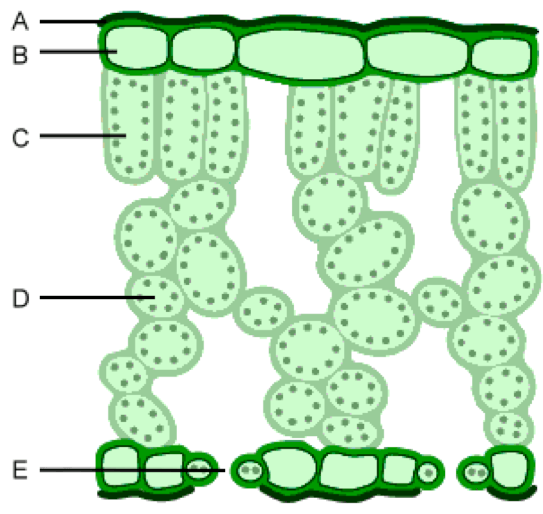
What is A pointing to?
a)
lower epidermis
b)
cuticle
c)
upper epidermis
d)
stomata
113.
What is B pointing to?
a)
lower epidermis
b)
cuticle
c)
upper epidermis
d)
stomata
114.
What is C pointing to?
a)
lower epidermis
b)
cuticle
c)
palisade layer
d)
spongy layer
115.
What is D pointing to?
a)
lower epidermis
b)
cuticle
c)
palisade layer
d)
spongy layer
116.
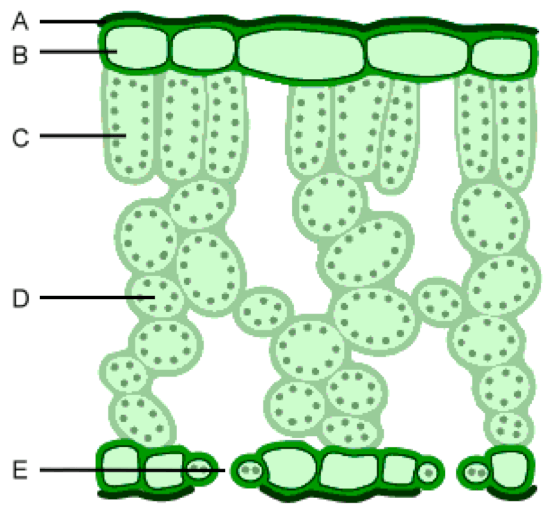
What is E pointing to?
a)
waxy cuticle
b)
stomata
c)
upper epidermis
d)
cuticle
117.
What is E pointing to?
a)
waxy cuticle
b)
stomata
c)
upper epidermis
d)
cuticle
118.
Tightly packed "tall" cells make up the _ layer. This layer does most of the photosynthesis.
a)
Palisade
b)
Spongy
c)
Epidermal
d)
Ground
119.
Stomata are
a)
tiny holes in the leaves of a plant that allow gases to enter or leave the plant
b)
living things
c)
the cells which form the opening in leaves
d)
the waxy layer to protect leaves from sun and wind
120.
Gases pass in and out of a leaf through the what?
a)
xylem
b)
phloem
c)
stomata
d)
upper epidermis
121.
____________ cells open and close the stomata
a)
palisade
b)
guard
c)
xylem
d)
epidermis
122.
Which gas is removed from the atmosphere during photosynthesis?
a)
hydrogen
b)
oxygen
c)
nitrogen
d)
carbon dioxide
123.
What are the products of photosynthesis?
a)
water and carbon dioxide
b)
oxygen and glucose
c)
oxygen and carbon dioxide
d)
oxygen and water
124.
What colors of light do plants absorb?
a)
green and yellow
b)
red and green
c)
red and blue
d)
blue and yellow
100 %

