wayground logo

Free Printable Worksheets

Font size

S
M
L
XL
Worksheets

Final Exam Review: Electrostatics, Circuits & Magnetism

Total questions: 100

Worksheet time: 54mins

Name
Class
Date
1.
Rubbing a balloon on hair is an example of static charge build up created by....
a)
conduction
b)
friction
c)
induction
d)
hairduction
2.
What is the unit of electric charge?
a)
Volts
b)
Amps
c)
Coulombs
d)
Ohms
3.
What are the two types of charges that objects may possess?
a)
+ and +
b)
+ and -
c)
+ and neutral 
d)
- and neutral 
4.
What is it called when an object gains a charge when touched by a charged object?
a)
Induction
b)
ESD
c)
Conduction
d)
Conducting path
5.
What is it called when an object gains a charge without touching a charged object but by being held near the charged object?
a)
Induction
b)
ESD
c)
Conduction
d)
Conducting path
6.
A material in which electrons are able to move easily
a)
Circuit
b)
Insulator 
c)
Resistance 
d)
Conductor 
7.
When a balloon is rubbed on clothes it acquires a charge by ___________
a)
Induction
b)
reduction
c)
friction 
d)
concuction
8.
The atomic nuclei of almost all elements consists of
a)
protons
b)
protons and electrons
c)
protons and neutrons
d)
only neutrons
9.
What is the unit for Electric Force?
a)
Newton
b)
Couloumb
c)
Newtons/Couloumb
d)
Nano
10.
Negative charge is formed when there is an excess amount of
a)
Electrons
b)
Neutrons
c)
Protons
11.
In an electrically neutral object, what must be true about the numbers of protons and electrons?
a)
They are equal
b)
There are more protons than electrons
c)
The protons and and neutrons must be equal
d)
There are more electrons than protons
12.

An insulator is a material that:

a)

Transfers thermal and electrical energy

b)

Transfers electrical energy and slows thermal energy

c)

Slows electrical energy and allows thermal energy to pass

d)

Slows thermal and electrical energy from transferring

13.

A great conductor of electric charge is:

a)

wood

b)

plastic

c)

metal

d)

cloth

14.

In a solid material the __ move to create unbalanced charges.

a)

Neutrons

b)

Protons

c)

Electrons

d)

Static Electricity

15.
Removing a static charge by providing a path to the ground is called __.
a)
electric transfer
b)
grounding
c)
switching
d)
seperation
16.
Which of the following interactions would attract? 
a)
positive + positive
b)
negative + negative
c)
positive + negative
d)
neutral + neutral
17.

When a glass rod is rubbed with silk and the glass rod becomes positively charged, what happens to the electrons?

a)

they are removed from the rod and moved to the silk

b)

they are removed from the silk moved to the rod

18.

What direction are the electric field lines around a proton?

a)

towards the charge

b)

away from the charge

19.
The law of conservation of charge states that...
a)
all atoms have more protons than electrons
b)
only protons can be rubbed off of an atom
c)
charge cannot be created or destroyed
d)
charge cannot be transferred 
20.
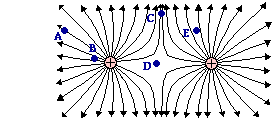
Which of the following labeled points is in the region with the strongest force of electric charge
a)
A
b)
B
c)
C
d)
D
21.
An atom loses an electron.  What type of charge does it have now?
a)
positive
b)
negative
22.
An atom gains an electron.  What type of charge does it have now?
a)
positive
b)
negative
c)
No charge
23.
What direction are the electric field lines around an electron?
a)
towards the charge
b)
away from the charge
24.
When the distance between two charges is halved, the electrical force between the charges
a)
quadruples
b)
reduces to one fourth
c)
halves
d)
doubles
25.
Coulomb's law says that the force between any two charges depends
a)
directly on the size of the charges
b)
inversely on the square of the distance between the charges
c)
both A and B
d)
none of the above
26.
Two particles opposite in charge are held near each other and released.  As they move the force on each particle
a)
Increases
b)
decreases
c)
stays the same
d)
t
27.
In the diagram below, P is a point near a negatively charged sphere. Which direction best represents the direction of the electric field at point P?
a)
Right
b)
Left
c)
Up 
d)
Down
28.

Consider the electric field lines shown in the diagram below. From the diagram, it is apparent that object A is ____ and object B is ____.

a)

Both A & B are positively charged

b)

A is Positive & B is Negative

c)

A is Negative and B is Positive

d)

Both A & B are Negative

29.

Consider the electric field lines drawn at the right for a configuration of two charges. Several locations are labeled on the diagram. Which of these shows the ranking in order of strongest to weakest force correctly?

a)

D>A>B

b)

B>A>D

c)

A>B>D

d)

B>A=D

30.
Qand Qare two charges creating an electric field. Based on the electric field lines, we can conclude
a)
Qand Qare both positive
b)
Qand Qare both negative
c)
Qis positive and Qis negative
d)
Qis negative and Qis positive
31.
The electrical force between charges is strongest when the charges are
a)
close together
b)
far apart
c)
 the electric force is constant everywhere.
d)
there is no pattern
32.

What is the magnitude of the electric field intensity at a point where an electron experiences an electrostatic force of magnitude 2.30 x 10⁻²⁵ newton? (E=f/q and qe = 1.6 x 10^19 C)

a)

1.44 x 10⁻⁶ N/C

b)

3.68 x 10⁶ N/C

c)

1.44 x 1044 N/C

d)

3.68 x 10-44 N/C

33.

The diagram below represents the magnetic lines of force around a bar magnet. At which point is the magnitude of the magnetic field strength of the bar magnet the strongest?

a)

A

b)

B

c)

C

d)

D

34.

A magnetic compass needle points towards the north geographic pole of the Earth because

a)

all magnetic poles, north or south, point that way due to the spin of the Earth.

b)

there is a north magnetic pole near the north geographic pole.

c)

there is a south magnetic pole near the north geographic pole.

d)

the static electricity in the atmosphere causes the alignment of the compass.

35.
What do the lines around this magnet represent?
a)
North Pole
b)
South Pole
c)
Magnetic Declination
d)
Magnetic Field
36.

What is the symbol for magnetic field?

a)

F

b)

B

c)

M

d)

I

37.

What is the symbol for a charge?

a)

Q

b)

B

c)

F

d)

C

38.

What units do you measure magnetic fields in?

a)

B

b)

T

c)

N

d)

C

39.

What unit do you measure L in?

a)

m/s

b)

T

c)

m

d)

C

40.

What units do you measure I (this is a capital i) in?

a)

C

b)

B

c)

A

d)

m

41.

A wire carrying a current of 3.4 A east is perpendicular to a magnetic field of .08 T downward. The force on the wire is 2.3 N. Calculate the length of the wire.

a)

8.5 m

b)

.12 m

c)

9.7 m

d)

.074 m

42.

What is the current of a .004 m wire in a .86 T magnetic field, with a force of 4.2 E -3 ?

a)

.82 A

b)

2.04 A

c)

1.2 A

d)

1.83 A

43.

A straight segment of wire has a length of .6 m and carries a current of 2.0 A. It is oriented at right angles to a magnetic field of 0.9 T. What is the magnitude of the magnetic force on this segment of the wire?

a)

3.7 N

b)

2.13 N

c)

1.08 N

d)

.875 N

44.

Poles of a magnet: like poles _______ and opposite poles _________.

a)

attract, repel

b)

repel, attract

c)

positive, negative

d)

not attract, repel

45.
Electric motors are devices that convert _____ energy into  _____ energy.
a)
electrical; mechanical
b)
mechanical; electrical
c)
chemical; potential
d)
mechanical; kinetic
46.
A simple electromagnet can be made with which of the following?
a)
an electric current
b)
a turbine and nail
c)
a nail, a wire, and a battery
d)
a compass and a battery
47.

The direction of magnetic field lines are drawn

a)

out of the north pole and into the south pole.

b)

out of the middle of the magnet and into each pole.

c)

out of the south pole and into the north pole.

48.
The atoms of a magnetized substance organize into regions in which the magnetic fields of the atoms are aligned.
a)
spins
b)
domains
c)
energy levels
d)
arrangements
49.

This picture best illustrates the construction of a(n)

a)

magnet

b)

electromagnet

c)

series circuit

d)

parallel circuit

50.
How do you make an electromagnet stronger?
a)
Add a motor and/or lightbulbs
b)
Add more light bulbs and/or wire coils
c)
add more wire coils and/or a switch
d)
add more wire coils and/or batteries
51.

A _______________ is a current-carrying coil of wire with many loops.

a)

magnet

b)

electromagnet

c)

solenoid

d)

compass

52.

A _____________ transforms mechanical energy into electrical energy.

a)

generator

b)

electromagnet

c)

circuit

d)

magnetic field

53.

What happens when an electric current flows through a wire?

a)

The wire begins to spin.

b)

Nothing happens.

c)

A field of gravity is created around the wire.

d)

A magnetic field is created around the wire.

54.
What would happen if I move a bar magnet in and out of a coil of copper wire?
a)
Electric current would disappear 
b)
The magnet would explode 
c)
Electric current will flow through the wire
d)
It would produce a gravitational field
55.
A magnet is moved in and out of a coil of wire connected to a high-resistance voltmeter. If the number of coils doubles, the induced voltage 
a)
quadruples
b)
doubles
c)
is the same
d)
halves
56.
When there is a change in the magnetic field in a closed loop of wire
a)
(a) a voltage is induced in the wire
b)
(b) current is made to flow in the loop of wire 
c)
(c) electromagnetic induction occurs
d)
(d) all of these
57.
Which of the following shows the magnetic field correctly around a bar magnet?
a)
A
b)
B
c)
C
d)
D
58.
A temporary magnet
a)
has no magnetic domains until a magnet is near it
b)
has magnetic domains aligned only when another magnet is near it
c)
has magnetic domains aligned all the time
d)
has no magnetic domains
59.
What direction is the force on a positive charge when entering a uniform B field in the direction indicated?
a)
Left
b)
Into the page
c)
Up
d)
Out of the page
60.

What does the direction of the pointing fingers mean in this picture?

a)

the direction of the voltage

b)

the rotation of the wire

c)

the direction of the magnetic field

d)

the direction of the current

61.
a)

one N and one S

b)

both N

c)

both S

d)

each piece still has a N and S

62.

F = BIL If the current and magnetic field are doubled, the magnetic force on the wire

a)

halves

b)

remains the same

c)

doubles

d)

quadruples

63.
An electromagnet's poles may be reversed by:
a)
decreasing the voltage of the coil
b)
increasing the number of coils
c)
changing the direction of current flow
d)
altering the material used to make the coils
64.
The diagram below shows a bar magnet. Which direction best represents the direction of the needle of a compass placed at point A?
a)
left
b)
right
c)
up
d)
down
65.

Which statement best describes what will occur when the switch is closed?

a)

Nothing will happen to the compass

b)

The compass will deflect due to the current pushing the compass needle

c)

The compass will deflect due to the magnetic field created by the current in the wire

d)

The compass will deflect because the voltage pushes the compass needle

66.

A student makes an electromagnet by wrapping a wire around an iron nail then connecting the wires to the battery. The student is unable to pick a paperclip up with her electromagnet. Which suggestion would help the student pick up a paperclip?

a)

Taking the nail out of the coil will increase the strength of the electromagnet

b)

Wrapping more coils around the nail will increase the strength of the electromagnet

c)

Reducing the voltage of the battery will increase the strength of the electromagnet

d)

Adding one resistor to the circuit will increase the strength of the electromagnet

67.

In the picture above, a magnet is passed in and out of a coil of wire. The coils are hooked up to a meter shown below the coils. What is the meter measuring and why does it deflect different directions based on which way the magnet is moving?

a)

The meter is measuring the magnetic field. It changes because the magnetic field changes based on which way you move a magnet

b)

The meter is measuring current. The current changes direction depending on which way you move the magnet in the coils.

c)

The meter is measuring the number of loops of wire.

d)

The meter is measuring how much resistance is in the wires. The resistance changes based on how close the magnet is to the wires.

68.
An incomplete circuit is shown.
To complete the circuit, a wire should be placed from —
a)
Point D to Point C
b)
Point B to Point C
c)
Point A to Point D
d)
Point B to Point D
69.
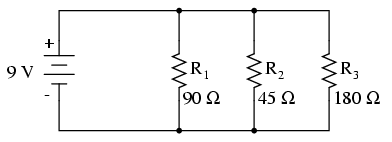
What kind of circuit is this?
a)
Series
b)
Consecutive
c)
Parallel
d)
Training
70.
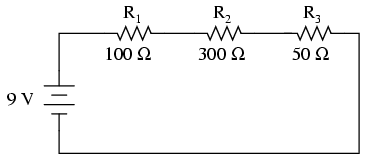
What kind of circuit is this?
a)
series
b)
parallel
71.
The total resistance in this circuit is 
a)
100 ohms
b)
450 ohms
c)
400 ohms
d)
30 ohms
72.
The voltage dropped across the 300 ohm resistor is 
a)
6 V
b)
9 V
c)
2 V
d)
30 V
73.
As resistors are added in series to a circuit, the total resistance will...
a)
increase
b)
decrease
c)
stay the same
74.
As the resistance of a circuit increases, the current will...
a)
increase
b)
decrease
c)
stay the same
75.
In a parallel circuit which of the following is the same value throughout the circuit?
a)
Voltage
b)
Current
c)
Resistance
d)
Charge
76.
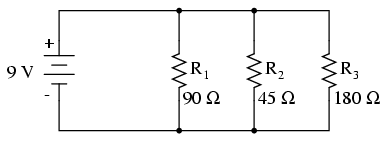
The current going through the 45 ohm resistor is 
a)
0.05 amps
b)
0.2 amps
c)
0.1 amps
d)
5 amps
77.
The total resistance of this circuit is 
a)
25.7 ohms
b)
315 ohms
c)
324 ohms
d)
90 ohms
78.
The total current going through the battery of this circuit is
a)
0.35 amps
b)
0.0286 amps
c)
0 amps
d)
9 amps
79.
What will happen if one light bulb is removed from this circuit?
a)
The other bulbs will go out.
b)
The other bulbs will stay on
c)
The other bulbs will get dimmer.
d)
The battery will become stronger.
80.
This measures the speed of the current in a circuit
a)
voltage
b)
ammeter
c)
switch
d)
resistance
81.
What slows down the flow of electricity in a circuit?
a)
resistance
b)
voltage
c)
current
d)
source of electric current
82.
Which circuit (s) are parallel?
a)
A
b)
A and B
c)
B and C
d)
C
83.

Which one will still function if one light bulb goes out?

a)

A-Series

b)

B-Parallel

c)

A-Parallel

d)

B-Series

84.
If I add more light bulbs to a series circuit what happens?
a)
The current speeds up and the lights get brighter
b)
The current slows down and the lights dim lower
c)
The current speeds up and the lights dim lower
d)
The current slows down and the lights get brighter
85.

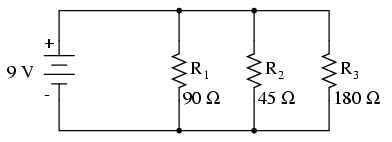
The current going through the 90 ohm resistor is

a)

10 amps

b)

0.1 amps

c)

0.2 amps

86.

A 2.0-ohm resistor and a 4.0-ohm resistor are connected in series with a 12-volt battery. If the current through the 2.0-ohm resistor is 2.0 amperes, the current through the 4.0-ohm resistor is

a)

1.0 A

b)

2.0 A

c)

3.0 A

d)

4.0 A

87.

Where should an ammeter be located to correctly measure the total current and where should a voltmeter be located to correctly measure the total voltage?

a)

ammeter at 3 and voltmeter at 4

b)

ammeter at 1 and voltmeter at 4

c)

ammeter at 2 and voltmeter at 3

d)

ammeter at 1 and voltmeter at 2

88.
This is the symbol for a _____?
a)
an AC current source
b)
a DC current source
c)
a battery
d)
a single cell
89.
this is the symbol for a _____?
a)
switch
b)
light 
c)
battery
d)
wires
90.

What is this Symbol?

a)

Motor

b)

Voltmeter

c)

Ammeter

d)

Buzzer

91.
How much CURRENT does a 1200 W bread maker draw from a 110 V outlet?
P = IV
P = I2R
P = V2/R
a)
132000 amps
b)
0.09 amps
c)
1200 amps
d)
10.9 amps
92.
Three resistors of 20. ohms, 30. ohms, and 60. ohms are connected in series with a battery. A current of 2 amperes will flow through this circuit when the potential difference of the battery is 
a)
10. V
b)
220 V
c)
110 V
d)
20. V 
93.
Two identical resistors connected in parallel have an equivalent resistance of 40 ohms. What is the resistance of each resistor? 
a)
40. Ohm
b)
160 Ohm
c)
80. Ohm
d)
20. Ohm
94.

What happens to total current in a series circuit when the total voltage stays the same, and the circuit resistance decreases?

a)

current increases

b)

current stays the same

c)

current decreases

95.
Unit for resistance
a)
Ampere
b)
Ohm
c)
Volt
d)
Watt
96.
What happens to the total current in a parallel circuit as you add resistors?
a)
Increases
b)
Decreases
c)
Nothing
d)
A black hole
97.
A student makes a simple circuit. A 9.0 V battery is connected to a light bulb. The resulting current is 0.33 A. What is the resistance of the bulb?
a)
2.7 Ohms
b)
3 Ohms
c)
9 Ohms
d)
27 Ohms
98.
A motor has a current of 2.00 A flowing through it when it is powered with a
12-volt battery.  What is the power used by the motor?
 
a)
16
b)
6
c)
14
d)
24
99.
Calculate the current for a 120-volt refrigerator that uses 650 watts of power.
a)
0.18
b)
5.4
c)
120
d)
78,000
100.

If an electrical circuit were analogous to a water circuit at a water park, then the battery voltage would be comparable to ___________________.

a)

the rate at which water flows through the circuit

b)

the speed at which water flows through the circuit

c)

the distance that water flows through the circuit

d)

the water pressure between the top and bottom of the circuit

e)

the hindrance caused by obstacles in the path of the moving water