
 Worksheets
Semester 2 Review
Total questions: 112
Worksheet time: 2hrs 50mins
Name
Class
Date
1.
Humans have ________ pairs of chromosomes.
a)
21
b)
23
c)
46
d)
None of the above
2.
The individual strands on duplicated chromosomes are called_____________
a)
Centromeres
b)
daughters
c)
Chromatids
d)
Karyotypes
3.
In the G1 stage of the cell cycle, the cell
a)
Grows
b)
Matures
c)
Carries on normal activities
d)
All of the above
4.
In the S stage of interphase_______________
a)
the cell grows
b)
the nucleus divides
c)
the cell membrane divides
d)
the DNA is replicated
5.
In the G2 stage of cell division, ______________ are made.
a)
organelles
b)
structures for cell division
c)
proteins
d)
all of the above
6.

The structure labeled A is a(n)
a)
chromatid
b)
centriole
c)
centromere
d)
chromosphere
7.

The structures labeled B are
a)
centrioles
b)
chromatids
c)
centromeres
d)
chromospheres
8.

The chromosome in the diagram
a)
has been replicated
b)
consists of 2 copies of 1 chromosome
c)
is about to go through cell division
d)
all of the above.
9.
The material of chromosomes which is made up of proteins and DNA is called ________________.
a)
Centromere
b)
Chromatid
c)
Karyotype
d)
Chromatin
10.

Identify the Cell Cycle Stage.
a)
Anaphase
b)
Cytokinesis
c)
Telophase
d)
Metaphase
11.

Identify the Cell Cycle Stage.
a)
Prophase
b)
Interphase
c)
Anaphase
d)
Telophase
12.

Identify the Cell Cycle Stage.
a)
Anaphase
b)
Cytokinesis
c)
Interphase
d)
Prophase
13.

Identify the Cell Cycle Stage.
a)
Interphase
b)
Anaphase
c)
Telophase
d)
Prophase
14.
Which of the following phrases best describes cancer
a)
absence of cyclins in DNA
b)
multiple gene mutations on a chromosome of DNA
c)
uncontrolled cell growth caused by mutations in genes that control the cell cycle
d)
presence of genetic defects caused by hereditary disorders
15.

During the cell cycle, the resting phase is ...
a)
G0
b)
G1
c)
G2
d)
S
16.
A cell spends most of its life in
a)
Anaphase
b)
Interphase
c)
Metaphase
d)
Prophase
17.
Which of these is a risk factor for developing cancer?
a)
growing older
b)
genetic inheritance
c)
exposure to carcinogens
d)
all of the above
18.
________________is a critical point where stop and go signals can regulate the cycle
a)
Metastasis
b)
Checkpoint
c)
Malignant
d)
Benign
19.
What kind of a gene is p53?
a)
Proto-Oncogene
b)
Oncogene
c)
Tumor Suppressor Gene
d)
Proto-Tumor Suppressor Gene
20.
What kind of mutation is the result of an insertion?
a)
Silent Mutation
b)
Missense mutation
c)
Nonsense mutation
d)
Frameshift mutation
21.
A nonsense mutation results in _________.
a)
A truncated protein
b)
A slightly altered polypeptide chain
c)
A shift in the reading frame
d)
The regulatory sequence being altered.
22.
Because some amino acids can be coded for by multiple codons, this type of mutation is possible.
a)
Nonsense Mutation
b)
Missense Mutation
c)
Degenerate Mutation
d)
Silent Mutation
23.
If below is the wild-type DNA sequence, which one shows a point mutation?
5'-ATTCGC-3'
5'-ATTCGC-3'
a)
5' - AATTCGC - 3'
b)
5'- ATCCGC - 3'
c)
5' - ATCGC - 3'
d)
5' - ATTCGC - 3'
24.
A base pair substitution can result in all of the following except __________.
a)
Missense mutation
b)
Frameshift Mutation
c)
Silent Mutation
d)
Nonsense mutation
25.
Which type of mutations are heritable
a)
Mutations in somatic cells
b)
Mutations in germ line cells
c)
Mutations in germ line cells and somatic cells are both heritable.
d)
It depends on the specific mutation.
26.

Which phase of which process does this picture show?
a)
Transcription
b)
Translation
c)
Replication
27.
Which is the mRNA molecule that would be transcribed from this DNA template:
TGGCAAGTACGT
TGGCAAGTACGT
a)
ACCGTTCATGCA
b)
UGGCAAGUACGU
c)
UCCGUUCUUGCU
d)
ACCGUUCAUGCA
28.
ATTTGAGCC - Original
ATTGAGCC - Mutated
The example above is an example of a
ATTGAGCC - Mutated
The example above is an example of a
a)
Insertion- Frameshift
b)
Deletion- Substitution
c)
Deletion -Frameshift
d)
All of the above
29.
Why is the order of amino acids so important?
a)
The order of amino acids dictates the function of the protein and what shape the protein will fold into.
b)
It is not important. The protein folding chamber will force the protein to fold into the correct shape.
c)
The order of the amino acids tells the cell what DNA to make.
d)
It is not important that is why most mutatiosn are silent.
30.
Which of the following represents a gene?
a)
p53
b)
ATCGAATTA
c)
chromosome 17
d)
X
31.
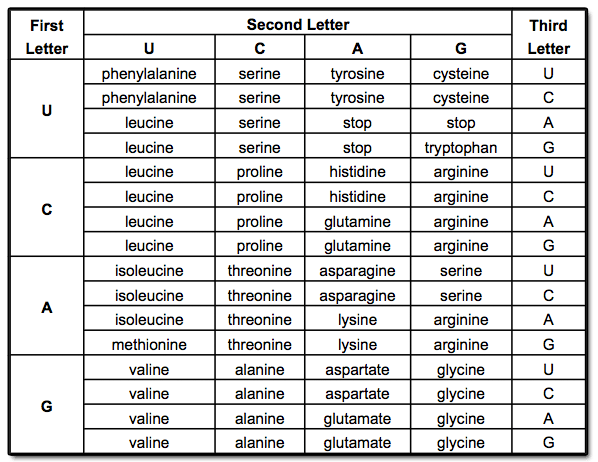
What is the correct amino acid sequence for the mRNA code AUGCCAGUAUGA
a)
Met-Pro-Ala-Val
b)
Met-Pro-Val
c)
Tyr-Gly-His
d)
Tyr-Gly-Arg-His
32.
Restriction Enzymes . . .
a)
cut DNA at precise locations
b)
help bacteria to pick up DNA
c)
move DNA through a gel
d)
copy DNA
33.
Why do we need meiosis?
a)
To double the number of chromosomes going into sex cells
b)
To halve the number of chromosomes going into sex cells
c)
To triple the number of chromosomes going into sex cells
d)
To not change the number of chromosomes going into sex cells
34.
Unlike mitosis, meiosis in male mammals results in the formation of
a)
one haploid gamete
b)
three diploid gametes
c)
four diploid gametes
d)
four haploid gametes
35.
products of meiosis are genetically
a)
different
b)
identical
36.
If the Diploid number of Carrots is 18, the haploid number is
a)
18
b)
9
c)
27
d)
36
37.
The chromosomes that pair up during meiosis, are called __________ chromosomes.
a)
homozygous
b)
asexual
c)
homologous
d)
genes
38.
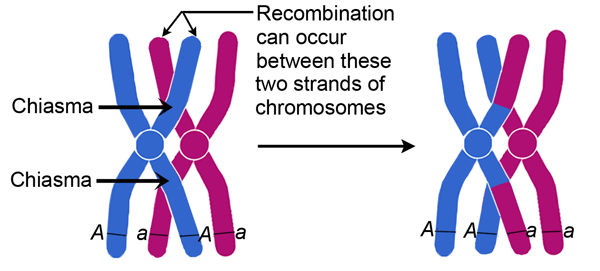
This image shows chromosomes during Prophase 1. Which of the following correctly describes the process shown?
a)
segregation of sister chromatids
b)
condensation and segregation of alleles
c)
mutationin which the DNA content of the gene is altered
d)
crossing - over in which alleles are exchanged
39.
How many cells are produced during telophase I ?
a)
4
b)
8
c)
2
d)
0
40.

Identify the phase.
a)
Metaphase I
b)
Metaphase II
c)
Prophase I
d)
Anaphase II
41.
How many PAIRS of sex chromosomes do humans have?
a)
23
b)
46
c)
1
d)
2
42.

What percentage of the offspring will have this recessive disease?
a)
0%
b)
25%
c)
50%
d)
75%
43.

What percentage of the female offspring will be a carrier for this recessive disease?
a)
0%
b)
50%
c)
100%
d)
25%
44.
Hemophilia is a recessive x-linked disorder.
Which genotype represents a female who is a carrier for hemophilia?
Which genotype represents a female who is a carrier for hemophilia?
a)
XHXh
b)
XhXh
c)
XHXH
d)
XhY
45.
Hemophilia is a recessive x-linked disorder.
Which genotype represents a male with hemophilia?
Which genotype represents a male with hemophilia?
a)
XHXh
b)
XhXh
c)
XHY
d)
XhY
46.

Which of the following genotypes belongs in the red box in the Punnett square?
a)
XBXb
b)
XbXb
c)
XbY
d)
XBY
47.

Hemophilia is a recessive x-linked disorder. According to the Punnett square, what percentage of offspring will have the disorder?
a)
0%
b)
25%
c)
50%
d)
100%
48.

Is it possible for individual IV-2 to be a carrier? Why?
a)
No, because her parents don't have the trait.
b)
No, because she doesn't have the trait.
c)
Yes, because her siblings have it.
d)
Yes, because her parents are carriers.
49.

Which gender can be carriers of colorblindness and not have it?
a)
Just males
b)
Just females
c)
Both genders
50.

Give the genotype for person II-1
a)
GG
b)
Gg
c)
gg
51.
1. In a certain species of animal, black fur (B) is dominant over tan fur (b).
Which type of dominance does this cross show?
Which type of dominance does this cross show?
a)
Complete Dominance
b)
Incomplete Dominance
c)
Codominance
d)
Polygenic Inheritance
52.
Snapdragon flowers come in red, pink and white. What type of inheritance is this?
a)
Complete Dominance
b)
Incomplete Dominance
c)
Codominance
d)
Polygenic Inheritance
53.

If you cross a black chicken with a white chicken, only checkered chickens would be produced. What kind of inheritance pattern does this follow?
a)
incomplete Dominance
b)
Co-Dominance
54.
How are Incomplete Dominance and Co Dominance different than a normal Mendelian cross?
a)
There is no difference
b)
The heterozygous genotype has a unique phenotype
c)
There is no heterozygous genotype
d)
There is only one phenotype regardless of genotype.
55.
What shape best describes DNA
a)
helix
b)
double helix
c)
triple helix
d)
circular
56.
The "backbone" of DNA consists of
a)
nitrogen base, phosphate
b)
sugar (deoxyribose) and phosphate
c)
sugar (ribose) and phosphate
d)
adenine, thymine, cytosine, guanine
57.
adenine, guanine, cytosine, and thymine are known as
a)
sugars
b)
phosphates
c)
lipids
d)
nitrogen bases
58.
adenine pairs with
a)
guanine
b)
thymine
c)
cytosine
d)
adenine
59.
What would be the complementary strand of DNA if you were given this sequence
AACTGC
AACTGC
a)
AACTGC
b)
TTGACG
c)
GCAGTT
d)
GATCAT
60.
The triplet code in DNA such as "GAT" codes for...
a)
RNA
b)
Amino Acids
c)
Proteins
d)
Additional DNA
61.
RNA has two main differences when compared to DNA apart from its helix structure is...
a)
Sugar is ribose and has uracil instead of thymine
b)
Sugar is ribose and has uracil instead of adenine
c)
Sugar is deoxyribose and has adinine instead of thymine
62.

The concept that DNA is made of two strands running in opposite directions is called:
a)
Antiparallel
b)
Isomerism
c)
Enantiomerism
d)
S/R Chirality
63.
What is the difference between pyrimidines and purines
a)
size
b)
color
c)
function
d)
bond type
64.
Which two bases are pyrimidines
a)
thymine and cytosine
b)
cytosine and guanine
c)
thymine and adenine
d)
guanine and thymine
65.
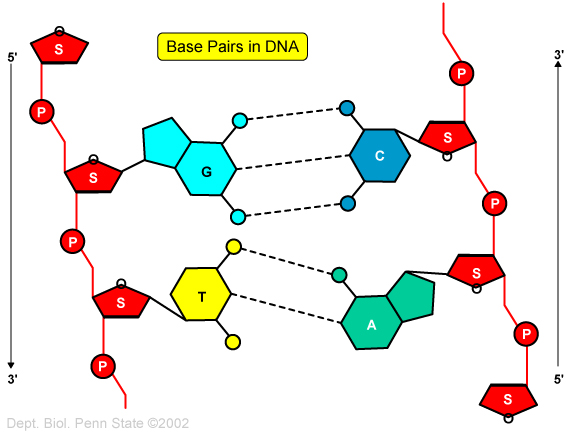
Nitrogenous bases are joined by which type of bond?
a)
polar bonds
b)
ionic bonds
c)
covalent bonds
d)
hydrogen bonds
66.
The enzyme that unzips the DNA to prepare for replication
a)
helicase
b)
replicase
c)
polymerase
d)
synthase
67.
DNA replication results in two DNA molecules,
a)
each one with two original strands
b)
each one with two new strands
c)
each one with one new strand and one original strand
d)
one with two new strands and the other with two original strands
68.
Which enzyme is responsible for adding nucleotides ("The Builder")?
a)
Topoisomerase
b)
DNA Polymerase
c)
Ligase
d)
Primase
69.
Which enzyme is responsible for connecting parts of newly created DNA fragments together?
a)
Topoisomerase
b)
DNA Polymerase
c)
Ligase
d)
Primase
70.
What type of RNA carries the DNA message out of the nucleus to the ribosomes?
a)
mRNA
b)
tRNA
c)
RNA
d)
DNA
71.
What do we call the process of turning DNA into mRNA?
a)
Translation
b)
Transcription
c)
Replication
72.
When the RNA gets to the ribosomes, which molecule transfers to the mRNA to amino acids?
a)
DNA
b)
mRNA
c)
tRNA
d)
Replicated RNA
73.
What is a Codon?
a)
4 base pairs that transfer to amino acids
b)
3 base pairs that transfer to amino acids
c)
3 base pairs that transfer to DNA
d)
3 base pairs that transfer to mRNA
74.

What process is occurring in this photo?
a)
Transcription
b)
DNA unwinding
c)
Translation
d)
Transfer RNA is creating bases
75.

What is the correct amino acid sequence for the mRNA code AUGCCAGUAUGA?
a)
Met-Pro-Val-Stop
b)
Met-Pro-Arg-Stop
c)
Tyr-Gly-His
d)
Tyr-Gly-Arg-His
76.
Where does Translation occur?
a)
Proteins
b)
Mitochondria
c)
Ribosomes
d)
Cytoplasm
77.
Which enzyme is responsible for making RNA?
a)
DNA polymerase
b)
RNA enzymase
c)
RNA polymerase
d)
RNA proliferase
78.
If the percentage of DNA is made of 30% Thymine, what is the correct percentage of Guanine?
a)
30
b)
15
c)
20
d)
70
79.

what did Charles Darwin observe in finch populations of the Galapagos Islands off the coast of South America?
a)
different species on different islands
b)
all species on one of the islands
c)
identical species on all the islands
d)
the same species as North America
80.
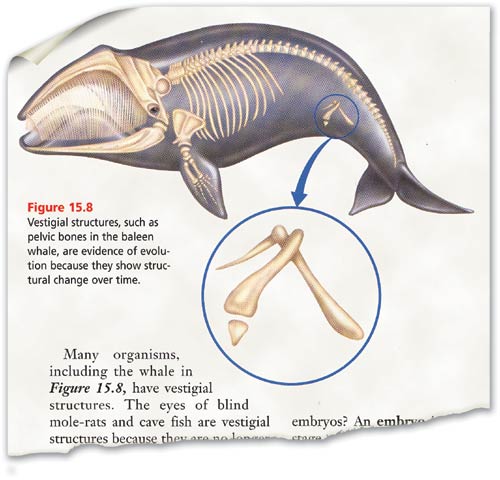
Which of the following is an example of a vestigial structure?
a)
the wings of a red-tailed hawk
b)
the hind limbs of a house cat
c)
the fins of sharks
d)
the tailbone of a human
81.

What type of structures are these?
a)
homologous
b)
vestigial
c)
analogous
d)
fossil
82.
What does Darwin's theory of evolution suggest?
a)
species change over time
b)
extinct species are not related to living species
c)
different species can interbreed
d)
animals that look alike are most closely related
83.

Individuals that are well adapted to their environment will survive and produce:
a)
Fewer mutations
b)
Stronger genes
c)
More offspring
d)
Better traits
84.
When the DNA of an organism is altered it is referred to as…
a)
Mutation
b)
Gene Flow
c)
Genetic Drift
d)
Sexual Selection
85.
What is a change in an organism that allows for it to survive in its environment?
a)
homologous
b)
vestigial
c)
variation
d)
adaptation
86.
Genetic drift is a process that causes---
a)
The genetic makeup of an entire population to disappear
b)
The genetic makeup of an entire population to be altered
c)
Organisms to better adapt to their environment
d)
Organisms to have the same DNA as their parents
87.
T7. Which Hardy-Weinberg factor represents the frequency of heterozygous individuals in a population?
a)
p2
b)
2pq
c)
q2
d)
p2 + 2pq
88.
T7. In a population of humans, the frequency of no dimples is 0.36. If having no dimples is the recessive phenotype, what is the frequency of the recessive allele?
a)
0.6
b)
0.36
c)
0.64
d)
0.18
89.
T7. Within a population of 500 butterflies, the color purple is dominant over the color white. 200 of the butterflies are white. What is the frequency of homozygous dominant individuals? Give your answer as a decimal to the nearest hundredth.
a)
.40
b)
.36
c)
.16
d)
.60
90.
T7. If a population has the following genotype frequencies: AA = 0.42, Aa = 0.46, and aa = 0.12, what are the allele frequencies?
a)
A = 0.42, a = 0.12
b)
A = 0.6, a = 0.4
c)
A = 0.65, a = 0.35
d)
A = 0.84, a = 0.24
91.

The following stem is which of the following?
a)
angiosperm monocot
b)
angiosperm dicot
c)
gymnosperm monocot
d)
gymnosperm dicot
92.
Moves water UP
a)
Xylem
b)
Phloem
93.
Moves sugar from leaves to roots
a)
Xylem
b)
Phloem
94.

Both the xylem and phloem are considered-
a)
Stomata
b)
Leaves
c)
Roots
d)
Vascular tissue
95.

What is #3 pointing to?
a)
stigma
b)
filament
c)
ovary
d)
anther
96.
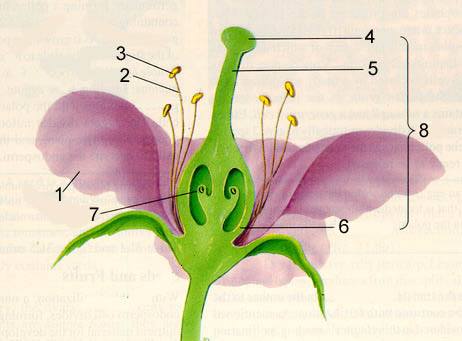
What is #4 pointing to?
a)
anther
b)
style
c)
stigma
d)
ovary
97.

What is #6 pointing to?
a)
stigma
b)
style
c)
ovary
d)
petal
98.
The male part of the flower is known as the _____.
a)
stamen
b)
pistil
c)
ovary
d)
petal
99.
Alternation of generations refers to a life cycle in which the organism cycles between ___________ and ___________ generations.
a)
Haploid / Diploid
b)
Male / Female
c)
Tall / Short
d)
Fat / Slim
100.
Secondary growth
a)
Increases the width of the plant
b)
Increases the length of the plant
c)
Increases the number of leaves of the plant
d)
Increases the number of plants
101.
A monocot has _______ cotyledons.
a)
1
b)
2
c)
3
d)
4
102.
A cotyledon is a
a)
Root
b)
Seed leaf
c)
Vein
d)
Stem
103.
The area of a plant where active growth occurs.
a)
Pollination
b)
Germination
c)
Meristem
d)
Dormancy
104.

Identify the type of angiosperm as a dicot or monocot.
a)
monocot
b)
dicot
105.
A leaf-like structure that protects the flower in the bud and opening stages
a)
Sepal
b)
Petal
c)
Calyx
106.
What does an ovule become when it is pollinated?
a)
a seed
b)
a sprout
c)
a fruit
d)
it stays an ovule
107.
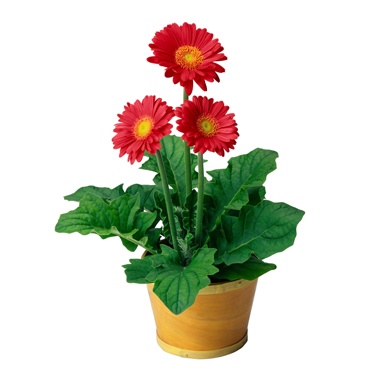
This is a _____ plant.
a)
gymnosperm
b)
vascular
c)
nonvascular
d)
not enough information to tell
108.
Seedless plants reproduce with ___.
a)
spores
b)
seeds
c)
binary fission
d)
flowers
109.
Water moves in bryophytes by means of
a)
diffusion
b)
phloem
c)
xylem
d)
active transport
110.
The filament___________
a)
holds up the anther
b)
protects the petal
c)
is the male part of the flower
d)
catches pollen
111.

Sam placed a bag over a plant to protect it from the cold weather. He noticed moisture on the inside of the bag when he awakened. What caused this moisture?
a)
precipitation
b)
evaporation
c)
transpiration
112.
The sticky tip of the pistil that attracts and collects the pollen
a)
Stigma
b)
Style
c)
Ovary
d)
Stamen
100 %

