wayground logo

Free Printable Worksheets

Font size

S
M
L
XL
Worksheets

Genetics

Total questions: 77

Worksheet time: 3hrs 34mins

Name
Class
Date
1.
If a diploid cell from a worm has 60 chromosomes, how many will be in one egg cell (gamete)?
a)
60 
b)
30 
c)
2
d)
120
2.
If a diploid cell of a beetle has 10 chromosomes, how many chromosomes will be in one stomach cell from this beetle?
a)
2
b)
5
c)
10
d)
20
3.
The genotype for gene D shown on these chromosomes is
a)
homozygous
b)
heterozygous
c)
homologous
d)
unknown
4.
The chromosome number for this species is
a)
2
b)
4
c)
8
d)
unknown
5.
At the end of meiosis, this cell will have
a)
8 replicated chromosomes )(
b)
4 replicated chromosomes )(
c)
8 single chromosomes (
d)
4 single chromosomes (
6.
The haploid number of human chromosomes is
a)
11
b)
12
c)
23
d)
46
7.
Histones are 
a)
proteins wound up in DNA
b)
critical to maintaining the shape of chromosomes
c)
aid in the tight packing of DNA
d)
all of these 
8.
Autosomes are
a)
chromosomes found in autotrophs, only
b)
chromosomes that automatically correct all errors in the DNA
c)
chromosomes that determine traits other than sex
d)
chromosomes that determine the sex of the individual
9.
The individual strands on duplicated chromosomes are called_____________
a)
Centromeres
b)
Daughters
c)
Chromatids
d)
Karyotypes
10.
What is shown in this karyotype?
a)
A female with Down syndrome
b)
A male with Down syndrome
c)
A normal female
d)
A normal male
11.
The structure labeled A is a(n)
a)
chromatid
b)
centriole
c)
centromere
d)
chromophere
12.
The structures labeled B are
a)
centrioles
b)
chromatids
c)
centromeres
d)
chromopheres
13.
A human cell has between 20 000 and 25 000 genes whereas an E. coli cell has approximately 4000 genes. Which of the following statements is true?
a)
The human genome is larger than the E. coli genome.
b)
There are more genes on each human chromosome than on the E. coli chromosome.
c)
The human cell and the E. coli cell produce approximately the same variety of proteins.
d)
The DNA in both organisms is associated with histones (proteins).
14.
Which of the following statements about homologous chromosomes is correct?
a)
Each gene is at the same locus on both chromosomes.
b)
They are two identical copies of a parent chromosome which are attached to one another at the centromere.
c)
They come from the same parent.
d)
They are chromosomes that have identical genes and alleles.
15.
Which cellular process is shown?
a)
meiosis
b)
endocytosis
c)
mitosis
d)
cytokinesis
16.
The chromosomes that pair up during meiosis, are called __________ chromosomes.  
a)
homozygous 
b)
sister
c)
homologous
d)
daughter
17.
Crossing over helps promote 
a)
male genotypic traits
b)
genetic variation
c)
DNA replication
d)
meiosis
18.
Which term describes the position of a gene on a chromosome?
a)
Locus
b)
Allele
c)
Centromere
d)
Diploid
19.
What is a picture used to examine chromosomes called?
a)
Sonogram
b)
Electrocardiogram
c)
X-Ray
d)
Karyotype
20.
The cause of many genetic disorders, like Down Syndrome, is...
a)
Nondisjunction
b)
Overfertilization
c)
Uncontrolled Meiosis
d)
Translocation
21.
When a cell is not actively dividing, it is in what phase?
a)
interphase
b)
anaphase
c)
prophase
d)
telophase
22.
What portion of the cell cycle involves the actual dividing?
a)
interphase
b)
mitosis
c)
Gap 1
d)
Gap 2
23.
When a cell divides, what do we call the 2 new cells?
a)
mother cells
b)
father cells
c)
daughter cells
d)
son cells
24.
Before a cell can divide, what must happen?
a)
Nothing, it is always ready to divide
b)
The number of chromosomes must be cut in half
c)
The number of chromosomes must double
d)
The number of chromosomes must triple.
25.
If the message never gets through for a cell to stop dividing and it just keeps dividing over and over again, what can form?
a)
tumor
b)
freckle
c)
goosebump
d)
scab
26.
When you start with 1 cell, at the end of mitosis, how many identical cells will you have?
a)
1
b)
2
c)
3
d)
4
27.
After meiosis is complete how many cells will there be?
a)
1
b)
2
c)
3
d)
4
28.
Another name for a sex cell is a:
a)
gamete
b)
embryo
c)
bone cell
d)
muscle cell
29.
After meiosis is complete, the new cells:
a)
are all identical
b)
are all different
c)
are half identical and half different
d)
are all stretched out
30.
Why is sexual reproduction better than asexual reproduction?
a)
It gives an advantage to organisms to be different than the rest, if the environment changes.
b)
It is better for all organisms to be the same.
c)
It happens faster.
d)
It helps skin cells divide faster to heal wounds.
31.
A is:
B is:
C is:
a)
A: chromatid
B: centromere
C: chromosome
b)
A: chromosome
B: chromatid
C: centromere
c)
A: chromosome
B: centromere
C: chromatid
d)
A: centromere
B: chromosome
C: chromatid
32.
Place these cells in order of mitosis.
a)
A, B, C, D, E
b)
B, E, D, A, C
c)
C, E, A, D, B
d)
B, D, A, E, C
33.
The union of male and female gametes to form a zygote
a)
sperm
b)
egg
c)
fertilization
d)
tetrads
34.
Which is a disadvantage of sexual reproduction?
a)
Sexually reproducing organisms reproduce too quickly
b)
Sexually reproducing animals must find a mate
c)
Sexual reproduction does not allow organisms to adapt
d)
Sexually reproducing organisms are identical to their parents
35.
What are the differences between a prokaryote and a eukaryote?
a)
The prokaryote does not have a membrane bound nucleus, but the eukaryotes does
b)
The prokaryote has more cell structures then the eukaryote
c)
The eukaryote has several cells
d)
The prokaryote is larger
36.
The dark "spider" looking things on opposite sides of the cell are called "Spindle Fibers".  What is their job?
a)
Eating the chromosomes
b)
Pulling the chromosomes apart
c)
Putting the chromosomes together
37.
Identify the phase of mitosis. 
a)
Cytokinesis
b)
Anaphase
c)
Telophase
d)
Prophase
38.
Identify the phase of mitosis.
a)
Cytokinesis
b)
Interphase
c)
Anaphase
d)
Metaphase
39.
Name the phase:
a)
Anaphase
b)
Telophase
c)
Metaphase
d)
Prophase
40.
Haploid Cells are represented by
a)
2n
b)
n
c)
1/2 n
d)
4n
41.
If a somatic cell in a butterfly contains 24 chromosomes, a butterfly egg would contain
a)
3
b)
6
c)
12
d)
24
42.
Crossing over helps promote 
a)
male genotype
b)
genetic variation
c)
DNA replication
d)
mitosis
43.
When homologous chromosomes match up, they form a structure call a ___________.
a)
tetrad
b)
triad
c)
diploid
d)
gamete
44.
Aa, DD, bB, yy are all examples of
a)
genotypes
b)
phenotypes
45.
AA and Aa always show up as
a)
dominant
b)
recessive
46.
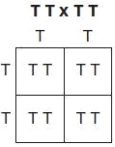
What ratio of the offspring from the cross shown will be homozygous recessive for the  trait of tallness? 
a)
0 in 4
b)
1 in 4
c)
2 in 4
d)
4 in 4
47.
Which of the following genotypes is homozygous dominant?
a)
A
b)
Aa
c)
AA
d)
aa
48.
Which of the following genotypes is heterozygous?
a)
Bb
b)
BB
c)
bb
d)
B
49.
In a flowering plant species, red flower color (R) is dominant over white flower color (r). What is the genotype of any red-flowering plant resulting from this species?
a)
rr
b)
R
c)
RR
d)
RR or Rr
50.
Which of the characteristics is a lion least likely to pass on to its offspring?
a)
fur color
b)
length of tail
c)
scars on leg
d)
body size
51.
What you see, or the physical appearance.
a)
Genotype
b)
Phenotype
c)
Homozygous
d)
Heterozygous
52.
B = brown eyes
b = blue eyes
What is true about these two brothers that have brown eyes?
One has genotype BB the other Bb.
a)
they have same phenotype and genotype
b)
they have different genotypes and phenotypes
c)
they have same phenotype but different genotypes
d)
they have same genotype but different phenotypes
53.
How many alleles (letters) do each person carry for a trait?
a)
1
b)
2
c)
3
d)
4
54.
How many individuals are there in the 3rd generation?
a)
2
b)
3
c)
4
d)
6
55.
In the second generation-how many people are carriers of the trait?
a)
2
b)
3
c)
5
d)
6
56.
Examine the pedigree. The allele for the presence of a widow’s peak is dominant. Therefore, we can tell from the chart that in the couple labeled 2:
a)
the male is heterozygous and the female is homozygous.
b)
the male is homozygous and the female is heterozygous.
c)
the male is homozygous and the female is homozygous.
d)
the male is heterozygous and the female is heterozygous.
57.
What is the mode of inheritance shown here?
a)
Autosomal Dominant
b)
Autosomal Recessive
c)
Sex Linked Recessive
58.
What is the mode of inheritance shown here?
a)
Sex Linked
b)
Autosomal Dominant
c)
Autosomal Recessive
59.
What is the mode of inheritance shown here?
a)
Autosomal Recessive
b)
Autosomal Dominant
c)
Sex Linked
60.
Freckles (F) are dominant over nonfreckles.   What is the phenotype of individual #3
a)
Ff
b)
ff
c)
freckles 
d)
nonfreckles 
61.
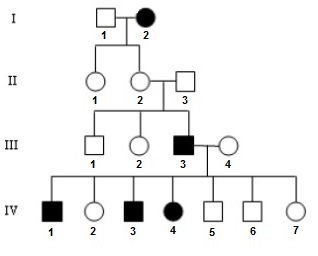
The genotype of the affected son and daughter at the bottom of this pedigree...
a)
homozygous dominant
b)
homozygous recessive
c)
heterozygous
d)
Can't tell
62.
What is the relationship between person I 1 and III 2?
a)
Father and Son
b)
Father and Daughter
c)
Grandfather and Granddaughter
d)
Uncle and Niece 
63.
If this pedigree shows an autosomal recessive disorder, what MUST the genotype of individual II-3 be?
a)
HH
b)
Hh
c)
hh
d)
None of the above
64.
How are individuals III-2 and II-4 related?
a)
Cousins
b)
Dad and Daughter
c)
Uncle and Niece
d)
Grandpa and Granddaughter
65.
If a woman is a carrier for a sex linked recessive trait of hemophilia and her husband has hemophilia, which of the following is true
a)
All sons will have hemophilia
b)
all daughters will have hemophilia
c)
50% of daughters and 50% of sons have hemophilia
d)
100% of sons have hemophilia and 100% of daughters are carriers
66.
Why do all the daughters in Generation II carry the colorblind gene?
a)
Because mom passed on the gene.
b)
Because dad passed on the X chromosome.
c)
Because their brother has it.
d)
Because their brother gave it to them.
67.
Name 2 IV generation colorblind males.
a)
IV-1 and IV-2
b)
IV-1 and IV-6
c)
IV-5 and IV-8
d)
IV-1 and IV-5
68.
If a trait shows up more commonly in men than women it is probably
a)
not inherited
b)
on the x chromosome and dominant
c)
on the x chromosome and recessive
d)
on a normal body chromosome
69.

A woman is a carrier for a sex-linked recessive trait of hemophilia and her husband has hemophilia. Which of the following is true? Make a punnet square! (STEP 1 - genotypes of parents? STEP 2 - punnet square!)

a)

All sons will have hemophilia

b)

all daughters will have hemophilia

c)

50% of daughters and 50% of sons have hemophilia

d)

100% of sons have hemophilia and 100% of daughters are carriers

70.

The inheritance of short legs in flies is sex-linked recessive trait. If a short-legged female mates with a long-legged male, what will the offspring be? (STEP 1 - genotypes of parents? STEP 2 - punnet square!)

a)

all offspring will be short-legged

b)

all females will be long legged, and all males will be short-legged

c)

all females will be short-legged, all males will be long-legged

d)

half of the males and females will be short-legged, and half will be long-legged

71.
Hemophilia is a recessive x-linked disorder.
Which genotype represents a female who is a carrier for hemophilia?
a)
XHXh
b)
XhXh
c)
XHXH
d)
XhY
72.
Hemophilia is a recessive x-linked disorder.
Which genotype represents a male with hemophilia?
a)
XHXh
b)
XhXh
c)
XHY
d)
XhY
73.
Colorblindness is a recessive x-linked disorder.
Which genotype represents a male with normal vision?
a)
XNXN
b)
XnXn
c)
XNY
d)
XnY
74.
Which of the following genotypes belongs in the red box in the Punnett square?
a)
XBXb
b)
XbXb
c)
XbY
d)
XBY
75.
In fruit flies, red eye color (R) is a sex-linked trait that is dominant over white eye color (r).
According to the Punnett square, what percentage of offspring will have white eyes?
a)
0%
b)
25%
c)
50%
d)
100%
76.

What do we use pedigrees for?

a)

To look at families

b)

To make determinations about the offspring

c)

To track traits in families

d)

To find out what type of dog we have

77.

If hemophilia is a sex-linked recessive trait, what genotype would individual III-3 have?

a)

XhX

b)

XhXh

c)

XhYh

d)

XhY