
Font size
S
M
L
XL
 Worksheets
AP Biology test review
Total questions: 111
Worksheet time: 3hrs 51mins
Name
Class
Date
1.
A weightlifter is using heavy weights in short bursts for a competition. Because his muscle cells are not able to take in enough oxygen to make very much ATP the weightlifter begins to get fatigue in his muscles. Which of the following processes is most likely going on in the muscles of the weightlifter as he competes in his event?
a)
As the cells run out of oxygen they switch to anaerobic respiration, which allows the cell to make small amounts of ATP in the absence of oxygen.
b)
As the cells run out of oxygen, they die off gradually and the weightlifter's muscles have fewer contracting muscle cells.
c)
The cells will never run out of oxygen if the weightlifter is breathing.
d)
As the cells run out of oxygen, they will continue to make the same amount of ATP, since oxygen is not required to make ATP.
2.
Which process takes place in the presence of oxygen and produces nearly 20 times as much as ATP as glycolysis alone?
a)
photosynthesis
b)
lactic acid fermentation
c)
aerobic respiration
d)
alcoholic fermentation
3.
Two different species of bacteria are examined. Scientists find that species X always produces CO2 and H2O during cellular respiration. Species Y always produces ethyl alcohol and CO2. Which conclusion can be made from these observations?
a)
Only species Y is aerobic.
b)
Only species Y is anaerobic
c)
Both species X and Y are aerobic.
d)
Both species X and Y are anaerobic.
4.
What are the reactants in the equation for cellular respiration?
a)
oxygen and lactic acid
b)
carbon dioxide and water
c)
glucose and oxygen
d)
water and glucose
5.
Where does glycolysis occur?
a)
Inner mitochondrial membrane
b)
Mitochondrial Matrix
c)
Cytosol
d)
At a ribosome
6.
NADH is a ______ form of NAD+.
a)
Reduced
b)
Oxidized
c)
Catabolized
d)
Hydrolized
7.

In this photo, what do the explosions represent?
a)
Glucose
b)
ATP
c)
Pyruvate
d)
Cleavage
8.
Which molecule enters Kreb's Cycle?
a)
Pyruvate
b)
Glucose
c)
Acetyl CoA
d)
reducing powers
9.
Which gas is a product released during photosynthesis that humans need for survival?
a)
Carbon dioxide
b)
neon
c)
nitrogen
d)
oxygen
10.
Hemophilia is a recessive x-linked disorder.
Which genotype represents a male with hemophilia?
Which genotype represents a male with hemophilia?
a)
XHXh
b)
XhXh
c)
XHY
d)
XhY
11.
Snap dragon color is a incomplete dominant trait. A red flower (RR) is crossed with white flower (WW). What color are flowers that are heterozygous?
a)
Red
b)
Red and White
c)
White
d)
Pink
12.
Gametes are _________.
a)
Diploid
b)
Haploid
c)
Aneuploid
d)
variably ploidy
13.

The physical appearance of an organism based on traits
a)
Genotype
b)
Phenotype
c)
Meiosis
d)
Genetics
14.

What type of chromosomal mutation is this?
a)
Inversion
b)
Translocation
c)
Deletion
d)
Duplication
15.

If this image were real, it would represent what type of inheritance?
a)
incomplete dominance
b)
codominance
c)
polygenic inheritance
d)
compete dominance
16.
What fraction of offspring from the cross AaBB x Aabb will be heterozygous for both traits?
a)
1/16
b)
4/16
c)
8/16
d)
3/16
17.
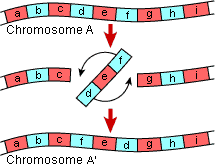
Which type of chromosome mutation is this (use image) and why?
a)
Inversion, because the genes are switching places with those of another chromosome
b)
Translocation, because the genes are switching places with those of another chromosome
c)
Inversion, because the genes of the same chromosome are switched to opposite orders
d)
Translocation, because the genes of the same chromosome are switched to opposite orders
18.

Transcribe the following DNA sequence:
TAT GGC ACT
TAT GGC ACT
a)
TAT GGC ACT
b)
ATA CCG TGA
c)
AUA GGC UGA
d)
UAU GGC ACU
19.
Where does transcription occur in eukaryotic cells?
a)
Nucleus
b)
Ribosome
c)
Cytoplasm
d)
Rough E.R.
20.
What is the complementary tRNA anticodon to the following mRNA codon: AUG
a)
UAC
b)
TAC
c)
ATG
d)
AAC
21.
The genetic code is essentially the same for all organisms. From this, one can logically assume which of the following?
a)
The same codons in different organisms translate into the different amino acids.
b)
A gene from an organism can theoretically be expressed by any other organism.
c)
All organisms have experienced convergent evolution.
d)
DNA was the first genetic material.
22.

What is this?
a)
karyotype
b)
pedigree
c)
Venn diagram
d)
Punnett Square
23.
Increases the fluidity of the plasma membrane
a)
more saturated fatty acids
b)
more unsaturated fatty acids
c)
more cholesterol
d)
more integral proteins
24.
chemical that acts as a signal when it binds to a protein
a)
ligand
b)
aquaporin
c)
integrin
d)
actin
25.
What happens to a RBC when it is put into a hypertonic solution?
a)
it swells
b)
it shrinks
c)
it stays the same size
d)
it breaks
26.
What are alleles
a)
different forms of the same gene
b)
an alternate step of the cell cycle
c)
body cells
d)
another name for gametes
27.

When an area of a chromatid is exchanged with the matching area on a chromatid of its homologous chromosome, _________________ occurs
a)
crossing over
b)
mutagenesis
c)
hybridization
d)
fertilization
28.
A haploid cell has
a)
one-half of a set of chromosomes
b)
one set of chromosomes
c)
two sets of chromosomes
d)
four sets of chromosomes
29.
What is meant that DNA replication follows a “semi-conservative” model?
a)
After DNA replication, each strand contains one side that is a parental strand and the other side is a daughter strand.
b)
After DNA replication, one completed strand contains only parental DNA while the other contains only daughter DNA.
c)
None of these identify the “semi-conservative” model.
d)
After DNA replication, one completed strand contains a mixture of both parental DNA and daughter DNA dispersed throughout the strand.
30.
How does mitosis in plant cells differ from mitosis in animal cells?
a)
animal cells form a cell plate
b)
plant cells form a cell plate
c)
plant cells go through the process in reverse
d)
plant cells go through two rounds of mitosis while animal cells just do one
31.

Structure (b) is a ____.
a)
chromosome
b)
chromatid
c)
centromere
32.
Why do cells go through cell division
a)
Growth
b)
Reproduction
c)
Repair
d)
All of the above
33.
Human eggs and sperm are _____, and each has ____ chromosomes.
a)
diploid, 23
b)
diploid, 46
c)
haploid, 23
d)
haploid, 46
34.
Trisomy is a genetic disorder that ________
a)
has three sets of chromosomes
b)
has three copies of a particular chromosome
c)
that is curable
d)
none of the above
35.
Meiosis results in ______.
a)
4 genetically distinct haploid gametes
b)
2 genetically distinct cells
c)
2 genetically identical cells
d)
4 genetically identical cells
36.

Fruit fly body cells have 8 chromosomes. After mitosis, you would expect a resulting fruit fly daughter cell to have ...
a)
16 chromosomes.
b)
46 chromosomes.
c)
8 chromosomes.
d)
4 chromosomes.
37.
A student isolates, purifies, and combines in a test tube a variety of molecules needed for DNA replication. After adding some DNA to the mixture, replication occurs, but each DNA molecule consists of a normal strand paired with numerous segments of DNA a few hundred nucleotides long. What has the student probably left out of the mixture?
a)
DNA polymerase
b)
DNA ligase
c)
Okazaki fragments
d)
primase
38.
Plant cells have ___ for cell to cell communication.
a)
gap junctions
b)
plasmodesmata
c)
desmosomes
d)
tight junctions
39.
Prokaryotes are classified as belonging to two different domains. What are they?
a)
Bacteria & Protista
b)
Bacteria & Archaea
c)
Bacteria & Eukarya
d)
Archaea & Protista
40.
A chemical reaction that has a positive ΔG (free energy) is best described as
a)
entropic
b)
spontaneous
c)
endergonic
d)
exergonic
41.
Large numbers of ribosomes are present in cells that specialize in producing which of the following molecules?
a)
glycogen
b)
cellulose
c)
proteins
d)
lipids
42.
The difference between pinocytosis and receptor-mediated endocytosis is that
a)
pinocytosis requires cellular energy, but receptor-mediated endocytosis does not.
b)
pinocytosis brings only water molecules into the cell, but receptor-mediated endocytosis brings in other molecules as well.
c)
pinocytosis is nonselective in the molecules it brings into the cell, whereas receptor-mediated emdocytosis offers more selectivity.
d)
pinocytosis increases the surface area of the plasma membrane whereas receptor-mediated endocytosis decreases the plasma membrane surface area.
43.
Which is not a part of a signal transduction pathway?
a)
response
b)
transcription
c)
transduction
d)
receptor
44.
Positive feedback differs from negative feedback in that
a)
positive feedback systems have control centers that are lacking in negative feedback systems.
b)
the positive feedback's effector responses are in the same direction as the inititiating stimulus producing an intensified response.
c)
positive feedback benefits the organism, whereas negative feedback is detrimental.
d)
the effector's response increases some parameter,such as body temperature, whereas in negative feedback it can only decrease the parameter.
45.
Of the following, a receptor protein in a membrane that recognizes a chemical signal or ligand is most similar to
a)
a metabolic pathway operating within a specific organelle.
b)
an enzyme having an optimum pH and temperature for activity.
c)
tRNA specifying which amino acids are in a polypeptide.
d)
the active site of an enzyme that binds to a specific substrate.
46.
The body's automatic tendency to maintain a constant and optimal internal environment is termed
a)
estivation.
b)
homeostasis.
c)
physiological chance.
d)
static equilibrium.
47.

Which temperature and pH profile curves on the graphs were most likely generated from analysis of an enzyme from a human stomach where conditions are strongly acid?
a)
curves 2 & 5
b)
curves 1 & 5
c)
curves 1 & 4
d)
curves 2 & 4
48.
Compare & contrast competitive and noncompetitive inhibition. Provide examples of each. Diagrams may be used to support your explanation but using diagrams only will not earn you any points.
a)
1
b)
1
49.
Describe the process of protein synthesis beginning with the nucleolus and every organelle until it the modified protein is released as secretory vesicle.
a)
1
b)
1
50.
Choose the pair of terms that correctly completes this sentence: Catabolism is to anabolism as __ is to __.
a)
exergonic; endergonic
b)
free energy; entropy
c)
work; energy
d)
exergonic;spontaneous
51.
What is meant by the description "antiparallel" regarding the strands that make up DNA?
a)
The twisting nature of DNA creates nonparallel strands.
b)
One strand is positively charged and the other is negatively charged.
c)
The 5' to 3' direction of one strand runs counter to the 5' to 3' direction of the other strand.
d)
Base pairings create unequal spacing between the two DNA strands
52.
Which scientist(s) stated that DNA contains phosphorus while proteins contain sulfur?
a)
Meselson & Stahl
b)
Hershey & Chase
c)
Watson & Crick
d)
Franklin & Watkins
53.
Which scientist(s) mixed a heat-killed pathogenic strain of bacteria with a living nonpathogenic strain can convert some of the living cells into the pathogenic form?
a)
Griffith
b)
Watson & Crick
c)
Meselson & Stahl
d)
Chargaff
54.
In E. coli, there is a mutation in a gene called dnaB that alters the DNA helicase that normally acts at the origin. Which of the following would you expect as a result of this mutation?
a)
Replication will occur via RNA polymerase alone.
b)
The DNA will supercoil.
c)
No replication fork will be formed.
d)
No proofreading will occur.
55.
What is the flow of genetic information in cells from DNA to protein? (Central Dogma)
a)
RNA to DNA to protein
b)
DNA to RNA to protein
c)
protein to DNA to RNA
d)
RNA to protein to DNA
56.
Which of these nitrogenous bases is NOT in DNA?
a)
Uracil
b)
Thymine
c)
Cytosine
d)
Guanine
57.
RNA is read in sections called:
a)
Triplets
b)
Genes
c)
Codons
d)
Genes
58.
Which of the following is the driving force for facilitated diffusion?
a)
Concentration gradient
b)
ATP hydrolysis
c)
ADP hydrolysis
d)
Phosphorylation
59.
Which of the following is the driving force for simple diffusion?
a)
Concentration gradient
b)
ATP hydrolysis
c)
ADP hydrolysis
d)
Phosphorylation
60.
In a hypothetical study, cells are placed in a solution of glucose in which the concentration of glucose is gradually increased. At first, the rate at which glucose enters the cells is found to increase as the concentration of the glucose solution is increased. But when the glucose concentration of the solution is increased above 10 M, the rate no longer increases. Which of the following is the likely mechanism for glucose transport into these cells?
a)
Facilitated diffusion via a carrier protein
b)
Facilitated diffusion via a channel protein
c)
Pinocytosis
d)
Tertiary active transport
61.

Which way would the purple molecules move through the semi-permeable membrane?
a)
From the A side to the B-side
b)
From the B side to the A side
c)
none of the purple molecules would move
d)
they would move equally back and forth in a state of dynamic equilibrium
62.
Which of the following relate to vaccines?
a)
weakened or dead pathogens
b)
cause antibodies to be produced
c)
help boost an organism's immunity
d)
all of these
63.
The cell membrane is solid and rigid.
a)
true
b)
false
64.
A saltwater snail is placed in freshwater. What happens to its cells?
a)
They shrink
b)
They swell
c)
Nothing happens
65.
How do the cell membranes of a hibernating animal change in colder temperatures?
a)
They release all of their peripheral membrane proteins
b)
Saturated fatty acids are more tightly packed
c)
Integral membrane proteins increase in number
d)
Unsaturated fatty acids make up more of the lipid composition
66.
The difference between osmosis and diffusion is that
a)
diffusion is passive transport, whereas osmosis is active transport
b)
only in diffusion do molecules move from areas of high concentration to areas of low concentration
c)
osmosis is the opposite of diffusion and only involves the movement of water
d)
osmosis refers specifically to the movement of water, whereas diffusion refers to the movement of any type of molecules
67.
If a hospital patient is mistakenly given an IV of pure water instead of a saline solution that is isotonic to blood, the patient’s red blood cells will
a)
shrink and collapse
b)
release water to the plasma along its concentration gradient
c)
absorb water from the plasma and eventually burst
d)
transport equal amounts of water across the cell membrane in both directions
68.
The reactions of the Calvin cycle require all of the following except __.
a)
RuBP
b)
glucose
c)
CO2
d)
NADPH
69.
Which of the following shows the correct sequence of the cell cycle?
a)
Mitosis-> G1->S->G2->cytokinesis
b)
S->G1-> G2-> mitosis-> cytokinesis
c)
cytokinesis->mitosis->G1->S->G2
d)
G1->S->G2->mitosis->cytokinesis
70.
Which of the following is not a part of interphase?
a)
G2
b)
M
c)
G1
d)
S
71.
DNA is replicated during ______ of the cell cycle.
a)
G1
b)
S
c)
G2
d)
G0
72.

sequence
a)
C,D, B, A, F, E
b)
D,A,F,C,E,B
c)
B,E,C,F,A,D
d)
C,B,D,A E,F
73.
In which phase of mitosis do the sister chromatids line up on the equator of the cell?
a)
Prophase
b)
Metaphase
c)
Anaphase
d)
Telophase
74.
Why does sprinting lead to a burn in the muscles?
a)
The lack of oxygen leads to lactic acid fermentation
b)
The lack of oxygen leads to alcohol fermenation
c)
The increased oxygen consumption speeds up cellular respiration, overheating the muscles
d)
The decreased oxygen production overwhelms the signal proteins in your lungs
75.

What molecules are missing from the calvin cycle shown.
a)
NADPH and Glucose
b)
CO2 and NADPH
c)
FADH2 and NADH
d)
Glucose and water
76.
Which of the following is not necessary for ATP production during the electron transport chain?
a)
NADH
b)
FADH2
c)
A H+ concentration gradient
d)
NADPH
77.
At what point in cellular respiration is the majority of the NADH produced?
a)
Glycolysis
b)
Pyruvate Oxidation
c)
Citric Acid Cycle
d)
Electron Transport Chain
78.
The process of engulfing a bacterium or virus particle by a macrophage is known as
a)
Phagocytosis
b)
Pinocytosis
c)
T cell
d)
Dendritic cell
79.
The protein that sits on pathogenic surfaces and elicits an immune response is known as
a)
antigen
b)
histamine
c)
antibody
d)
anticytosis
80.
Which of the following is characteristic of the lytic cycle?
a)
A large number of phages are released at a time
b)
The virus-host relationship usually lasts for generations
c)
Viral DNA is incorporated into the host genome
d)
The viral genome replicates without destroying the host
81.
HIV attacks and kills which of the following?
a)
Plasma B cells
b)
Memory B cells
c)
Helper T cells
d)
Cytotoxic T cells
82.
Which organelle has cristae?
a)
chloroplast
b)
Golgi apparatus
c)
lysosome
d)
mitochondria
83.
Which of the following is true about organisms' surface area to volume ratio?
a)
the higher the SA/V ratio, the better
b)
the lower the SA/V ratio, the better
c)
villi decrease the SA/V ratio of the small intestine
d)
the volume of a cell determines the amount of substances that can enter and leave a cell
84.
Which of the following organelles are NOT found in prokaryotes?
a)
ribosomes
b)
plasma membrane
c)
flagella
d)
mitochondria
85.
What is the primary role of the golgi apparatus?
a)
concentrate, package and sort proteins
b)
make proteins
c)
break down macromolecules
d)
produce ATP
86.
At a specific area of a chromosome, the sequence of nucleotides below is present where the chain opens to form a replication fork:
3' C C T A G G C T G C A A T C C 5'
An RNA primer is formed starting at the red T of the template. Which of the following represents the primer sequence?
3' C C T A G G C T G C A A T C C 5'
An RNA primer is formed starting at the red T of the template. Which of the following represents the primer sequence?
a)
5' G C C T A G G 3'
b)
5' A C G U U A G G 3'
c)
5' A C G T T A G G 3'
d)
3' G C C T A G G 5'
87.
The genetic code is essentially the same for all organisms. From this, one can logically assume which of the following?
a)
The same codons in different organisms translate into the different amino acids.
b)
A gene from an organism can theoretically be expressed by any other organism.
c)
All organisms have experienced convergent evolution.
d)
DNA was the first genetic material.
88.
The function of DNA polymerase I is to ____.
a)
add nucleotide complements to the growing strand.
b)
remove the RNA primer.
c)
bond the Okazaki fragments together on the lagging strand.
d)
keep the DNA strands from reforming after DNA helicase "unzips" them.
89.
What is the function of telomeres on a DNA strand?
a)
They are used as a recognition site for DNA helicase to bond & begin "unzipping" the strand for replication.
b)
They bond the Okazaki fragments together forming a continuous replication of DNA on the lagging strand.
c)
When cell continually replicate, the DNA gets shorter so by adding telomeres to the ends of DNA, they extend the life of a cell.
d)
They help untangle the DNA strand prior to DNA helicase's arrival to unzip the DNA strand, readying it for replication.
90.
Where do the light-dependent reactions occur?
a)
thylakoid membrane
b)
stroma
c)
mesophyll
d)
mitochondria
91.
What is the primary function of the light reactions of photosynthesis?
a)
To produce glucose
b)
To produce NADPH and ATP
c)
To use ATP
d)
To produce RuBP
92.
Which of the following is NOT a product of the light reactions?
a)
ATP
b)
NADPH
c)
Oxygen
d)
Glucose
93.

What supplies the electrons that are lost in PS I?
a)
the electrons from PS II
b)
water
c)
glucose
d)
oxygen
94.
Which of the following is directly associated with Photosystem I?
a)
harvesting light energy to make ATP
b)
receiving electrons from the thylakoid membrane ETC
c)
generation of molecular oxygen
d)
extraction of hydrogen electrons from the splitting of water
95.
Organic chemistry is a science based on the study of
a)
functional groups.
b)
vital forces interacting with matter.
c)
carbon compounds.
d)
inorganic compounds.
96.

Which molecule is an carboxyl group?
a)
Molecule A
b)
Molecule B
c)
Molecule C
d)
Molecule D
97.
Which of the following best summarizes the relationship between dehydration reactions and hydrolysis?
a)
Hydrolysis only occurs in the urinary system, and dehydration reactions only occur in the digestive tract.
b)
Hydrolysis creates monomers, and dehydration reactions break down polymers.
c)
Dehydration reactions can occur only after hydrolysis.
d)
Dehydration reactions assemble polymers, and hydrolysis breaks down polymers.
98.
Alpha helix and beta pleated sheets are part of what level of protein structure?
a)
primary
b)
secondary
c)
tertiary
d)
quaternary
99.
Turn down for
a)
nothing
b)
what
c)
why
d)
how
100.
Some bacteria move by using a long, whip-like structure called a(n) ____________________
a)
tail
b)
cillia
c)
organs
d)
flagellum
101.
Three types of bacteria exchange DNA are
a)
transfrormation, conjugation, transduction
b)
mutations, reduction, translocation
c)
transformation, translation, conjugation
d)
binary fission, translocation, conjugation
102.

A calico cat shows both the traits for orange fur and black fur. What kind of allele expression is this?
a)
Incomplete Dominance
b)
Co dominance
c)
Independent assortment
d)
Recessive inheritance
103.
What type of inheritance do two alleles have if their traits blend together?
a)
Incomplete Dominance
b)
Co-Dominance
c)
Mendelian Inheritance
d)
Homozygous Inheritance
104.

A red flowered plant (RR) breeds with a White flowered plant (WW). The gene for petal color in these plants expresses incomplete dominance. What percentage of the offspring will have pink (RW) flowers?
a)
0%
b)
25%
c)
50%
d)
100%
105.

A roan cow shows co-dominance in fur color (orange and white). What is the phenotype ratio expected if a roan cow and a roan steer mate together?
a)
4: Orange and White
b)
1: Orange : 1 White
c)
2 Orange: 2 Orange and White: 0 White
d)
1: Orange: 2 Orange and White: 1 White
106.
A breed of chicken shows codominance for feather color. One allele codes for black feathers, another codes for white feathers. The feathers of heterozygous chickens of this breed will be:
a)
all black
b)
all white
c)
all gray
d)
speckled black and white
107.
In some carnations, flower color exhibits codominance. When crosses, Red (R) and white (W) flowers make speckled flowers (RW) that show both colors.
Complete a cross between A speckled flower and a red flower. Find the phenotype ratio.
Complete a cross between A speckled flower and a red flower. Find the phenotype ratio.
a)
2 red: 2 speckled: 0 white
b)
4 red: 0 speckled: 0 white
c)
0 red: 4 speckled: 0 white
d)
0 red: 2 speckled: 2 white
108.
Snap dragon color is a incomplete dominant trait. A red flower (RR) is crossed with white flower (WW)? What color are flowers that are RW?
a)
Red
b)
Red and White
c)
White
d)
Pink
109.

What percentage of the female offspring will be a carrier for this recessive disease?
a)
0%
b)
50%
c)
100%
d)
25%
110.

What percentage of the offspring will have this recessive disease?
a)
0%
b)
25%
c)
50%
d)
75%
111.
Hemophilia is a sex-linked recessive trait found on the x chromosome. Complete a cross between a woman who is a carrier and a man who is normal.
What are the chances, if they have a daughter, that she is a carrier?
What are the chances, if they have a daughter, that she is a carrier?
a)
100%
b)
75%
c)
50%
d)
25%
Reset

