
 Worksheets
Photosynthesis, Plant Adaptations, Xylem, & Turgor Pressure
Total questions: 102
Worksheet time: 1hrs 12mins
Name
Class
Date
1.
Which of the following is the correct equation for PHOTOSYNTHESIS?
a)
CO2 + light + H2O --> O2 + Sugar
b)
CO2 + sugar + H2O --> O2 + light
c)
O2 + light + H2O --> CO2 + Sugar
d)
CO2 + O2 + H2O --> Light+ Sugar
2.
What process occurs when light energy is captured in autotrophs and converted into sugar?
a)
Photosynthesis
b)
Cellular Respiration
3.
What is the ultimate ORIGINAL source of energy for living things
a)
Sugar
b)
Sun
c)
Moon
d)
Carbon Dioxide
4.
Which organisms perform Photosynthesis?
a)
Only Autotrophs
b)
Only Heterotrophs
c)
Autotrophs and Heterotrophs
5.
Which of the following is an example of an AUTOTROPH?
a)
Appletree
b)
Dog
c)
Mushroom
d)
Human
6.
Which of the following is an example of a HETEROTROPH?
a)
Grass
b)
Algae
c)
Lemon Tree
d)
Bear
7.
What is the pigment in chloroplasts that performs photosynthesis?
a)
Chlorosynthesis
b)
Chlorophyll
c)
ADP
d)
Electron Transport
8.
Which gas is removed from the atmosphere during photosynthesis?
a)
hydrogen
b)
oxygen
c)
nitrogen
d)
carbon dioxide
9.
What are the products of photosynthesis?
a)
water and carbon dioxide
b)
oxygen and glucose
c)
oxygen and carbon dioxide
d)
oxygen and water
10.
Plants need ________ for photosynthesis
a)
oxygen
b)
soil
c)
carbon dioxide
d)
sugar
11.
What is photosynthesis?
a)
The process in which humans eat their food
b)
When a photographer takes a photo.
c)
To get your pictures from the photo lab.
d)
The process in which plants make their food.
12.
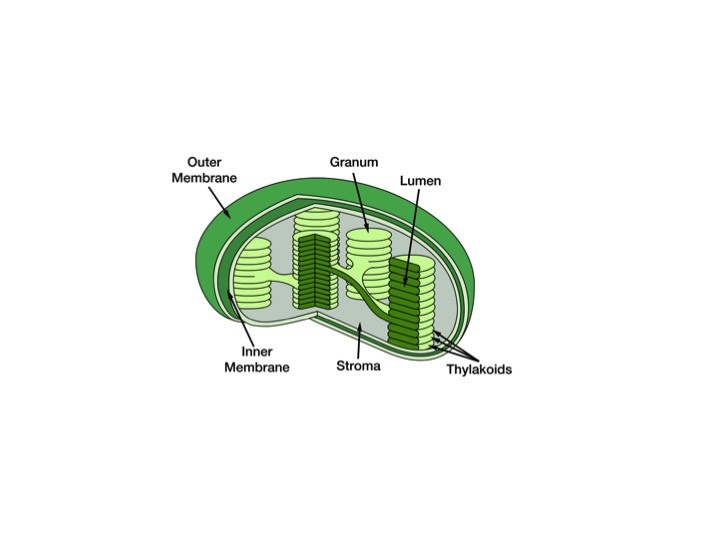
Chloroplasts are...
a)
Structures of animal cells to produce ATP
b)
Organelles where lipids are elaborated
c)
Specialized structures of plants where food is made
d)
Waste organelle of plants
13.
Leaves look green because.....
a)
they eat their vegetables
b)
to blend into their environment
c)
they contain a molecule named chlorophyll
d)
they are sick
14.

Which organelle from the plant cell is primarily responsible for converting sunlight to energy?
a)
Mitochonria
b)
Nucleus
c)
Vacuole
d)
Chloroplast
15.

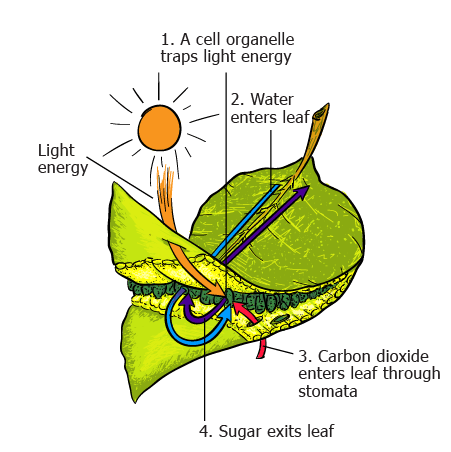
What process is the diagram representing?
a)
Photosynthesis
b)
Soil development
c)
Plant reproduction
d)
Nitrogen Cycle
Nitrogen cycle
Nitrogen cycle
16.

What is produced as a result of photosynthesis?
a)
Glucose and Chlorophyll
b)
Glucose and Oxygen
c)
Water and Light energy
d)
Carbon dioxide and Water
17.

If all four plants were watered daily but placed in a closet, receiving no sunlight, what process would NOT occur?
a)
Ingestion of carbon dioxide
b)
Filtration of water through the soil
c)
Photosynthesis
d)
Water absorbtion
18.
Look at the image
What substances and organelle work together to absorb sunlight to perform photosynthesis in this example?
What substances and organelle work together to absorb sunlight to perform photosynthesis in this example?
a)
cell wall and chloroplast
b)
mitochondria and water
c)
vacuole and carbon dioxide
d)
chloroplast and chlorophyll
19.

Most plants appear green because chlorophyll
a)
absorbs green light.
b)
absorbs violet light.
c)
reflects green light.
d)
does not absorb violet light.
20.

The reactants of photosynthesis are
a)
sugar and water.
b)
sugar and oxygen.
c)
carbon dioxide and water.
d)
carbon dioxide and oxygen.
21.

Which statement about photosynthesis is correct?
a)
Plants get the energy they need for photosynthesis from water.
b)
Plants get the energy they need for photosynthesis from soil.
c)
Plants get the energy they need for photosynthesis from sunlight.
d)
Plants do not require energy to perform photosynthesis.
22.

What are the products of photosynthesis?
a)
Carbon dioxide and water
b)
Carbon dioxide and oxygen
c)
Glucose and oxygen
d)
Glucose and water
23.

Which of the following is the correct equation for PHOTOSYNTHESIS?
a)
6CO2 + 6H2O --> 6O2 + C6H12O6
b)
6CO2 + C6H12O6 + 6H2O --> O2
c)
6O2 + 6H2O --> 6CO2 + C6H12O6
d)
C6H12O6 + 6O2 ---> 6H2O + 6CO2
24.

Most plants appear green because chlorophyll
a)
absorbs green light.
b)
absorbs violet light.
c)
does not absorb green light.
d)
does not absorb violet light.
25.
Small grains that contain a plant's male reproductive cells.
a)
stamen
b)
pollen
c)
pistil
d)
stigma
26.

Small leaf-like structures forming an outer circle at the base of a flower.
a)
petals
b)
sepal
c)
stigma
d)
pistil
27.
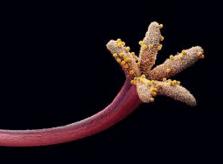
The part of the flower on which the pollen grains land.
a)
pistil
b)
stamen
c)
sepals
d)
stigma
28.
Brightly colored parts of flowers that attract insects.
a)
petals
b)
pistils
c)
stamen
d)
filaments
29.
They enclose the egg cells inside the ovaries.
a)
ovules
b)
anther
c)
seeds
d)
stamen
30.
The transfer of pollen to the female part of the flower.
a)
seed disperal
b)
pollination
c)
germination
d)
fertilization
31.
The male part of the flower is________
a)
pistil
b)
sepal
c)
ovaries
d)
stamen
32.
Stem
a)
supports the plant
b)
A flower
c)
Part of a flower
d)
A plant
33.
chlorophyll
a)
green pigment
b)
A liquid
c)
Type of texture
d)
All of above
34.
Leaves
a)
make food for the plant.
b)
on a tree
c)
on a plant
d)
in nature
35.
Fruit
a)
protects and holds the seeds
b)
Vegetable
c)
Food
d)
All of them
36.
This part holds the plant steady in the ground and sucks up water and nutrients
a)
Roots
b)
Stem
c)
Leaves
d)
Flowers
37.
Roots perform all of the following functions EXCEPT
a)
Carrying out the light reactions of photosynthesis
b)
Anchoring the plant in the soil
c)
Absorbing water and nutrients from the soil
d)
Storing water and minerals
38.
Movement in response to lights coming from one direction is called what?
a)
Phototropism
b)
Nastic response
c)
Gravitropism
d)
Photoperiodism
39.
Movement of the plant in response to touch is called what?
a)
Gravitropism
b)
Thigmotropism
c)
Photoperiodism
d)
Phototropism
40.
Movement of the plant in response to gravity is called what?
a)
Gravitropism
b)
Thigmotropism
c)
Photoperiodism
d)
Phototropism
41.
Movement of the plant in response to gravity is called what?
a)
Geotropism
b)
Thigmotropism
c)
Photoperiodism
d)
Phototropism
42.
Response to an external stimulus in a specific direction is called what?
a)
Tropism
b)
Petiole
c)
Meristem
d)
Root cap
43.
Most plants appear green because chlorophyll
a)
absorbs green light.
b)
absorbs violet light.
c)
reflects green light.
d)
does not absorb violet light.
44.
A student is collecting the gas given off from a plant in bright sunlight at a temperature of 27°C. The gas being collected is probably ________.
a)
oxygen
b)
carbon dioxide
c)
ATP
d)
glucose
45.
If carbon dioxide is completely removed from a plant’s environment, what would you expect to happen to the plant’s production of high-energy sugars (rate of photosynthesis)?
a)
Sugar production will likely increase.
b)
Sugars will not be produced.
c)
The rate of sugar production will decrease .
d)
Fewer sugars will be produced at first, but then the plant will recover.
46.
The raw materials or "ingredients" of photosynthesis are
a)
sugar and water.
b)
sugar and oxygen.
c)
carbon dioxide and water.
d)
carbon dioxide and oxygen.
47.
An example of Gravitropism is
a)
a sunflower turning to the sun
b)
roots of a plant growing down
c)
ivy plants clinging to a tree trunk
d)
a cactus in the dessert, storing water
48.
Plants adapt to their environment
a)
to help them survive in dry climates.
b)
to help them thrive in wet, crowded environments.
c)
to help protect against plant eating animals.
d)
all of the above
49.

A cactus can live in the desert because of this adaptation:
a)
has wide flat leaves to catch water
b)
has shallow roots
c)
thick, waxy leaves help it store water
50.

The sundew......
a)
has sticky leaves covered with sweet smelling liquid that traps bugs
b)
Catches its prey
c)
collects water
d)
has spiny leavs
51.
What is a trait?
a)
plant
b)
an adaptation
c)
a characteristic or feature
52.

The Prickly Pear Cactus can grow in a dry environment because.....
a)
it is able to store water
b)
it has spiny leaves
c)
is carnivorous
d)
collects salt
53.

The bald cypress tree has
a)
knees that help is stand in water
b)
spiny leaves that protect it from animals
c)
leaves shaped to prevent water loss
d)
poisons to protect it from animals
54.

The long leaf pine depends on ......... to help its seeds grow.
a)
bare soil left after a fire
b)
animals to spread seeds
c)
butterflies
d)
birds
55.
A trait that helps a living thing survive is called an _______.
a)
trait
b)
adaptation
c)
survive
d)
reproduce
56.
What is the process of producing food for a plant?
a)
Photosynthesis
b)
food
57.

How are hardwood trees adapted to live in cold winters?
a)
They have long stems buried in mud.
They have long stems buried in mud.
They have long stems buried in mud.
b)
They live on tree islands.
c)
They lose their leaves in winter.
They lose their leaves in winter.
They lose their leaves in winter.
d)
They grow low to the ground.
58.
What type of vascular tissue is responsible for transporting water from the roots to the leaves?
a)
Cuticle
b)
Phloem
c)
Stomata
d)
Xylem
59.
What type of vascular tissue is responsible for transporting the sugars made in photosynthesis from the leaves to the roots?
a)
Cuticle
b)
Phloem
c)
Stomata
d)
Xylem
60.

What type of tropism is seen here?
a)
hydrotropism
b)
gravitropism
c)
thigmotropism
d)
phototropism
61.

What type of tropism is seen here with the ivy plant and the wooden stake?
a)
phototropism
b)
gravitropism
c)
thigmotropism
d)
hydrotropism
62.

What type of tropism is seen here?
a)
thigmotropism
b)
hydrotropism
c)
phototropism
d)
gravitropism
63.
A growth response of a plant toward or away from a stimulus
a)
Nastism
b)
Tropism
c)
Photosynthesis
d)
Transpiration
64.
Tia looked at a leaf under a microscope and noticed a number of pores on its surface. These pores are called __________________
a)
cells
b)
veins
c)
stomata
d)
chlorophyll
65.
Which feature would be most helpful to a plant in a desert?
a)
small leaves
b)
large seeds
c)
small roots
d)
smelly flowers
66.
A plant growing in response to the sunlight.
a)
Gravitropism
b)
Phototropism
c)
Thigmotropism
d)
Hydrotropism
67.
The shoot of a plant growing up.
a)
Positive Gravitropism
b)
Negative Gravitropism
c)
Thigmotropism
d)
Hydrotropism
68.
The root of a plant growing down.
a)
Positive Gravitropism
b)
Negative Gravitropism
c)
Thigmotropism
d)
Hydrotropism
69.
This is produced by the plant to protect the seeds and is something we can eat...
a)
Fruit
b)
Flower
c)
Seed
d)
Stem
70.
What is the name of the process in which extra water exits the leaf?
a)
stomata
b)
epidermis
c)
transpiration
d)
photosynthesis
71.
What part of the flower will turn into a fruit?
a)
petal
b)
ovary
c)
ovule
d)
stamen
72.
Gases pass in and out of a leaf through the what?
a)
vascular tissue
b)
mouth hole
c)
stomata
d)
cell wall
73.

Which type of tropism?
a)
hydrotropism
b)
thigmotropism
c)
phototropism
d)
gravitropism
74.
Cells that control the opening and closing of stomata
a)
Cuticle
b)
Guard cell
c)
Vascular tissue
d)
Stomata
75.

What type of tropism is seen here?
a)
hydrotropism
b)
phototropism
c)
gravitropism
d)
thigmotropism
76.

What type of tropism is seen here?
a)
thigmotropism
b)
hydrotropism
c)
phototropism
d)
gravitropism
77.
The function of a ___ is to absorb water, store food, and anchor plants.
a)
phloem
b)
tissue
c)
xylem
d)
root
78.
The main function of the leaves of a plants is....
a)
carry out photosynthesis
b)
support the plant
c)
get water to all plant parts
d)
anchor the plant
79.

What is one possible reason for seeds to have hooks of barbs?
a)
to stay warm during the winter
b)
to protect themselves from sunlight
c)
to get attached to passing animals and get carried away
d)
to stick to animals and steal nutrients from them
80.

Some trees shed their leaves in time for winter. Why is this adaptation useful?
a)
The trees save energy during the darker, colder months.
b)
The trees take in more sunlight through their branches.
c)
The trees attract animals to spread their seeds.
d)
The trees blend into their environment and hide.
81.

Why might some plants that grow on the shady rain forest floor have large leaves?
a)
to stay safe from predators
b)
to attract different animals
c)
to survive harsh winters with heavy snowfall
d)
to take in as much sunlight as possible
82.

Why might some plants have thorns?
a)
to stay safe from animals that want to eat the plant
b)
to attract insects that spread pollen to other plants
c)
to take in nutrients from the air
d)
to provide shade for the plant
83.

The rose of Jericho grows in dry areas. It curls up and stays DORMANT until there is enough water. What does DORMANT mean?
a)
flowering
b)
not active
c)
dead
d)
dried
84.
Some grasses grow in hot dry areas. Why might they grow deep roots?
a)
to protect the plant from sun damage
b)
to take in as much light as possible
c)
to spread seeds to new places
d)
to reach water down below
85.

what is the function of xylem tissue?
a)
transports water and minerals salt
b)
control the opening and closing of stoma
c)
carry out photosynthesis
d)
provide support for young plant
86.

what is the function of phloem tissue?
a)
transport water and minerals
b)
support plants
c)
photosynthesis process occur
d)
transport organic nutrients
87.

This picture represents which type of tropism?
a)
Thigmotropism
b)
Geotropism
c)
Hydrotropism
d)
Phototropism
88.
Which type of tropism involves a flower following the sun to obtain the most amount of light?
a)
Geotropism
b)
Thigmotropism
c)
Hydrotropism
d)
Phototropism
89.
In thigmotropism, what is the stimulus and the response?
a)
Stimulus: sunlight; response: growing towards light
b)
Stimulus: touch; response: leaves fold up
c)
Stimulus: gravity; response: roots growing downward
d)
Stimulus: water; response: roots growing toward water
90.
The root of a plant growing down.
a)
Geotropism
b)
Negative Gravitropism
c)
Thigmotropism
d)
Hydrotropism
91.
A stimulus is ___________
a)
a change in an organisms surroundings that causes a reaction
b)
process in which organisms grow larger.
c)
a reaction to a change in surroundings
d)
the result of sexual reproduction.
92.
The roots of a plant help anchor the plant into the soil. Which of the following are helpful to ensure that the plant's roots are growing in the right direction?
a)
phototropism
b)
thigmotropism
c)
turgor pressure
d)
geotropism
93.

Why do plants wilt?
a)
low turgor pressure
b)
high turgor pressure
c)
too much water
d)
no cell membrane
94.
What in the world is turgor pressure?
a)
How much care the plant receives from farmers
b)
How much carbon dioxide is in the vacuole of a plant cell
c)
When the vacuoles of plant cells swell up with water and make the plant rigid
d)
How much soil is being used to plant the crop
95.

What does this picture represent?
a)
thigmotropism
b)
Phototropism
c)
Hydrotropism
d)
Geotropism
96.
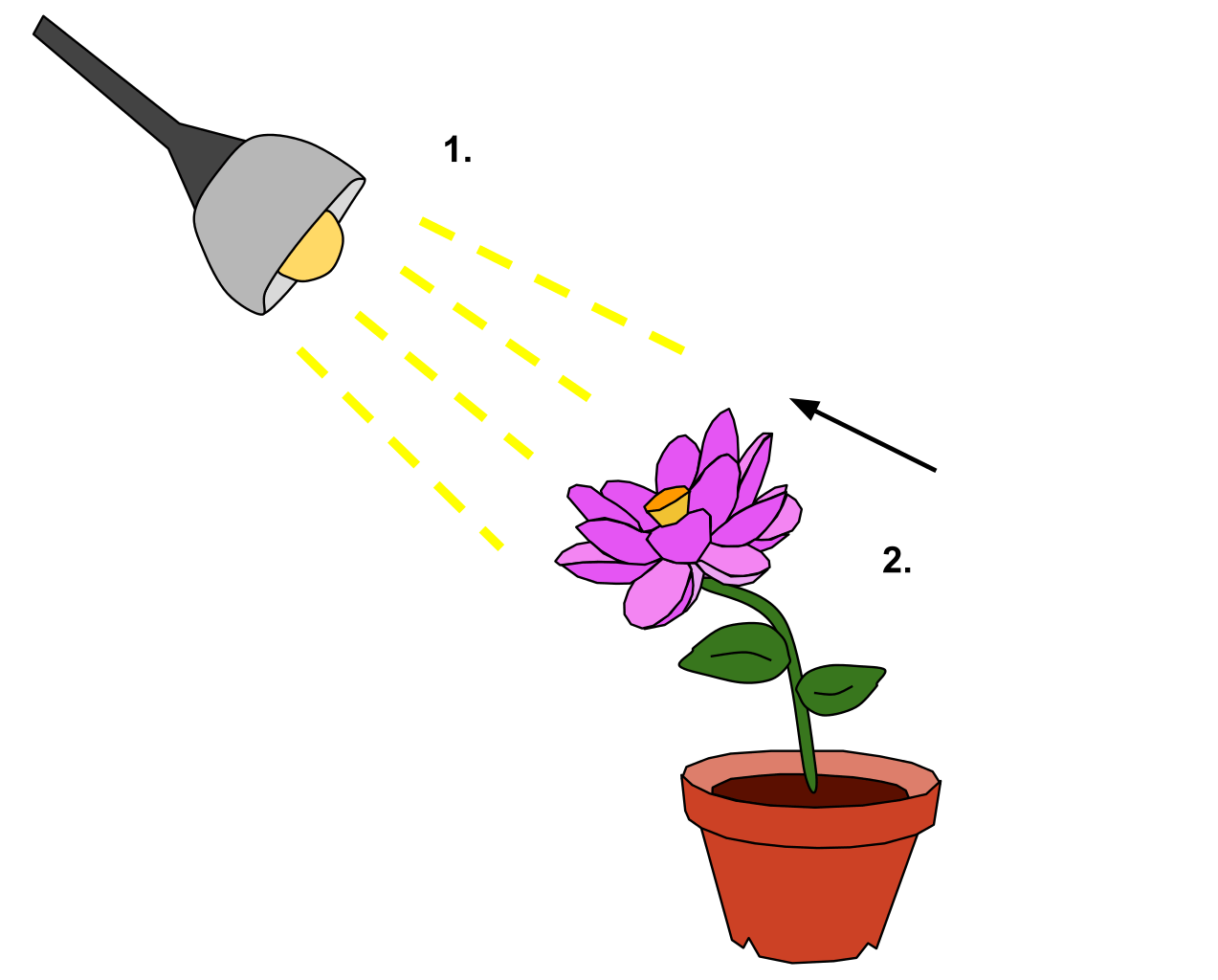
What does this picture represent?
a)
thigmotropism
b)
Phototropism
c)
Hydrotropism
d)
Geotropism
97.
What is the correct stimulus for hydrotropism?
a)
Gravity
b)
Touch
c)
Water
d)
Sunlight
98.
Which of the following is a stimulus?
a)
a red light
b)
a fire alarm
c)
a change in air pressure
d)
all of the above
99.
Cause: Effect::
a)
homeostasis : stimulant
b)
reflex : response
c)
response : fever
d)
stimulus : response
100.
What is a stimulus?
a)
A reaction to an event
b)
A change that causes a reaction
c)
A change that is caused by an action
d)
A rare disease
101.

Which plant has more turgor pressure and how can you tell?
a)
Plant A because it is full
b)
Plant B because it is full
c)
Plant A because it is wilting
d)
Plant B because it is wilting
102.
Vegetables are often sprayed with water in grocery stores.
What will happen to the cells? They will -
What will happen to the cells? They will -
a)
undergo plasmolysis
b)
increase in turgor pressure
c)
crenate
d)
become hypotonic
100 %

