wayground logo

Free Printable Worksheets

Font size

S
M
L
XL
Worksheets

Enviro Final Review

Total questions: 100

Worksheet time: 1hrs 6mins

Name
Class
Date
1.
Which BEST describes how coal forms?
a)
dead plant material completely decomposes in a desert environment
b)
tiny sea animals and plants die and are buried by sediment 
c)
dead plant material temporarily decays in a swamp environment
d)
dead animals partially decay in a desert environment
2.
What is a non renewable resource?
a)
water
b)
wind
c)
coal
d)
biomass
3.
What are the 3 main fossil fuels?
a)
Coal, Oil, and Gasoline
b)
Coal, Oil, and Natural Gas
c)
Electricity, Gasoline, Petroleum
d)
Coal, Oil, Non-renewable Resources
4.
Oil and natural gas were formed from ___________________
a)
marine organisms
b)
dead plants
c)
trees
5.
Fossil fuels are classified as nonrenewable because they.......
a)
require expensive equipment
b)
take millions of years to replace
c)
can be found all over 
d)
provide all the energy we use
6.
What are fossil fuels?
a)
Dinosaur bones
b)
Resources made from once living organisms 
c)
Combination of different rocks
d)
Gas Stations
7.
Where did the energy for fossil fuels come from?
a)
Animals
b)
Plants
c)
Sun
d)
Chemosynthesis
8.
Why is burning fossil fuels harmful? 
a)
then we won't have any fossil fuels if we burn them all
b)
They can get extremely hot
c)
Increases the amount of greenhouse gases in the air
d)
this would destroy fossils
9.
Which technology converts solar energy into electricity?
a)
Photovoltaic cells/ Solar panels
b)
Solar still
c)
Generator
d)
All of them
10.
Why is solar energy considered renewable energy?
a)
It's cheaper than fossil fuels
b)
The sun's energy would not run out for billions of years
c)
Solar energy recharges batteries
d)
All of them
11.
What are the following devices called?
a)
Turbines
b)
Mills
c)
Converters
d)
All of them
12.
Where will it be better to place a wind turbine? Where will it receive more wind?
a)
On top of a hill/mountain
b)
On the bottom of a hill/mountain
c)
Is the same
d)
I don't know
13.
Which one of these is not renewable?
a)
Trees
b)
Wind
c)
Solar
d)
Uranium
14.
What is the disadvantage of coal?
a)
Air Pollution
b)
Not much left
c)
World does not use much
d)
It is only used to roast hot dogs
15.
What is a disadvantage of wind power?
a)
We have too many rainy days in US
b)
It is not always windy in some places
c)
Companies charge too much to make the wind blow
d)
The sun is not always out
16.
Nuclear power is energy created from
a)
Helium
b)
Wood
c)
Uranium
d)
Iron
17.
Geothermal energy is energy from 
a)
the sun
b)
heat from deep in the earth
c)
wind
d)
inexhaustable
18.
What is the process used in nuclear reactors today to generate energy called?
a)
Nuclear Fusion
b)
Nuclear Fission
c)
Nuclear Generation
d)
Nuclear Chemical Synthesis
19.
Which environmental issue occurred in 1986 in Chernobyl, Ukraine.
a)
Smog
b)
Noise Pollution
c)
Nuclear Power Plant Explosion
d)
Acid Rain
20.

About how long ago did the disaster in Chernobyl happen?

a)

3 months

b)

3 years

c)

30 years

d)

300 years

21.
Hydropower uses _________ to turn turbines that run generators.
a)
steam
b)
moving water
c)
uranium
d)
tides
22.
One advantage of tidal power is -
a)
it can be used anywhere
b)
tides are predictable
c)
tidal power does NOT need a back up source
d)
it is available ALL day
23.
Which is NOT an example of Biomass?
a)
wood
b)
crops
c)
wind
d)
animal and yard waste
24.
Which of these sets of three items produce CFCs
a)
cars, factories, and cardboard
b)
spray cans, cardboard, insulation
c)
spray cans, refrigerant, cardboard
d)
spray cans, refrigerant, insulation
25.
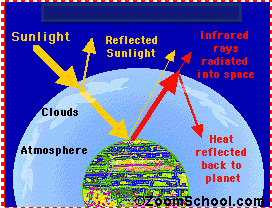
What does this diagram illustrate?
a)
Ozone Layer
b)
The Greenhouse Effect
c)
Ultraviolet Radiation
d)
Layers of the atmosphere
26.
What do we call gases such as carbon dioxide, methane, nitrous oxide, water vapor, and ozone in the atmosphere which are involved in the greenhouse effect?  
a)
Bad Gases
b)
Ozone Gases
c)
Greenhouse Gases
d)
Atmospheric Gases
27.
What chemical is responsible for breaking up the ozone?
a)
CFCs
b)
Carbon Dioxide
c)
Nitrogen
d)
Oxygen
28.
The Montreal Protocol banned the use of CFCs. What so they hope this will do for the ozone layer?
a)
Deplete it completely
b)
Make the ozone hole smaller
c)
Make the ozone hole larger
d)
Thin the layer to allow more gas to escape
29.
How do changes in the ocean affect coral reefs?
a)
Warm, acidic water causes coral to bleach and then die
b)
Coral reefs grow faster in warmer water
c)
Warmer water supports fish that like to eat coral, destroying the reefs
d)
Coral reefs aren't affected by changes in temperature and acidity
30.
Things you can do to help decrease global warming include:
a)
Eat more ice cream.
b)
Keep your freezer door open.
c)
Keep your air conditioner on high.
d)
Turn off your lights when you’re not using them.
31.
Melting of glaciers and polar ice caps....
a)
will result in cooler temperatures in the Arctic
b)
will result in sea-levels rising
c)
Will have no effect on ecosystems
d)
None of the above
32.
What is the average weather for a particular time and region called?
a)
drought
b)
weather
c)
emissions
d)
climate
33.
What is the definition of weather?
a)
a period of abnormally dry weather that lasts at least 2 years
b)
the specific condition of the atmosphere at a particular place and time
c)
a complex community of organisms and the community's environment
d)
a release of toxic gas
34.
This is the word for a disease causing organism.
a)
Phagocyte
b)
Pathogen
c)
Pandemic
35.

______ may encourage certain diseases to spread by expanding into areas that were once cooler.

a)

Climate change

b)

The CDC

c)

Mobility

d)

Water

36.

In the United States it is the _____ which is the primary national center for responding to emerging diseases.

a)

WHO

b)

U.S. Dept. of Health

c)

Child Development & Family Services

d)

CDC

37.

What pollutant causes black lung disease?

a)

lead

b)

pesticides

c)

coal dust

d)

bacteria

38.

Toxicology is used to determine

a)

the classification of a pathogen.

b)

the vectors of a disease.

c)

how poisonous a substance is.

d)

what emerging viruses cause disease.

39.

Construction of irrigation canals and dams has enabled the spread of infectious diseases by

a)

providing a site for waste disposal.

b)

eliminating pathogens’ natural predators.

c)

allowing viruses to evolve.

d)

increasing the habitat for vectors.

40.

After an outbreak of an illness, scientists use epidemiology to try to find

a)

the origin of the disease

b)

how the disease spreads

c)

how to prevent the spread of the disease

d)

all of the above

41.

The environment is an important factor in the spread of cholera and dysentery because

a)

air can carry the pathogens.

b)

water provides a habitat in which the pathogens breed.

c)

the pathogens reproduce in soil.

d)

the disease is transmitted by mosquitoes.

42.

Pollutants that are used in agriculture and landscaping and might cause nerve damage, birth defects, and cancer in humans are ____________________.

a)

pesticides

b)

vectors

c)

particulates

d)

plants

43.

DDT is known as a(n) ____________________ pesticide because it breaks down slowly in the environment.

a)

persistent

b)

inevitable

c)

unceasing

d)

unbreakable

44.

The damage to health that results from exposure to a given dose is called ____________________.

a)

response

b)

dose

c)

curve

d)

epidemiology

45.

Much of the pollution in our environment is a byproduct of inadequate _________________________.

a)

food supply

b)

waste disposal

c)

mosquito breeding plants

d)

spread of pathogens

46.
In what year did Earth Day begin?
a)
1950
b)
1960
c)
1970
d)
1980
47.
Identify the process shown in this diagram.
a)
Extinction
b)
Toxin Accumulation
c)
Pollution
d)
Biomagnification
48.
The process when concentrations of a harmful substance increases in organisms at higher trophic levels in a food chain or food web.
a)
Biomagnification
b)
Predation
c)
Extinction
d)
Accumulation
49.
An aquifer is a(n)
a)
well in which water rises because of pressure
b)
underground layer of rock or sediment that holds water
c)
type of hot spring from which the water periodically erupts
d)
place where groundwater bubbles or flows out of cracks in the rock
50.
Most water pollution is the result of __________________.
a)
natural processes
b)
animal waste
c)
human activities
d)
acid rain
51.
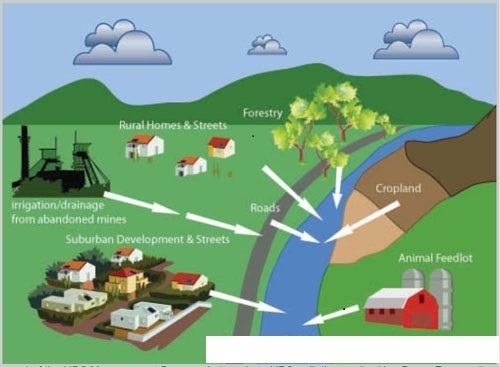
___________________ washes agricultural wastes, including animal wastes, fertilizers, and pesticides, into bodies of water, causing algae to grow.
a)
Runoff
b)
Peak flow
c)
Groundwater
d)
Municipal sewage
52.
Wastes produced by agriculture, households, industry, mining, and other human activities can end up in ______________.
a)
groundwater
b)
streams and rivers
c)
oceans
d)
All of these choices
53.
The water and human wastes that are washed down sinks, showers, and toilets are called __________________.
a)
the water cycle
b)
sewage
c)
thermal pollution
d)
point pollution sources
54.
When reservoirs are polluted by an indirect source, it is called?
a)
Non Point source pollution
b)
Point Source pollution
55.
The circulation of the earth's water, in which water evaporates from the sea into the atmosphere, where it condenses and falls as rain or snow, returning to the sea by rivers or returning to the atmosphere by evapo-transpiration is called the...
a)
carbon cycle
b)
nitrogen cycle
c)
water cycle
d)
rock cycle
56.

______________________ is pollution that comes from many different sources or locations.

a)

biomagnification

b)

point source pollution

c)

nonpoint source pollution

d)

wastewater

57.
______________________ is water waste discharge from a single source.
a)
nonpoint source pollution
b)
wastewater
c)
point source pollution
d)
pathogen
58.

Fertilizer, sewage, and animal feces can wash in to water, leading to...

a)

thermal pollution

b)

eutrophication

c)

desalination

d)

biomagnification

59.

______________________ is when there is an increase in the overall temperature of a body of water and most commonly results from power plants using water for cooling purposes.

a)

artificial eutrophication

b)

biomagnification

c)

toxic wastewater

d)

thermal pollution

60.
What is the main source of noise pollution in urban areas?
a)
Transportation
b)
Factories
c)
Agriculture
d)
Music
61.
Sound that affects the quality and/or health of human life
a)
Light pollution
b)
Air pollution
c)
Noise pollution
d)
Acid shock
62.
Causes stress, high blood pressure, hearing loss
a)
Light pollution
b)
Noise pollution
c)
Indoor air pollution
d)
Sick building syndrome
63.
Can occur in tightly sealed buildings
a)
Light pollution
b)
Noise pollution
c)
Sick building syndrome
d)
Long-term effects of air pollution
64.
Sources include plastics, carpets, cleaning fluids, radon, and asbestos
a)
Light pollution
b)
Noise pollution
c)
Indoor air pollution
d)
Sick building syndrome
65.
Headache, eye irritation, coughing, bronchitis
a)
Short-term effects of air pollution
b)
Long-term effects of air pollution
c)
Light pollution
d)
Noise pollution
66.
Emphysema, lung cancer, heart disease
a)
Short-term effects of air pollution
b)
Long-term effects of air pollution
c)
Noise pollution
d)
Light pollution
67.
Which is a natural indoor air pollutant? 
a)
Carbon monoxide
b)
Formaldehyde
c)
Nitrogen oxides 
d)
Radon
68.
Which is true of air pollution and human health? 
a)
Years of research link air pollution to lung diseases.
b)
Air pollution is commonly listed as a cause of death.
c)
None of the health effects of air pollution are reversible.
d)
Healthy adults are most affected by air pollution.
69.
Which air pollutant scars the lungs? 
a)
Asbestos
b)
Radon
c)
Fungi
d)
Ozone
70.
Which gas exists in the highest concentration in the Earth's atmosphere?
a)
Hydrocarbons
b)
Ozone
c)
Oxygen
d)
Nitrogen
71.
Which of the following is not a likely result of global warming?
a)
Rising sea level
b)
Increased agricultural productivity worldwide
c)
Worsening health effects
d)
Increased storm frequency and intensity
72.

There is definitely a relationship between ____ & ____.

a)

carbon dioxide and temperature

b)

oxygen and helium

c)

nitrogen and temperature

d)

carbon dioxide and nitrogen

73.

In the ____ & ____, the Northern Hemisphere is tilted away from the Sun.

a)

fall and winter

b)

winter and spring

c)

fall and summer

d)

spring and summer

74.

As water temperatures _____________, storm activity has intensified.

a)

increases

b)

decreases

c)

speed up

d)

slow down

75.

What is global warming?

a)

Every place in the world getting hotter

b)

The average temperature of all places on Earth rising

c)

Nothing, it's fake

d)

The world getting colder

76.

How are humans contributing to global warming?

a)

Using too much fossil fuels, releasing carbon dioxide into atmosphere

b)

Overpopulation, too much body heat from humans

c)

Breathing, because we breathe out carbon dioxide

d)

Too much clothing being made

77.

How are humans contributing to global warming?

a)

Using too much fossil fuels, releasing carbon dioxide into atmosphere

b)

Overpopulation, too much body heat from humans

c)

Breathing, because we breathe out carbon dioxide

d)

Too much clothing being made

78.

In the 1800's why did CO2 levels increase significantly?

a)

New factories were being built that caused more pollution

b)

The civil war caused more pollution

c)

Scientists figured out how to clean up pollution in the air

d)

It did not increase

79.

97% of scientists believe what is causing climate change?

a)

Animals and Plants

b)

Eco-Friendly Cars

c)

Humans

d)

Conservation of energy

80.

Why do we want to use more renewable energy sources?

a)

They cause more pollution

b)

They will go away if we don't use them

c)

They cause less pollution

d)

They are easier to create

81.

David Attenborough is known for his work on

a)

the book "Silent Spring"

b)

the documentary "An Inconvenient Truth"

c)

the series "Planet Earth"

d)

poems about Walden Pond

82.

President who created the US Forest Service and several National Parks

a)

Teddy Roosevelt

b)

Donald Trump

c)

Al Gore

d)

Steve Irwin

83.
you can save water in the bathroom by making sure toilets and sinks 
a)
run all night
b)
do not leak
c)
drip constantly
d)
freeze
84.
How could pesticides get into lakes and streams?
a)
too much could be used
b)
it could be sprayed too close to a stream
c)
rain could wash pesticides into a stream
d)
all of the above
85.
Most freshwater is ________________.
a)
in aquifers
b)
frozen in ice caps and glaciers
c)
in the atmosphere as water vapor
d)
found in lakes
86.
Organisms that can cause illness or disease when in your drinking water are called 
a)
Antigens
b)
Recharge zone
c)
Porosity
d)
Pathogens
87.
An area of the Earth’s surface from which water percolates down into an aquifer is called a
a)
Surface water
b)
Recharge zone
c)
Potable
d)
Dam
88.
As streams and rivers cross land, they form a flowing network of water called a 
a)
Groundwater
b)
River system.
c)
Floodgate
d)
Recharge zone
89.
is water found on Earth’s land surfaces
a)
Surface water 
b)
Sea water
c)
Salt water
d)
Permeability
90.
When the temperature of a body of water, such as a lake or stream, increases, ___________ can occur
a)
Thermal pollution
b)
Point source pollution
c)
Wastewater
d)
Groundwater
91.
Water that is safe to drink is called 
a)
Permeable
b)
Sea water
c)
Potable
d)
Passable
92.
 A _______ is a structure built across a river to control the river’s flow
a)
Dam
b)
Desalination
c)
Levee
d)
Point source pollution
93.
When the nuclei of certain isotopes (atoms) are unstable and spontaneously decompose, this is called ________________.
a)
radioactive
b)
a melt down
c)
ionization
d)
half-life
94.

What is true of the waste generated by nuclear power?

a)

Causes air pollution

b)

Causes acid rain

c)

Emits greenhouse gases

d)

Remains hazardous for a long time

95.

Which renewable energy does not require spinning a turbine?

a)

hydroelectric

b)

wind

c)

tidal

d)

photovoltaic cells

96.

A home is built with clear glass panels that allow sunlight to pass through. This is an example of

a)

Active solar

b)

Passive solar

c)

Parabolic collector

d)

Photovoltaic Cells

97.

a home is fitted with pumps that pipe water to the roof of the home to be heated by the sun. This is an example of

a)

passive solar

b)

active solar

c)

parabolic collector

d)

photovoltaic cell

98.

which of the following is not a biofuel or a biomass?

a)

wood

b)

ethanol from corn

c)

dung

d)

methane

99.

fuel cells that use a chemical reaction to generate electricity are using

a)

hydrogen gas

b)

methane gas

c)

water

d)

oil

100.
Efficiency is...
a)
The percentage of energy that is actually used to do work
b)
The stuff in the walls that keeps energy in