
 Worksheets
AP Biology Exam Review
Total questions: 115
Worksheet time: 2hrs 2mins
Name
Class
Date
1.
Where does glycolysis occur?
a)
Inner mitochondrial membrane
b)
Mitochondrial Matrix
c)
Cytosol
d)
At a ribosome
2.
Cellular respiration involves the net _______ of glucose.
a)
Reduction
b)
Oxidation
c)
ATP
d)
REDOX
3.
Where does ETC occur?
a)
Mitochondrial matrix
b)
Outer mitochondrial membrane
c)
Inner mitochondrial membrane
d)
Cytosol
4.
Imagine you are performing a cross involving seed color in garden pea plants. What F1 offspring would you expect if you cross true-breeding parents with green seeds and yellow seeds? Yellow seed color is dominant over green.
a)
100 percent yellow-green seeds
b)
100 percent yellow seeds
c)
50 percent yellow, 50 percent green seeds
d)
25 percent green, 75 percent yellow seeds
5.
If black and white true-breeding mice are mated and the result is all gray offspring, what inheritance pattern would this be indicative of?
a)
dominance
b)
codominance
c)
multiple alleles
d)
incomplete dominance
6.
A recessive trait will be observed in individuals that are ________ for that trait.
a)
heterozygous
b)
homozygous or heterozygous
c)
homozygous
d)
diploid
7.
Meiosis results in ______.
a)
4 genetically distinct haploid gametes
b)
2 genetically distinct cells
c)
2 genetically identical cells
d)
4 genetically identical cells
8.

When an area of a chromatid is exchanged with the matching area on a chromatid of its homologous chromosome, _________________ occurs
a)
crossing over
b)
mutagenesis
c)
hybridization
d)
fertilization
9.
The observable outward manifestation of the genes of an individual is referred to as its
a)
blueprint
b)
genotype
c)
phenotype
d)
genetic map
10.
In humans, if a non-disjunction event leads to an individual that is XXY, they would
a)
be female because they have 2 X chromosomes
b)
be male because they have a Y chromosome
c)
not survive
d)
have both male and female characteristics
11.
In humans, hemophilia is an X-linked recessive trait. If a man and a woman have a son who is affected with hemophilia, which of the following is definitely true?
a)
The mother carries an allele for hemophilia
b)
The father carries an allele for hemophilia
c)
The father is afflicted with hemophilia
d)
both parents carry an allele for hemophilia
12.

Which stages show is most responsible for the variation caused by independent assortment
a)
A
b)
D
c)
H
d)
J
13.

Which genetic abnormality does this baby have?
a)
Partial Deletion
b)
Partial Addition
c)
Trisomy
d)
Monosomy
14.

The red and blue pair of chromosomes in the bottom row are
a)
genetically identical
b)
carrying the same genes, but different alleles
c)
carrying completely different genes
d)
carrying the same genes and the same alleles
15.

Give the genotype for person III-3
a)
GG
b)
Gg
c)
gg
d)
Cannot determine
16.
Hemophilia is a recessive x-linked disorder.
Which genotype represents a male with hemophilia?
Which genotype represents a male with hemophilia?
a)
XHXh
b)
XhXh
c)
XHY
d)
XhY
17.
Snap dragon color is a incomplete dominant trait. A red flower (RR) is crossed with white flower (WW). What color are flowers that are heterozygous?
a)
Red
b)
Red and White
c)
White
d)
Pink
18.
Gametes are _________.
a)
Diploid
b)
Haploid
c)
Aneuploid
d)
variably ploidy
19.

If this image were real, it would represent what type of inheritance?
a)
incomplete dominance
b)
codominance
c)
polygenic inheritance
d)
compete dominance
20.
How is a molecule reduced?
a)
electrons are given to the molecule
b)
electrons are taken from the molecule
c)
money is taken from the molecule
d)
protons are given to the molecule
21.
Which molecule is responsible for carrying electrons to the Calvin Cycle during photosynthesis?
a)
NADPH
b)
NADH
c)
FADH2
d)
ATP
22.
How is a molecule oxidized?
a)
Electrons are added to the molecule
b)
Electrons are taken from the molecule
c)
Electrons are shared with the molecule
d)
Protons are added to the molecule
23.
During which phase of photosynthesis is O2 created?
a)
Light dependent reactions
b)
Calvin Cycle
c)
Citric Acid Cycle
d)
Glycolysis
24.
Why must plants keep their stomata closed during hot days?
a)
Open stomata release too much CO2, starving the plants.
b)
Open stomata release water, causing the plant to dry out.
c)
Open stomata cause the plant to lose access to CO2 molecules
d)
Open stomata lead to a buildup of O2 molecules in the cells.
25.

What energy production process is shown in the image?
a)
cellular respiration
b)
alcohol fermenation
c)
lactic acid fermenation
d)
citric acid cycle
26.
What energy production process is shown in the image?
a)
cellular respiration
b)
alcohol fermenation
c)
lactic acid fermenation
d)
citric acid cycle
27.
Why does sprinting lead to a burn in the muscles?
a)
The lack of oxygen leads to lactic acid fermentation
b)
The lack of oxygen leads to alcohol fermenation
c)
The increased oxygen consumption speeds up cellular respiration, overheating the muscles
d)
The decreased oxygen production overwhelms the signal proteins in your lungs
28.
Where does transcription occur in eukaryotic cells?
a)
Nucleus
b)
Ribosome
c)
Cytoplasm
d)
Rough E.R.
29.
What is the complementary tRNA anticodon to the following mRNA codon: AUG
a)
UAC
b)
TAC
c)
ATG
d)
AAC
30.
A certain gene codes for a polypeptide that is 120 amino acids long. Approximately how many nucleotides long is the mRNA that codes for this polypeptide likely to be?
a)
360
b)
480
c)
40
d)
30
31.

Transcribe the following DNA sequence:
TAT GGC ACT
TAT GGC ACT
a)
TAT GGC ACT
b)
ATA CCG TGA
c)
AUA GGC UGA
d)
UAU GGC ACU
32.

Translate the following RNA sequence:
AUG AAU UGU UGA
AUG AAU UGU UGA
a)
Met-Phe-Cys-Stop
b)
Met-Asn-Cys-Stop
c)
Met-Asn-Cys-Trp
d)
Tyr-Leu-Thr-Thr
33.

What is the complementary RNA sequence for the following:
ATC AAT CGT TAG
ATC AAT CGT TAG
a)
TAG TTA GCA ATC
b)
UAG UUA GCA AUC
c)
AUC AAU CGU UAG
d)
GCT GGC TAC CGA
34.
The genetic code is essentially the same for all organisms. From this, one can logically assume which of the following?
a)
The same codons in different organisms translate into the different amino acids.
b)
A gene from an organism can theoretically be expressed by any other organism.
c)
All organisms have experienced convergent evolution.
d)
DNA was the first genetic material.
35.
A frameshift mutation could result from
a)
a base insertion only.
b)
a base deletion only.
c)
a base substitution only.
d)
either an insertion or a deletion of a base.
36.
In eukaryotic cells, transcription cannot begin until
a)
the two DNA strands have completely separated and exposed the promoter.
b)
several transcription factors have bound to the promoter.
c)
the 5' caps are removed from the mRNA.
d)
the DNA introns are removed from the template.
37.
Original: ATC CAT
Mutation: ATC GCAT
What mutation occurred?
Mutation: ATC GCAT
What mutation occurred?
a)
deletion
b)
insertion
c)
silent
d)
transverse
38.
The "on/off" switch for an operon is called the
a)
promoter
b)
repressor
c)
operator
d)
gene
39.
In his work with pneumonia-causing bacteria & mice, Griffith found that
a)
the protein coat from pathogenic cells was able to transform nonpathogenic cells.
b)
heat-killed pathogenic cells caused pneumonia.
c)
some substance from pathogenic cells was transferred to nonpathogenic cells, making them pathogenic.
d)
the polysaccharide coat of bacteria caused pneumonia.
40.
In analyzing the number of different bases in a DNA sample, which result would be consistent with the base-pairing rules?
a)
A = G
b)
A + G = C + T
c)
A + T = G + G
d)
A = C
41.
Which of the following is not a part of interphase?
a)
G2
b)
M
c)
G1
d)
S
42.
DNA is replicated during ______ of the cell cycle.
a)
G1
b)
S
c)
G2
d)
G0
43.
Which of the following shows the correct sequence of the cell cycle?
a)
Mitosis-> G1->S->G2->cytokinesis
b)
S->G1-> G2-> mitosis-> cytokinesis
c)
cytokinesis->mitosis->G1->S->G2
d)
G1->S->G2->mitosis->cytokinesis
44.
When does crossing over occur?
a)
Interphase
b)
Prophase 1
c)
Prophase 2
d)
Metaphase 1
45.
What are alleles
a)
different forms of the same gene
b)
an alternate step of the cell cycle
c)
body cells
d)
another name for gametes
46.
If there are 30 chromosomes in the blood cells, how many chromosomes will be in the bone cells?
a)
15
b)
60
c)
30
d)
120
47.
If there are 48 chromosomes in the skin cells of an organism, how many chromosomes would be found in the organism's sperm cells?
a)
48
b)
24
c)
96
d)
12
48.
The chromosome of a bacterium...
a)
occurs in multiple pairs within the cell
b)
is wrapped around proteins
c)
has a circular shape
d)
is found within the nucleus
49.
DNA wraps around organizing proteins called:
a)
chromatin
b)
chromatid
c)
histones
d)
centromere
50.
Where does DNA synthesis happen in eukaryotic cells?
a)
cytoplasm
b)
mitochondria
c)
nucleus
d)
Golgi apparatus
51.
The cell cyle is regulated by...
a)
cyclins
b)
CDK's
c)
hormones
d)
CDK's and cyclins
52.
The condition in which there are barriers to successful interbreeding between individuals of different species in the same community is referred to as
a)
sexual dependency
b)
reproductive isolation
c)
geographic isolation
d)
adaptive radiation
53.
In a population that is in Hardy-Weinberg equilibrium, the frequency of a particular recessive allele a is .4. What is the percentage of the population heterozygous for this allele?
a)
4 percent
b)
16 percent
c)
32 percent
d)
48 percent
54.
The differences in sparrow songs among sympatric species of sparrows are examples of
a)
geographic isolation
b)
convergent evolution
c)
behavioral isolation
d)
mechanical isolation
55.
variations in a population are maintained by
a)
mutations
b)
genetic recombination
c)
gene flow
d)
all of the above
56.
which of the following is NOT a requirement for Hardy-Weinberg equilibrium?
a)
small population
b)
no gene flow
c)
no mutations
d)
no selection
57.
Which of the following is an example of gene flow?
a)
A subordinate wolf successfully challenges the alpha male and mates with pack females
b)
A deer picks up spores from a plant as it grazes and deposits them next to that plant.
c)
A young stallion is driven out of its herd by the alpha stallion and begins its own herd in another location
d)
All of these answers
58.

A common ancestor for both C and E could be at position __.
a)
1
b)
2
c)
3
d)
4
59.
Which statement correctly explains how resistance to penicillin appeared after a few years of its widespread use to fight bacterial infection?
a)
in order to survive exposure to penicillin, bacteria developed a resistance to the drug
b)
a few bacteria became resistant to penicillin, and through sexual reproduction , most bacteria acquired the resistance
c)
penicillin never really successfully wiped out populations of bacteria, scientist did not use proper controls in their studies
d)
some bacteria were resistant to penicillin and their population spread rapidly, without competition from bacteria that were killed by penicillin
60.
Why would a population with a large amount of genetic variation be more likely to survive a severe climate change in its environment?
a)
Individuals will only create offspring well-suited to the climate change
b)
The individuals would produce more offspring
c)
Individuals better suited to the new climate will help less-suited individuals survive
d)
Some individuals will posses traits better suited to the new climate and be more likely to pass them on
61.
Which of the following is not in Hardy-Weinberg equation?
a)
a population with non-random mating
b)
a population in which the allele frequencies do not change over time
c)
p2+2pq+q2=1
d)
a population undergoing natural selection
62.
Selective breeding of domesticated plants and animals to produce offspring with desired genetic traits
a)
Stabilizing selection
b)
Artificial selection
c)
Disruptive selection
d)
Directional selection
63.
All of the alleles in all the individuals that make up a population's fitness
a)
fitness
b)
gene pool
c)
gene flow
d)
genetic drift
64.
What type of macromolecule are enzymes?
a)
Protein
b)
Carbohydrate
c)
Lipid
d)
Nucleic Acid
65.
Enzymes need certain environmental conditions in order to function properly. What happens when enzymes are heated to a high temperature?
a)
they die
b)
they denature
c)
they change their amino acid sequence
d)
they work better
66.
Which of the following correctly describes how enzymes work?
a)
they lower the energy of the reactants to increase the rxn rate
b)
they supply energy to the reaction to increase the rxn rate
c)
they lower the energy of the products to increase the rxn rate
d)
they lower the activation energy of the reaction to increase the rxn rate
67.
Which enzyme breaks down hydrogen peroxide to water and oxygen gas?
a)
sucrase
b)
lactase
c)
catalase
d)
peroxidase
68.
Enzymes are made up of these repeating monomers.
a)
monosaccharides
b)
amino acids
c)
nucleotides
d)
phospholipids
69.
The part of the enzyme that the substrate bonds to is called the _____.
a)
active site
b)
activation energy
c)
bond site
d)
peptide bond
70.
What 3 letters do enzymes typically end in?
a)
-ose
b)
-ase
c)
-ese
d)
-tic
71.
Changes in pH and temperature can damage an enzymes active site. What is this called?
a)
reusable
b)
catalyst
c)
specific
d)
denature
72.
The energy needed to start a reaction
a)
activation energy
b)
adhesion energy
c)
chemical energy
d)
cohesion energy
73.

What is structure D?
a)
Substrate
b)
Active site
c)
Enzyme
d)
Products
74.

What is structure A?
a)
Substrate
b)
Active site
c)
Enzyme
d)
Products
75.

Which of the following conclusions can be drawn from this graph?
a)
The optimum pH of the enzyme is 6.6.
b)
The optimum pH of the enzyme is 5.8
c)
The enzyme’s activity increases as pH increases 5.0 to 9.0
d)
The enzyme’s activity is greater around pH of 8.0 .
76.
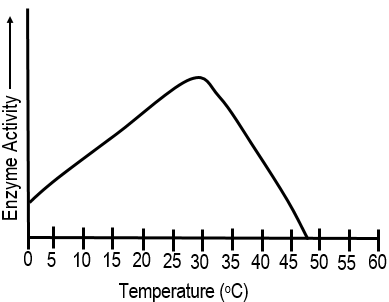
Based on the graph, what is the optimal temperature for this enzyme?
a)
15oC
b)
40oC
c)
30oC
d)
35oC
77.
Which of these is NOT true?
a)
Enzymes can denature (change shape) when the temperature gets too high.
b)
Enzymes can only be used once in a chemical reaction.
c)
Extreme pH can denature enzymes.
d)
Enzymes speed up chemical reactions.
78.
Which of these is most likely an enzyme?
a)
Sucrose
b)
Galactose
c)
Fructose
d)
Amylase
79.
Which of the following correctly describes enzyme structure and function?
a)
The shape of an enzyme is responsible for its function.
b)
All enzymes can bind to all substrates.
c)
The substrate is responsible for the shape of the enzyme.
d)
The location of an enzyme determines its function.
80.
Which statement is correct about diffusion?
a)
It's very rapid over long distances.
b)
It's a passive process which molecules move from a region of higher to lower concentration.
c)
It requires an energy expenditure by the cell.
d)
It's an active process where molecules move from a region of lower to higher concentration.
81.
Which describes the events of apoptosis?
a)
The cell's DNA & organelles become fragemented, the cell shrinks & forms blebs, the cell's parts are packaged in vesicles that are digested by cells like macrophages.
b)
The cell dies, it is lysed, its organelles are phagocytized, and its contents are recycled.
c)
The cell's DNA and organelles become fragmented, the cell dies, and it's phagocytized.
d)
The cell shrinks, dies, and the presence of its fragmented contents stimulate nearby cells to divide.
82.
Prokaryotes are classified as belonging to two different domains. What are they?
a)
Bacteria & Protista
b)
Bacteria & Archaea
c)
Bacteria & Eukarya
d)
Archaea & Protista
83.
Which structure is common to plant and animal cells?
a)
central vacuole
b)
chloroplast
c)
wall made of cellulose
d)
mitochondrion
84.
Which of the following is major cause of the size limits for certain types of cells?
a)
evolutionary progression in cell size; more primitive cells have smaller sizes.
b)
the need for sufficient surface area to support the cell's metabolic needs.
c)
limitation on the strength and integrity of the plasma membrane as cell size increases
d)
the difference in plasma membranes between prokaryotes and eukaryotes
85.
White blood cells engulf bacteria through what process?
a)
pinocytosis
b)
osmosis
c)
phagocytosis
d)
exocytosis
86.
A patient has had a serious accident and lost a lot of blood. In an attempt to replenish body fluids, distilled water-equal to the volume of blood lost-is transferred directly into one of his veins. What will be the most probable result of this transfusion?
a)
The patient's red blood cells will shrivel up because the blood fluid has become hypertonic compared to the cells.
b)
The patient's red blood cells will shrivel up because the blood fluid has become hypotonic compared to the cells.
c)
It will have no unfavorable effect as long as the water is free of viruses and bacteria.
d)
The patient's red blood cells will swell because the blood fluid has become hypotonic compared to the cells.
87.
A biologist ground up some plant leaf cells and then centrifuged the mixture to fractionate the organelles. Organelles in one of the heavier fractions could produce ATP in the light, whereas organelles in the lighter fraction could produce ATP in the dark. The heavier and lighter fractions are most likely to contain, respectively,
a)
mitochondria and chloroplasts.
b)
peroxisomes and chloroplasts.
c)
chloroplasts and peroxisomes.
d)
chloroplasts and mitochondria.
88.
Large numbers of ribosomes are present in cells that specialize in producing which of the following molecules?
a)
glycogen
b)
cellulose
c)
proteins
d)
lipids
89.
Which of the following would likely move through the lipid bilayer of a plasma membrane most rapidly?
a)
CO2
b)
an amino acid
c)
starch
d)
glucose
90.
Which is not a part of a signal transduction pathway?
a)
response
b)
transcription
c)
transduction
d)
receptor
91.
Positive feedback differs from negative feedback in that
a)
positive feedback systems have control centers that are lacking in negative feedback systems.
b)
the positive feedback's effector responses are in the same direction as the inititiating stimulus producing an intensified response.
c)
positive feedback benefits the organism, whereas negative feedback is detrimental.
d)
the effector's response increases some parameter,such as body temperature, whereas in negative feedback it can only decrease the parameter.
92.
O2
a)
osmosis
b)
carrier protein
c)
endocytosis
d)
simple diffusion
93.
What happens to a RBC when it is put into a hypertonic solution?
a)
it swells
b)
it shrinks
c)
it stays the same size
d)
it breaks
94.

Name the functional group (-OH) in the corner.
a)
carbonyl
b)
carboxyl
c)
hydroxyl
d)
methyl
95.
What makes a molecule polar?
a)
Equal sharing of valence electrons
b)
Unequal sharing of valence electrons
c)
Stealing of electrons
d)
Temporary charges that come and go
96.
Which biomolecule is mainly hydrocarbons and therefore very hydrophobic?
a)
carbohydrate
b)
nucleic acid
c)
protein
d)
lipid
97.
CO2 is an example of a(n) _____ bond.
a)
covalent
b)
adhesive
c)
ionic
d)
cohesive
98.
Which type of bonding causes all of water's unique properties?
a)
hydrogen bonding
b)
ionic bonding
c)
Van der Waals bonding
d)
covalent bonding
99.

Because water has a positively charged end and a negatively charged end, it can be described as
a)
amphipathic
b)
hydrophobic
c)
polar
d)
nonpolar
100.

The fact that ice floats on liquid water is due to the fact that water's solid is ___________ than it's liquid form
a)
less polar
b)
more polar
c)
less dense
d)
more dense
101.
Neurons are cells of the nervous system that receive and transmit signals. Which part of a neuron receives incoming messages from other cells and carry information to the cell body?
a)
axon
b)
dendrites
c)
neurotransmitters
d)
nucleus
102.
Which type of neuron receives signals/stimuli from the eyes, ears, nose, skin, or tongue and transmits this information to other neurons?
a)
sensory
b)
motor
c)
interneuron
d)
relay neuron
103.
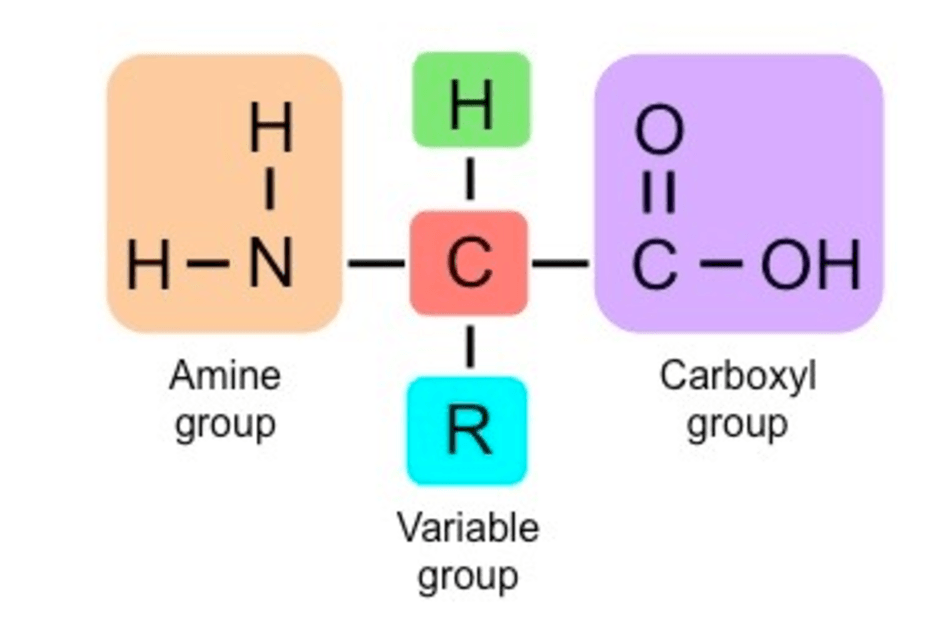
What is the monomer of a protein?
a)
amino acid
b)
monosaccharide
c)
fatty acid
d)
nucleic acid
104.
How many structures or stages are there in proteins?
a)
1
b)
2
c)
3
d)
4
105.
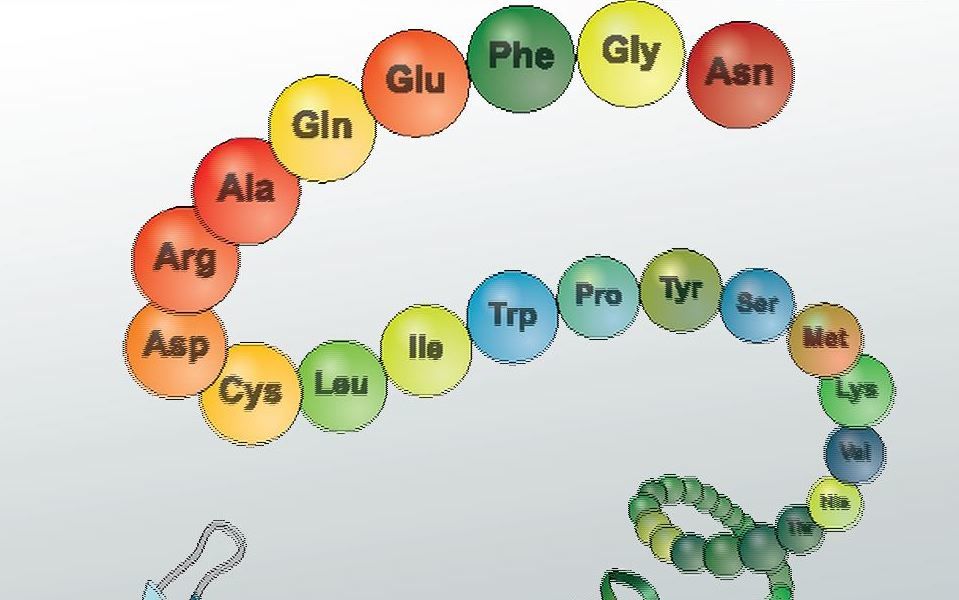
The name of the initial chain of monomers in a protein is called.....
a)
polypeptide
b)
polysaccharide
c)
polyester
d)
polynucleotide
106.
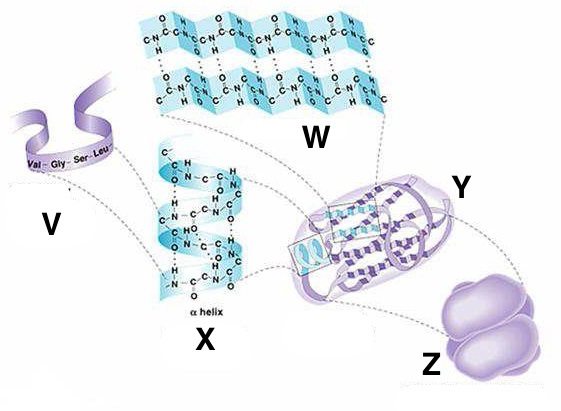
What is the function of a protein?
a)
cell energy
b)
enzymes and body tissue
c)
long term energy storage
d)
contain genetic information
107.
The main bonding in the secondary structure of a protein is due to.....
a)
covalent bonding
b)
ionic bonding
c)
hydrogen bonding
d)
polar bonding
108.
The two types of folding in the secondary structure are.....
a)
alpha-helix & beta-pleated sheets
b)
polypeptide & nucleotide
c)
globular & fibrous
109.
The tertiary structure folding in proteins is primary due to the interactions of....
a)
the 'R' groups
b)
the 'P' groups
c)
the 'A' groups
d)
the 'S'
110.
What gives a protein its unique shape?
a)
the unique sequence of amino acids in its polypeptide chain
b)
the unique folding due to the sequence of amnio acids in the polypeptide chain
c)
hydrogen bonding & unique interactions between the 'R' groups
d)
all of these
111.
Why is the order of amino acids so important?
a)
The order of amino acids dictates what shape the protein will fold into.
b)
It is not important. The protein folding chamber will force the protein to fold into the correct shape.
112.

What is the name of this molecule?
a)
amino acid
b)
nucleotide
c)
monosaccharide
d)
triglyceride
113.

The diagram shows the structure of an amino acid. Which type of molecule is formed from amino acids?
a)
lipids
b)
proteins
c)
carbohydrates
d)
nucleic acids
114.
All compounds that end in ASE are..
a)
Sugars
b)
Enzymes
c)
DNA
d)
Fats
115.
The bond between two amino acids is called...
a)
Peptide bond
b)
Amino acid bond
c)
Nothing. There isn't a name for it
d)
Hydrogen bond
100 %

