wayground logo

Free Printable Worksheets

Font size

S
M
L
XL
Worksheets

Spring Final Exam Review

Total questions: 127

Worksheet time: 3hrs 10mins

Name
Class
Date
1.
What do you call the process of charging a conductor by bringing it near another charged object?
a)
induction
b)
polarization
c)
neutralization
d)
conduction
2.
When a balloon is rubbed on clothes it acquires a charge by ___________
a)
Induction
b)
reduction
c)
friction 
d)
concuction
3.
In a good insulator, electrons are usually
a)
free to move around
b)
free to move around after an impurity has been added
c)
semi-free to move around
d)
tightly bound in place
4.
The amount of energy necessary to move a single charge in an electric field
a)
electric force
b)
electric field strength
c)
voltage
d)
conduction
5.
A(n) is material in which charges will move easily
a)
Conductor
b)
Insulator
c)
Vacuum
6.
The law of conservation of charge states that...
a)
all atoms have more protons than electrons
b)
only protons can be rubbed off of an atom
c)
charge cannot be created or destroyed
d)
charge cannot be transferred 
7.
The reason a charged balloon will stick to a wall is that
a)
the charge is slightly sticky and acts like glue
b)
electrons transfer back and forth between the wall and the balloon
c)
induced opposite charges in the wall are closer than other wall charges
d)
balloon material simply sticks to walls
8.
Charges A and B are identical positive charges located in the electrical field of a positively charged sphere, which statement is true. 
a)
the potential is the same at A and B.
b)
The potential at B is greater than the potential at A
c)
The Potential at B is less than the potential at A
d)
Cannot be determined
9.
The following graph is a correct representation of electric force with respect to distance.
a)
True 
b)
False
10.
The following graph is a correct representation of electric force with respect to distance.
a)
True 
b)
False
11.
The following graph is a correct representation of electric force with respect to distance.
a)
True 
b)
False
12.
The reason that a charged balloon can stick to a wall is because the wall is charged through
a)
conduction
b)
induction
c)
friction
d)
discharge
13.
If charge X applies an electric force F to the right on charge Y, then which of the following is a true statement about the electric force that Y applies to X
a)
equal to F to the right
b)
equal to F to the left
c)
equal to 2F to the right
d)
equal to 2F to the left
14.
Which of the following represents the energy per charge
a)
voltage
b)
work
c)
charge
d)
Force
15.
The following graph is a correct representation of electric force with respect to distance.
a)
True 
b)
False
16.
The following graph is a correct representation of electric force with respect to distance.
a)
True 
b)
False
17.
The distance between two charges doubles at the same time that the charge on each also doubles.  What happens to the electric force?
a)
doubles
b)
quadruples
c)
cut in half
d)
no change
18.
The diagram shows two identical charges, A, and B. Each charge has the same mass and the same magnitude of charge. Which diagram best represents the electrostatic force Fe and the gravitational force Fg acting on sphere A due to sphere B?
a)
1
b)
2
c)
3
d)
4
19.
The diagram shows two identical charges, A, and B. Each charge has the same mass and the same magnitude of charge. Which diagram best represents the electrostatic force Fe and the gravitational force Fg acting on sphere A due to sphere B?
a)
1
b)
2
c)
3
d)
4
20.
The diagram shows two identical charges, A, and B. Each charge has the same mass and the same magnitude of charge. Which diagram best represents the electrostatic force Fe and the gravitational force Fg acting on sphere A due to sphere B?
a)
1
b)
2
c)
3
d)
4
21.
The diagram shows two identical charges, A, and B. Each charge has the same mass and the same magnitude of charge. Which diagram best represents the electrostatic force Fe and the gravitational force Fg acting on sphere A due to sphere B?
a)
1
b)
2
c)
3
d)
4
22.
Which Force is greater?
a)
The force the proton experiences due to the electron (F1)
b)
The force the electron experiences due to the proton (F2)
c)
F1 is equal in magnitude to F2
23.
Which will experience a greater acceleration and why?
a)
The proton will experience a greater acceleration becasue it has a greater mass
b)
The electron will experience a greater acceleration because it has a smaller mass
c)
The proton will experience a greater acceleration since the force acting on it is greater
d)
The electron will experience a greater acceleration because the force acting on it is greater
24.
DC current is found in _______, which means the current flows in ________ direction
a)
Batteries, one
b)
Wall outlet, one
c)
Batteries, both
d)
Wall outlet, both
25.
Which of the following correctly identifies where to place the ammeter and voltmeter
a)
X:Voltmeter
Y: Ammeter
b)
X:Ammeter
Y:Voltmeter
26.
Will the light bulbs light or not light based on this circuit design?
a)
The light bulbs will light.
b)
The light bulbs will NOT light.
27.
What do the lines around this magnet represent?
a)
North Pole
b)
South Pole
c)
Magnetic Declination
d)
Magnetic Field
28.
If you cut a magnet in half, what happens to the poles?
a)
One half gets the North Pole, the other half gets the South Pole
b)
Both halves get only a North Pole
c)
Both halves get only a South Pole
d)
Both halves get a North pole and a South Pole
29.
An electromagnet's poles may be reversed by:
a)
decreasing the voltage of the coil
b)
increasing the number of coils
c)
changing the direction of current flow
d)
altering the material used to make the coils
30.
What kind of magnet can be turned on and off?
a)
refridgerator magnet
b)
electromagnet
c)
magnetite
d)
iron
31.
The strongest part of a magnet is...
a)
the bars.
b)
the force field.
c)
the poles. 
d)
the middle.
32.

It is possible for a magnet to have only one pole.

a)

True

b)

False

33.
Which of the following will induce a current in a nearby circuit? 
a)
any magnet 
b)
a stationary horseshoe magnet 
c)
a stationary electromagnet 
d)
a moving electromagnet 
34.
Voltage can be induced in a wire by
a)
moving the wire near a magnet.
b)
moving a magnet near the wire.
c)
changing the current in a nearby wire.
d)
all of these
35.
The direction of the current is west as show in the image. What is the direction of the magnetic field above the wire at point P?
a)
West
b)
East
c)
Into the page
d)
Out of the page
36.
Which diagram shows the current magnetic field around a current carrying wire that is directed into the page
a)
A
b)
B
c)
C
d)
D
37.
An electric motor converts
a)
mechanical energy to electrical energy
b)
electrical energy to mechanical energy
c)
electrical energy to heat 
d)
mechanical energy to heat
38.
An electric generator converts
a)
mechanical energy to electrical energy
b)
electrical energy to mechanical energy
c)
electrical energy to heat 
d)
mechanical energy to heat
39.
Which of the following is NOT a way to increase the strength of an electromagnet.
a)
Increase the current in the wire
b)
Increase the number of coils
c)
Add an Iron core
d)
rotate the coil in  magnetic field
40.
Which of the following is NOT a way to increase the induced current.
a)
Changing the strength of the magnetic field
b)
Changing the area in the magnetic field
c)
Changing the angle between the loop of wire and the magnetic field
d)
adding an iron core
41.
An iron nail becomes magnetic when
a)
positive ions gather at one end and negative ions at the other end
b)
positive charges line up on one side and negative charges on the other side
c)
the domains all point in the same direction
d)
the electrons stop moving and point in the same direction
42.
inducing a voltage by changing the magnetic field around around a conductors is called
a)
transformer induction
b)
generated voltage
c)
electromagnetic induction
d)
Faraday's radiation
43.
What is the direction of the force acting on the wire in the magnetic field.
a)
Upward
b)
downward
c)
Into the page
d)
Out of the page
44.
The diagram shows a current traveling in a wire. At which point is the magnetic field the weakest?
a)
A
b)
B
c)
C
d)
All Points have the same magnetic field
45.
The diagram shows a current coming out of the page. What is the direction of the magnetic field at point P?
a)
North
b)
South
c)
East 
d)
West
46.
A magnetic field can deflect a beam of electrons, but it cannot speed them up. Why?
a)
There is no magnetic force acting on the electrons
b)
electrons cannot be accelerated by anything
c)
the current creates a magnetic field
d)
the magnetic force is perpendicular to the direction of motion
47.
When does the magnetic field exert the greatest amount of force on a moving charge
a)
When the velocity is perpendicular to the magnetic field
b)
When the velocity is parallel to the magnetic field
c)
when the magnetic field is opposite to the vleocity
d)
when the magnetic field is directed clockwise
48.
Magnetic field lines about a current-carrying wire
a)
extend radially  from the wire
b)
circle the wire in closed loops
c)
both of these
d)
neither of these
49.
AC current is used in most household because
a)
There is less loss in energy by using AC over large distances
b)
AC voltage may be stepped up or stepped down
c)
AC current can use thinner wires than DC voltage with the same power output
d)
all options are correct
50.
What is our best evidence that Earth has a magnetic field?
a)
All things fall toward Earth's center
b)
A compass needle lines up with it
c)
Winds blow from east to west
d)
Earth's oceans all have currents
51.

This substance is

a)

magnetizecd

b)

unmagnetized

c)

positively charged

d)

negatively charged

52.

You know this substance is magnetized because

a)

all the domains have right angles

b)

the arrows are drawn in red

c)

the domains are aligned

d)

the domains are random

53.

To make this electromagnet stronger you could

a)

use less wire

b)

have fewer wire coils around the nail

c)

have more wire coils around the nail

d)

use a plastic core

54.
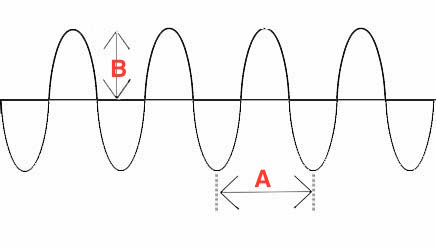
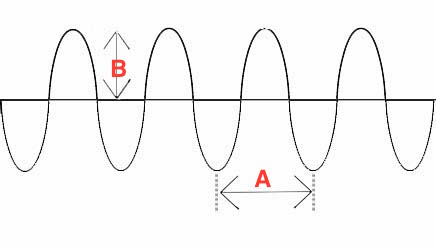
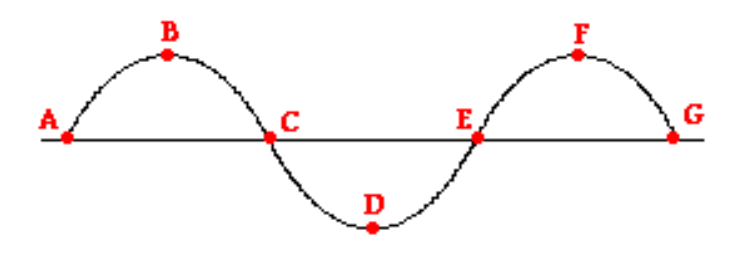
What property of this wave is represented by the letter "A"
a)
amplitude
b)
crest
c)
trough
d)
wavelength
55.
What property of the wave is represented by the letter "B"?
a)
amplitude
b)
crest
c)
trough
d)
wavelength
56.
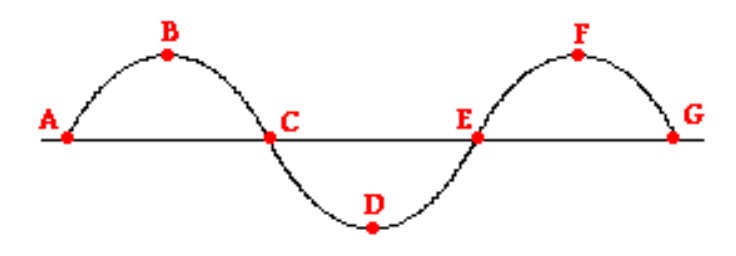
Which letter(s) represent the trough of the wave?
a)
A
b)
B & D
c)
D
d)
C & G
57.
Which letter(s) represent the crest of the wave?
a)
A
b)
B & D
c)
B & F
d)
F
58.
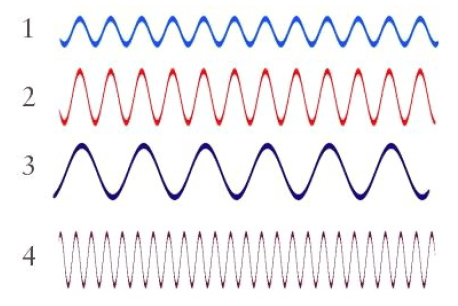
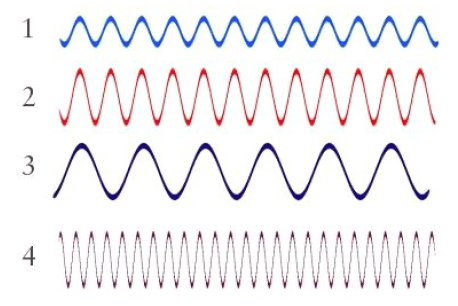
Which wave in the diagram has the greatest frequency?
a)
1
b)
2
c)
3
d)
4
59.
Which wave in the diagram has the greatest wavelength?
a)
1
b)
2
c)
3
d)
4
60.
Which of the following can sound travel through?
a)
solid
b)
liquid
c)
gas
d)
all options
61.
How would a person measure the wavelength on this sound wave?
a)
dense to less dense
b)
trough to crest
c)
compression to compression
d)
beginning of illustration to the end
62.
What type of wave is pictured?
a)
Transversal
b)
Longitudinal
c)
Surface
d)
Seismic
63.
What do we call the part of a longitudinal wave that is spread apart?
a)
compression
b)
rarefaction
c)
crest
d)
trough
64.
This is what you get when sound waves are reflected, or bounce back, off of a hard surface.
a)
Amplitude
b)
Pitch
c)
Volume
d)
Echo
65.
What is frequency?
a)
the number of vibrations per second
b)
how high or low a sound is
c)
the loudness or softness of a sound
d)
the back and forth movement of matter
66.
This word refers to any substance that sound can travel through.  Sound can travel through solids, liquids, and gases.
a)
Decibel
b)
Medium
c)
Vibration
d)
Oscilloscope
67.
The speed of a sound wave depends on
a)
the frequency
b)
the medium
c)
both air temperature and medium
d)
the air temperature
68.
What kind of interference is shown?
a)
Resonance
b)
Constructive Interference
c)
Destructive Interference
d)
Doppler Effect
69.
The Doppler effect can cause an apparent change in...
a)
loudness
b)
intensity
c)
pitch
d)
reasonance
70.
Sound travels most quickly through...
a)
Solid
b)
Liquid 
c)
Gas
d)
All the same
71.
Why can you see lightning before you hear it? 
a)
Light travels faster than sound.
b)
Sound travels faster than light.
c)
Both travel at equal speeds. 
72.
___________________ is when light waves strike an obstacle and new waves are produced, like when light bends around a doorway.
a)
refraction
b)
diffraction
c)
reflection
d)
interference
73.
When a wave changes direction and speed when it enters a new material.
a)
refraction
b)
diffraction
c)
reflection
d)
interference
74.
When a wave hit a surface and bounces back at the same angle.
a)
refraction
b)
diffraction
c)
reflection
d)
interference
75.
Which characteristic is associated with pitch?
a)
frequency
b)
amplitude
c)
wavelength
d)
speed
76.
Which characteristic is associated with loudness?
a)
frequency
b)
amplitude
c)
wavelength
d)
speed
77.
When an object is forced to vibrate at its natural frequency 
a)
resonance 
b)
constructive interference
c)
destructive interference
d)
the Doppler effect
78.
Which option can sound NOT travel through
a)
air
b)
water
c)
steel
d)
vacuum
79.
What type of a wave is A in the image
a)
transverse 
b)
longitudinal
80.
What type of a wave is B in the image
a)
transverse 
b)
longitudinal
81.
If you triple the frequency of a vibrating object, its period will 
a)
double
b)
cut in half
c)
triple
d)
cut into thirds
82.
light waves are ______and sound waves are _____
a)
transverse; longitudinal
b)
longitudinal; transverse
c)
mechanical; transverse
d)
longitudinal; electromagnetic
83.
How does light travel? 
a)
in longitudinal waves
b)
in transverse waves
c)
in a zig zag line
d)
back and forth
84.
Light waves need matter to travel.
a)
True
b)
False
85.
Which of the following electromagnetic waves has the lowest energy?
a)
gamma ray
b)
infrared wave
c)
visible light wave
d)
microwave
86.
Which of the following electromagnetic waves is given off as heat? 
a)
Radio Waves
b)
Infrared Rays
c)
Visible Light
d)
Gamma Rays
87.
A wave with a large wavelength will have a ______ frequency and _____ energy
a)
high, low
b)
high, high
c)
low, high
d)
low, low
88.
What are the 3 primary colors?
a)
red, green, blue
b)
yellow, orange, violet
c)
red, black, green
d)
magenta, cyan, indigo
89.
What happens to blue light when it hits a shirt that appears blue?
a)
The light is reflected.
b)
The light is absorbed.
c)
The light is refracted.
d)
The light is blocked.
90.
Why do we see objects as black?
a)
They absorb all the light
b)
They reflect all the light
c)
They absorb some light and reflect 
91.
Light behaves like a 
a)
particle
b)
wave
c)
particle and wave
92.
Cyan light is a mix of
a)
blue and yellow
b)
green and yellow
c)
blue and green
d)
red and blue
93.
Yellow light is a mix of
a)
blue and red
b)
green and magneta
c)
blue and green
d)
red and green
94.
Magenta light is a mix of
a)
blue and red
b)
green and cyan
c)
blue and green
d)
red and green
95.
What type polarization light comes of glare from horizontal surface?
a)
Horizontal
b)
Vertical
c)
None
d)
All
96.
What are types lenses make 3D glasses?
a)
Two Horizontal Polarized
b)
Two Vertical Polarized
c)
One Horizontal Polarized
&
One Vertical Polarized
97.
Electromagnetic waves are 
a)
are produced by vibrating charges
b)
all travel at the same speed in a vacuum
c)
are electric field lines and magnetic field lines oscillating together.
d)
all options are correct
98.

If polarized filters have their axis oriented at 180 degree (parallel) to each other then

a)

They will block half the light

b)

They will block all the light

c)

They will block a quarter of the light

d)

They will block no light

99.

If polarized filters have their axis oriented at 90 degree (perpendicular) to each other then

a)

They will block half the light

b)

They will block all the light

c)

They will block a quarter of the light

d)

They will block no light

100.
Which of the following is the best description of polarization
a)
light waves oriented all in one plane
b)
light waves bending as they pass through small openings
c)
light waves changing speed and wavelength when entering a new medium
d)
light waves changing color due to the motion of the object
101.
Which of the following is the best description of diffraction
a)
light waves oriented all in one plane
b)
light waves bending as they pass through small openings
c)
light waves changing speed and wavelength when entering a new medium
d)
light waves changing color due to the motion of the object
102.
Which of the following is a coherent source of light
a)
a incandescent bulb
b)
a fluorescent bulb
c)
a red laser
d)
a uv lamp
103.
constructive interference occurs when
a)
the crest of one wave meets the crest of another wave
b)
the crest of one wave meets the trough of another wave
c)
Both options create constructive interference
104.
destructive interference occurs when
a)
the crest of one wave meets the crest of another wave
b)
the crest of one wave meets the trough of another wave
c)
Both options create destructive interference
105.
When you increase the distance between the openings with diffraction, then the distance between the maximums will 
a)
increase
b)
decrease
c)
stay the same
106.
What happens to the speed of a light ray when it enters a more dense material?
a)
It slows down
b)
It speeds up
c)
It stays the same
107.
An image that forms at a location from which the real light rays appear to come together but do not actually cross
a)
real 
b)
virtual
c)
critical
d)
focal
108.
Nearsighted vision is corrected when _____ lenses allow light rays to focus on the retina
a)
converging
b)
diverging 
109.
farsighted vision is corrected when _____ lenses allow light rays to focus on the retina
a)
converging
b)
diverging 
110.
Which explains why the fork looks different under water?
a)
light can't pass through the glass
b)
the wavelength of light lengthens
c)
the amount of light increases when going through water
d)
light is refracted at an angle
111.
The Law of Reflection:
The angle of incidence is _________ the angle of reflection
a)
bigger than
b)
the same as
c)
smaller than
112.
_____ is a lens that is thicker in the middle and makes an object appear bigger.
a)
prism
b)
convex lens
c)
concave lens
d)
mirror
113.
______ is a lens that is thicker on its edges and makes an object appear smaller?
a)
mirror
b)
convex lens
c)
concave lens
d)
prism
114.
This is an example of...
a)
Reflection
b)
Refraction
c)
Polarization
d)
Spectrum
115.
A convex lens is a __________ device.
a)
Convergent
b)
Divergent
c)
Reflective
d)
None of the option
116.
A Concave lens is a __________ device.
a)
Convergent
b)
Divergent
c)
Reflective
d)
None of the options
117.
What property of waves stays constant during refraction?
a)
frequency
b)
wavelength
c)
speed
d)
amplitude
118.
Which of the following in the diagram is the incident ray?
a)
A
b)
B
c)
C
d)
D
119.
Which of the following in the diagram is the refracted ray?
a)
A
b)
B
c)
C
d)
D
120.
A ray of white light passes through a prism.  On the other side of the prism, you see a rainbow.  What is this phenomenon called?
a)
Reflection
b)
Refraction
c)
Medium
d)
Dispersion
121.
How does light behave as it enters these mediums?
a)
continue its path as straight line.
b)
bends toward the normal
c)
bends away from the normal
d)
reflects
122.
This image is...
a)
Inverted and smaller
b)
inverted and bigger
c)
not inverted and smaller
d)
not inverted and bigger
123.
An object of height 4 cm is placed 10 cm away from a concave lens of focal length 6 cm as shown below.Image is 
a)
virtual.inverted
b)
virtual,upright
c)
real,inverted
d)
real,upright
124.
Which is the angle of refraction?
a)
Angle 1
b)
Angle 2
125.
Glass has a _____________ index of refraction than air.
a)
Equal
b)
Greater
c)
Less
d)
Impossible to say
126.
The diagram below shows light ray R entering air from water. Through which point is the ray most likely to pass
a)
A
b)
B
c)
C
d)
D
127.
When a light ray moves from air into glass at an angle of 45 degrees to the normal, its path is
a)
bent toward the normal
b)
bent away from the normal
c)
parallel to the normal
d)
not bent