wayground logo

Free Printable Worksheets

Font size

S
M
L
XL
Worksheets

Physics B Final Exam Review

Total questions: 110

Worksheet time: 2hrs 12mins

Name
Class
Date
1.
The measure of average kinetic energy of all the particles within an object is called ____________. 
a)
temperature
b)
conduction
c)
radiation
d)
heat 
2.
heat always travels from _____ to ______ objects
a)
hot to cold
b)
cold to hot
c)
cold to cold
d)
hot to hot
3.
The energy transferred between the particles of two objects because of the temperature difference between the two objects is called ________________.
a)
heat
b)
insulator 
c)
conductor 
4.
Thermal energy always moves:
a)
From a high temperature object to a lower temperature object.
b)
From a lower temperature object to a higher temperature object.
c)
From an object with lower kinetic energy to an object with higher kinetic energy.
d)
From an object of higher mass to an object of lower mass.
5.
The symbol for specific heat is .......
a)
c
b)
Q
c)
m
d)
t
6.
There are four cups of hot cocoa. The cup sizes are shown. The temperature of the cocoa in each cup is 25 degrees celsius. Which cup has the MOST thermal energy?
a)
Large cup (Trenta)
b)
Small cup (Tall)
c)
Venti
d)
All three are the same temperature so they have same thermal energy
7.
What is Specific Heat?
a)
The  amount of thermal energy required to increase the temperature of 1kg of a material by 1°C.
b)
The  amount of radiant energy required to increase the temperature of 1kgof a material by 1°C
c)
The  amount of energy required to increase the temperature of 1kgof a material by 1°C.
d)
The  amount of friction  required to increase the temperature of 1kgof a material by 1°C.
8.
A sample of iron receives 50.J of heat energy that raises the temperature of the iron 25.0°C. If iron has a specific heat of .10 J/g°C, what is the mass of the iron sample?
a)
25g
b)
30g
c)
20g
d)
50g
9.
Water has a specific heat of 4184 J/KgºC.  Wood has a specific heat of 1760 J/KgºC.  What material needs more energy to raise the temperature 1ºC
a)
Wood
b)
Water
c)
Both are the same
10.
Copper, Stainless Steel, Carbon Steel, and Zinc were all heated using the same thermal energy.  What material would be the coolest after being heated?
a)
Copper
b)
Carbon Steel
c)
Zinc
d)
Stainless Steel
11.
The first law of thermodynamics is basically the same as which law?
a)
Newton's first law
b)
The law of conservation of energy
c)
The law of conservation of momentum
d)
Newton's second law
12.
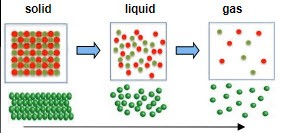
Entropy increases from solid, liquid to gas. Why?
a)
Molecular disorder increases
b)
Molecular randomness decreases
c)
Molecules are more energetic
d)
Molecules are more reactive
13.
Two cups of water, one at 100oC and the other at 50oC are poured into a larger container. What would be the final temperature of the water?
a)
Less than 50oC.
b)
Greater than 100oC.
c)
Between  50oC and 100oC.
d)
The water temperature will rise and fall continually.
14.
What is the efficiency of a machine if 55.3 J of work are done on the machine, but only 14.3 J is produced by the 1machine?
a)
0.25 J
b)
26%
c)
386%
d)
3.86 J
15.
What is the work output of a machine that has a work input of 2,800 Joules and an efficiency of 92.3%? 
a)
2,690J
b)
92.3J
c)
0.0082J
d)
2,584.4
16.
Ratio to work out to work in
a)
Efficiency
b)
Law of Conservation of Energy
c)
Transformation
d)
Lumens
17.

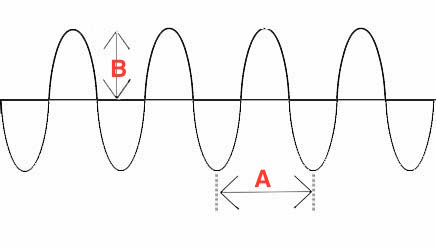
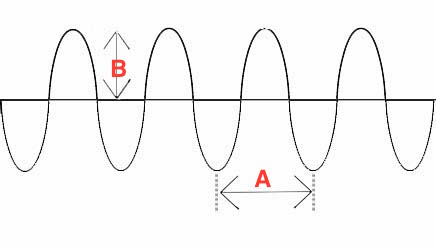
What property of this wave is represented by the letter "A"

a)

amplitude

b)

crest

c)

trough

d)

wavelength

18.
What property of the wave is represented by the letter "B"?
a)
amplitude
b)
crest
c)
trough
d)
wavelength
19.
The highest point on a wave is:
a)
the crest
b)
the trough
c)
the top
d)
the coast 
20.
The lowest point on a wave is the:
a)
Amplitude
b)
Crest
c)
Trough
d)
Wavelength
21.
The number of wavelengths that pass a point each per second is:
a)
frequency
b)
period
c)
longitudinal 
d)
transverse wave 
22.
The type of waves that require medium to pass:
a)
Mechanical Waves
b)
Electromagnetic Waves
23.
When the frequency of a wave increases, what happens to the wavelength?
a)
The wavelength is not directly affected by the frequency of a wave.
b)
The wavelength increases.
c)
The wavelength decreases.
d)
More specific information is needed to form a conclusion about the wavelength.
24.
A mechanical wave cannot travel through...
a)
a vacuum(empty space).
b)
water.
c)
air. 
d)
glass.
25.
Which of the following can sound travel through?
a)
solid
b)
liquid
c)
gas
d)
all of the above
26.
Electromagnetic waves include the following except
a)
radio waves
b)
X-rays
c)
doing the wave at a football game
d)
microwaves
27.
regular disturbances that carry energy through matter or space
a)
crest
b)
energy
c)
wave
d)
trough
28.
which material does sound travel the fastest?
a)
solid 
b)
liquid 
c)
gases
29.
When a wave bends as it passes through at an angle from one medium to another.(example: pencil in a glass of water-)
a)
medium
b)
refraction
c)
reflection
d)
interference
30.
Amplitude reflects the amount of ____________________ in a wave.
a)
energy
b)
compression
c)
rarefaction
d)
speed
31.
Sound will travel slowest through which of the following forms of matter?
a)
milk
b)
desk
c)
air
d)
door
32.
The units for frequency are measured in _____________.
a)
hertz
b)
seconds
c)
m/s
d)
m
33.
A stretched spring attached to two fixed points is compressed on one end and released, as shown in the picture. The resulting wave travels back and forth between the two fixed ends of the spring until it comes to a stop.  This mechanical wave is an example of a
a)
longitudinal wave
b)
transverse wave
c)
superpositioned wave
d)
refracted wave
34.
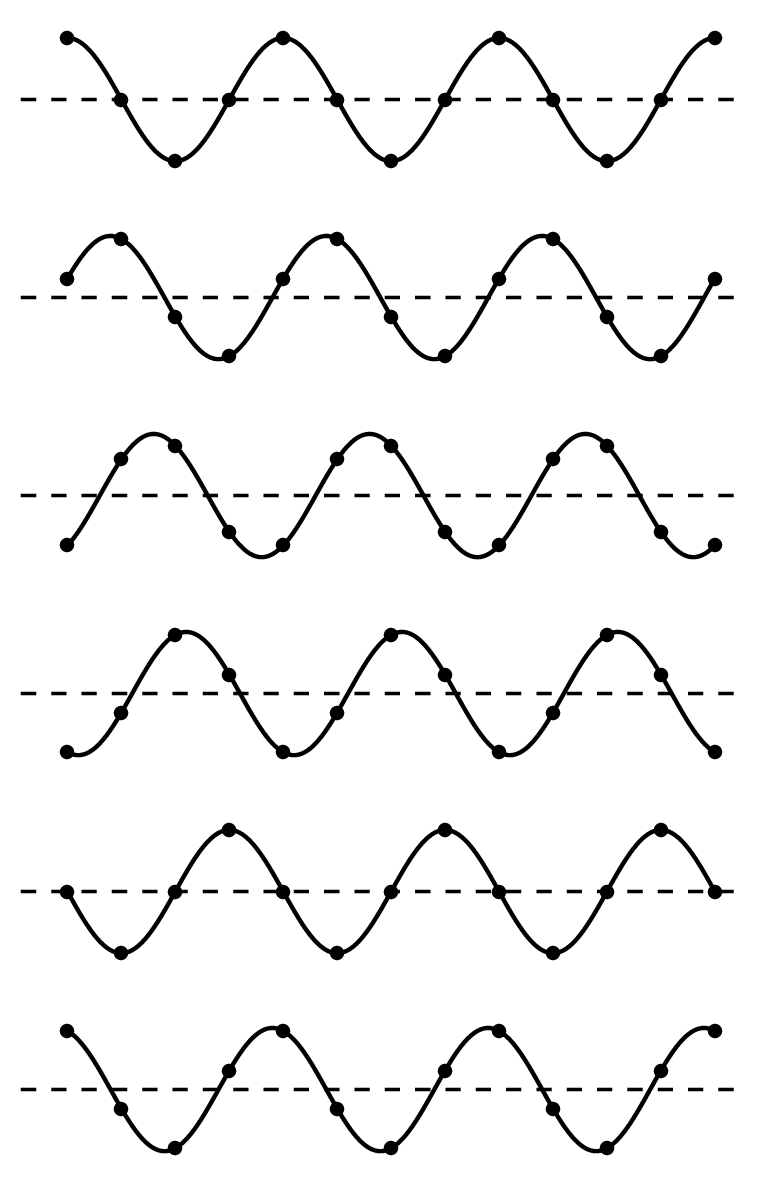
What kind of wave is this?
a)
Transverse Wave
b)
Longitudinal Wave
35.
Which direction does a Transverse wave travel
a)
parallel
b)
perpendicular
36.
Which direction does a compressional wave travel
a)
parallel
b)
perpendicular
37.
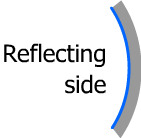
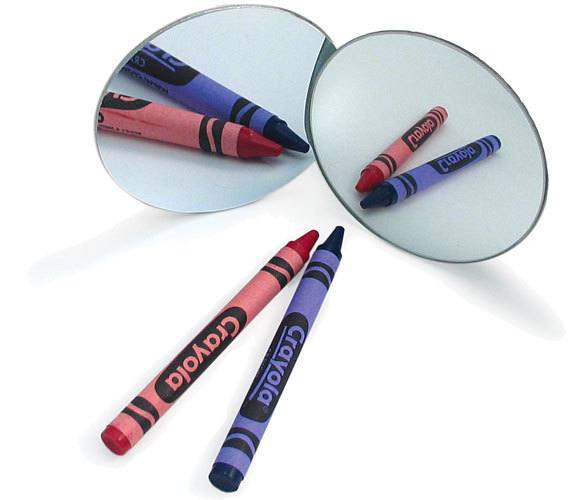
The following is a picture of what type of mirror? 
a)
Convex Mirror
b)
Concave Mirror
c)
Plane Mirror
d)
Flat Mirror
38.
The following is a picture of what type of mirror? 
a)
Convex Mirror
b)
Concave Mirror
c)
Plane Mirror
d)
Flat Mirror
39.
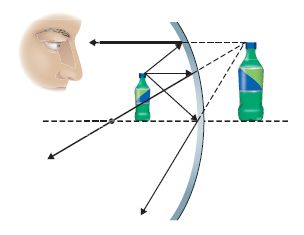
Which terms describe the reflection seen in this image?
a)
virtual, upright
b)
virtual, inverted
c)
real, upright
d)
real, inverted
40.

What type of image is produced by a flat mirror?

a)

Real and upright

b)

Real and inverted

c)

Virtual and upright

d)

Virtual and inverted

41.

Convex mirrors can create virtual images.

a)

True

b)

False

42.

The point half way between the mirror and the radius of curvature is called the _____________

a)

center point

b)

focal point

c)

radius of curvature

d)

object distance

43.

A smooth surface will create what type of reflection?

a)

Diffuse

b)

Specular

c)

Imaginary

44.
According to the Law of reflection, a light ray striking a mirror
a)
continues moving through the mirror in the same direction
b)
moves into the mirror at a slightly different angle
c)
bounces off the mirror toward the direction it came from
d)
bounces off the mirror at the same angle it hits.
45.

Why can't you see an image when light reflects off a rough surface?

a)

because not enough light is not reflected

b)

because the reflection is specular

c)

because the reflection is diffuse

d)

because the law of reflection does not apply

46.
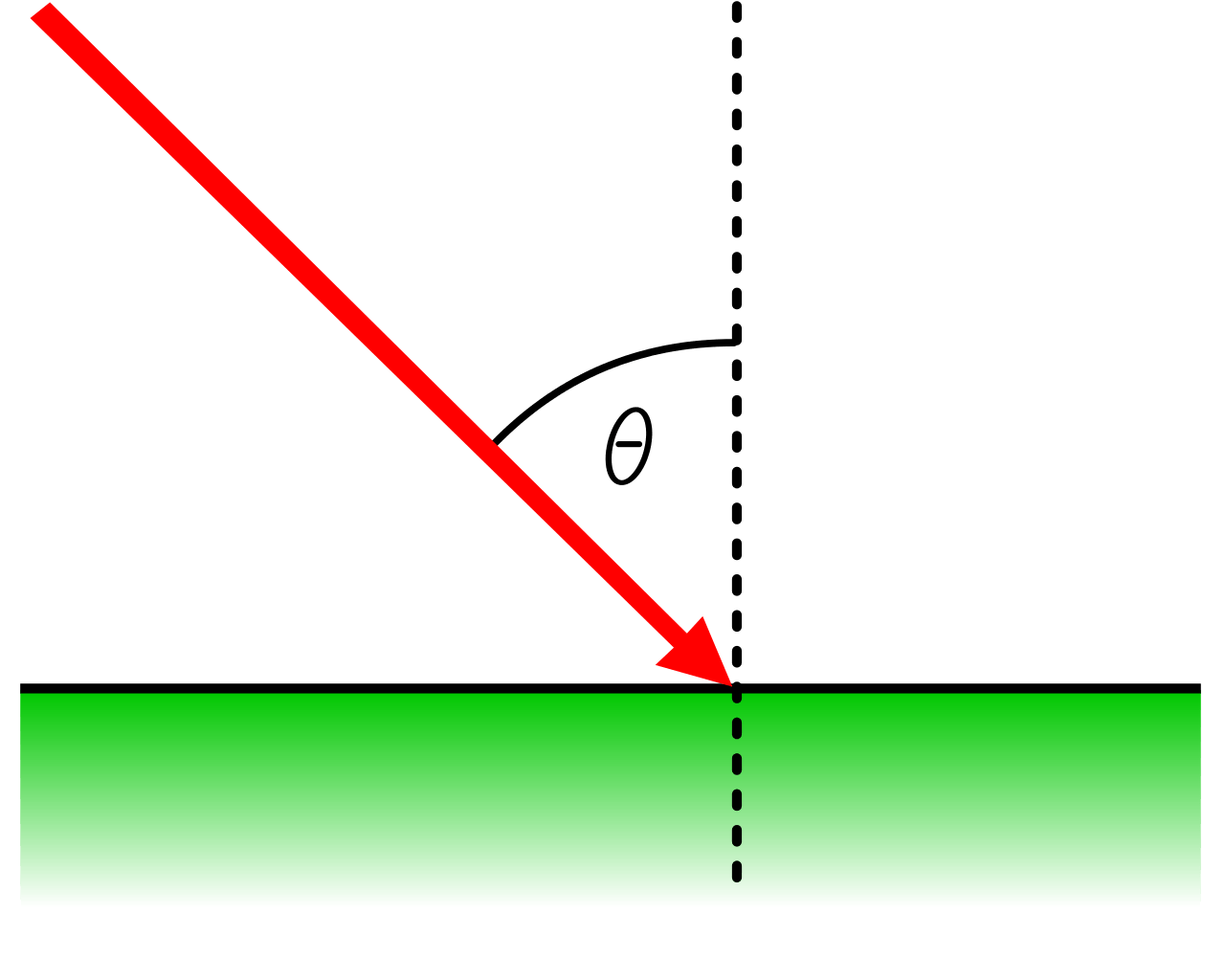
The fact the two angles are the same is an example of....
a)
Refraction
b)
Angle of Incidence
c)
Law of reflection
d)
Magnification
47.

An ray that travels parallel to the principal axis of a concave mirror...

a)

will reflect parallel to the principal axis

b)

will reflect through the focal point

c)

will reflect through the center of curvature

d)

will continue along the same path through the lens

48.
Light has the highest velocity in which medium?
flint glass n=1.70
barium glass n=1.60
crown glass n=1.523
water n=1.33
diamond n=2.45
a)
diamond
b)
water
c)
flint glass
d)
barium glass
49.
A ray of light traveling from air into crown glass strikes the surface at an angle of 30 degrees. What is the angle of refraction? (air n=1, crown glass n=1.532)
a)
39.7 degrees
b)
19.2 degrees
c)
59.1 degrees
d)
12.3 degrees
50.
The measure of how much light refracts is called...
a)
Refraction
b)
Law of reflection
c)
reflected ray
d)
Index of refraction
51.
What is the index of refraction of a refractive liquid if the angle of incidence in the air is 35 degrees and the angle of refraction is 14 degrees?
a)
1.33
b)
2.21
c)
2.37
d)
1.72
52.
Glass has a _____________ index of refraction than air.
a)
Equal
b)
Greater
c)
Less
d)
Impossible to say
53.
Absolute refractive index of any medium is always _______.
a)
less than 1
b)
greater than 1
c)
1
d)
0
54.
Refraction occurs when _____________
a)
the wave's speed changes by entering a new medium
b)
a wave bounces off of a boundary
c)
waves parts meet each other
d)
waves bend around a barrier
55.

Which wave phenomenon makes it possible for a player to hear sound from a referee's whistle in an open field even when standing behind the referee?

a)

diffraction

b)

Doppler effect

c)

reflection

d)

refraction

56.
What does the word "converging" mean?
a)
to separate
b)
to come together
c)
parallel 
d)
perpendicular
57.
What does the word "diverging" mean?
a)
to spread apart
b)
to come together
c)
parallel
d)
perpendicular
58.
Images produced by a diverging lens are always _____.
a)
real, reduced, and inverted
b)
virtual, reduced, and upright
c)
real, enlarged, and inverted
d)
virtual, enlarged, and upright
59.
What type of image is formed when rays of light actually intersect?
a)
real
b)
virtual
c)
projected
d)
curved
60.

Which of the following is the correct discription of the image?

a)

real, magnified 2x, inverted

b)

virtual, magnified 2x, right-side up

c)

real, magnified 0.5x, right-side up

d)

virtual, magnified 0.5x, inverted

61.

What is the correct description of the image?

a)

Real, magnified 0.5x, right-side up

b)

Real, magnified, 0.5x, inverted

c)

Virtual, magnified 0.5x, right-side up

d)

Virtual, magnified 0.5x, inverted

62.

What do lenses do?

a)

separate white light into a rainbow

b)

bend rays of light to form an image

c)

reflect light similarly to a mirror

d)

absorb all light

63.
When socks get stuck to towels in your dryer, this is an example of________________
a)
current electricity
b)
static electricity
64.
What types of charges attract?
a)
Positive and Positive
b)
Positive and Neutral
c)
Negative and Neutral
d)
Positive and Negative
65.
The accumulation of excess electric charge on an object is called
a)
Static electricity 
b)
Electric discharge
c)
Resistance
d)
Circuit 
66.
Electric charges that are alike _______ each other.
a)
Attract
b)
Repel
67.
If a substance has a higher number of electrons than protons on its surface, what type of charge does it have?
a)
A positive charge.
b)
A negative charge.
c)
A neutral charge
d)
No charge at all
68.
What is the major difference between static electricity and current electricity?
a)
Current electricity involves a continuous flow of neutrons; static electricity is a sudden transfer of protons
b)
Current electricity can be deadly; static electricity is almost always safe
c)
In current electricity, there's a single transfer of electrons; in static electricity, there's a steady flow of electrons
d)
Current electricity involves a flow of electrons; static electricity involves a single transfer of electrons
69.
What would have to happen for an atom to become negatively charged?
a)
Gain protons
b)
Gain electrons
c)
Lose protons
d)
Lose electrons
70.
The transfer of charge when electrons move from a charged object to another object by direct contact is called ________________
a)
Polarization 
b)
Induction 
c)
Conduction
d)
Friction 
71.
Electric charge is measured in the SI unit _______________.
a)
Volts
b)
Watts
c)
Coulombs
d)
Amps
72.
When charge is transferred within an object.
a)
Conduction
b)
Insulation
c)
Induction
73.
When a neutral object has a charge in one area
a)
Current
b)
Polarization
c)
Magnetized
d)
Field Force
74.
What happens to the force between two charged objects when you double the distance between them?
a)
2X
b)
1/2X
c)
4X
d)
1/4X
75.
What happens to the force between two charged objects if you triple the magnitude of one charge? 
a)
1/3X
b)
3X
c)
1/9X
d)
9X
76.

Approximately how much force would be generated by two charged objects held 2 m apart, if q1 has a charge of 3.0 C and q2 has a charge of 4.0 C?

a)

0.5 x 10¹⁰ N

b)

1.5 x 10¹⁰ N

c)

2.7 x 10¹⁰ N

d)

6 x 10¹⁰ N

77.

A material through which charges will not move easily.

a)

Conductor

b)

Insulator

c)

Facilitators

d)

Plastics

78.
Does this diagram represent a series or parallel circuit?
a)
series circuit
b)
parallel circuit
79.
What kind of circuit is this?
a)
series
b)
parallel
80.
Resistance is measured in ___. 
a)
watts. 
b)
amps.
c)
ohms.
81.
what is this symbol for?
a)
light bulb
b)
switch
c)
battery
d)
resistor
82.
As the resistance of a circuit increases, the current will
a)
increase
b)
decrease
c)
stay the same
83.
The difference in electrical potential energy between two places is called
a)
resistance
b)
friction
c)
induction
d)
voltage
84.
If the current through a circuit is 2 A and the resistance of a light bulb in the circuit is 10 Ohms, what is the voltage difference across the light bulb?
a)
5 V
b)
12 V
c)
0.2 V
d)
20 V
85.
If we have several light bulbs connected to a battery in parallel...
a)
The voltage will be the same across each bulb
b)
the current will be the same across each bulb
c)
The current will be the same through each bulb
d)
The resistance will be the same across each bulb
86.
The current passing through bulbs in series will be...
a)
...the same
b)
...different
87.
What is electric current?
a)
The number of charged particles that pass a point each second
b)
The difference in potential
c)
The resistance
d)
Light Emitting Diode
88.
What 'flows' in a wire?
a)
Protons
b)
Neutrons
c)
Atoms
d)
Electrons
89.
this is the symbol for a _____?
a)
switch
b)
light 
c)
battery
d)
wires
90.
A Charging system producing 14.5 Volts with a current flow of 43.5 Amps, what is the circuit resistance
a)
58 Amps
b)
0.33 Amps
c)
13 Amps
d)
1 Amp
91.
This is an example of a ______ circuit
a)
Series
b)
Parallel
c)
Open
d)
Dihexihedral
92.
The equivalent resistance in this circuit is 
a)
100 ohms
b)
450 ohms
c)
400 ohms
d)
30 ohms
93.
The voltage dropped across the 300 ohm resistor is 
a)
6 V
b)
9 V
c)
2 V
d)
30 V
94.
The voltage drop across the 180 ohm resistor is 
a)
9 V
b)
6 V
c)
2 V
d)
12 V
95.
The current going through the 180 ohm resistor is 
a)
0.05 amps
b)
0.2 amps
c)
0.1 amps
d)
20 amps
96.
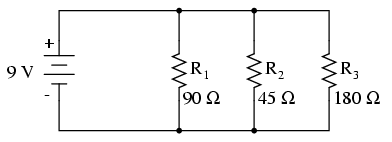
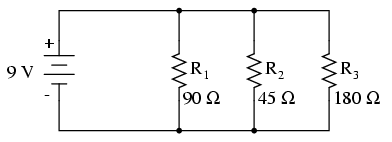
The equivalent resistance of this circuit is 
a)
25.7 ohms
b)
315 ohms
c)
324 ohms
d)
90 ohms
97.
What will happen if one light bulb is removed from this circuit?
a)
The other bulbs will go out.
b)
The other bulbs will get brighter.
c)
The other bulbs will get dimmer.
d)
The battery will become stronger.
98.
Pick the correct sentence.
a)
This circuit will work because it is a closed circuit.
b)
Energy will freely flow in this circuit.
c)
This circuit will not work because there is no energy source.
d)
This circuit will not work because there is no switch.
99.
a)
Series circuit - Bulbs are lit
b)
Series circuit - Bulbs are off
c)
Parallel circuit - Bulbs are lit
d)
Parallel circuit - Bulbs are off
100.
This circuit does not work because…
a)
the bulbs are not connected properly
b)
two cells are not powerful enough
c)
there is a break in the circuit
d)
the cells are facing each other
101.
This circuit does not work because…
a)
the bulbs are not connected properly
b)
the single cell is not powerful enough
c)
there is a break in the circuit
d)
there is a short crcuit
102.
What best describes the doppler effect?
a)
An apparent change in frequency of a wave due to the relative motion between a wave source and an observer
b)
When sound changes pitch
c)
When light changes color
d)
An apparent change in the amplitude of a wave due to the relative motion between a wave source and an observer.
103.

A police speed trap calculates the speed of a car by using the Doppler shift produced when an electromagnetic wave is reflected off a moving car. To beat the trap the car could send a different frequency wave back to the policeman, the wave should be

a)

the same frequency as received.

b)

a higher frequency than received.

c)

a lower frequency than received.

d)

it's not possible to beat the trap.

104.

As the siren goes off in the PARKED car, the young felon at position Y hears

a)

a higher pitch than if she were standing still

b)

a lower pitch than if she were standing still

c)

the same pitch he would if she were standing still

105.

As the siren goes off in the PARKED car, the young felon at position X hears

a)

a higher pitch than if he were standing still

b)

a lower pitch than if he were standing still

c)

the same pitch he would if he were standing still

106.
The unit to measure the resistivity of a wire is 
a)
ohms
b)
Volt 
c)
ohms.m
d)
ohms.s
107.
Materials that have a high electrical resistance
a)
less length
b)
less tempareture 
c)
more thickness 
d)
less cross sectional area
108.
the  resistance of the two conductor 
a)
R2 > R3
b)
R2 = R3
c)
R2 < R3
d)
NONE OF THE ABOVE 
109.

Which copper wire has the lowest resistance?

a)

1 meter of 1 mm diameter wire

b)

0.5 meter of 1 mm diameter wire

c)

0.5 meter of 0.5 mm diameter wire

d)

1 meter of 0.5 mm diameter wire

110.
Factor which does not affect the resistance
a)
Type of material
b)
Length of material
c)
Mass of the material
d)
Area of the material