wayground logo

Free Printable Worksheets

Font size

S
M
L
XL
Worksheets

SCIENCE 8 FINAL EXAM

Total questions: 108

Worksheet time: 2hrs 13mins

Name
Class
Date
1.
What is the original source of almost all energy in most ecosystems?
a)
carbohydrates
b)
sunlight
c)
water
d)
carbon
2.
which symbiosis is this 
a)
parasitism 
b)
mutualism
c)
commensalism
d)
nonalism 
3.
What does a food web represent?
a)
All connections of energy flow throughout all organisms in a habitat.
b)
The specific ways that mutualism is carried out.
c)
A single pathway or energy flow between organisms. 
d)
How carnivores get their food. 
4.
The image provided is an example of a(n):
a)
Carnivore
b)
Herbivore
c)
Producer
d)
Autotroph
5.
The nonliving aspects of an ecosystem.
a)
Abiotic factors
b)
Biotic factors
6.
The living portions of the ecosystem.
a)
Biotic factors
b)
Abiotic factors
7.
A collection of organisms that belong to different populations but all live in the same area and interact with one another.
a)
Population
b)
Ecosystem
c)
Community
d)
Ecosphere
8.
A collection of organisms that make up a community as well as all of the nonliving aspects of the environment.
a)
Population
b)
Community
c)
Habitat
d)
Ecosystem
9.
Organisms that can capture energy from inorganic, nonliving sources.
a)
Producers
b)
Consumers
c)
Detritivores
d)
Carnivores
10.
The study of how living things interact with one another and with their environment.
a)
Biology
b)
Lithology
c)
Ecology
d)
Farmacology
11.
An animal that is hunted and eaten for food is a 
a)
predator
b)
prey
12.

The entire layer of living things around the globe is called the:

a)

Population

b)

Geosphere

c)

Biome

d)

Biosphere

13.

What can limit an area's carrying capacity?

a)

Lack of predators in the area

b)

a plentiful amount of food

c)

lack of food in the area

d)

all of the above

14.

When a population grows past the ecosystem's carrying capacity, what happens to the population?

a)

Continues to grow at the same rate

b)

The population starts to die off or moves away, returning to carrying capacity

c)

The population will go extinct suddenly due to lack of resources

d)

The population grows and then finds a new carrying capacity

15.

The picture shows what type of succession?

a)

primary

b)

secondary

c)

tertiary

d)

rock and roll

16.
The picture shows what type of succession?
a)
primary
b)
secondary
c)
tertiary
d)
quadanary
17.

Organisms that break down dead plants & animals- like Norbert the dead rat- and release nitrogen back into atmosphere:

a)

bacteria

b)

plants

c)

animals

d)

secondary consumers

18.

Animal respiration serves what purpose in the carbon cycle

a)

absorbs CO2

b)

releases CO2

c)

fixes carbon

d)

kills the invading Red Lectroids

19.

How does carbon in a grass plant get into a lion?

a)

The lion eats the grass because it is an herbivore

b)

Carbon from the grass doesn't end up in a lion.

c)

The carbon is eaten by animals that become food the lion eats.

d)

The lion breathes in carbon given out by the plant

e)

Lions don't need any carbon!

20.

Which process from the carbon cycle removes carbon from the atmosphere?

a)

animal respiration

b)

fungi respiration

c)

combustion

d)

photosynthesis

21.
What is the name of the process that converts atmospheric nitrogen, a gas (N2), into forms usable by plants? 
a)
transpiration
b)
nitrogen fixation
c)
nitrogen decomposition
d)
photosynthesis
22.
Combustion is another word for _______________.
a)
a train
b)
a bus
c)
a dog
d)
burning
23.

Primary succession can begin where there is no soil such as

a)

a severe storm

b)

a lava field from volcanic eruption

c)

an old farm is abandoned

d)

a forest fire

24.

The first "soil" layer during primary succession is usually made of rock broken down by acid and this:

a)

dirt from underground

b)

dead lichens

c)

old Justin Bieber T-shirts

d)

dead animals

25.

Cycles in nature that are vital to the biosphere's success include all of the following except for:

a)

carbon

b)

neon

c)

nitrogen

d)

calcium

e)

phosphorus

26.
The ability to resist or recover from an infectious disease is known as: 
a)
invulnerability 
b)
immortality
c)
immunity
d)
imperviousness
27.
A disease causing organism is known as a ___.
a)
macrophage
b)
pathogen
c)
antigen
d)
antibody
28.
Which of the following is considered the 1st line of defense for the immune system?
a)
lymphocytes
b)
antibodies
c)
heatlamp
d)
skin
29.
This process was initially used to heat wine to prevent spoiling and to kill harmful bacteria. 
a)
Pasteurization
b)
Refrigeration 
c)
vaccination 
d)
irradiation
30.
An inappropriate response to something harmless in the environment, such as pollen, or bunny rabbits.
a)
Allergy
b)
Auto-immune Disease
c)
Antibodies 
31.
A body system that protects us from pathogens.
a)
Immune System 
b)
Skeletal System
c)
Muscular System
d)
Reproductive System
32.
Helps to kill bacterial infections in the body.
a)
Antibiotics 
b)
Allergy
c)
Vaccines
d)
The Punisher
33.
True or False: Pasteurization uses very cold temperatures to kill bacteria
a)
False
b)
True
34.
True or False: Antibodies remember specific pathogens and attach to the resulting antigens to help you fight off the pathogen next time.
a)
True
b)
False
35.
When our body attacks its own body cells it causes an....
a)
Auto-immune Disease
b)
Allergy
c)
Antibody
36.
Viruses are a non-living particles that can only multiply inside a ____________cell.
a)
Host
b)
Parasite 
c)
Bacteria
d)
prison
37.
How do antigens protect the body from diseases?
a)
They make white blood cells.
b)
They produce mucus, which washes away germs.
c)
They help destroy T cells.
d)
They stimulate the immune system when pathogens enter the body.
38.
What role does stomach acid do in the immune system?
a)
Digests pathogens
b)
Kills antibodies
c)
Kill white blood cells
d)
Digests killer T-cells
39.
A weakened or dead virus can act as a-
a)
vaccine
b)
leukocyte
c)
allergen
d)
macrophage
40.
Pathogens that pass diseases to humans include:  
a)
Viruses, influenza, library cards,  HIV, and vaccines
b)
Viruses, bacteria, fungi, proteins, and parasites
c)
Viruses, cancers, mutagens, RNA, and DNA
d)
Violence, blood, pollutants, and symptoms
41.
Which answer best describes how an infectious disease may get transmitted (passed on) to another person?  
a)
people can sneeze or cough and pass disease on through the air
b)
drinking water can be contaminated with diseases
c)
objects such as doorknobs and towels can be contaminated by disease
d)
all of the above answers are ways that diseases are transmitted
42.
Condition in which cells grow at an uncontrolled rate
a)
macrophage
b)
cancer
c)
mutation
d)
chicken pox 
43.
This body reaction will slow the growth of some pathogens, while helping B cells and T cells multiply faster.
a)
nausea
b)
fever
c)
diarrhea 
d)
playing video games
44.
Most of the nutrients in a tropical rain forest are found in the plants.  What can you infer from this fact?
a)
The rain forest soil is very rich.
b)
The rain forest soil is poor in nutrients.
c)
There are few plants in the rain forest.
d)
There are few animals in the rain forest. 
45.

From where does phytoplankton get food?

a)

insects

b)

small fish

c)

dolphins

d)

photosynthesis

e)

Arby's

46.
Which biome has permafrost and is in the Arctic or Antarctic?
a)
coniferous forest
b)
polar tundra
c)
alpine tundra
d)
desert
47.

Which biome is found above the tree line of mountains?

a)

savanna

b)

temperate deciduous forest

c)

temperate grassland

d)

alpine tundra

48.
This zone in the marine biome contains the deep water of the open ocean and animals such as whales and sharks.
a)
Oceanic zone
b)
Benthic zone
c)
Neritic zone
d)
Intertidal zone
49.

This zone in the marine biome is the home to animals that must adapt to crashing waves and exposure to air.

a)

Oceanic zone

b)

Benthic zone

c)

Neritic zone

d)

Intertidal zone

50.

This habitat is made of the skeletons of small animals.

a)

polar ice

b)

marsh

c)

estuary

d)

coral reef

51.

This is a wetland that is often in shallow areas along shores.

a)

marsh

b)

swamp

c)

estuary

d)

intertidal area

52.
This has a constantly changing amount of salt in the water.
a)
intertidal area
b)
swamp
c)
estuary
d)
polar ice
53.

What can you infer about animals that live in the desert?

a)

Most of them are quite large

b)

Most of them are warm-blooded

c)

Most are unable to withstand temperatures below 90 degrees Fahrenheit

d)

Most can survive on very little water

54.
What two biomes get less than 10 inches of rainfall per year?
a)
Temperate Deciduous Forest and the Taiga
b)
Chapparal and Desert
c)
Tropical and Temperate grasslands
d)
The desert and the tundra
55.

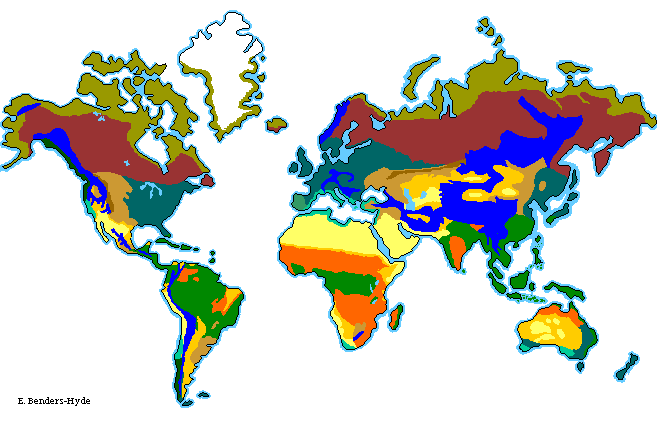
Which 2 biomes are you able to see in this picture? click all that apply

a)

Alpine tundra

b)

Savanna

c)

Polar tundra

d)

Temperate deciduous forest

e)

Alien

56.

A large region characterized by a specific type of climate and certain types of plant and animal communities is called a/an ______ ?

a)

Ecosystem

b)

Habitat

c)

Biome

d)

Niche

e)

System

57.
We live in this biome....which incidentally is the only biome with 4 seasons
a)
tundra
b)
temperate deciduous forest
c)
grasslands
d)
desert
58.
What aquatic biome is characterized by flowing fresh water?
a)
Lakes/Ponds
b)
Mangroves Swamps
c)
Rivers/Streams
d)
Coral Reefs
59.

Which of these are biotic factors found in marine/ocean biomes?

a)

seaweed

b)

coral reef

c)

phytoplankton

d)

pH

e)

Salinity

60.

A major abiotic factor of the marine biomes

a)

Salt content

b)

fungi

c)

plant life

d)

humidity

61.
_________________ and _______________ are the two types of tundras.
a)
Hot and Cold
b)
Polar and Alpine
c)
Snow and Ice
d)
Savannah and Temperate
62.
Which color has the least amount of energy?
a)
red
b)
orange
c)
green
d)
blue
63.
Put the visible light colors in order from longest wavelength to shortest wavelength
a)
Violet, Indigo, Blue, Green, Orange, Yellow, Red
b)
Red, Yellow, Green, Orange, Violet, Blue, Indigo
c)
Red, Orange, Yellow, Green, Blue, Indigo, Violet
64.

Which has the LONGEST wavelength and, therefore, the lowest frequency/energy

a)

Gamma Rays

b)

Radio Waves

c)

Visible Light

d)

Infrared rays

65.

Select the correct order of waves on the EMS

a)

Radio, Micro, Infrared, Visible, Ultraviolet, X-ray, Gamma

b)

Gamma, X-ray, Ultraviolet, Visible, Infrared, Micro, Radio

c)

Visible, Micro, Infrared, Ultraviolet, X-ray, Gamma, Radio

d)

Micro, Radio, Visible, Infrared, Ultraviolet, X-ray, Gamma

66.

What is a natural vacuum that sound cannot travel through?

a)

Water

b)

Air

c)

a wall

d)

Space

67.

Sound waves are ALWAYS what 2 types of wave?

a)

Transverse

b)

Longitudinal

c)

Depends

d)

Mechanical

68.
The term for any wave that hits a surface and bounces off
a)
Transparent
b)
Translucent
c)
Refraction
d)
Reflection
69.
Band of color in a rainbow, or from a light passing through a prism.
a)
Spectrum
b)
Space
c)
Prism
d)
Refraction
70.
The bending of waves as they pass from one substance into another.
a)
Reaction
b)
Reflection
c)
Refraction
d)
Repost
71.
A tiny bundle of energy by which light travels
a)
Photographs
b)
Photos
c)
Photons
d)
Friends
72.

The lowest part of the wave is called the ?

a)

frequency

b)

crest

c)

amplitude

d)

trough

73.
Electromagnetic waves include the following except
a)
radio waves
b)
X-rays
c)
doing the wave at a football game
d)
microwaves
74.
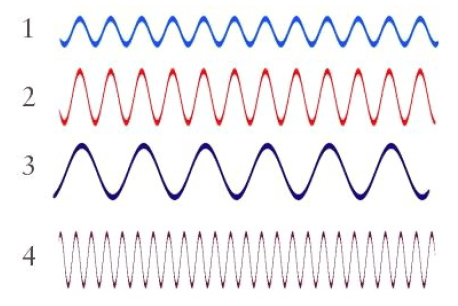
Which wave in the diagram has the greatest frequency?
a)
1
b)
2
c)
3
d)
4
75.

When the frequency of a wave increases, what happens to the wavelength?

a)

The wavelength is not directly affected by the frequency of a wave.

b)

The wavelength increases.

c)

The wavelength decreases.

d)

More specific information is needed to form a conclusion about the wavelength.
76.

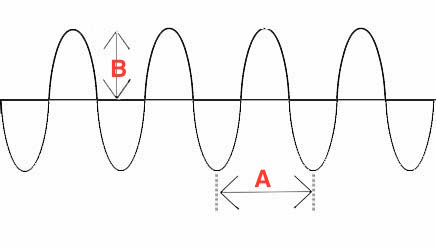
What property of this wave is represented by the letter "A"

a)

amplitude

b)

crest

c)

trough

d)

wavelength

77.

The highest part of the wave is called the ?

a)

frequency

b)

crest

c)

amplitude

d)

trough

78.
"For every action, there is an equal and opposite reaction."
a)
Newton's 1st Law
b)
Newton's 2nd Law
c)
Newton's 3rd Law
d)
Newton's 4th Law
79.
Force = Mass x Acceleration
a)
Newton's 1st Law
b)
Newton's 2nd Law
c)
Newton's 3rd Law
d)
Newton's 4th Law
80.
"An object in motion (or at rest) will to stay in motion (or at rest) until an outside force acts upon it."
a)
Newton's 1st Law
b)
Newton's 2nd Law
c)
Newton's 3rd Law
d)
Newton's 4th Law
81.
The tendency of an object to resist changes in its motion is...
a)
inertia
b)
force
c)
acceleration
d)
velocity
82.
Any push or pull on an object.
a)
force
b)
velocity 
c)
inertia
d)
momentum
83.
The force that opposes motion between two surfaces in contact with each other.
a)
inertia
b)
friction
c)
momentum
d)
gravity
84.
The combination of all the forces acting on an object is the...
a)
net force
b)
action force
c)
reaction force
d)
balance force
85.
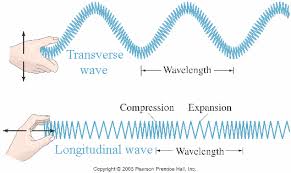
These are waves in which the matter in the medium moves back and forth along the same direction (parallel) that the energy of the wave travels.
a)
compressional waves
b)
transverse waves
c)
reflections
d)
refractions
86.
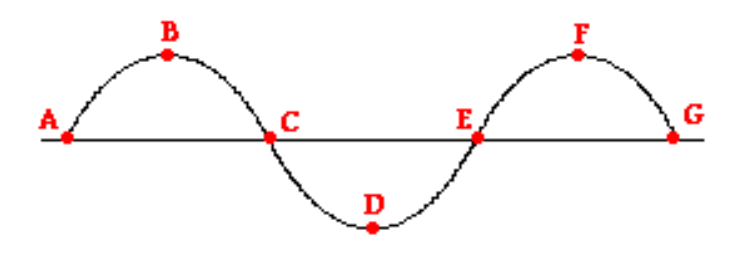
Which letter(s) represent the rest position on the wave?
a)
A, C, E & G
b)
D
c)
B & F
d)
None of the above
87.

In a Longitudinal (or Compressional) Wave, what is the part called that is SPREAD APART?

a)

rarefactions

b)

compressions

c)

Trolley

d)

trough

88.

In a Longitudinal Wave, what is the part called that is SQUISHED together?

a)

rarefactions

b)

compressions

c)

crest

d)

pickle barrel

89.
_____?______ materials do not allow light waves to pass through.
a)
Opaque
b)
Transparent
c)
Translucent
90.
_____?_____ materials allow some light to partially pass through, but not in a straight path.
a)
Opaque
b)
Transparent
c)
Translucent
91.
_____?_____ materials allow light waves to pass through easily.
a)
Opaque
b)
Transparent
c)
Translucent
92.
Which of these objects is "Opaque"?
a)
A Brick Wall
b)
Eye Glass Lenses
c)
Stained Glass Windows
93.
What is the name of the group of colors of light into which the white light was separated?
a)
transparent
b)
ROY G. BIV (spectrum)
c)
radiation
d)
opaque
94.

What is the speed of light?

a)

18,600 miles/sec or 30,000 km/sec

b)

186,000 miles/sec or 300,000 km/sec

c)

760 miles/hour or 1,223 km/hour

d)

orange

95.
What was the event that inspired Homer and his friends to build rockets?
a)
He learned about space in science 
b)
President Kennedy was assinated
c)
Sputnik, the first satellite was launched into space
d)
They wanted to blow up stuff
96.

In the movie October Sky Homer's dad encouraged him in his dream to build rockets.

a)

True

b)

False

97.

In October Sky, what was the nickname given to Homer and his friends?

a)

The Geeks

b)

The 4 Coal Miners

c)

The Mad Scientists

d)

The Rocket Boys

98.

What was the name of the main character in the movie October Sky?

a)

Chris Owen

b)

Homer Hickam Jr

c)

Quentin Davis

d)

Bartleby Humperdinkle

99.

What are the 2 types of carbohydrates

a)

Good and Evil

b)

Left and Right

c)

Simple and Complex

d)

Saturated and aerobic

100.

Vigorous activity lasting 20 minutes or longer that raises your heart rate is:

a)

aerobic exercise

b)

hygiene

c)

whack, dawg

d)

problematic

101.

Your body's physical and mental response to pressure is called:

a)

hygiene

b)

addiction

c)

eating Arby's Beef and Cheddars

d)

stress

102.

Which of the following is not a good way of dealing with stress?

a)

Doing drugs

b)

discussing problems with a friend or family member

c)

exercising

d)

making a plan to deal with issues

103.

A substance in food or drink that provides energy and is necessary for life and growth is called

a)

cholesterol

b)

spinach juice

c)

nutrient

d)

flax

104.

This nutrient makes up roughly 70% of your body:

a)

water

b)

calcium

c)

uranium

d)

Vitamin C

105.

Having an extremely high percentage of body fat is called

a)

anorexia nervosa

b)

obesity

c)

malnutrition

d)

scurvy

106.

A physical or psychological need for alcohol is called:

a)

nicotine

b)

alcoholism

c)

festering

d)

drug

107.

When a body needs larger doses of a drug to get the same effect, it is called:

a)

tolerance

b)

withdrawal

c)

addiction

d)

diabetes

108.

Which of the following are parts of maintaining good hygiene?

a)

showering or bathing

b)

brushing your teeth

c)

studying and doing your homework

d)

shampooing your hair