wayground logo

Free Printable Worksheets

NEW

Font size

S
M
L
XL
Worksheets

PreAP Biology Fall Sem Test 2018

Total questions: 70

Worksheet time: 43mins

Name
Class
Date
1.

Proteins have many different functions in a cell. Which of the following are possible functions of a protein?

a)

catalysts and building blocks of DNA

b)

enzymes and actively transports molecules across the cell membrane

c)

building blocks of DNA and structural components of cell membrane

d)

components of the cell membrane and main source of energy in cellular respiration

2.

A sugar, a phosphate group, and a nitrogen base form the building blocks of which organic compound?

a)

carbohydrates

b)

lipids

c)

nucleic acids

d)

proteins

3.
Water is often called the "universal solvent" because many substances can be dissolved in water. What property of water allows it to be such a versatile solvent?
a)
purity
b)
polarity and cohesion
c)
high heat capacity
d)
expansion upon freezing
4.

Which of the following best compares the structures of lipids and carbohydrates?

a)

Both are made up of monosaccharide monomers, but lipids are hydrophobic and carbohydrates are hydrophilic.

b)

Both contain carbon and hydrogen, but carbohydrates also contain oxygen and lipids contain nitrogen.

c)

Both consist of carbon, hydrogen, and oxygen, but carbohydrates have repeating structural units and lipids do not.

d)

Both have a carbon backbone, but lipids also have an amino group and carbohydrates have a carboxylic acid group.

5.
Which of the following conclusions can be drawn from this graph?
a)
The optimum pH of the enzyme is 6.6.
b)
The optimum pH of the enzyme is 5.8
c)
The enzyme’s activity increases as pH increases 5.0 to 9.0
d)
The enzyme’s activity is greater around pH of 8.0 .
6.
A solution with a pH of 8.6 would be...
a)
Acid
b)
Base
c)
Neutral
d)
Acid and Base
7.
Waters ability to move from the roots of trees to the leaves is do to its-
a)
Its adhesion and cohesion
b)
surface tension
c)
lower density as a solid
d)
high heat capacity
8.
All organic compounds contain the element
a)
carbon
b)
nitrogen
c)
phosphorus
d)
sulfur
9.
What does pH measure?
a)
Amount of Oxygen Ions
b)
Amount of Hydrogen/Hydronium Ions
c)
The amount of salt in a solution
d)
The density
10.
Because water has a positively charged end and a negatively charged end, it can be described as
a)
amphipathic
b)
hydrophobic
c)
polar
d)
nonpolar
11.
The fact that ice floats on liquid water is due to the fact that water's solid is ___________ than it's liquid form
a)
less polar
b)
more polar
c)
less dense
d)
more dense
12.
Which of the following is correctly defined as the attraction of the hydrogen from one molecule to the oxygen of a different molecule?
a)
amphipathic
b)
hydrophobic
c)
hydrogen bonding
d)
adhesion
13.
Robert Hooke, Anton van Leeuwenhoek, Theodor Schwann, Rudolf Virchow, and Matthias Schliden were all responsible for what theory?
a)
The Theory of Gravity
b)
The Theory of Relativity
c)
The Cell Theory
d)
The Theory of Continental Drift
14.
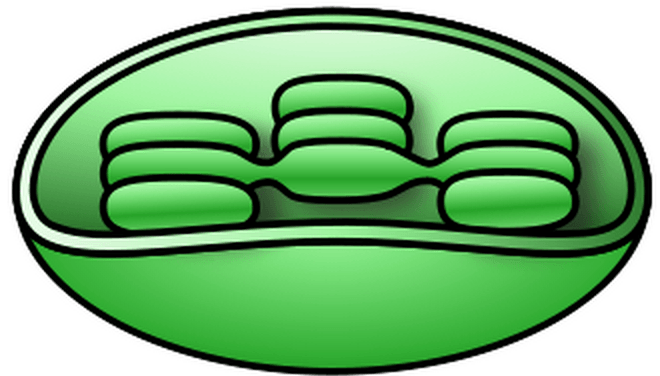
What would happen to the plant cell without the chloroplasts?
a)
There wouldn't be an organelle that performs photosynthesis
b)
There wouldn't be an organelle that serves as the resevoir for water and waste
c)
There wouldn't be an organelle that regulates what comes in and out of the cell
d)
They wouldn't be an organelle that makes necesary proteins
15.
Which of the following is NOT a cell theory.
a)
All non-living things are made of cells
b)
All cells come from pre-existing cells
c)
Cells are the basic unit of structure and function of all living things
16.
The movement of molecules from higher concentration to lower concentration is
a)
diffusion
b)
cell division
active transport
c)
active transport
d)
tonicity
17.
Active transport requires
a)
energy
b)
the nucleus
c)
chloroplasts
d)
lysosomes
18.
What organelles are only found in PLANT cells
a)
lysosomes & centrioles
b)
cell wall & chloroplasts
c)
nucleus & nucleolus
d)
mitochondria & ribosomes
19.
What organelles is NOT found in a PROkaryote
a)
nucleus
b)
cell membrane
c)
Chromosomes (DNA)
DNA
d)
ribosomes
20.
Amino acids link together to form proteins. In which organelle would this process occur?
a)
Lysosome
b)
Ribosome
c)
Centriole
d)
Mitochondria
21.

Which structure in Figure 1 would be found in both a prokaryotic cell and eukaryotic cell?

a)

Structure M

b)

Structure F

c)

Structure L

22.

The 3 essential parts of a eukaryotic cell are…

a)

Cell wall, cytoplasm and vacuole

b)

Cell wall, cell membrane and cytoplasm

c)

Cell membrane, cytoplasm and nucleus

23.

Cell membranes are made up of,

a)

Proteins

b)

Lipids

c)

Carbohydrates

d)

All of the above

24.
Which cell structure is correctly paired with its primary function?
a)
ribosome - movement
b)
mitocondria - energy production
c)
vacuole - cell division
d)
nucleus - storage of nutrients
25.
This organelle moves materials throughout the cell. 
a)
Endoplasmic Reticulum
b)
Ribosomes
c)
FedEx
d)
Golgi Complex
26.
Which organelle packages up waste to be eliminated?
a)
Golgi Complex
b)
ribosomes
c)
nucleus
d)
Endoplasmic Reticulum
27.
Sac-like organelle that digests or "cleans up" waste and parts of dead cells.
a)
ER
b)
Lysosomes
c)
Vacuoles
d)
Mitochondria
28.
What is the name of the genetic material that is inside the nucleus?
a)
ER
b)
ATP
c)
YOLO
d)
DNA
29.
I am only found in a plant cell. I use radiant energy to make glucose through a process called photosynthesis. What am I?
a)
cell wall
b)
mitochondria
c)
cytoplasm
d)
chloroplast
30.
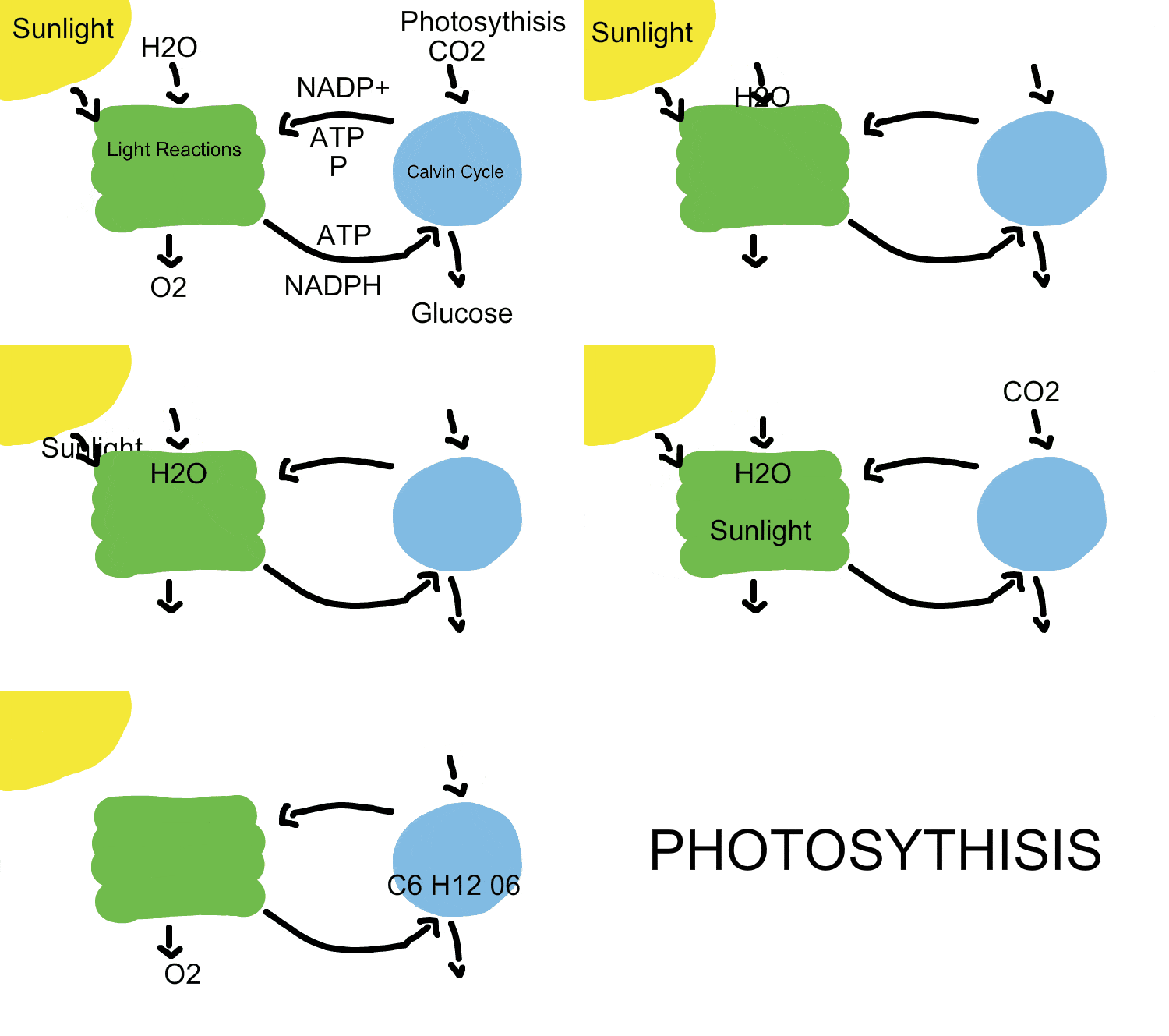
What is the purpose of photosynthesis?
a)
make glucose
b)
make ATP
c)
make light
d)
release carbon dioxide
31.
Chlorophyll absorbs a higher percentage of _____ and _______ light.
a)
purple and green
b)
red and blue
c)
black and orange
d)
yellow and green
32.
Most plants appear green because chlorophyll
a)
absorbs green light.
b)
absorbs violet light.
c)
reflects green light.
d)
does not absorb violet light.
33.
The reactants of photosynthesis are
a)
sugar and water.
b)
sugar and oxygen.
c)
carbon dioxide and water.
d)
carbon dioxide and oxygen.
34.
Which of the following is the correct equation for PHOTOSYNTHESIS?
a)
6CO2 + 6H2O --> 6O+ C6H12O6
b)
6CO+ C6H12O6 + 6H2O --> O
c)
6O2 + 6H2O --> 6CO+ C6H12O6
d)
C6H12O6 + 6O2 ---> 6H2O + 6CO2 
35.
Where do the light-dependent reactions occur? 
a)
thylakoid membrane
b)
stroma
c)
mesophyll
d)
mitochondria
36.
What is the primary function of the light-dependent reactions of photosynthesis?
a)
To produce glucose
b)
To produce NADPH and ATP
c)
To use ATP
d)
To produce RuBP
37.
Use the diagram to answer the question. Between which parts of the molecule must the bonds be broken to form an ADP molecule?
a)
A and B
b)
A and C
c)
B and C
d)
C and D
38.
How many sugar molecules are produced from every six molecules of carbon dioxide that enter the Calvin cycle?
a)
1
b)
3
c)
6
d)
12
39.
Which of the following is considered a waste product of photosynthesis?
a)
glucose
b)
oxygen
c)
carbon dioxide
d)
sunlight
40.

How many ATP are produced in aerobic respiration?

a)

2

b)

28

c)

4

d)

36

41.
In which way are photosynthesis and cellular respiration different?
a)
Cellular respiration stores ATP, while photosynthesis releases ATP.
b)
Cellular respiration produces oxygen, while photosynthesis uses oxygen.
c)
Photosynthesis releases energy, while cellular respiration stores energy.
d)
Photosynthesis used carbon dioxide, while cellular respiration produces carbon dioxide.
42.
What is the correct equation for cellular respiration?
a)
6O2 + C6H12O6 -> 6CO2 + 6H2O + Energy
b)
6O2 + C6H12O6 + Energy -> 6CO2 + 6H2O
c)
6CO2 + 6H2O -> 6O2 + C6H12O6 + Energy
d)
6CO2 + 6H2O + Energy -> 6O2 + C6H12O6
43.
Anaerobic respiration.....
a)
doesn't require CO2
b)
requires CO2
c)
doesn't require oxygen
d)
requires oxygen
44.
Cellular Respiration's goal is to
a)
make water
b)
make ATP
c)
make glucose
d)
make  oxygen
45.
Glycolysis results in a net gain of how many ATP?
a)
0
b)
2
c)
4
d)
1
46.
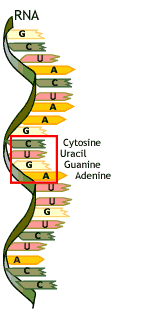
In RNA, Uracil pairs with ______. 
a)
cytosine
b)
adenine
c)
guanine
d)
thymine
47.
The process to go from DNA to mRNA is _______
a)
translation
b)
transcription
c)
replication
48.
The process to go from mRNA to a protein is called ____
a)
transcription
b)
rRNA
c)
replication
d)
translation
49.
DNA holds the code for
a)
lipids
b)
carbohydrates
c)
protein
d)
sugar
50.
Choose the nucleotide sequence of the RNA strand that would be complementary to the following strand: 
GTAGTCA
a)
UATUAGA
b)
ACGACTG
c)
CAUCAGU
d)
CATCAGT
51.
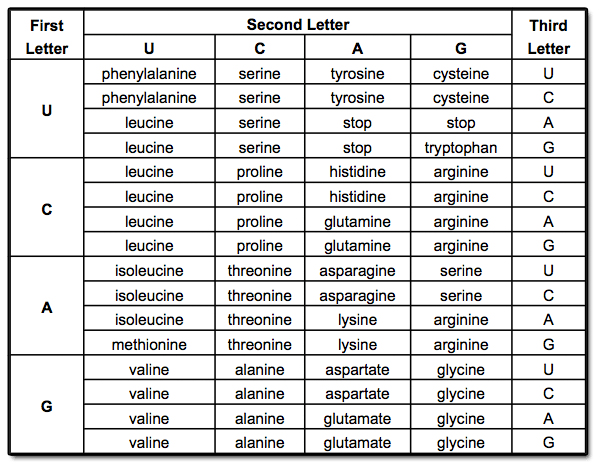
What amino acid is represented by the codon UUA?
a)
Phenylalanine
b)
Tyrosine
c)
Leucine
d)
Stop codon
52.
Which component of DNA determines the traits of an organism? 
a)
Nitrogen Bases
b)
Sugar-Phosphate Backbone
c)
Hydrogen bonds
53.
What is the location in the cell for translation?
a)
nucleus
b)
mitochondria
c)
ribosome
d)
chloroplast
54.
What is the three base sequence of mRNA that codes for a single amino acid?
a)
Anticodon
b)
Codon
c)
Protein
55.
What are the backbones (sides) of the DNA structure made up of?
a)
repeating phosphates and sugars
b)
nitrogen bases
c)
nucleotides
d)
adenine and thymine
56.
Does the order of amino acids in a protein matter?
a)
YES!
b)
NO!
57.

What type of bond holds together the two strands of the DNA double helix?

a)

covalent

b)

ionic

c)

hydrogen

d)

metallic

58.

What are the three components of a DNA monomer unit?

a)

ribose, phosphate, nitrogen base

b)

ribose, sugar, nitrogen base

c)

deoxyribose, phosphate, nitrogen base

d)

deoxyribose, sugar, nitrogen base

59.

The monomers that make up DNA and RNA are called?

a)

amino acids

b)

monosaccharides

c)

nucleotides

d)

fatty acids

60.

The process of DNA copying itself is

a)

conservative - one original and one new DNA molecule

b)

semi-conservative - 2 DNA molecules with one new and one original strand

c)

dispersive - 2 DNA molecules with each strand consisting of alternating segments of new and original DNA parts

d)

partial - one complete DNA molecule and one partial DNA molecule

61.

If one strand of DNA has the following base sequence, what will the other strand's base sequence be? AATGGC

a)

AATGGC

b)

TTACCG

c)

UUACCG

d)

GGCAAT

62.

The segment of DNA that has the directions for making a protein is called?

a)

chromosome

b)

strand

c)

gene

d)

nucleotide

63.

How would you be able to distinguish RNA from DNA?

a)

RNA is single stranded

b)

RNA has Uracil

c)

RNA has Ribose

d)

All of these are ways that RNA differs from DNA!

64.
What type of mutation occurs, when a base is subtracted from the sequence? 
a)
Deletion
b)
Insertion
c)
Substitution 
65.
Why are insertion and deletion (frameshift) mutations so harmful?
a)
They change all of the codons from the mutation on down the line, which changes the amino acid sequence
b)
They insert things that an organism doesn't need.
c)
They often delete things that organisms need.
d)
Insertion and deletions are not any more harmful than substitution mutations.
66.

Process that separates DNA fragments by size and charge.

a)

Gel electrophoresis

b)

Cloning

c)

Transgenic

d)

Recombinant DNA

67.

Undifferentiated cells that can become any type of cell.

a)

Plasmids

b)

Transgenic

c)

Stem Cells

d)

DNA

68.

Genetic material found in ALL living things.

a)

Plasmid

b)

Stem Cells

c)

DNA

d)

Restriction Enzymes

69.

Process that can rapidly multiply small pieces of DNA.

a)

Restriction Enzyme

b)

Gel Electrophoresis

c)

Polymerasae Chain Reaction

d)

Transgenic

70.

The way that crimes are solved today was affected by which of the following technologies?

a)

gene therapy

b)

genetic testing

c)

DNA fingerprinting (gel electrophoresis)

d)

genetic modification