wayground logo

Free Printable Worksheets

Font size

S
M
L
XL
Worksheets

Unit 1 Exam Review - BIO 110

Total questions: 90

Worksheet time: 1hrs 17mins

Name
Class
Date
1.

Living organisms are made up of building blocks called

a)

DNA

b)

Homeostasis

c)

Cells

d)

Seeds

2.

All living things contain genetic material in the form of

a)

RNA

b)

Protein

c)

DNA

d)

Lipid

3.

All organisms are able to grow and develop. An example of this is

a)

A dog sitting in the sun

b)

A caterpillar becoming a butterfly

c)

A unicellular organism

d)

An increase in heart rate following exercise

4.

All of the chemical reactions that allow organisms to build up and break down molecules is called

a)

Metabolism

b)

Combustion

c)

Digestion

d)

Absorption

5.

Maintaining a stable internal environment is called

a)

Homeostasis

b)

Balance

c)

Equilibrium

d)

Fair

6.
Living things change during their lives through ___.
a)
reproduction
b)
growth and development
c)
making responses
d)
adaptation and organization
7.
Any structure, behavior, or internal process that enables an organism to better survive in an environment
a)
development
b)
adaptation
c)
environment
d)
evolution
8.

Prokaryotic

a)

Bacteria

b)

Protists

c)

Plant

d)

Animal

e)

Fungi

9.
This kingdom includes unicellular organisms, they reproduce quickly by binary fission (asexual), and live in your gut.
a)
Archaebacteria
b)
Fungi
c)
Eubacteria
d)
Protists
10.
What organism possesses these traits?
a)
A. Eubateria
b)
B. Fungi
c)
C. Plantae
d)
D. Monera
11.

Orchids are multicellular organisms with complex cells. They convert the sun's energy into food. Orchids are classified into this kingdom.

a)

protist

b)

archaebacteria

c)

plant

d)

fungi

12.
Used for short term (quick) energy.
a)
carbohydrates
b)
lipids
c)
proteins
d)
nucleic acids
13.
Provides long term energy and insulation,
a)
lipids
b)
carbohydrates
c)
nucleic acids
d)
proteins
14.
Contains DNA and RNA
a)
lipids
b)
carbohydrates
c)
proteins
d)
nucleic acids
15.
Contains a phosphate, sugar and nitrogen base
a)
nucleic acid
b)
lipid
c)
carbohydrate
d)
protein
16.
Building blocks of the body, hair , muscles etc.
a)
protein
b)
nucleic acid
c)
lipids
d)
carbohydrates
17.
Is found in the cell membrane as a bilayer. 
a)
lipids
b)
protein
c)
nucleic acid
d)
carbohydrate
18.
Identify the macromolecule in the picture
*GLUCOSE
a)
lipid
b)
protein
c)
nucleic acid
d)
carbohydrate
19.
Identify the macromolecule in the picture.
* look at the R.....
a)
carbohydrates
b)
lipids
c)
proteins 
d)
nucleic acids
20.
Identify the macromolecule in the picture
* cholesterol and triglycerides
a)
carbohydrate
b)
protein
c)
lipid
d)
nucleic acid
21.
Identify the macromolecule in the picture
a)
carbohydrate
b)
lipid
c)
protein
d)
nucleic acid
22.
Proteins are made of monomers called ___________
a)
Nucleotides
b)
Monosaccharides
c)
Amino Acids
d)
Glycerol and fatty acids
23.
The element _______is found in all of the organic compounds.
a)
Iron
b)
Nitrogen
c)
Carbon
d)
Oxygen
24.
_________ are composed out of carbon (C), hydrogen (H), oxygen (O), nitrogen (N), and phosphorus (P)
a)
Carbohydrates
b)
Lipids
c)
Proteins
d)
Nucleic Acids
25.
Nucleotides are monomers of
a)
Carbohydrates
b)
Lipids
c)
Proteins
d)
Nucleic Acids
26.
Monosaccharides are monomers of
a)
Carbohydrates
b)
Lipids
c)
Proteins
d)
Nucleic Acids
27.
Waxes, oils and fats are examples of
a)
Carbohydrates
b)
Lipids
c)
Proteins
d)
Nucleic Acids
28.
Which sequence of DNA bases would pair with this partial strand
ATG TGA CAG
a)
ATG TGA CAG
b)
TAC ACT GTC
c)
GTA AGT GAC
d)
CAT TCA CTG
29.
Which of the following best describes a DNA molecule?
a)
double helix
b)
contains ribose
c)
made of amino acids
d)
contains Uracil
30.
Why is DNA important?
a)
it is very small and very complicated
b)
it's in everything
c)
it serves as the blueprint for traits of all living things
d)
because we eat it every day for energy
31.
Which 2 molecules form the sides (backbone) of the DNA ladder?
a)
deoxyribose sugar and adenine
b)
deoxyribose sugar and a hydrogen bond
c)
deoxyribose sugar and the nucleus
d)
deoxyribose sugar and phosphate
32.
Which organelle is DNA usually found in?
a)
cell membrane
b)
vacuole
c)
chloroplast
d)
nucleus
33.
Nitrogenous bases are joined by which type of bond?
a)
polar bonds
b)
ionic bonds
c)
covalent bonds
d)
hydrogen bonds
34.
The enzyme that unzips the DNA to prepare for replication
a)
helicase
b)
replicase
c)
polymerase
d)
synthase
35.
A process in which DNA has the unique ability to make an exact copy of itself.
a)
Replication
b)
Translation
c)
Transcription
36.
In what phase of the cell cycle does DNA replication take place?
a)
G1
b)
S
c)
G2
d)
M
37.
How does RNA differ from DNA?
a)
RNA contains uracil and deoxyribose
b)
RNA contains ribose and thymine
c)
RNA contains uracil and ribose
d)
RNA contains adenine and ribose
38.

I am a message that is translated to form a protein

a)

mRNA

b)

rRNA

c)

tRNA

d)

hRNA

39.

Brings amino acids to help make the growing protein

a)

mRNA

b)

rRNA

c)

tRNA

40.

Protein synthesis is

a)

The process of creating new proteins

b)

The process of creating new carbohydrates

c)

The process of creating new lipids

d)

The process of creating new nucleic acids

41.
What subatomic particles would you find in the nucleus of an atom?
a)
Protons only
b)
Protons and Neutrons
c)
Neutrons and Electrons
d)
Protons and Electrons 
42.
What is the number of protons that the element in this image contain?
a)
14
b)
7
c)
15
d)
18
43.
If an atom has 12 positively charged subatomic particles, which of the following must it also have to be considered a neutral atom?
a)
12 neutrons
b)
12 electrons
c)
12 protons
d)
24 protons and neutrons
44.
A(n) _________ is an ion with a positive (+) charge.
a)
anion
b)
cation
c)
ion
d)
solute
45.
When an atom loses an electron, it becomes a:
a)
positive ion
b)
negative ion
c)
neutral ion
d)
neutral atom
46.
What are ionic bonds?
a)
valence electrons transferred between atoms
b)
Inner most electrons transferred between atoms
47.
How do covalent bonds form?
a)
Donating & receiving valence e- between atoms.
b)
Opposite slight charges attract each other between compounds.
c)
Scientists are still not sure how they form.
d)
Sharing valence e- between atoms.
48.
Which of the following properties of water enables it to move from the roots to the leaves of plants?
a)
Water expands as it freezes.
b)
Water is an excellent solvent.
c)
Water exhibits cohesive behavior.
d)
Water moderates temperature.
49.
Large bodies of water do not quickly fluctuate in temperature. Why?
a)
Water is a solvent.
b)
Water has a high heat capacity.
c)
Water acts as a buffer.
d)
Water is non-polar.
50.
What two elements make up water?
a)
Helium and oxygen
b)
Hydrogen and oxygen
c)
helium and carbon
d)
oxygen and carbon
51.
What word describes when water is attracted to other substances?
a)
cohesion
b)
adhesion
c)
capillary action
d)
surface tension
52.
This structure controls what can enter and leave a cell.
a)
Nucleus
b)
Cytoplasm
c)
Cell Membrane
d)
Golgi Body
53.
This small structures break down materials in the cell.
a)
Cholorplasts
b)
Ribosomes
c)
Lysosomes
d)
Golgi Body
54.
This structure packages and distributes proteins throughout the cell. 
a)
Golgi Body
b)
Lysosome
c)
Ribosome
d)
Mitochondria
55.
This structure produces protein in the cell.
a)
Ribosomes
b)
Cytoplasm
c)
Nucleus
d)
Lysosomes
56.
A phospholipid has 2 parts. What are they called? 
a)
Hydrophilic Head, Hydrophobic Tail 
b)
Hydrophobic Head, Hydrophilic Tail 
57.
"Water Loving"
a)
Hydrophobic
b)
Hydrophilic 
c)
Hydroelectric 
d)
Hydroloric
58.
"Water Fearing" 
a)
Hydrophobic
b)
Hydrophilic 
c)
Hydroelectric 
d)
Hydroloric
59.
Describes the arrangement of the cell membrane as bendable and made of many parts. 
a)
The Fluid Mosaic Model 
b)
The Major Mobility Model 
c)
The Crazy Cell Model
d)
The Maze Model
60.
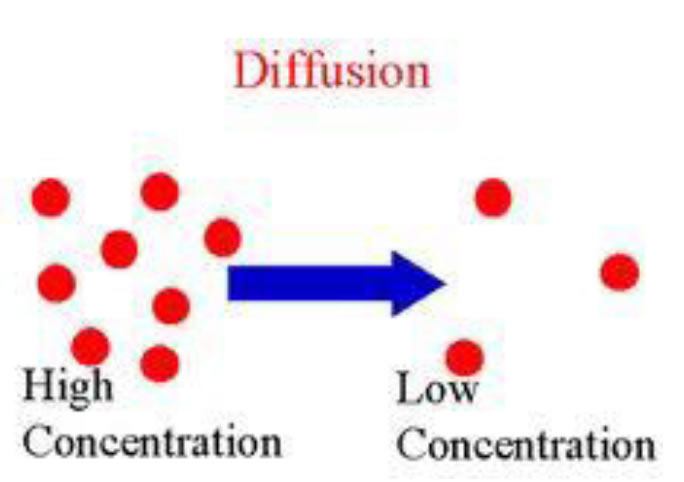
Movement of particles from high to low concentration. 
a)
Passive Transport
b)
Active Transport
61.
Osmosis is a form of ______________. 
a)
Passive Transport
b)
Active Transport
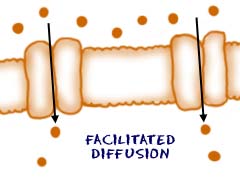
62.
a)
Passive Transport
b)
Active Transport
63.
Endocytosis
a)
Passive Transport
b)
Active Transport
64.
This takes substances into a cell
a)
endocytosis
b)
exocytosis
c)
both
65.
This uses energy
a)
endocytosis
b)
exocytosis
c)
both
66.
What is the longest stage of the cell cycle called?
a)
Cytokinesis
b)
M phase
c)
Interphase
d)
G1 Phase
67.
During what phase of the cell cycle does cell division occur?
a)
Interphase
b)
M phase
c)
S phase
d)
G2 phase
68.
During what phase of the cell cycle is DNA replicated?
a)
G1 phase
b)
S phase
c)
G2 phase
d)
M phase
69.
During what phase of the cell cycle does the cell grow?
a)
G1 phase
b)
S phase
c)
M phase
d)
Cytokinesis
70.
Put the following actions in order: DNA replicates, cell grows, cell divides, cell prepares for mitosis. 
a)
DNA replicates, cell grows, cell prepares for mitosis, cell divides
b)
cell grows, cell prepares for mitosis, DNA replicates, cell divides
c)
cell grows, DNA replicates, cell prepares for mitosis, cell divides
d)
DNA replicates, cell prepares for mitosis, cell grows, cell divides
71.
Why would it be important to replicate DNA before a cell divides in mitosis or meiosis?
a)
In order for genetic information to be transferred into daughter cells.
b)
In order for the cell to be able to increase in size.
c)
In order for the DNA to be contained in the nucleus.
d)
In order for the cell to re-order the DNA sequencing in the new cells.
72.
Before cells can divide, what must be copied?
a)
mitochondria
b)
cytoplasm
c)
DNA
d)
Cell Wall
73.
The division of the nucleus is known as:
a)
Synthesis
b)
Mitosis
c)
G1
d)
G2
74.
Humans have ________ pairs of chromosomes.
a)
21
b)
23
c)
46
d)
None of the above
75.
The ___________ holds the replicated sister chromatids together.
a)
centriole
b)
chromosomes
c)
centromere
d)
cycles
76.
Uncontrollable cell growth is known as _____
a)
obesity
b)
cancer
c)
diabetes
d)
hepatitis
77.
A human cell has 46 chromosomes before mitotic division.  How many chromosomes will the daughter cells after mitosis.
a)
12
b)
23
c)
46
d)
92
78.
Why do we need meiosis?
a)
To double the number of chromosomes going into sex cells
b)
To halve the number of chromosomes going into sex cells
c)
To triple the number of chromosomes going into sex cells
d)
To not change the number of chromosomes going into sex cells
79.
The process to go from DNA to mRNA is _______
a)
translation
b)
transcription
c)
replication
80.
The process to go from mRNA to a protein is called ____
a)
transcription
b)
rRNA
c)
replication
d)
translation
81.
DNA holds the code for
a)
lipids
b)
carbohydrates
c)
protein
d)
sugar
82.
Choose the nucleotide sequence of the RNA strand that would be complementary to the following strand: 
GTAGTCA
a)
UATUAGA
b)
ACGACTG
c)
CAUCAGU
d)
CATCAGT
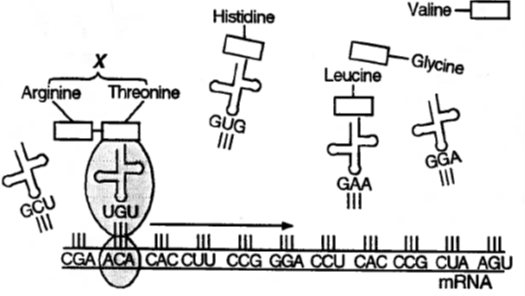
83.
What process is going on in this photo? 
a)
Transcription 
b)
Translation 
c)
Replication 
d)
All the above 
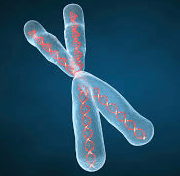
84.
Each identical side of a chromosome is the 
a)
centromere
b)
chromatin
c)
centriole
d)
chromatid
85.

A photograph or picture of chromosomes grouped in ordered pairs is called a.....

a)

Pedigree

b)

Chromosome chart

c)

Mitotic index

d)

Karyotype

86.

What is the gender of the individual whose karyotype is seen in the image?

a)
b)
87.
The genetic transmission (passing on) of characteristics from parents to offspring.
a)
Inheritance
b)
Genotype
c)
Phenotype
d)
Genetics
88.

What is a chromosome?

a)

deoxyribonucleic acid, a self-replicating material which is present in nearly all living organisms. It is the carrier of genetic information.

b)

a threadlike structure of nucleic acids and protein found in the nucleus of most living cells, carrying genetic information in the form of genes.

c)

one of two or more alternative forms of a gene that arise by mutation and are found at the same place on a DNA strand

d)

your complete heritable genetic identity

89.

A chromosome that is not directly involved in determining sex, as opposed to a sex chromosome is called a _________.

a)

autosome

b)

chromosome

c)

allele

d)

karyotype

90.
The cell below is in a _________ solution.
a)
Hypotonic
b)
Hypertonic
c)
Isotonic