wayground logo

Free Printable Worksheets

Font size

S
M
L
XL
Worksheets

Geology Unit Review

Total questions: 90

Worksheet time: 1hrs 4mins

Name
Class
Date
1.

The layer of the Earth that contains the plates is called

a)

outer core

b)

inner core

c)

asthenosphere

d)

lithosphere

2.

What type of boundary is the Mid-Atlantic Ridge a result of?

a)

divergent

b)

convergent

c)

strike-slip

d)

transform

3.

Which of the following is NOT caused by the movement of plates?

a)

tsunamis

b)

earthquakes

c)

hurricanes

d)

mountain-building

4.

Evidence of life from the past, often with leaves, bones or footprints is called

a)

rocks

b)

fossils

c)

pattern

d)

rate

5.

Which of the following statements is TRUE concerning convection?

a)

When matter heats up, it expands and becomes more dense.

b)

When matter heats up, it contracts and becomes more dense.

c)

When matter heats up, it expands and becomes less dense.

d)

When matter heats up, it contracts and becomes less dense.

6.

Which of the following is true about subduction of plates? Choose the one best answer.

a)

Oceanic plates are denser and thinner than continental plates; oceanic plates are subducted under continental plates.

b)

Oceanic plates are thicker and more dense than continental plates and therefore subduct under continental plates.

c)

Continental plates are more dense than oceanic plates and therefore subduct under oceanic plates.

d)

Oceanic plates are less dense than continental plates; therefore oceanic plates subduct under continental plates.

7.

What causes plates to move?

a)

energy from the sun

b)

convection currents in the asthenosphere

c)

gravity and friction

d)

natural disasters such as volcanic eruptions and tsunamis

8.

The process by which the ocean floor sinks beneath a deep-ocean trench and back into the mantle is known as

a)

uplift

b)

convection

c)

seafloor spreading

d)

subduction

9.

About 90% of the world’s earthquakes and 75% of the world’s volcanoes take place in the “Ring of Fire”. Why is this the case?

a)

It is a place where there is large amount of plate movement.

b)

It is very warm in this region of the world which allows for high levels of convection.

c)

It is the region of the world which is most affected by the weather phenomenon “El Niño”.

d)

It is the location of the largest ridge system, the Mid-Atlantic Ridge.

10.

A fracture or break in the crust of the Earth

a)

fault

b)

epicenter

c)

focus

d)

uplift

11.
How is it possible for new crust to be formed without increasing the surface area of the Earth?
a)
Crust is destroyed at the same time it is created
b)
New crust is underwater where it sinks
c)
New crust breaks more easily than old crust
12.
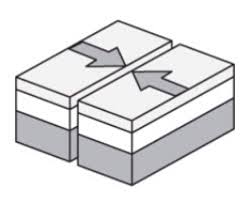
Name the boundary
a)
convergent boundary
b)
divergent boundary
c)
transform boundary
d)
sergent boundary
13.

How is it possible for new crust to be formed without increasing the surface area of the Earth?

a)

Crust is recycled in subduction zones at the same time it is created at mid-ocean ridges

b)

New crust is underwater where it sinks

c)

New crust breaks more easily than old crust

d)

The oldest crust just breaks apart as the plates move

14.
By definition, a mineral has which of the following characteristic(s)?
a)
definite chemical composition
b)
crystal structure
c)
naturally occuring
d)
all of the above
15.
What mineral is used for pencils?
a)
Graphite
b)
Galena
c)
Magnetite
d)
Quartz
16.

1. Rock sediments that travel down a mountain, sand being blown across the beach, and mud sliding down a hill are all examples of

a)

pressing and cementing

b)

erosion

c)

part of the rock cycle

d)

fossil formation

17.

The remains of living things that died long ago are often found in what type of rock?

a)

igneous rocks

b)

sedimentary rock

c)

metamorphic rock

d)

all rocks

18.

The cooled and hardened magma from volcanoes form what rocks?

a)

igneous

b)

sedimentary

c)

metamorphic

d)

fossils

19.

Hot, molten rock inside the earth is called ...

a)

lava

b)

magma

c)

igneous rock

d)

minerals

20.

Once magma reaches the earth's surface, it is called __________.

a)

a vent

b)

minerals

c)

igneous rocks

d)

lava

21.
What type of rock forms when sand, particles of rock, bits of soil, and remains of once-living things are cemented?
a)
igneous
b)
sedimentary
c)
minerals
d)
metamorphic
22.
The continuous series of change that rocks undergo is known as the _____.
a)
rock cycle
b)
water cycle
c)
hibernation
d)
metamorphisis
23.
The process when rocks break into smaller pieces due to exposure to natural elements is called
a)
erosion
b)
weathering
c)
sediments
d)
deposition
24.

What are the two types of crust?

a)
continental and oceanic
b)
ocean and upper
c)
lower and upper
d)
pizza and subway
25.

What is the MAIN way rocks are classified?

a)

Their color and shapes

b)

How they form

c)

Texture

d)

Composition

26.
Each rock type can follow only one pathway of the rock cycle.
a)
True
b)
False
27.

What do scientists know about an undisturbed sequence of rocks based on superposition?

a)

Older rocks are on top of younger rocks

b)

Younger rocks are on top of older rocks

c)

Older rocks have eroded away

d)

Younger walks get deposited and do not stay

28.
The trace or remains of an organism that lived long ago, most commonly preserved in sedimentary rock
a)
varve
b)
index fossil
c)
trace fossil
d)
fossil
29.
The age of an object in relation to the ages of other objects is known as what?
a)
relative age
b)
absolute age
c)
half-life
d)
unconformity
30.
What is the scientific study of fossils called?
a)
uniformitarianism
b)
unconformity
c)
paleontology
d)
radiometric dating
31.
Fossilized dinosaur eggs have been found in the third of five rock layers during a fossil dig.  Based on the law of superposition, which best represents the age of the eggs?
a)
The eggs are older than all of the rock layers.
b)
The eggs are younger than all of the rock layers.
c)
The eggs are about the same age as the third rock layer.
d)
The eggs are about the same age as the fifth rock layer.
32.

How does the law of crosscutting relationships explain the age of a fault caused by an earthquake?

a)

The fault is older than the rocks above it.

b)

The fault is younger than the rocks above it.

c)

The fault is older than rocks it cuts through.

d)

The fault is younger than the rocks it cuts through.

33.

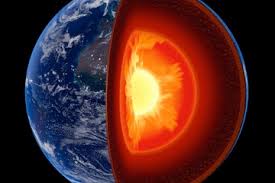
The asthenosphere can best be described as

a)

The rigid rock material found in the upper mantle

b)

the plastic-like area of the upper mantle that the lithosphere "floats" on

c)

The melted rock material found deep in the mantle

d)

The liquid iron and nickel that move in the core

34.

Which statement best compares and contrasts the inner and outer cores

a)

The inner and outer core both are made of iron and nickel, but the metals are in a liquid state in the outer core. On the other hand, the iron and nickel are solid in the core due to the high pressure

b)

The inner core is made of solid iron and nickel The outer core is made of liquid iron and nickel.

c)

The outer core is solid iron and nickel, whereas the same material is in a liquid state in the inner core because it is so hot at that depth.

d)

The inner and outer core are both metal and part of the layers of Earth. They are different too.

35.

5. Scientists' knowledge of the Earth's interior has come primarily from...

a)

a. studying magnetic reversals in oceanic crust

b)

b. using a system of satellite called the giobal positioning system

c)

c. studying sesmic waves generated by earthquakes.

d)

d. studying the pattern of fossils on different continents.

36.
Less dense materials rise to the top.
a)
True
b)
False
37.
What is the difference between a rock and a mineral?
a)
Minerals are composed of organic material, and rocks are composed of minerals.
b)
Rocks are composed of only organic material, and minerals are composed of rocks.
c)
Rocks are composed of minerals and other organic material while minerals are inorganic and composed of the same elements every time. 
d)
Minerals are composed of rocks and other organic material while rocks are inorganic and composed of the same elements every time. 
38.
Which layer is the oldest? 
a)
c
b)
a
c)
b
d)
d
39.
What fossil is the oldest?
a)
d
b)
b
c)
a
d)
c
40.
On top of Mt. Everest, there are fossilized remains of sea life; this tells us that the rocks at the top of world's highest mountain 
a)
used to be above sea level
b)
used to be below sea level
c)
used to be on Mars
d)
came from an asteroid
41.
Which layer contains the oldest index fossils?
a)
Layer 1
b)
Layer 2
c)
Layer 3
d)
Layer 4
42.
Tiny bits of weathered rock are called ________
a)
Sediment
b)
basalt
c)
mineral
d)
coal
43.
What can studying fossils tell us?
a)
They can tell us about what past environments were like and what kind of animals lived there
b)
They can tell us about the animals that will live there in the future
c)
they can tell us how to train and care for extinct animals
44.

Where does the heat come from that drives convection currents in the asthenosphere?

a)

The sun

b)

The crust

c)

the mantle

d)

the core

45.

The ability to do work or cause change

a)

system

b)

energy

c)

matter

d)

element

46.
The age of a rock compared to the ages of other rocks.
a)
relative age
b)
half-life
c)
absolute age
d)
radioactive decay
47.

Which letter matches with the OLDEST layer of rock?

a)

W

b)

X

c)

Y

d)

Z

48.
Which period are we currently in?
a)
Quaternary
b)
Holocene
c)
Jurassic
d)
Tertiary
49.
What is the correct order of these rocks, from old to young?
a)
C, H, E, G, A, F, D, B
b)
C, H, E, D, A, G, F, B
c)
C, A, H, E, D, G, F, B
d)
B, F, G, A, D, E, H, C
50.
How was a large canyon like this most likely formed based on the clues from the picture. 
a)
Weathering due to a river cutting through rock
b)
A glacier cutting through a valley
c)
A sinkhole due to water eroding the dirt away from under the rock
d)
An earthquake suddenly splitting the rock open
51.

What is the order of layers (from oldest to youngest) in this picture ?

a)

QPONMLHIJK

b)

QONPMLHIJK

c)

QONMLHIJKP

d)

QONMLPHIJK

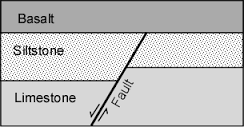
52.

What are the relative ages of the features in order from oldest to youngest?

a)

Limestone, Basalt, Fault, Siltstone

b)

Siltstone, Fault, Basalt, Limestone

c)

Limestone, Fault, Basalt, Siltstone

d)

Limestone, Siltstone, Fault, Basalt

53.
Evidence shows that Earth is about
a)
1.9 million years old
b)
2.8 million years old
c)
3.8 billion years old
d)
4.5 billion years old
54.

Someone who studies rocks and minerals

a)

paleontologist

b)

geologist

c)

astronomer

d)

biologist

55.

The solid, nonliving part of earth is called

a)

geosphere

b)

biosphere

c)

hydrosphere

d)

atmosphere

56.

"The present is the key to the past" is called

a)

Pangaea

b)

Uniformitarianism

c)

Law of Faunal Succession

d)

Law of Wegner

57.

The point right above where an earthquake begins

a)

focus

b)

epicenter

c)

magnitude

d)

hypocenter

58.

Earth is a DYNAMIC planet

a)

True - because Earth is constantly changing

b)

True - because earth can sustain life

c)

False - because earth is stagnant

d)

False - because Earth is a system

59.

What large pieces of the Earth's crust are convection currents responsible for moving?

a)

lithospheric plates

b)

dinner plates

c)

empty plates

d)

dinosaur plates

60.

Theory describing how the continents were once connnected and slowly over time drifted apart to their current locations

a)

Theory of Evolution

b)

Sea Floor Spreading Theory

c)

Law of Superposition

d)

Continental Drift Theory

61.

Which is NOT evidence to support Continental Drift?

a)

The shapes of the continents match

b)

Photographs taken of Earth being one landmass

c)

Same fossils found on different continents

d)

Magnetic layers in sea floor spreading

62.

In which type of rock can most fossils be found?

a)

igneous

b)

sedimentary

c)

metamorphic

d)

intrusive igneous

63.

Which of the following most likely causes Earth's inner core to be a solid?

a)

metals in the core are very heavy

b)

pressure at the core is very high

c)

the temperature at the core is very low

d)

the layers alternate form

64.
Earth's plates are...
a)
constantly moving and changing the face of the earth
b)
Never moves
c)
Moves seldom and very fast
d)
Moves when it feels like it
65.
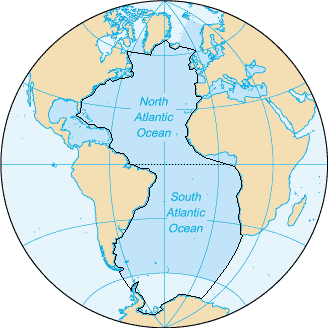
In the Atlantic ocean, where is the youngest seafloor located?
a)
Towards the edges, near the eastern and western continents
b)
Towards the middle of the ocean
c)
Towards the north and south poles
d)
Young seafloor is located randomly throughout the ocean
66.
True or False: The Mid-Atlantic ridge in the Atlantic ocean is the ONLY example of a divergent boundary (<---->)
a)
True
b)
False
67.
True or False: The continents on the eastern (the Americas) and western (Europe, Africa) side of the Atlantic Ocean are moving closer together. 
a)
True
b)
False
68.
Undersea mountain range.
a)
Rift
b)
Mid-ocean ridge
c)
seafloor spreading
d)
Continental drift
69.

True or False : Sea-floor Spreading adds new material to the ocean floor.

a)
True
b)
False
70.

This scientist was the first to propose seafloor spreading

a)

William Watts

b)

Harry Hess

c)

Alfred Wegener

d)

Tenzing Norgay

71.
What type of plate boundary is this?
a)
Plate
b)
Divergent
c)
Convergent
d)
Transform
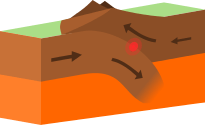
72.
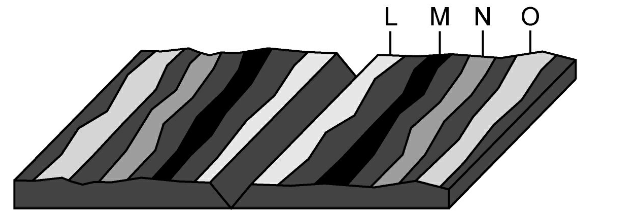
What type of event will occur at this boundary?
a)
Earthquake
b)
Volcano Eruption
c)
Tornado
d)
Mountain Building
73.
Where would the oldest rock be found?
a)
L
b)
M
c)
N
d)
O
74.
This landform can occur at a divergent plate boundary.
a)
ocean trench
b)
mid-ocean ridge
c)
tall mountains
d)
transform fault
75.
The Himalayas in Asia are an example of what type of plate boundary?
a)
divergent
b)
continent-to-continent convergent
c)
ocean-to-continent convergent
d)
transform
76.
The average density of one of the continental crusts is 2.8 g/cm3 and the average density of one of the oceanic crusts is 3.2 g/cm3. If these two plates came together, what could be expected to happen? 
a)
  The two plates would push apart and form a rift zone. 
b)
The oceanic plate would rise up over the continental plate. 
c)
The oceanic plate would be pushed under the continental plate. 
d)
The two plates would meet head on and rise up to form mountains.
77.
Who is the German Scientist that came up with the theory of the Continental Drift? 
a)
Albert Einstein 
b)
Ms. Stukel 
c)
Galileo
d)
Alfred Wegener
78.
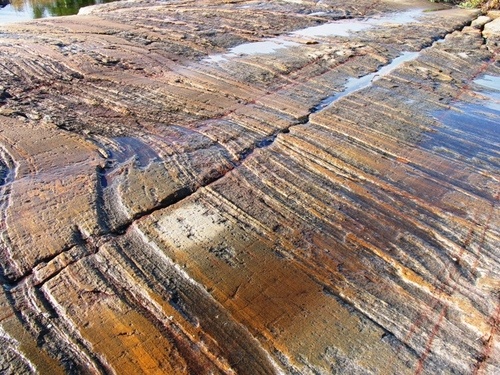
This is a picture of glacier scars found in Africa.  What are these evidence for?
a)
Africa has always been near the equator
b)
Africa was once in an area of the Earth that had a very cold climate
c)
The continents have not moved
d)
sea floor spreading
79.
What evidence did Wegener use to support his theory?
a)
Continents and fossils fitting together/matching-up like puzzle pieces 
b)
glacier scars and other climate evidence from temperature
c)
mountain ranges and rocks line up across continents
d)
all of the above
80.
Each rock type can follow only one pathway of the rock cycle.
a)
True
b)
False
81.
How are weathering and erosion related?
a)
Both weathering and erosion break down soil. 
b)
Both weathering and erosion move rocks.
c)
Weathering breaks down rocks, and then erosion moves the broken down rocks.
d)
They are not related at all.
82.
As you travel from the inner core to the crust, how would temperature, pressure and density of the material change?
a)
The would all increase
b)
The would all decrease.
c)
They would stay the same.  
d)
Temperature would decrease, but pressure and density would increase. 
83.

The ability to do work or cause change

a)

system

b)

energy

c)

matter

d)

element

84.

When two plates diverge, what happens?

a)

A new plate from underneath fills in the gap.

b)

Sand and dirt fill in the gap.

c)

Soft solid rock rises, hardens and joins at the edge of the plates.

d)

Water fills in the gap.

85.

True or False? Earthquakes is what causes plates to move.

a)

true

b)

false

86.

Which of the following locations is NOT along the Ring of Fire?

a)

Indonesia

b)

Alaska

c)

England

d)

Chile

87.

About 90% of the world’s earthquakes and 75% of the world’s volcanoes take place in the “Ring of Fire”. Why is this the case?

a)

It is a place where there is large amount of plate movement.

b)

It is very warm in this region of the world which allows for high levels of convection.

c)

It is the region of the world which is most affected by the weather phenomenon “El Niño”.

d)

It is the location of the largest ridge system, the Mid-Atlantic Ridge.

88.
The San Andreas Fault is a crack in the Earth's crust that runs the length of California. What plate boundary feature caused this?
a)
an inactive convergent boundary
b)
an active convergent boundary
c)
an active transform boundary
d)
a volcanic eruption
89.
Mesosaurus fossils are found between where?
a)
India
b)
Africa and South America
c)
Antartica
d)
Australia
90.

Which statement about Iceland is FALSE?

a)

It is located at a convergent plate boundary.

b)

It is growing in size, as it is located at a divergent plate boundary.

c)

It is made up of two tectonic plates.

d)

It is part of the Mid-Atlantic Ridge