
 Worksheets
Study Guide for Test 2
Total questions: 115
Worksheet time: 2hrs 37mins
If listed from the smallest scale to the largest, which is the correct order of these common components of an organ system?
cells, tissues, organs, organelles
organelles, cells, tissues, organs
cells, tissues, organelles, organs
tissues, organs, organelles, cells
Cell theory states that
cells are the basic unit of structure and function in living things.
All of these answers are correct.
all living things are composed of cells.
new cells are produced by existing cells.
All living things have an internal structure called ____________, which are the smallest unit of life.
Cells
ATP
Glucose
Sugar
Which word means to increase in size to become adults?
sensitivity
movement
respiration
growth
Which life process means to produce young like themselves?
excrete
movement
reproduction
sensitivity
A word that means to get rid of waste from the body...
nutrition
respiration
grow
excrete
An example of a biotic factor is a
bone
car
tree
rock
An example of an abiotic factor is a
wooden table
bone
mosquito
plastic toy
Which DOES NOT show growth and development?
A tadpole turns into a frog.
A watermelon seed turns into a watermelon plant.
An anteater eats a thousand ants.
A bacteria cell splits in half.
This characteristic means that organisms are arranged from smallest to largest.
Energy Use
Cells
Homeostasis
Organization
Identical twins have 99.999% of the same genes.
All living things contain DNA
All living things require and use energy
All living things are made of cells
All living things maintain a stable internal balance
This network of passageways carries materials from one part of the cell to another.
endoplasmic reticulum
golgi bodies
vacuole
cell

Robert Hooke, Anton van Leeuwenhoek, Theodor Schwann, Rudolf Virchow, and Matthias Schleiden were all responsible for what theory?
The Theory of Gravity
The Theory of Relativity
The Cell Theory
The Theory of Continental Drift
Nucleus
Which of the following is the correct term used to describe a group of body parts such as mouth, esophagus, stomach, small intestines, and large intestines that are working together to perform a specific function?
organism
tissue
organ system
organ
What type of cell does not have a defined nucleus or membrane bound organelles?
Animal Cell
Prokaryote
Eukaryote
Plant Cell
Eyepiece = 10X
Objective lens = 55X

What bone is highlighted?
Skull (Cranium)
Mandible
Clavicle
Scapula

What bone is highlighted?
Skull (Cranium)
Mandible
Scapula
Clavicle

What bone is highlighted?
Skull (Cranium)
Scapula
Clavicle
Mandible

What bone is highlighted?
Skull (Mandible)
Clavicle
Mandible
Scapula
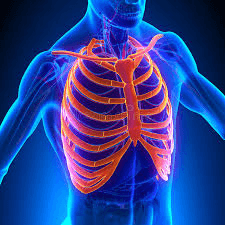
What bone is highlighted?
Ribs
Vertebrae
Clavicle
Femur

What bone is highlighted?
Radius
Ulna
Humerus
Carpals

What bone is highlighted?
Vertebrae
Radius
Pelvis
Ribs

What bone is highlighted?
Radius
Ulna
Humerus
Carpals

What bone is highlighted?
Radius
Ulna
Humerus
Carpals

What bone is highlighted?
Femur
Tibia
Fibula
Humerus

What bone is highlighted?
Patella
Pelvis
Clavicle
Femur

What bone is highlighted?
Patella
Pelvis
Clavicle
Mandible

What bone is highlighted?
Tibia
Fibula
Femur
Humerus

What bone is highlighted?
Tibia
Fibula
Radius
Ulna

What is this muscle?
Chest
Pectorals
Deltoids
Trapezius

What muscle can you see in the image?
Hamstrings
Quadriceps
Gluteus Maximus
Gastrocnemius

What group of muscles are located in the upper front part of the leg?
quadriceps
gastrocnemius
hamstrings
abdominals

Abdominals
Obliques
Pectorals
Trapezius

What are these muscles?
Biceps
Triceps
Occuli
Trapezius


Plasma is a
liquid
solid
muscle
artery


the organ of the body that controls functions, movements, sensations and thoughts
spinal cord
brain
nerves
nervous system
the large group of nerves that run through the center of the spine and carry messages between the brain and the rest of the body
nerves
brain
nervous system
spinal cord
How many bones are in the adult human body?
206
300
150
600

