wayground logo

Free Printable Worksheets

Font size

S
M
L
XL
Worksheets

Eco, Plant and Animal Systems

Total questions: 146

Worksheet time: 2hrs 10mins

Name
Class
Date
1.

The function of a plant root is to:

a)

Make food for the plant

b)

Get rid of waste products

c)

Absorb water and minerals

d)

Digest plant and animal matter

2.

Prairie plants that live in dry climates and have large, underground root systems. How does this help them?

a)

The roots cool the plants off when they overheat.

b)

The roots manufacture water in times of drought.

c)

The roots help take in carbon dioxide for photosynthesis.

d)

The roots provide more surface area for the water absorption.

3.
The main job of plant leaves is to:
a)
make food for the plant through photosynthesis
b)
keep the plant cool by making shade
c)
collect water for the plant when it rains
d)
help in the process of reproduction
4.
What is a function of stems and trunks?
a)
To anchor the plant in its environment
b)
To produce new offspring
c)
To support the leaves and reproductive parts
d)
To collect water and minerals
5.

Which reproductive strategy is represented by the flower in the picture above?

a)

budding

b)

pollination

c)

conjugation

d)

fragmentation

6.
What is the correct term that describes the tendency of a plant to grow towards lights?
a)
thigmotropism
b)
gravitropism
c)
hydrotropism
d)
phototropism
7.

When a fly lands on a leaf of a Venus Fly Trap (Dionaea muscipula), the leaf closes. This is an example of -

a)

thigmotropism

b)

gravitropism

c)

hydrotropism

d)

phototropism

8.
When a plant is left in a closed clear container, moisture can be observed inside the container. The water comes from –
a)
photosynthesis
b)
cellular respiration
c)
a decrease in phloem function
d)
a decrease in xylem function
9.
In order for a plant to survive, why must its different systems interact?
a)
Because each individual system is specialized and cannot function on its own
b)
Because all of the different systems need to function independently
c)
Plants do not have separate systems therefore they cannot interact
d)
None of the above
10.
Phloem delivers the sugar made during photosynthesis to various parts of a plant. Some food energy is converted into ATP for uses during plant activities such as phototropism. Which two plant systems are interacting in this scenario?
a)
Reproductive and response
b)
Transport and response
c)
Reproductive and transport
d)
No plant systems are interacting.
11.

The plant shown below is growing in a glass beaker with access to water, nutrients, and light. What explanation best accounts for the directional change in growth observed in the plant shown?

a)

The plant was only watered on the left side of the beaker.

b)

The plant was initially grown in the dark, then was placed in the sunlight.

c)

The plant was initially grown on its side in a tray of water, then moved upright into a beaker.

d)

Sunlight is only accessible from the left side of the beaker.

12.

To determine if the direction of root growth is influenced by the orientation of seeds when they are planted, an investigation was set up as shown in diagram A below. The container was placed in the dark for one week. The results are shown in diagram B. Which factor caused the emerging roots to grow downward?

a)

Lack of light, which prevented photosynthesis

b)

Loss of water from the seeds during the week

c)

The influence of temperature on root growth

d)

The influence of gravity on hormone distribution in each root

13.

The diagram at right shows how hormones produced by a fully developed flower inhibit the development of a bud, temporarily preventing the bud from maturing. Which two systems are interacting in the diagram?

a)

Reproductive and support

b)

Reproductive and response

c)

Support and transport

d)

No plant systems are interacting.

14.

According to this information, some organs of the gastrointestinal tract —

a)

fit in more than one organ system

b)

perform only one function at a time

c)

supply the body with platelets

d)

produce soluble vitamins

15.
How is the circulatory system related to the digestive system?
a)
The brain stem controls the heart rate.
b)
Blood carries nutrients to body cells.
c)
Stomach muscles contract and expand.
d)
The pharynx is a passageway for air and food.
16.

The diagram above represents a reflex arc in a human. This pathway responds when someone touches something that causes pain, such as a hot stove. Which of the following shows the correct order of the body systems involved in this response?

a)

Integumentary, respiratory, digestive

b)

Circulatory, respiratory, nervous

c)

Integumentary, nervous, muscular

d)

Circulatory, digestive, nervous

17.
Homeostatic regulation of the body is made possible through coordination of all body systems. This coordination is achieved mainly by
a)
nervous and endocrine systems
b)
respiratory and reproductive systems
c)
skeletal and excretory systems
d)
circulatory and digestive systems
18.
Which systems in the human male share anatomical features that are related?
a)
Endocrine and excretory
b)
Reproductive and excretory
c)
Excretory and digestive
d)
Endocrine and nervous
19.

Pelicans prevent serious wing damage by entering the water in the manner shown above. Which two organ systems in the pelican work together the most to accomplish this maneuver?

a)

Circulatory and nervous systems

b)

Nervous and muscular systems

c)

Muscular and digestive systems

d)

Digestive and circulatory systems

20.
Which two systems work together to remove excess water from the body?
a)
endocrine and nervous
b)
excretory and circulatory
c)
integumentary and immune
d)
muscular and digestive
21.
Blood sugar levels are controlled in the body through the feedback mechanisms of which two body systems?
a)
Respiratory and digestive
b)
Immune and nervous
c)
Endocrine and nervous
d)
Muscular and skeletal
22.

Overlapping circles can be used to show relationships. In this diagram, levels of organization within living things can be shown. If each circle is made from the smaller circles inside it, what does circle “D” stand for?

a)

organs

b)

cell

c)

tissues

d)

organ system

23.

What would circle “C” be?

a)

organs

b)

cell

c)

tissues

d)

organ system

24.
Which of the following structures are listed in order from the least complex to the most complex?
a)
chloroplast, plant cell, leaf, rose bush
b)
plant cell, leaf, chloroplast, rose bush
c)
chloroplast, leaf, plant cell, rose bush
d)
rose bush, leaf, plant cell, chloroplast
25.

Which of the following correctly lists the biological levels of organization from A to E?

a)

tissue, cell, organ, organism, organ system

b)

organism, organ system, organ, tissue, cell

c)

cell, tissue, organ, organ system, organism

d)

cell, organ, tissue, organ system, organism

26.
The body regulates blood pressure in a process in which nerves sense the blood flow resistance associated with higher blood pressure; the nerves relay this message to the brain; the brain then slows down the heart rate and dilates the blood vessels, lowering the blood pressure. This process is an example of –
a)
negative feedback
b)
positive feedback
c)
action potential
d)
atherosclerosis
27.
Which of the following phrases best defines homeostasis in a multicellular animal?
a)
Keeping a constant external environment to ensure survival
b)
Each cell acting independently without communication to create homeostasis
c)
Period of no change in evolutionary history due to geological processes
d)
Keeping a stable internal environment to sustain life processes
28.
When an individual goes without eating for a day, his or her blood sugar level remains about the same throughout the day. This relatively constant condition is maintained by -
a)
Reproduction
b)
Homeostatic control
c)
Growth of cells
d)
Sweating
29.
A negative feedback loop is essential in maintaining homeostasis. In negative feedback, any deviation from normal levels is resisted. Which of the following is not an example of negative feedback?
a)
Saliva production is increased when a person is hungry.
b)
Increased blood pressure causes blood vessels to dilate.
c)
Increased insulin is produced when blood sugar levels increase.
d)
Metabolic rate lowers when the body is deprived of food over a period of time.
30.

A scientist is writing a report and wants to include the following diagram. Which is the best title for this diagram?

a)

Body Temperature Control Through Negative Feedback

b)

Body Temperature Control Through Positive Feedback

c)

Body Temperature on a Hot Summer Day

d)

The Function of the Hypothalamus

31.
 Invasive plant species affect the interactions of living and nonliving components of an ecosystem, so the removal of invasive plants is often necessary. The goal of most plant-control methods is to disrupt or inhibit the function of different plant systems. For example, insects can be used to chew through roots in order to reduce a plant’s ability to absorb water.
Which of these functions would be most immediately affected by a reduction in water uptake by roots?
a)
Disease resistance 
b)
Seed dispersal
c)
Sunlight absorption
d)
Photosynthesis 
32.
A student reads this advertisement for a product containing a plant micronutrient that can be added to soil.
Based on this information, the student can conclude that boron is absorbed by plant roots from soil and then —
a)
transported to reproductive tissues by the plant’s shoot system
b)
stored in plant stems until the flowers are pollinated
c)
concentrated in the roots until the plant’s reproductive tissues mature
d)
transported by the phloem to the stomata in leaves, where it attracts pollinators
33.
A student studying interactions between body systems constructs this table. The student plans to fill out the table with phrases that describe an interaction between each pair of systems. 
Which of these phrases could be placed in the position marked with an X? 
a)
Provides nutrients to kidney cells
b)
Provides nutrients to brain cells
c)
Provides nutrients to nerve cells
d)
Provides nutrients to muscle cells 
34.
 Recent studies in bone research indicate that using ultrasound on a broken bone can decrease the healing time by 25%. Which of these are the most basic levels of organization involved when a bone heals? 
a)
Cells and tissue
b)
Cells and organ system
c)
Organ system and organism
d)
Tissue and organ system
35.
The diagram demonstrates a feedback process involving antidiuretic hormone (ADH). ADH increases the permeability of parts of the nephrons of the kidney, resulting in less water in the urine.
This feedback loop is likely to be activated when — 
a)
the body experiences dehydration
b)
blood glucose levels are stable
c)
body temperature drops
d)
the urinary tract is infected
36.
The picture shows bean-shaped glands called nodes. The clusters of cells in nodes include macrophages that break down viruses and other potentially harmful materials. Nodes also contain cells that produce protein particles capable of capturing harmful materials that flow in tissue fluid through the nodes. Different parts of the body are drained by nodes in different regions of the body.
Which body systems are directly responsible for regulating these nodes and protecting the body from harmful materials in tissue fluid?
a)
Immune and lymphatic systems
b)
Digestive and nervous systems
c)
Endocrine and digestive systems
d)
Circulatory and nervous systems
37.
 The surface of the stomach is lined with epithelial cells called surface mucous cells. These cells produce a thick mucus that coats the epithelium on the inside surface of the stomach. What is the purpose of the mucous coating?
a)
It allows the epithelium to aid in the process of digestion.
b)
It causes the epithelium to expand as food enters the stomach.
c)
It protects the epithelium from the acid content of the stomach.
d)
It traps nutrients inside the epithelium as food passes through the stomach
38.
Several structures work together to allow flowering plants to reproduce. The diagram shows a typical flower.
Which table correctly identifies the function of each structure or group of structures in the reproduction of the plant?
a)
X Pollen production
Y Pollen transfer
Z Production of eggs
b)
X Attraction of pollinators
Y Production of male sex cells
Z Egg production and embryo development
c)
X Protection for embryo
Y Supply nourishment to embryo
Z Place of embryonic development
d)
X Photosynthesis
Y Production of cells that protect internal organs
Z Production of egg and sperm
39.

The part of the plant

that is generally

under the ground

and in the soil

a)

Reproductive System

b)

Transpiration

c)

Shoot System

d)

Root System

40.

The outer layer of plants which protects the plants and regulates water levels inside the plant.

a)

Shoot System

b)

Root System

c)

Dermal System

d)

Reproductive System

41.

Vascular tissue (tubes) responsible for the transportation of water and minerals up from the roots and around the plant.

a)

Stomata

b)

Transpiration

c)

Phloem

d)

Xylem

42.

Two cells that regulate the size of the stomata depending on temperature and

water conditions

a)

Phloem

b)

Xylem

c)

Stomata

d)

Guard Cells

43.

A large number of elongated cells that

grow out from the roots. They absorb water and minerals from the soil

via osmosis.

a)

Root Hairs

b)

Stomata

c)

Guard Cells

d)

Pholem

44.

The plant hormone response to the

force of gravity

a)

Phototropism

b)

Geotropism

c)

Thigmotropism

d)

Transpiration

45.
Flower: What is label B (the head of the male part of a flower)?
a)
Anther
b)
Filament
c)
Petal
d)
Pistil
46.
Flower: What is label E?
a)
Ovary
b)
Filament
c)
Petal
d)
Pistil
47.
Flower: What is label A?
a)
Anther
b)
Filament
c)
Petal
d)
Pistil
48.
Flower: What is label G (where the seeds are made)?
a)
Anther
b)
Ovule
c)
Petal
d)
Pistil
49.
Flower: What is label D?
a)
Sepal
b)
Ovule
c)
Petal
d)
Pistil
50.
Flower: What is label H (the body of the male part of the flower)?
a)
Sepal
b)
Ovule
c)
Filament
d)
Pistil
51.
Is this a monocot or dicot?
a)
Dicot
b)
Monocot
52.
Is this a monocot or dicot?
a)
Monocot
b)
Dicot
53.
Tiny openings in the leaves called _______________ allow the plant to take in carbon dioxide and release oxygen.
a)
Chlorophyll
b)
Glucose
c)
Stomata
d)
Xylem
54.
What is the function of the Xylem?
a)
Transport sugar
b)
Transport water
c)
Transport salt
d)
Turgor Pressure
55.
Photosynthesis  takes place inside the ________ of the plants.
a)
Root
b)
Leaf
c)
Shoot
d)
Taproot
56.
A plant moving away from a stimulus is showing __________ tropism.
a)
Positive
b)
Negative 
c)
Taproot
d)
Auxin
57.
Phloem is a vascular tissue that transports....
a)
Sugar
b)
Auxin
c)
Water
d)
Shoot
58.
This organ is covered in stomata for gas transfers.
a)
Leaf
b)
Tree
c)
Root
d)
Stem
59.
To prevent water from evaporating from its leaves, a plant will keep its stomata closed during the heat of the day. What cells regulate this process by controlling the size of the stomata?
a)
Gamete Cells
b)
Guard Cells
c)
Root Cells
d)
Vascular Cells 
60.
The only way plants respond to stimulus is by the use of a plant hormone called_______.
a)
Phototropism
b)
Xylem
c)
Phloem
d)
Auxin
61.
These two systems interact to allow our bodies respond to the environment and to maintain homeostasis.  (Hint - they both send messages and one is fast, one is slow)
a)
nervous and endocrine
b)
nervous and digestive
c)
endocrine and excretory
d)
respiratory and digestive
62.
Organs of this system include the kidneys and bladder
a)
Digestive
b)
Excretory
c)
Immune
d)
Skeletal
63.
Functions of this system include production of red blood cells, storage of minerals, support of the body, and protection of organs.
a)
Muscular
b)
Excretory
c)
Skeletal
d)
Nervous
64.
Which human body systems interact to produce movement of the body?
a)
Nervous and endocrine
b)
Skeletal and muscular
c)
Circulatory and digestive
d)
Excretory and nervous
65.
Which body systems work together to supply the body's cells with oxygen?
a)
Respiratory and immune
b)
Nervous and reproductive
c)
Circulatory and respiratory
d)
Endocrine and muscular
66.
Which two body systems work together to break down food into energy and rid the body of the waste produced during this process?
a)
Skeletal and endocrine
b)
Digestive and excretory
c)
Nervous and immune
d)
Muscular and skeletal
67.
The diaphragm is a muscle that interacts with the _____ system because it expands and relaxes your chest which pull air in and out of your lungs. 
a)
nervous
b)
respiratory
c)
digestive
d)
endocrine
68.
David has diabetes. His sugar level is often rising and lowering. Which body system is in charge of regulating his sugar levels?
a)
Excretory
b)
Endocrine
c)
Circulatory
d)
Nervous
69.

When your body comes in contact with a sharp object, an impulse sent you your brain triggers a reflex that causes you to move away from the object. What body systems are interacting to cause this response?

a)

Nervous, Respiratory,

b)

Nervous, Muscular

c)

Nervous, Skeletal

d)

Nervous, Digestive

70.

What is an example of a positive feedback mechanism?

a)
b)
71.

What is an example of a negative feedback mechanism?

a)
b)
72.
Pathogens are dangerous bacteria. What body systems are most important when dealing with pathogens that might be in your blood?
a)
immune, circulatory
b)
nervous, skeletal
c)
muscular, endocrine
d)
reproductive
73.

How does the skeletal system help defend an organism?

a)

White blood cells are produced in the bone marrow

b)

Protects organs

c)

Works with the muscular system to helps= the organism move away from danger

d)

All of the above are ways that the skeletal system helps protect the organism

74.

A man was walking through the desert and he became lost. The temperature outside rose to 110 degrees Fahrenheit and the man’s body temperature increased with it. His skin began to excrete sweat in an effort to cool his body back down. Which two body systems are working to help him maintain homeostasis?

a)

Endocrine and Excretory

b)

Excretory and Integumentary

c)

Integumentary and Skeletal

d)

Skeletal and Respiratory

75.

When you get cut, your skin cells release hormones that signal platelets to come and stop the bleeding. Platelets then release more hormones that signal even more platelets to help stop bleeding. The hormone signals continue growing until the cut is closed.

a)

Positive Feedback Response

b)

Negative Feedback Loop

76.
The "cause" for something to happen is the
a)
response
b)
effect
c)
stimulus
d)
homeostasis
77.
The picture shows what type of succession?
a)
primary
b)
secondary
c)
tertiary
d)
quadanary
78.
The first organisms that appear in an ecological community
a)
ecological succession 
b)
primary succession 
c)
secondary succession
d)
pioneer speciles
79.
The picture shows what type of succession?
a)
primary
b)
secondary
c)
tertiary
d)
quadanary
80.
A drought has hit this grassland biome. How will this effect the rabbit population?
a)
The rabbits will increase in number.
b)
The rabbit population will stay the same.
c)
The rabbit population will decrease.
d)
The rabbit population will become extinct immediately.
81.
How would the biodiversity of this ecosystem be affected if the lantern fish disappeared?
a)
The ocean sunfish population would increase.
b)
The large shark population would die out.
c)
The squid would die out.
d)
There would be no change.
82.
Biodiversity is the variety of ________ in a community.
a)
genes
b)
population
c)
species
d)
community
83.
Two organisms fighting over resources (food, territory, a mate etc.)
a)
Mutualism 
b)
Competition
c)
Predator/Prey
d)
Commensalism 
84.
A relationship between two organisms in which one organisms eats the other.
a)
Mutualism 
b)
Competition
c)
Predator/Prey
d)
Commensalism 
85.
Mistletoe extracts water and nutrients from the spruce tree to the tree's detriment. 
a)
Mutualsim 
b)
Parasitism 
c)
Commensalism 
86.
Barnacles create home sites by attaching themselves to whales. This neither harms nor benefits the whales
a)
Mutualsim 
b)
Parasitism 
c)
Commensalism 
87.
Oxpeckers feed on the ticks found on rhinoceros. Both species benefit
a)
Mutualism 
b)
Parasitism 
c)
Commensalism 
88.
What word describes a trait that helps an organism survive in its environment?
a)
natural selection
b)
mutation
c)
camouflage
d)
adaptation
89.
Do organisms "decide" to evolve and change?
a)
Yes, they know they need to change to survive 
b)
No, they change because of natural selection
90.
Why are advantageous traits more likely to be passed onto offspring?
a)
Because they are more likely to survive and reproduce.
b)
Because they come from dominant alleles.
c)
Because they come from recessive alleles.
d)
Because the trait is an acquired phenotype.
91.
Lions often hide in the tall grass while stalking their prey.  This is an example of...
a)
camouflage
b)
warning coloration
c)
mimicry
d)
hibernation
92.
How would warmer temperatures affect polar bears?
a)
there would be more ice. so hunting would be easier
b)
there would be less ice, so, hunting would be easier
c)
there would be more ice, so hunting would be harder
d)
there would be less ice, so hunting would be harder
93.
To survive, organisms must maintain what state?
a)
Classified
b)
Breathing
c)
Homeostasis
d)
Living
94.

In this Food Web Pyramid, which type of consumer gets only 10% of the energy stored in plants?

a)

Herbivore

b)

Carnivore

c)

Omnivore

d)

Secondary Consumer

95.
Which is a producer?
a)
deer
b)
tall grass
c)
lion
d)
worm
96.
In the energy pyramid here, which organisms have the most energy available?
a)
Producers
b)
Carnivores
c)
Herbivores
d)
Top Predator
97.
In the energy pyramid below, which organism has the least amount of energy available?
a)
Producers
b)
Herbivores
c)
Carnivores
d)
Top Predator
98.
Which organelle performs PHOTOSYNTHESIS?
a)
Chloroplast
b)
Mitochondria
99.

What organisms are most likely to first occupy an area in primary succession?

a)

Sloths

b)

Fungi

c)

Lichens

d)

Frogs and Toads

100.
What is the goal of the pioneer species in Primary Succession?
a)
To kill the dead materials after a disaster
b)
To rebuild soil
c)
To feed Johnny
d)
To put fresh oxygen into the air
101.
After a volcanic eruption, lava covers the land. What is the order that plants grow to repopulate the area?
a)
Lichens → Shrubs → Grasses → Trees
b)
Lichens → tree → shrubs→Grasses
c)
Grasses → Lichens → Shrubs → Trees
d)
Lichens → Grasses → Shrubs → Trees
102.

What is a niche?

a)

An organism's habitat

b)

An organism's job or role

c)

An organism's community

d)

An organism's population

103.

Why is a Food Web an important part of an ecosystem?

a)

It shows the transfer of energy between the living parts of an ecosystem

b)

It shows what animals eat

c)

It shows what a producer is

d)

It shows us how to find our food to eat

104.

What type of organism always ends the food chain?

a)

Producer (Plants)

b)

Consumers (Organisms)

c)

Predators (Organisms)

d)

Decomposers

105.
What is ecological succession?
a)
A series of predictable changes that occur in a community over time
b)
A series of changes that occur in an area where no ecosystem previously existed
c)
A series of changes that occur after a disturbance in an existing ecosystem
d)
A natural disturbance or an human activity
106.

What is the term for each step in the transfer of energy and matter within a biological community?

a)

energy path

b)

food web

c)

trophic level

d)

food pyramid

107.
A living relationship between two species in which one organism is harmed is called...
a)
mutualism
b)
commensalism
c)
parasitism
d)
niche
108.
The rabbit in this food web would be considered a:
a)
Decomposer
b)
Producer
c)
Secondary Consumer
d)
Primary Consumer
109.
Which order of these shows the food chain in the correct order?
a)
Zooplankton--->Bear--->Salmon
b)
Salmon--->Zooplankton--->Bear
c)
Zooplankton-->Salmon--->Bear
d)
Bear--->Zooplankton--->Salmon
110.
An ocean food chain is shown in the diagram above. How much of the initial amount of solar energy acquired by the phytoplankton is present in the trophic level containing the Sand eels?
a)
100%
b)
50%
c)
10%
d)
1%
111.
Surtsey is an island located south of Iceland. The island was formed by a volcanic eruption and first appeared in 1963. The table above contains descriptions of changes in the population and diversity of species on Surtsey. Which of these lists the descriptions in the correct order of ecological succession on Surtsey?
a)
I, II, IV, III 
b)
III, I, II, IV 
c)
IV, III, I, II
d)
II, IV, I, III
112.
 The overgrowth of algae poses a major problem for coral reefs. Intensive fishing is one factor that contributes to algae overgrowth because it does which of the following?
a)
Allows more sunlight to be available to algae 
b)
 Inhibits the spread of pathogens in algae colonies
c)
Reduces the number of organisms that feed on algae
d)
Increases the competition between different algae species
113.
 A student sets up a compost bin outdoors. Inside the bin microorganisms convert the student’s vegetable and paper scraps into rich fertilizer. Which of the following best describes the role that these microorganisms play in natural habitats?
a)
The microorganisms help balance the numbers of producers and consumers.
b)
 The microorganisms help keep nutrients cycling through the ecosystem.
c)
The microorganisms turn solar energy into sugars. 
d)
The microorganisms function as autotrophs. 
114.
 A native species and a non-native species are competing for resources within the same ecosystem. The non-native species is more likely to survive than the native species in which of the following situations? 
a)
Both the native species and the non-native species thrive on the same food source.
b)
The native species is immune to certain pathogens in the ecosystem.
c)
Predators prey on both native and non-native species.
d)
The non-native species has no natural enemies in the ecosystem. 
115.
A marine ecosystem is represented in the photo. What is lost to the environment at each of the trophic levels of this ecosystem?
a)
Nutrients from the soil
b)
Living space for the organisms
c)
Food sources
d)
Heat
116.
The iris controls the size and shape of the pupil. Which eye most likely belongs to an animal that is active most of the day on white desert sand?
a)
A
b)
B
c)
C
d)
D
117.
Brazil nuts (Bertholletia excelsa) are tall canopy trees that make up a large portion of the Amazon rain forest. They produce large grapefruit-sized seedpods. The agouti, a ground-dwelling rodent, has teeth strong enough to open the tough seedpods. While the agouti eats some of the tree’s seeds, it also buries caches in various spots on the rain forest floor. Why is the agouti important to the rain forest ecosystem?
a)
It eats and disperses the trees’ seeds.
b)
It eats the trees’ excess seeds and prevents other animals from doing so.
c)
It cleans the rain forest floor of debris, allowing for easier motility.
d)
It prevents the trees’ seeds from rotting on the rain forest floor. 
118.
The acacia ant (Pseudomyrmex ferruginea) lives in the bullshorn acacia plant, as shown above. The acacia ant nests and feeds in the plant’s hollow thorns. The ant helps protect the bullshorn acacia by attacking insects and grazing animals that come near the plant. The relationship between the acacia ant and the bullshorn acacia is an example of which of the following?
a)
 Commensalism
b)
Mutualism
c)
Neutralism
d)
Parasitism
119.
Which of the following lists only organisms that are secondary consumers in this food web?
a)
Mice, rabbits, herbivorous insects, and squirrels
b)
Predaceous insects, toads, spiders, and foxes
c)
Spiders, foxes, owls, hawks, and snakes
d)
Insectivorous birds, seed-eating birds, owls, and hawks
120.
The primary consumers are provided 54,000 joules of energy.  From this amount, 540 joules are provided to the tertiary consumers. How much of the energy was provided to secondary consumers?
a)
53,460J
b)
5,400J
c)
540J
d)
54J
121.
Which organisms are both secondary and tertiary consumers in this food web?
a)
chemosynthetic bacteria and amphipods
b)
zooplankton and mussels
c)
ratfish and octopuses
d)
galatheid crabs and zoarcid fish
122.
As a population grows, it will most likely stop growing at what size?
a)
Growth limit
b)
Exponential limit
c)
Carrying Capacity
d)
It won't stop growing
123.
The carrying capacity of an environment for a particular species at a particular time is determined by the
a)
number of individuals in the species.
b)
distribution of the population.
c)
reproductive potential of the species.
d)
supply of the most limited resources
124.
Which kind of growth does the human population follow? It is described as a J-shaped curve.
a)
Exponential Growth
b)
Logistic Growth
c)
Outstanding Growth
d)
Minimal Growth
125.
A population is...
a)
A group of one species in one area
b)
Multiple species that live in one area
c)
All of the living and nonliving things in an area
d)
None of these
126.
What type of growth is represented behind?
a)
exponential
b)
logistics
c)
a good kind
d)
representative
127.
Which will add more organisms to a population? 
a)
5 animals die
b)
0 animals are born
c)
3 animals immigrate to the population
d)
2 animals emmigrate from the population
128.
What is the carrying capacity of the following graph?
a)
1000
b)
8000
c)
800
d)
600
129.

Which of the following are density dependent factors?

a)

competition for resources

b)

predation

c)

disease

d)

natural disasters

130.

Which organism in the food web would

contain the highest concentration of chemical pollutants?

a)

producers

b)

primary consumers

c)

secondary consumers

d)

tertiary consumers

131.

Which organism in the food web shown to the right would

contain the lowest concentration of chemical pollutants?

a)

producers

b)

primary consumers

c)

secondary consumers

d)

tertiary consumers

132.

The accumulation of heavy metals or other pollutants causes

a decline in the population of predatory birds because –

a)

heavy metals make it difficult for the birds to hunt

b)

pesticides diminish the amount of available food

c)

the pollutants interfere with bird reproduction

133.

Chemical pesticides tend to be used in terrestrial ecosystems, but they are commonly found in the tissues of aquatic organisms. Because of this, birds and other animals with a diet high in fish commonly suffer the effects of biological magnification. How do these pesticides end up in these aquatic ecosystems?

a)

Pesticides evaporate and are delivered to water sources by rainfall

b)

Land animals containing pollutants die and decompose in waterways

c)

Pesticides are carried to water sources by freshwater runoff.

134.

The rapid growth of algae, called an algal bloom, can lead to the formation of dead zones that cannot sustain aquatic life. This is mainly because the algal bloom lowers the amount of –

a)

chemical pollutants

b)

dissolved oxygen

c)

freshwater runoff

135.

What type of pyramid is shown? How would a large omnivore change the flow of energy?

a)

Biomass pyramid; the omnivore would use energy from just the producer level disrupting the flow to higher consumers.

b)

Energy pyramid; the omnivore would use energy from just the producer level disrupting the flow to higher consumers.

c)

Energy pyramid; the omnivore would use energy from all levels disrupting the flow to higher consumers.

d)

Biomass pyramid; the omnivore would use energy from all levels disrupting the flow to higher consumers.

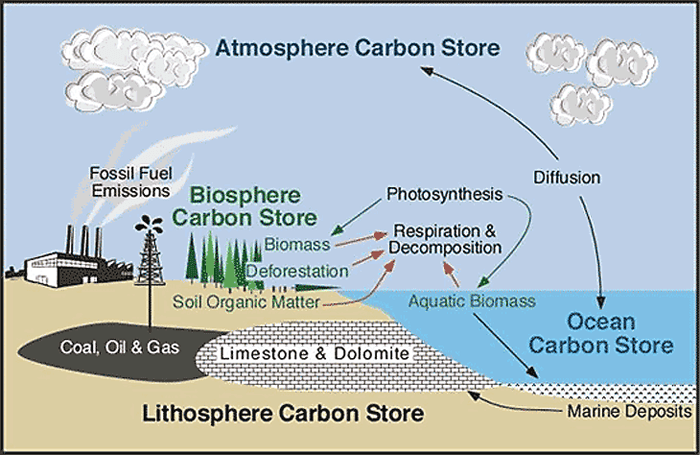
136.

Which of the following is represented by this picture?

a)

the water cycle

b)

the carbon cycle

c)

the nitrogen cycle

d)

the hydrogen cycle

137.

Which of the following is represented in this picture?

a)

the water cycle

b)

the carbon cycle

c)

the nitrogen cycle

d)

the hydrogen cycle

138.

Which of the following is represented in this picture?

a)

the water cycle

b)

the carbon cycle

c)

the nitrogen cycle

d)

the hydrogen cycle

139.

Which cycle involves condensation, evaporation, and precipitation?

a)

The water cycle

b)

The carbon cycle

c)

The nitrogen cycle

d)

The motor cycle

140.

Death and decomposition are part of many life cycles. What else helps return nitrogen and carbon to the ground?

a)

animal waste

b)

lightning

c)

rain

d)

DNA

141.

Earth's atmosphere is made up of 78% _______________ and 21% ___________________.

a)

nitrogen, oxygen

b)

oxygen, nitrogen

c)

hydrogen, carbon monoxide

d)

hydrogen, carbon dioxide

142.

Carbon exists in the atmosphere as part of

a)

carbon trioxide

b)

carbon dioxide

c)

water

d)

none of these answers are correct

143.

What "fixes" nitrogen in the soil so that it can be used by plants?

a)

decomposing plants

b)

bacteria

c)

viruses

d)

rocks

144.

How is it possible for a carbon atom to become part of a fossil fuel?

a)

it is part of decomposing plant and animal matter are under pressure for millions of years

b)

it is transformed by lava that hits the earth's surface

c)

it is changed when it reaches the atmosphere

d)

water can change carbon into a fossil fuel

145.

The nitrogen cycle is a process in which nitrogen is moving from the air to the ground to ____________________________ and back again.

a)

plants, animals, and humans (living things)

b)

lava

c)

clouds

d)

hydrogen

146.

How do humans get nitrogen?

a)

eating plants and animals

b)

breathing it in

c)

absorbing it through our skin

d)

none of these are correct