wayground logo

Free Printable Worksheets

Font size

S
M
L
XL
Worksheets

2nd Semester Biology Review

Total questions: 100

Worksheet time: 2hrs 42mins

Name
Class
Date
1.
An individual belonging to a specific species
a)
Biotic
b)
Community
c)
Organism
d)
Reptile
2.
All of the living and nonliving things in an area that interact with each other are called a/an ______.
a)
community
b)
habitat
c)
population
d)
ecosystem
3.
An area where an organism finds food, shelter and water in a specific arrangement
a)
niche
b)
biosphere
c)
biome
d)
habitat
4.
The living part of an ecosystem
a)
Biotic
b)
Abiotic
c)
Mother Earth
d)
Flowers
5.
The non-living part of an ecosystem
a)
Ocean
b)
Lava Flow
c)
Birds
d)
Abiotic
6.
The study of how living things interact with one another and with their environment.
a)
Biology
b)
Lithology
c)
Ecology
d)
Farmacology
7.
Organisms that look similar and can produce fertile offspring
a)
Species
b)
Fish
c)
Community
d)
Trees
8.
Two or more members of a particular species living and interacting in the same area
a)
Community
b)
Population
c)
Organisms
d)
Biosphere
9.
Different populations living and interacting with each other in the same area
a)
Biome
b)
Ecosystem
c)
Community
d)
Niche
10.
The area between the highest mountain and the deepest ocean where life can be found
a)
Biosphere
b)
Biome
c)
Farm
d)
Ecosystem
11.
What is a producer?
a)
an organism that gets energy from eating other organisms
b)
an organisms that uses sunlight to make its own food
c)
an organism that gets energy from eating dead organisms, non-living material or waste
12.
A community of living and nonliving things in their natural environment makes up a 
a)
food web
b)
ecosystem
c)
food chain
13.
An animal that hunts other animals for food is a ___________
a)
herbivore
b)
predator
c)
prey
d)
omnivore
14.
What is a herbivore?
a)
an animal that gets energy from eating other animals
b)
an organism that gets energy from eating only plants
c)
an animal that gets energy by eating both plants and other animals
15.
An organism that gets energy from eating other organisms is a ______________
a)
producer
b)
consumer
c)
decomposer
16.
A connection of food chains with many food energy paths in an ecosystem is a ____________
a)
ecosystem
b)
food web
c)
environment
17.
An animal that is hunted and eaten for food is a 
a)
predator
b)
prey
18.
An organism that gets energy from eating dead organisms, non-living material or waste
a)
producer
b)
consumer
c)
decomposer
19.
What is a carnivore?
a)
an animal that gets energy by eating other animals
b)
An animal that gets energy by eating only plants
c)
an animal that gets energy by eating both plants and animals
20.
An animal that gets energy from eating both plants and animals is a 
a)
herbivore
b)
carnivore
c)
omnivore
21.
Which of the following is NOT a consumer
a)
grass
b)
dog
c)
shark
d)
fish
22.
Which of the following is a living part of the ecosystem?
a)
Air
b)
Sunlight
c)
Mushroom
d)
Soil
23.
The shrew provides energy for the _______?
a)
cricket
b)
grasshopper
c)
frog
d)
snake
24.
Which of the following is a herbivore?
a)
cricket
b)
frog
c)
hawk
d)
shrew
25.
The direction of the flow of energy in a food web is represented by ___.
a)
Light bulbs
b)
Dotted Lines
c)
Arrows
d)
Bubbles
26.
Which of these is an example of an autotroph?
a)
Sunflower
b)
Krill
c)
Leopard
d)
Hummingbird
27.
Which is NOT a process of the water cycle?
a)
precipitation
b)
freezing
c)
transpiration
d)
evaporation
28.
The process of plants losing water through their leaves is called ____.
a)
condensation
b)
evaporation
c)
transpiration
d)
exhaling
29.
What are the swellings found on the roots of legumes called?
a)
noodles
b)
nodularisms
c)
nodules
d)
tubers
30.
What is the only process that removes carbon from the atmosphere?
a)
combustion
b)
cellular respiration
c)
photosynthesis
d)
decomposition
31.
These gases, such as carbon dioxide, trap heat in the Earth's atmosphere causing global warming
a)
Global warming gases
b)
Hot House gases
c)
Green House gases
d)
Thermal pollution
32.
The elements carbon, oxygen, hydrogen and nitrogen combined make up about 96% of our bodies (carbon is about 18%).  Carbon is necessary for life because it is a(n)
a)
uncommon element in all living things.
b)
element found only in the atmosphere
c)
excellent bonder
d)
is found mostly in dead things.
33.
Respiration is the process by which ____________ is consumed and _______________ is produced.
a)
Carbon, Oxygen
b)
Oxygen, Carbon dioxide
c)
H20, oxygen
d)
Carbon, H2O
34.
This process is responsible for most environmental problems of excess nitrogen and phosphorus entering streams, lakes and oceans.
a)
decomposition
b)
emissions from automobiles
c)
agriculture and house hold runoff
d)
photosynthesis
35.
Which of the following is known as the "sedimentary" cycle because its reservoir is sedimentary rock?
a)
Sulfur cycle
b)
Nitrogen cycle
c)
Phosphorus cycle
d)
Carbon cycle
36.
Phosphorous is needed in organisms for the production of
a)
ADP and ATP.
b)
Cellular membranes.
c)
Deoxyribonucleic and ribonucleic acids.
d)
All of the answers are correct
37.
N03 is also known as 
a)
ammonia
b)
nitrite
c)
nitrogen
d)
nitrate
38.
Identify the cycle pictured.
a)
The Water cycle
b)
The Carbon cycle
c)
The Nitrogen cycle
d)
The Phosphorus cycle
39.
This is released by the weathering of rocks.
a)
Carbon
b)
Oxygen
c)
Phosphorus
d)
Nitrogen
40.
Identify the cycle pictured.
a)
The Water cycle
b)
The Carbon cycle
c)
The Nitrogen cycle
d)
The Phosphorus cycle.
41.
How do animals get nitrogen?
a)
the atmosphere 
b)
eating other organisms
c)
rainwater
d)
lightning 
42.
What is the hydrosphere?
a)
Water on the earth's surface
b)
Oceans of the Earth
c)
Rivers, oceans and lakes of the Earth
d)
None of the above
43.
Using fossil fuels is a safe for the environment. 
a)
True
b)
False
44.
Organisms require nitrogen to make which of the following?
a)
glucose and starch
b)
lipids and nucleic acids
c)
proteins and nucleic acids
d)
carbohydrates and proteins
45.
What is the energy source for the water cycle?
a)
the sun
b)
the earth
c)
water
d)
the moon
46.
What is condensation?
a)
The part of the water cycle when the sun heats up water, turning it from a liquid into water vapor or steam. It rises from the ground into the air.
b)
The part of the water cycle when the water vapor in the air gets cold. The water turns back into a liquid and forms clouds.
c)
The part of the water cycle when clouds get heavy and can no longer hold the liquid water. This causes the water to fall from the sky to the earth as rain, snow, sleet, or hail.
47.

Evolution is best defined as:

a)

the process which organisms die.

b)

the process which organisms change over time.

c)

the process which organisms that are extinct become revived.

d)

the process which non-living things fossilize.

48.

The solidified remain or imprint of a once living thing are called:

a)

Fossils

b)

Homologous Structures

c)

Vestigial Structures

d)

DNA

49.

What type of evidence is represented in the picture above:

a)

Fossils

b)

Vestigial Structures

c)

DNA

d)

Homologous Structures

50.

What type of evidence is shown in the image above?

a)

Fossils

b)

Vestigial structures

c)

Homologous Structures

d)

DNA

51.

What type of evidence is shown in this picture?

a)

Fossils

b)

Homologous Structures

c)

Vestigial Structures

d)

DNA

52.

What type of evidence are shown in the picture above?

a)

Fossils

b)

Embryology

c)

Homologous Structures

d)

Vestigial Structures

53.

Adaptations are:

a)

physical or behavioral tendencies.

b)

physical or behavioral characteristics that help an organisms survive and reproduce.

c)

physical or behavioral characteristics that do not help the organism in any way.

d)

genetic mutations that have gone wrong.

54.
The similarities of the bones in the diagram provide evidence that---
a)
The organisms shown lived in the same natural envionrment
b)
The organisms shown may have developed from a common ancestor
c)
The organisms shown have the same genetic diseases
d)
All vertebrate species have identical forelimbs
55.
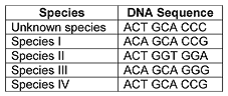
According to this data, the unknown bacterial species is most closely related to: 
a)
Species I
b)
Species II
c)
Species III
d)
Species IV
56.
The diagram shows fossils in different rock layers. Which of these statements about the age of these fossils is most likely correct?
a)
Fossil A and C are the same age
b)
Fossil B is older than fossil C
c)
Fossils A is older than fossil B
d)
Fossil D is older than fossil C
57.
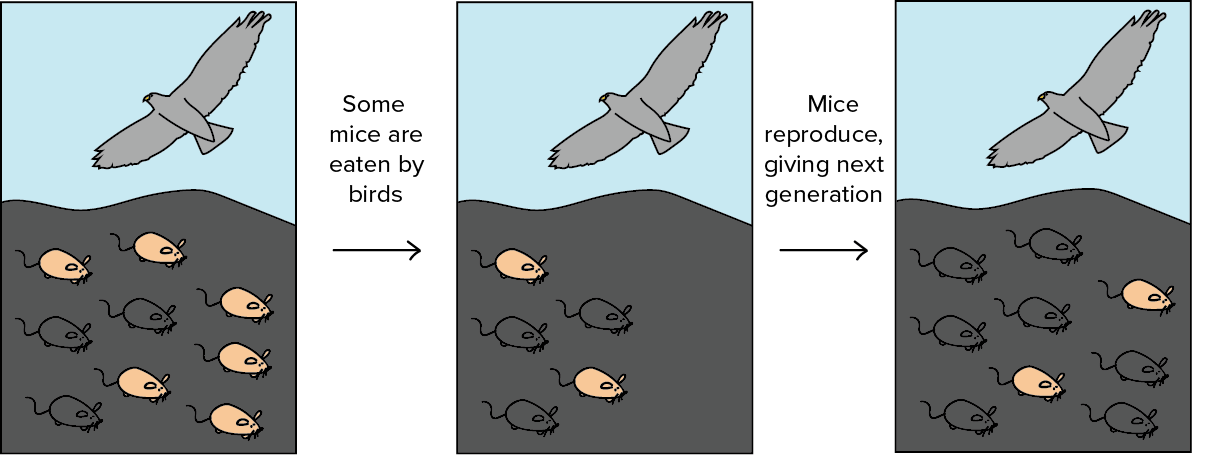
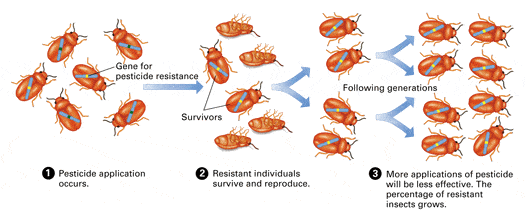
What process is being shown in this image?
a)
Variation
b)
Natural Selection
c)
Selective Breeding
d)
Homeostasis
58.
Why is the mouse population changing over time?
a)
The light mice can reproduce more successfully than the dark mice
b)
The hawks eat more dark mice than light mice because the dark mice taste better
c)
The hawks eat more light mice than dark mice because they can see the light mice more easily
d)
The hawks eat more dark mice than light mice because they can see the dark mice more easily
59.

Which scientist is known for his work that he did on the Galapagos Islands to develop his theory of natural selection?

a)

Gregor Mendel

b)

Charles Darwin

c)

Anton Van Leewenhoek

d)

Robert Brown

60.

The process by which two populations of the same species become so different that they can no longer interbreed.

a)

natural selection

b)

artificial selection

c)

speciation

d)

fossilization

61.

What are the 3 steps of speciation?

a)

Overproduction

b)

Separation

c)

Struggle for survival

d)

Adaptation

e)

Division

62.

Overproduction, Genetic Variation, Struggle to Survive, and Successful Reproduction are the 4 parts of:

a)

Natural Selection

b)

Speciation

c)

Artificial Selection

d)

Fossilization

63.

A species is defined as:

a)

a group of organisms that are extremely different.

b)

a group of organisms that have similar characteristics and always live in the same place.

c)

a group of organisms with similar characteristics and can reproduce to make fertile offspring.

d)

any two organisms to make a hybrid.

64.

What statement is true regarding why natural selection can be easily seen in insects and bacteria?

a)

Natural selection only occurs in prokaryotic cells

b)

Insects and bacteria can reproduce faster than more complex organisms and pass on selected traits quicker

c)

Insects were the first multi-cellular organism to live on land

d)

Bacteria have directly evolved from insect traits.

65.

Which of the following is true about the picture above?

a)

Camels are highly adapted to cold climates.

b)

There are no benefits to using a camel vs. a horse in the desert.

c)

Camels have directly evolved from whales.

d)

A camels long large intestine, long eyelashes and wide feet allow it to be very adapted to the desert.

66.

Which of the following is true regarding the evidence of evolution

a)

Vestigial structures are not real evidence of evolution.

b)

Homologous structures and fossils are the most dependable forms of evidence.

c)

Comparing DNA is the most definitive and accurate method to show evolutionary relationships.

d)

Embryology and Homologous structures do not support the theory of evolution.

67.
What do viruses need to reproduce?
a)
they need genetic material
b)
They need a host cell
c)
They need  bacteria
d)
They need insulin
68.
How does a virus cause a person to develop the common cold?
a)
invades the host cell to reproduce
b)
removes energy from the host cell
c)
produces toxins in the host cell
d)
protects the host cell from bacteria
69.
A virus can be classified by its type of
a)
mitochondria
b)
chromosomes
c)
nucleic acid
d)
carbohydrates
70.
A(n) _____ is a virus that enters a bacterial cell.
a)
endospore
b)
decomposer
c)
plasmid
d)
bacteriophage
71.
When a virus invades a living cell, its _______
takes over the cell's functions.
a)
outer coat
b)
genetic material
c)
core
d)
cytoplasm
72.
What part of the phage is the DNA?
a)
A
b)
B
c)
C
d)
D
73.
True or False
The flu is caused by a virus.
a)
true
b)
false
74.
Antibiotics kill viruses
a)
True
b)
False
75.
What part of a virus is the protein capsule that houses the genetic material (DNA/RNA)?
a)
tail
b)
nucleus
c)
capsid
d)
glycoprotein
76.
Which viral life cycle kills its host cell by lysing?
a)
lytic
b)
mitosis
c)
lysogenic
d)
S phase
77.
Which viral life cycle allows viral genetic material to lay dormant while the host cell reproduces?
a)
lytic
b)
mitosis
c)
lysogenic
d)
S phase
78.
Which of these is an animal virus?
a)
Tobacco mosaic virus
b)
bacteriophage
c)
influenza
79.
Which of these is a plant virus?
a)
tobacco mosaic virus
b)
bacteriophage
c)
influenza
d)
polio
80.
An organism that gets its food by consuming other organisms is known as a:
a)
heterotroph
b)
autotroph
c)
prokaryote
d)
eukaryote
81.
Which characteristics best describes the Plant Kingdom?
a)
unicellular; eukaryote; autotroph
b)
multicellular, prokaryote, autotroph
c)
multicellular, eukaryote, autotroph
d)
unicellular, prokaryote, heterotroph
82.
Which characteristics best describes the Animal Kingdom?
a)
unicellular, eukaryote, autotroph
b)
multicellular, prokaryote, heterotroph
c)
multicellular, eukaryote, autotroph
d)
multicellular, eukaryote, heterotroph
83.
Which characteristics best describe the Kingdom Fungi?
a)
multicellular and unicellular, eukaryote, autotroph
b)
multicellular and unicellular, prokaryote, heterotroph
c)
multicellular, eukaryote, heterotoph
d)
multicellular and unicellular, eukaryote, heterotroph
84.
Which characteristics best describes the Kingdoms Eubacteria and Archaebacteria?
a)
unicellular, prokaryote, heterotroph
b)
unicellular, prokaryote, heterotroph and autotroph
c)
multicellular, eukaryote, autotroph
d)
multicellular, prokaryote, heterotroph and autotroph
85.
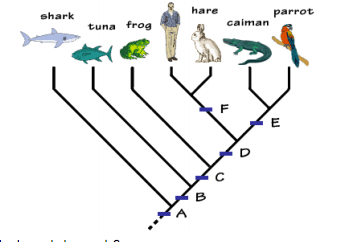
Cladograms are constructed by grouping organisms together based on their____________ characteristics.
a)
shared
b)
different
c)
similar
d)
opposite
86.
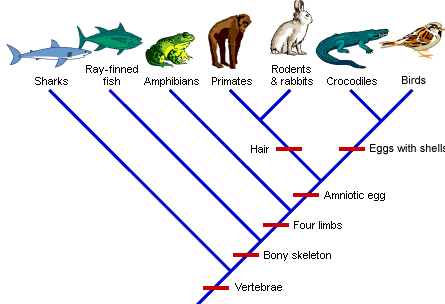
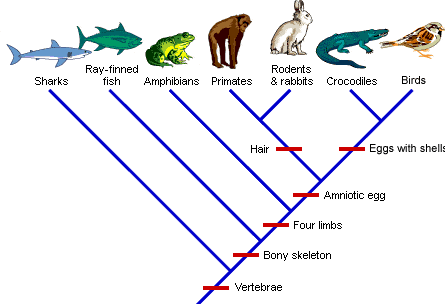
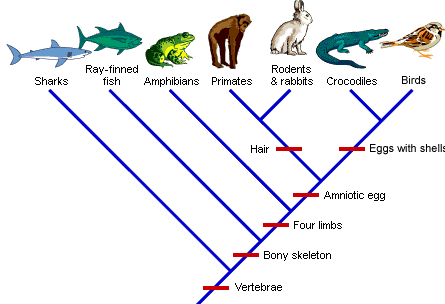
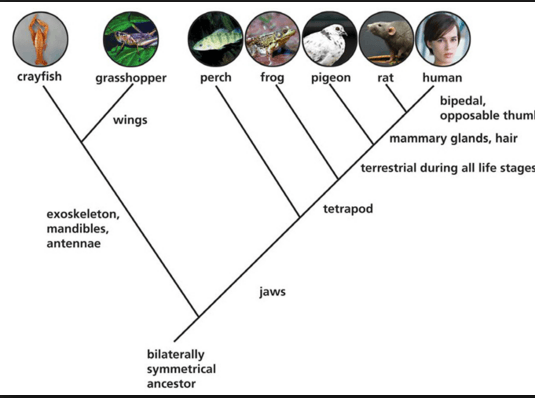
According to this cladogram, sharks are MOST closely related to which organism? 
a)
Amphibians
b)
Ray finned fish
c)
Crocodiles
d)
Birds
87.
Which two orgainsms have hair? 
a)
Sharks & Ray Finned Fish
b)
Primates & Rodents
c)
Birds & Crocodiles
d)
Rabbits & Birds
88.
According to this cladogram, birds are LEAST related to: 
a)
Amphibians
b)
Sharks
c)
Ray Finned Fish
d)
Crocodiles
89.
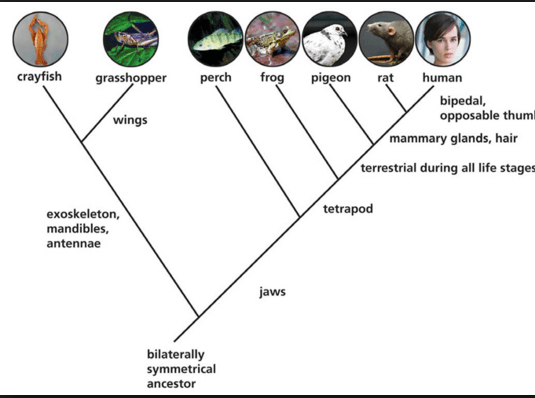
Which trait do only humans have, according to the cladogram?
a)
jaws
b)
mammary glands & hair
c)
terrestrial during all life stages
d)
bipedal & opposable thumbs
90.
According to the cladogram, which organism is most distantly related to the human?
a)
crayfish
b)
grasshopper
c)
perch
d)
frog
91.
On the cladogram, which organism is the closest relative of the human?
a)
Frog
b)
Hare
c)
Caiman
d)
Parrot
92.
Individuals that are well adapted to their environment will survive and produce:
a)
Fewer mutations
b)
Stronger genes
c)
More offspring
d)
Better traits
93.
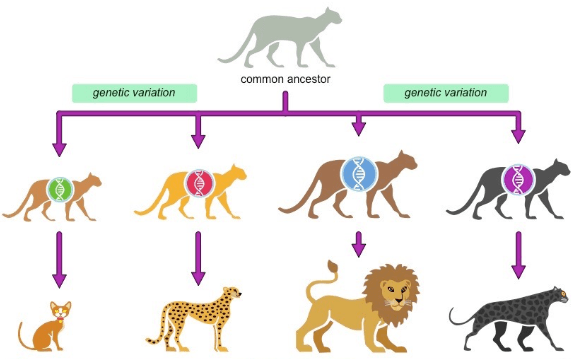
You look at two species and see very similar DNA. What does this likely tell you?
a)
These are the same animal.
b)
These animals have a common ancestor.
c)
These animals are not likely related.
d)
These animals are likely becoming one species.
94.
Horse breeding for specific desired traits is an example of which type of evolutionary evidence?
a)
Artificial selection
b)
Embryology
c)
Fossils
d)
Biochemical molecules
95.
An inherited characteristic that increases an organisms ability to survive and reproduce in its specific environment is called a(n)
a)
vestigial structure
b)
speciation
c)
analogous structure
d)
adaptation
96.
Common descent
a)
describes how a group of organisms share a most recent common ancestor
b)
Idk 
c)
No common ancestor
d)
None of the above
97.
Lamarck’s theory of evolution includes the concept that new traits appear because:
a)
natural variation and natural selection.
b)
use and disuse
c)
the environment is unchanged
d)
the natural variations are present within a population.
98.
Natural selection
a)
process by which individuals that are better suited to their environment survive and reproduce most successfully; also called survival of the fittest
b)
Humans select which animals live and die
c)
both 
d)
IDK
99.
speciation
a)
Formation of new species
b)
idk
c)
Formation of old species
d)
none of the above
100.
The finches on the Galapagos island were similar in form except for variations of their beaks. Darwin observed that these variations were useful for:
a)
 attracting a mate
b)
 defending territory
c)
 building nests
d)
 gathering food