wayground logo

Free Printable Worksheets

NEW

Font size

S
M
L
XL
Worksheets

Y12 Evolution and inheritance

Total questions: 71

Worksheet time: 1hrs 13mins

Name
Class
Date
1.
Change in a gene or chromosome
a)
evolution
b)
variation
c)
mutation
d)
adaptation
2.
Which one of the following shows continuous variation?
a)
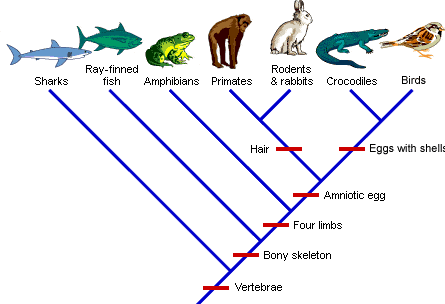
Blood group
b)
Height
c)
Male or female
d)
Tongue rolling
3.

Which of the four characteristics below is Environmental

a)

Language

b)

Hair Colour

c)

Weight

d)

Height

4.

For continuous data the most appropriate type of graph to draw would be...

a)

A line graph

b)

A scatter graph

c)

A bar chart

d)

A histogram

5.
A biological ____________ is a group of interbreeding populations that is reproductively isolated from other groups.
a)
species
b)
family
c)
phylogeny
d)
hybrid
6.
______ _________ explains how two or more organisms could evolve similar traits even though they are not related to each other.
a)
convergent evolution
b)
reproductive isolation
c)
derived characters
d)
hybrid vigor
7.
The system of binomial nomenclature was developed by ___________
a)
Linneaus
b)
Mayr
c)
Darwin
d)
Mr. King
8.
The scientific name for humans is _______ ____
a)
Homo sapiens
b)
Homo neandertal
c)
homo Sapiens
d)
homo sapiens
9.
__________ characters are similar characteristics that have evolved separately in two unrelated organisms.
a)
analogous
b)
homologous
c)
cladistic
d)
phylogenic
10.
_________ characters may or may not be similar between two organisms but they developed from a common ancestor.
a)
homologous
b)
analogous
c)
cladistic
d)
phylogenic
11.
______________ is the process by which populations change in response to their environment.
a)
natural selection
b)
adaptation
c)
reproductive isolation
d)
divergence
12.
__________ enable an organism to survive in its environment.
a)
adaptations
b)
natural selections
c)
divergence
d)
extinctions
13.
________ structures are reduced in size or function.
a)
vestigial
b)
homologous
c)
cladistic
d)
phylogenic
14.

What type of structures are shown?

a)

Homologous

b)

Analogous

c)

Vestigial

d)

Heterologous

15.

What type of structures are shown?

a)

Homologous

b)

Analogous

c)

Vestigial

d)

Heterologous

16.

What type of structures are shown?

a)

Homologous

b)

Analogous

c)

Vestigial

d)

Heterologous

17.

Which of the following is not considered a VESTIGIAL structures in humans.

a)

coccyx

b)

appendix

c)

wisdom teeth

d)

kidneys

18.
which of the folllowing is an exammple of a vestigial structure?
a)
the wings of a red-tailed hawk
b)
the hind limbs of a house cat
c)
the fins of sharks
d)
the wings of an ostrich
19.
Darwin’s finches is an example of this type of evolution.
a)
Divergent
b)
Coevolution
c)
Convergent
d)
Artificial
20.
Wings of a bat and wings or an insect are an example of this…
a)
Homologous Structure
b)
Analogous Structure
c)
Vestigial Structure
d)
None of the above
21.
In convergent evolution, organisms share physical similarities because they 
a)
have a common ancestor
b)
live in the same enviornment
c)
develop homologous structures
d)
are closely related 
22.

In the frigid waters of the ocean surrounding Antarctica, fish have a special trait which allows them to survive the big chill. As scientists discovered in the 1960s, the fish have adapted by evolving a kind of antifreeze. It's composed of molecules called glycoproteins that circulate in the blood of the fishes, slightly lowering the temperature at which their body fluids would otherwise freeze and kill them. The glycoproteins surround tiny ice crystals and keep them from growing. The fish at the other pole of the globe also have a similar protein. It was, however, seen as a mutation after they had diverged from the southern species.

a)

Phyletic Speciation

b)

Adaptive Radiation

c)

Convergent Evoltion

d)

Divergent Evoltuion

e)

Co-evolution

23.

The Apple Maggot Fly infests the fruit of a native North American Hawthorn Apple tree. In the 1860s some maggot flies began to infest apples. Now there are two populations of the fly feeding on the two food sources. The populations rarely interbreed and are showing genetic differences and therefore are becoming two separate species.

a)

Phyletic Speciation

b)

Adaptive Radiation

c)

Convergent Evoltion

d)

Divergent Evoltuion

e)

Co-evolution

24.
The combined genetic information of all members of a particular population is called a(n)
a)
gene pool
b)
allele frequency
c)
natural distribution
d)
DNA sequence
25.
The ___ of an allele is the number of times that the allele occurs in a gene pool, compared with the number of times other alleles occur.
a)
popularity
b)
average
c)
frequency
d)
size
26.
What is it called when a small number of individuals colonize a new area?
a)
founder effect
b)
bottleneck effect
c)
extinction
d)
adaptive radiation
27.
A random change in allele frequency is called
a)
genetic drift
b)
fitness
c)
speciation
d)
the founder effect
28.
According to this cladogram, primates are most closely related to -
a)
Amphibians
b)
Rodents and rabbits
c)
Crocodiles
d)
Birds
29.
According to this cladogram, birds are LEAST related to -
a)
Amphibians
b)
Sharks
c)
Ray Finned Fish
d)
Crocodiles
30.
The system of classification for organisms is called -
a)
taxonomy
b)
classification
c)
terraformy
d)
cladogram
31.
A common ancestor for both A and E could be at position __.
a)
1
b)
2
c)
3
d)
4
32.

Who is most closely related to Taxidea taxus?

a)

Lutra lutra

b)

Panthera pardus

c)

Canis latrans

d)

Canis lupus

33.
The most precise information to use when making phylogenetic trees is...
a)
morphology
b)
molecular
c)
fossil
d)
synapomorphies
34.
Which is true about phylogenetic trees?
a)
they are absolute fact
b)
they are dynamic and changing as we learn more 
c)
they are always constructed using morphological evidence
d)
they predict how organisms will change in the future
35.
What are the 8 levels of classification of living things from most general to most specific?
a)
domain, kingdom, phylum, class, order, family, genus, species
b)
domain, kingdom, phylum, class, order, family, genius, species
c)
domain, kingdom, phamily, class, order, family, genus, species
d)
domain, king, phillip, class, order, family, genus, species
36.
The scientific name for water bear is Hypsibius dujardini.  What is its genus?
a)
Hypsibius 
b)
dujardini
c)
water 
d)
tardigrade
37.
An organism that has cells that lack a nucleus are called:
a)
Eukaryote
b)
Heterotroph
c)
Prokaryote
d)
Autotroph
38.
Which characteristics best describes the Animal Kingdom?
a)
unicellular, eukaryote, autotroph
b)
multicellular, prokaryote, heterotroph
c)
multicellular, eukaryote, autotroph
d)
multicellular, eukaryote, heterotroph
39.
Which characteristics best describe the Kingdom Protista?
a)
multicellular, eukaryote, heterotroph and autotroph
b)
multicellular and unicellular, heterotoph and autotroph, eukaryote
c)
unicellular, autotroph, prokaryote
d)
multicellular and unicellular, prokaryote, heterotroph
40.
Which characteristics best describe the Kingdom Fungi?
a)
multicellular and unicellular, eukaryote, autotroph
b)
multicellular and unicellular, prokaryote, heterotroph
c)
multicellular, eukaryote, heterotoph
d)
multicellular and unicellular, eukaryote, heterotroph
41.
Which characteristics best describes the Kingdoms Eubacteria and Archaebacteria?
a)
unicellular, prokaryote, heterotroph
b)
unicellular, prokaryote, heterotroph and autotroph
c)
multicellular, eukaryote, autotroph
d)
multicellular, prokaryote, heterotroph and autotroph
42.
The 2-part naming system developed by Linneus is known as:
a)
dichotomous key
b)
taxonomy
c)
binomial nomenclature
d)
classification
43.
Which taxa has more organisms, family or phylum?
a)
phylum
b)
family
c)
they are equal
d)
not enough information to answer
44.
What do plants and fungi have in common?
a)
They are both autotrophic
b)
They are both unicellular
c)
They both have cell walls
d)
They both are prokaryotes 
45.
Which kingdom contains only multicellular autotrophs?
a)
fungi
b)
plant
c)
animal
d)
protist
46.

(Taxonomy) Which level of classification is the most broad?

a)

Species

b)

Class

c)

Domain

d)

Kingdom

47.

(Kingdoms) Organisms in ____________ kingdom are unicellular, heterotrophs or autotrophs, most are aquatic and can be animal-like, plant-like, or fungus-like.

a)

Fungi

b)

Animalia

c)

Protista

d)

Plantae

48.

(Kingdoms) This kingdom is the largest, organisms are multicellular, heterotrophs, most can move, aquatic or terrestrial, warm or cold blooded.

a)

Protista

b)

Animalia

c)

Plantae

d)

Fungi

49.

(Kingdoms) Which kingdom contains organisms that are mostly multicellular, have cell walls, and can be decomposers or heterotrophs?

a)

Fungi

b)

Plantae

c)

Animalia

d)

Protista

50.
Differences between members of the same species are called
a)
predators.
b)
selections.
c)
traits.
d)
variations.
51.
When a pine tree grows real tall and blocks sunlight to another pine tree it is _______ competition.
a)
Interference
b)
Intraspecific
c)
Interspecific
d)
Exploitative
52.

Two closely related species of birds live in the same tree. Species A feeds on ants and termites, while Species B feeds on caterpillars. The two species coexist successfully because

a)

each occupies a different niche

b)

they interbreed

c)

they use different methods of reproduction

d)

birds compete for food

53.
As the population of prey decreases, the population of the predator which eats it will...
a)
Increase
b)
Decrease
c)
Remain Constant
54.

In ecosystems, organisms rely on each other. This is called

a)

Interdependence

b)

relationships

c)

predation

d)

habitat

55.
Competition between members of different species in a community
a)
Interspecific 
b)
Intraspecific
c)
Conterspecific
d)
Aspecific
56.
Competition between members of the same species
a)
Interspecific
b)
Intraspecific
c)
Conterspecific
d)
Aspecific
57.
Which is an example of intraspecific competition
a)
2 types of bacteria competing for food
b)
Big horn sheep competing for mates
c)
Trees in the rain forest competing for light
d)
Lions and leopards competing for food 
58.
Which is an example of interspecific competition 
a)
Trees in the rainforest competing for light
b)
tadpoles in a pond competing for food
c)
big horn sheep competing for mates
d)
Wolves competing for food in the pack
59.

What is the standard deviation for the data given:

5, 10, 7, 12, 0, 20, 15, 22, 8, 2

a)

6.89

b)

10.1

c)

7.26

d)

9

60.
This data is normally distributed.  What percent of the data is in the shaded region?
a)
68%
b)
95%
c)
99.7%
d)
50%
61.
Find the median of these numbers:
4, 2, 7, 4, 3
a)
2
b)
5
c)
7
d)
4
62.
Roger bowled 7 games last weekend. His scores are: 155, 165, 138, 172, 127, 193, 142. What is the range of Roger's scores?
a)
193
b)
127
c)
60
d)
66
63.
What is the Normal Range of the monthly salary of teachers if the average is $4,000.00 with a standard deviation of 3,000?
a)
1000-7000
b)
3000-4000
c)
1000-4000
d)
4000-7000
64.
If a bowler needs to hit exactly 6 pins, which bowler is more reliable to hit that number?
a)
Bowler A
b)
Bowler B
c)
Both
d)
Neither
65.
If the two bowlers each play 1 round, which bowler probably hit the least amount of pins?
a)
Bowler A
b)
Bowler B
c)
Both
d)
Neither
66.
If the two bowlers each play 1 round, which bowler probably hit the most pins?
a)
Bowler A
b)
Bowler B
c)
Both
d)
Neither
67.
What is the Normal Range of the annual precipitation for Phoenix, if the average is 29 with a standard deviation of 3?
a)
26-32
b)
3-29
c)
26-29
d)
39-32
68.
Which of the following is a physical adaptation for the underlined animal?
a)
A snake unhinges its jaw to eat a rabbit it just caught.
b)
A hognose snake rolls over, slows its breathing, and hangs its tongue out to pretend to be dead.
c)
A herd of buffalo encircle their young to protect them from a pack of wolves.
d)
A dung beetle rolls a piece of dung across the desert.
69.
An example of a physical adaptation is...
a)
a turtle hiding inside its shell
b)
The spikes on a porcupine fish
c)
a rabbit burrowing underground
d)
a viper biting when threatened
70.

physical feature that helps an organism survive

- body part

a)

structural adaptation

b)

behavioral adaptation

c)

physiological adaptation

71.

involuntary action or change that helps an organism survive

- cell activity

- automatic

a)

structural adaptation

b)

behavioral adaptation

c)

physiological adaptation