wayground logo

Free Printable Worksheets

Font size

S
M
L
XL
Worksheets

Final Exam Prep

Total questions: 106

Worksheet time: 5hrs 43mins

Name
Class
Date
1.
4NH+ 5O2-->4NO + 6H2O
What is the total number of moles of H2O produced when 12 mole of NH3 is completely consumed?
a)
15
b)
18
c)
20
d)
24
2.
Using the following equation:
Fe2O3(s) + 3H2(g) → 2Fe(s) + 3H2O(l)
How many moles of iron can be made from  6 moles H2
a)
4 moles Fe
b)
6 moles Fe
c)
9 moles Fe
d)
2 moles Fe
3.
N2 +  3H2 → 2NH3 
How many moles of hydrogen are needed to react with 2 moles of nitrogen?
a)
6
b)
2
c)
3
d)
1
4.

Given the equation:

2NaClO3 (s) → 2NaCl (s) + 3O2 (g)

2.00 moles of NaClO3 will produce how many grams of O2? (mass of O2 = 32g/mol)

a)

56 g of O2

b)

96 g of O2

c)

64 g O2

d)

32 g O2

5.
2Na + 2H2O → 2NaOH+ H2
How many grams of hydrogen are produced if 120 g of Na are available?
a)
5.27 g
b)
2.6 g
c)
690 g
d)
45 g
6.
What is the percent composition by mass of sulfur in the compound MgSO4 (gram formula mass = 120 g/mol)?
a)
20%
b)
27%
c)
46%
d)
53%
7.

How many molecules are in 2.5 mol of NaCl?

a)

1.5 x 1024 molecules

b)

1.5 molecules

c)

4.15 molecules

d)

1.5 x 10²³ molecules

8.

How many moles are in 19.82 g Mg?

a)

1.23 mol Mg

b)

481.70 mol Mg

c)

1.00 mol Mg

d)

0.82 mol Mg

9.
A compound consists of 72.2% magnesium(Mg) and 27.8% nitrogen(N) by mass. What is the empirical formula?
a)
Mg4N3
b)
MgN2
c)
Mg3N
d)
MgN
10.
What is the percentage of iron in iron(III)oxide?
a)
30%
b)
70%
c)
40%
d)
60%
11.
What is the molecular formula if the empirical formula is CH2O and the molecular molar mass is 180.18?
a)
CH2O
b)
C2H4O2
c)
C4H8O4
d)
C6H12O6
12.
What is the molecular formula for a compound with the empirical formula: K2SOand a molecular mass of 696g.
a)
K2SO
b)
K8SO16
c)
K8S4O
d)
K8S4O16 
13.
Which of these results in the formation of a precipitate?
a)
AgNO3(aq)  +  NaOH(aq)→
b)
BaNO3(aq)  +  CaCl2(aq)→
c)
NaNO3(aq)  +  KOH(aq)→
d)
More than one of these form precipitates
14.
What is the precipitate formed when you mix silver nitrate with copper chloride?
a)
copper nitrate
b)
copper chloride
c)
silver chloride
d)
silver nitrate
15.
For the reaction...
SO2(g) + O2(g) <−>  SO3(g)
If the concentration of 
SO2(g)  is increased, the equilibrium of the reaction will ___________.
a)
shift to the left
b)
shift to the right
c)
not shift
16.
For the reaction...
SO2(g) + O2(g) <−>  SO3(g)

If the equilibrium shifts to the right, the concentration of O2(g) will ___________.
a)
increase
b)
decrease
c)
remain the same
17.
For the reaction...
energy +  N2(g)  +  O2(g)  <−>  2NO(g)
If  O2(g) is removed, the  concentration of N2 will _______.
a)
increase
b)
decrease
c)
remain the same
d)
double
18.
What is [A] and [B]?
a)
Concentration of Reactants
b)
Concentration of Products
c)
Energy of Reactants
d)
Energy of Products
19.
What is the proper Keq for the following reaction? 
   2 NO(g)  +  O2(g) ⇌ 2 NO2(g)
a)
Keq = [NO2]2 / [NO]2[O2]
b)
Keq =  [NO]2[O2] / [NO2]2
c)
Keq = [NO]2[O2][NO2]2
d)
Keq = 2[NO][O2] / 2[NO2]
20.
There are 40 liters of helium in a balloon at 100 K. If the temperature of the balloon is increased to 200 K, what will the new volume of the balloon be?
a)
80 L
b)
45 L
c)
54 L
d)
45.33 L
21.
How is pressure measured?
a)
kPa, mmHg, L
b)
kPa, mmHg, s
c)
kPa, mmHg, torr
d)
kPa, mmHg, torr, atm 
22.
The oxygen tanks on the sideline can be very dangerous if heated. Suppose an oxygen tank has a pressure of 120 atm at a room temperature of 25°C. If the temperature on the turf or field increases to 51°C, what will the resulting pressure of the oxygen tank be if the volume and amount of gas does not change?
a)
130 atm
b)
804 atm
c)
1.30 atm
d)
254 atm
23.
A gas has a pressure of 1.50 atm at a temperature of 273 K.  What will be the pressure at 410 K?
a)
.99 atm
b)
2.25 atm
c)
.75 atm
d)
2.5 atm
24.
Determine the Kelvin temperature required for 0.0470 mol of gas to fill a balloon to 1.20 L under .998 atm pressure. 
a)
0 K 
b)
107 K 
c)
207 K 
d)
307 K 
25.
Calculate the volume that a 0.323-mol sample of a gas will occupy at 265 K and a pressure of 0.900 atm.
a)
7.18 L 
b)
7.81 L
c)
4.63 L
d)
4.36 L
26.
___________ is measured by the unit Joules.
a)
Heat energy
b)
Temperature
c)
Specific heat
27.
Calculate the amount of energy required to melt 35.0 grams of ice.
(not in sig figs)  Hf = 334.0 J/g,  Hv = 2260J /g.
a)
79100J
b)
146.3J
c)
11690J
d)
39939.9J
28.
How many Joules of energy are required to make 100 grams of ice at 0 οC completely melt? The heat of fusion of ice is 334 J/g
a)
200 J
b)
400 J
c)
33,400 J
d)
2,000,000 J
29.
How many joules are required to boil 75 grams of water?
a)
25050J
b)
169500J
c)
31350J
d)
10000J
30.
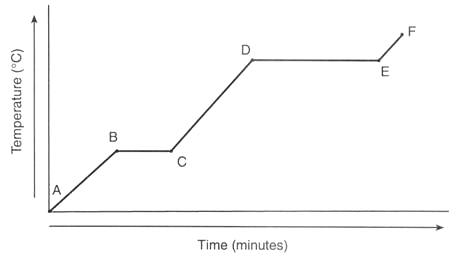
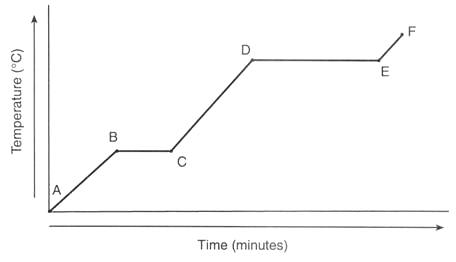
Between which points is the temperature of the substance remaining constant?
a)
A-B only. 
b)
A-B, C-D, E-F
c)
B-C only. 
d)
B-C, D-E
31.
What is the freezing point for this substance?
a)
60 °C
b)
40 °C
c)
80 °C
d)
100 °C
32.
Calculate the energy transferred when raising the temperature of 16000g of water by 3˚C (c=4.18 J/(gC))
a)
785 J
b)
126000J
c)
22000J
d)
200640 J
33.
How many Joules of energy are required to change 10 gram of water from 20 C to 90 C?
a)
1476 J
b)
2926 J
c)
210,050 J
d)
1,404,500 J
34.
What particle completes this reaction?
a)
alpha particle
b)
beta particle
c)
gamma particle
d)
neutron
35.
Solve this equation for alpha decay.
20985At = ___ + 42He
a)
20583Bi
b)
20986Rn
c)
20781Tl
d)
20885At
36.
Solve this equation for beta decay.
6027Co = ___ + 0-1e
a)
5625Mn
b)
6028Ni
c)
5823V
d)
5927Co
37.

How many neutrons does platinum have?

a)

78

b)

117

c)

195

d)

196

38.

Is potassium a cation or an anion?

a)

cation

b)

anion

39.

What is the charge of iron (III)?

a)

+3

b)

+2

c)

+6

d)

+4

40.

What is the cation charge of chromium (VI)?

a)

+6

b)

-6

c)

+24

d)

-24

41.
An atom becomes _________ when it gains electrons.
a)
Positive
b)
Negative
c)
Neutral
d)
Invinsible
42.
An atom becomes _______ when it loses electrons.
a)
Positive
b)
Negative
c)
Neutral
d)
Invinsible
43.
+  and  N-3
a)
KN
b)
KN3
c)
K3N3
d)
K3N
44.
Na +  and  S -2
a)
Na2S
b)
NaS2
c)
Na2S2
d)
NaS
45.
How many valence electrons does a bromine atom have?
a)
1
b)
2
c)
6
d)
7
46.
The chemical formula for an ionic compound of potassium and oxygen is
a)
KO.
b)
K2O.
c)
K2O2.
d)
KO2.
47.
What charge does a calcium (Ca) ion have?
a)
+1
b)
+2
c)
+3
d)
+4
48.
What are the electrons in the highest energy level of an atom called?
a)
orbital electrons
b)
valence electrons
c)
anions
d)
cations
49.
Which is the charge that results when oxygen becomes an ion?
a)
+3
b)
+2
c)
-2
d)
-3
50.
Atoms that lose electrons become...
a)
negatively charged (cations)
b)
positively charged (anions)
c)
negatively charged (anions)
d)
positively charged (cations)
51.
Atoms that gain electrons become...
a)
negatively charged (anions)
b)
positively charged (cations)
c)
remain neutrally charged
d)
21
52.
What is ionic formula:
Barium Chloride
a)
BaCl2
b)
BaCl
c)
Ba2Cl
d)
BaCl3
53.
Cu +2  and  OH -
a)
CuOH2
b)
Cu2OH
c)
Cu(OH)2
d)
correct answer is not given
54.
Ni +3  and  CO2 -2
a)
Ni3(CO2)2
b)
NiCO2
c)
Ni2(CO2)3
d)
correct answer is to given
55.
Ca +2  and  PO-3
a)
Ca3PO42
b)
Ca2(PO4)3
c)
CaPO4
d)
correct answer is not given
56.
phosphorus trichloride
a)
KCl3
b)
PCl3
c)
K3Cl
d)
P3Cl
57.
Name the prefix associate with:
7
a)
septa
b)
hexa
c)
octa
d)
hepta
58.
Which of these compounds is ionic? 
a)
Carbon dioxide
b)
Dinitrogen trioxide
c)
Silicon tetrachloride
d)
Lithium bromide
59.
What is the name of the compound SO2
a)
Monosulfate oxide
b)
Sulfur Dioxide
c)
Monosulfur dioxide
60.
If my charge becomes 2+ what does that say about me?
a)
I am stealing 2 electrons
b)
I am losing 2 electrons
c)
I am in period 2
d)
I have an atomic # of 2
61.

What is the correct name for: FeCl2

a)

iron dichloride

b)

iron(I) chloride

c)

iron(II) chloride

d)

iron chloride

62.
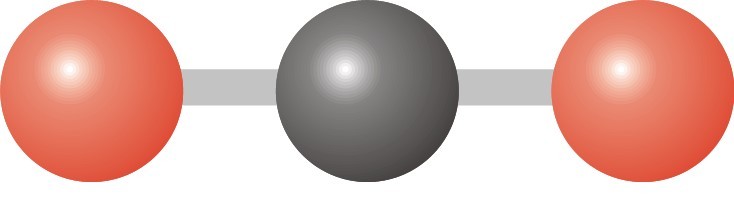
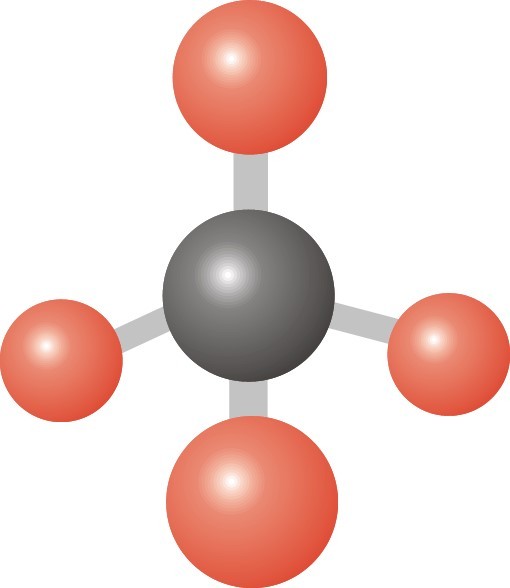
Which molecule would have this molecular geometry?
a)
BF3
b)
CH4
c)
PCl5
d)
CO2
63.
Who could this molecule be?
a)
CH4
b)
CO2
c)
PCl5
d)
BF3
64.
What is the MOLECULAR geometry of the central oxygen?
a)
Linear
b)
Trigonal Planar
c)
Bent
d)
Tetrahedral
65.
What is the name of TiF3?
a)
Titanium Fluoride
b)
Titanium Trifluoride
c)
Titanium (III) Fluoride
d)
Monotitanium Trifluoride
66.
What two types of atoms make a covalent bond?
a)
2 Nonmetals
b)
1 Nonmetal and 1 Metal
c)
2 Metals
d)
2 Noble Gases
67.
What do we call a covalent bond where electrons are shared UNEVENLY or UNEQUALLY?
a)
Ionic
b)
Polar Covalent
c)
Nonpolar Covalent
d)
Van der Waals Force
68.

When you have Br-Br, what is the polarity?

a)

Polar

b)

nonpolar

c)

Ionic

69.

When you have H-Cl, what is the polarity?

a)

nonpolar

b)

polar

c)

ionic

70.
What state of matter is X?
a)
solid 
b)
liquid
c)
gas
d)
supercritical fluid
71.
What state of matter is Y?
a)
solid 
b)
liquid
c)
gas
d)
supercritical fluid
72.
What change occurs from F to E?
a)
sublimation
b)
deposition
c)
melting
d)
condensation
73.
What change occurs from E to C?
a)
sublimation
b)
freezing
c)
melting
d)
boiling
74.

Phase change going from a Liquid to a Gas...

a)

Vaporization

b)

Deposition

c)

Condensation

d)

Melting

75.

Are the particles moving faster or slower as time goes on?

a)

Faster

b)

Slower

76.

What state/phase is the object likely from points A to B?

a)

Solid

b)

Liquid

c)

Gas

d)

Plasma

77.

What is happening to the particles in the substance between points D and E?

a)

Melting

b)

Freezing

c)

Vaporizing

d)

Sublimating

78.

Where on the graph are phase changes taking place?

a)

1

b)

2

c)

3

d)

4

e)

5

79.
The atomic number of an element that has 9 protons, 9 electrons, and 10 neutrons is _____.
a)
9
b)
10
c)
19
d)
28
80.
How many neutrons does uranium-239 have
a)
92
b)
147
c)
239
d)
331
81.
An atom has 5 neutrons and a mass number of 9.  How many protons does it have?
a)
2
b)
4
c)
5
d)
9
82.
Which of the following compounds is sulfuric acid?
a)
H2S
b)
SO4
c)
H2SO4
d)
HSO4
83.
Balance this equation:  H2 + N2 → NH3
a)
 H2 + 4N2 → NH3
b)
 H2 + 3N2 → 2NH3
c)
 3H2 + N2 → 2NH3
d)
 2H2 + 2N2 → 2NH3
84.
When a substance in a chemical equation is followed by (aq), it means that the substance is...
a)
a catalys
b)
dissolved in water
c)
a liquid
d)
a product
85.
Hydrocarbon + Oxygen = Carbon Dioxide + Water
a)
Decomposition
b)
Combustion
c)
Single Replacement
d)
Double Replacement
86.

Consider the following reaction. What would be the equilibrium constant expression?

4Br2(g) + CH4(g) ↔ 4HBr(g) + CBr4(g)

a)

[Br2]4 [CH4]

[HBr]4 [CBr4]

b)

[HBr]4 [CBr4]

[Br2]4 [CH4]

c)

[HBr ]

[Br2]4 [CH4]

d)

[HBr]4 [CBr4]

[Br2]4 [CH4]4

87.
Is the equation balanced?: 2H2O + O2 --> 4MgO + 3Fe
a)
Yes
b)
No
88.
Balance this equation-
__P+ __O--> __P2O3
a)
it is already balanced
b)
2, 1, 3
c)
1, 2, 3
d)
1, 3, 2
89.
Which of the following is an example of synthesis?
a)
Na + Br--> NaBr
b)
KClO--> KCl + O2
c)
HgO + Cl2-->HgCl + O2
d)
Cl2 + NaBr --> NaCl + Br2
90.
A neutralization reaction will always produce...
a)
water & salt
b)
water
c)
salt
d)
water & carbon
91.
Zn(OH)2 is an example of a...
a)
acid
b)
base
c)
salt
92.
Which solution releases H+ in solution?
a)
Base
b)
Acid
c)
Buffer
d)
Water
93.
This substance releases OH- into solution
a)
Acid
b)
Base
c)
Neutral
94.
HBr is an example of a(n)
a)
Acid
b)
Base
c)
Neutral
95.
Based on the activity series, which metal could X represent in the reaction below?
X + Ca (NO3)2 -->  Ca + X (NO3)2
a)
Ba
b)
Fe
c)
Mg
d)
Zn
96.
Which of the following metals is the most reactive according to the reactivity series of metals.
a)
Copper
b)
Zinc
c)
Magnesium 
d)
Lithium
97.
What is the molarity of 3 mole of hydrochloric acid in 3 L of water. 
a)
3
b)
1
c)
6
d)
9
98.
Calculate the molarity of the following solution:  1.0 mole of KCl in 750.0 mL of solution.
a)
0.750 M
b)
99 M
c)
1.3 M
d)
2.0 M
99.
What is the molarity of a solution made by adding 1.565 moles of PbNO3 to 500 mL?
a)
300. M
b)
31.3 M
c)
3.13 M
d)
1.56 M
100.
Put the visible light colors in order from longest wavelength to shortest wavelength
a)
Violet, Indigo, Blue, Green, Orange, Yellow, Red
b)
Red, Yellow, Green, Orange, Violet, Blue, Indigo
c)
Red, Orange, Yellow, Green, Blue, Indigo, Violet
101.

Which electron transmission in the H atom will result in the emission of red light?

a)

n =2 to n = 3

b)

n = 2 to n = 4

c)

n = 3 to n = 2

d)

n = 4 to n = 2

102.

Which transmission occurs when light with a wave length of 434 nm is emitted by a hydrogen atom?

a)

The electron jumps from n = 2 to n = 4

b)

The electron jumps from n = 2 to n = 5

c)

The electron falls from n = 4 to n = 2

d)

The electron falls from n = 5 to n = 2

103.
What is the molarity of a 30 mL HCl which is neutralized by 48 mL of 0.1 M NaOH?
a)
0.16 M
b)
6.25 M
c)
0.063 M
d)
3.80 M
104.
How many milliliters of 0.360 M H2SO4 are required to neutralize 25 mL of 0.1 M Ba(OH)2?
a)
90 mL
b)
0.00144 mL
c)
6.944 mL
d)
3.67 mL
105.
Which of the following is a physical characteristic of a metal?
a)
texture
b)
malleable
c)
brittle
d)
semi-conductor
106.
Some students conducted a laboratory investigation to learn more about the physical properties of different elements. They observed four samples and recorded their observations in the table . Based on these observations, which sample is most likely a nonmetal?
a)
Sample 1
b)
Sample 2
c)
Sample 3
d)
Sample 4