wayground logo

Free Printable Worksheets

Font size

S
M
L
XL
Worksheets

Final Exam: Living Environment RSS

Total questions: 100

Worksheet time: 2hrs 5mins

Name
Class
Date
1.
When should you look over the experiment instructions? 
a)
After starting the lab
b)
When your teacher tells you to
c)
Before starting the lab
d)
It doesn't really matter.  Instructions are silly!
2.
What safety symbol is this?
a)
Clothing Protection
b)
Hand Protection
c)
Eye Protection
d)
Sharp Object Hazard
3.
What is this?
a)
Measuring tube
b)
Test tube
c)
Graduated Cylinder
d)
Pipette
4.
Identify this piece of equipment.
a)
magnifying glass
b)
coverslip
c)
slide
d)
microscope
5.

As pressure increases, volume decreases. Which graph shows this relationship?

a)
b)
6.
What does the
Y axis say?
a)
Number of people
b)
Character
c)
Favorite Cartoon Characters
d)
Sponge Bob
7.
What does the
X axis say?
a)
Number of people
b)
Character
c)
Favorite Cartoon Characters
d)
Sponge Bob
8.
Which is NOT a characteristic that all living organisms share? 
a)
Ability to reproduce 
b)
Ability to grow 
c)
Ability to respond to their environment 
d)
Ability to dominate an ecosystem 
9.
All living things have an internal structure of ____________, which are the smallest unit of life. 
a)
Cells
b)
ATP
c)
Glucose
d)
Sugar
10.
You accidentally touch a hot burner and quickly pull your hand away. The burner is 
a)
homeostasis
b)
a reaction
c)
ATP
d)
a stimulus
11.
Something that has never shown the characteristics of life and never will. 
a)
dormant
b)
nonliving 
c)
living 
d)
dead 
12.
Fire is living because it has 6 of the 8 characteristics of life. 
a)
True 
b)
False
13.
The scientific name for something living is a(an)
a)
organism
b)
cell
c)
tissue
d)
human
14.
An organism made of one cell is called
a)
unicellular
b)
multicellular
15.
Multicellular means
a)
made of many cells
b)
made of one kind of cell
c)
made of only one cell
16.
What does reproduce mean?
a)
They grow - get larger
b)
They are living things
c)
Organisms make other organisms
17.
During ___________ conditions inside our body are kept stable (the same)
a)
homeopathic
b)
Homo sapian
c)
homeostasis
d)
homologous
18.
Living things need energy to survive?
a)
True
b)
False
19.
Living things change during their lives through ___.
a)
reproduction
b)
growth and development
c)
making responses
d)
adaptation and organization
20.
Rocks are not living because
a)
they never move
b)
they aren't needed for humans
c)
they are not made of cells
d)
they don't break down
21.
Organisms that cannot make their own food and must obtain energy from external sources are called
a)
autotrophs
b)
heterotrophs
c)
thylakoids
d)
plants
22.
What is an autotroph?
a)
an organism that can make their own food. 
b)
an organism that cannot make their own food
c)
Herbivore
d)
Omnivore
23.
Is the following asexual or sexual reproduction?
A labradoodle is a type of dog that is crossed between a labradoor retriever and a poodle.  The labradoodle puppy takes on the traits of both of its parents.  Female dogs have a pregnancy period of almost 70 days.
a)
Sexual
b)
Asexual
24.
Which reproduction requires a mate?
a)
asexual
b)
sexual
c)
neither
25.
What is a kingdom?
a)
the largest grouping of living things with similar characteristics
b)
a group of beneficial bacteria that live on your skin and prevent disease
c)
a place for kings and queens and their family
d)
a tiny living thing
26.
The correct order of species classification is:
a)
Domain, Kingdom, Phylum, Class, Order, Family, Genus, Species
b)
Kingdom, Phylum, Genus, Species, Class, Order, Domain, Family
c)
Kingdom, Family, Order, Class, Phylum, Domain, Genus, Species
d)
Domain, Order, Kingdom, Family, Class, Phylum, Genus, Species
27.
Which of the following elements is required in an organic compound?
a)
nitrogen
b)
oxygen
c)
carbon
d)
sodium
28.
Which organelle belongs in plant cells only?
a)
Cell Membrane
b)
Mitochondrion
c)
Chloroplast
d)
Nucleus
29.
Which organelle belongs in plant cells only?
a)
Cytoplasm
b)
Mitochondrion
c)
Cell Wall
d)
Nucleus
30.
Which organelle belongs in both plant and animal cells?
a)
Cytoplasm
b)
Chloroplast
c)
Large Central Vacuole
d)
Cell Wall
31.
Which organelle belongs in both plant and animal cells?
a)
Chloroplast
b)
Cell Wall
c)
Large Central Vacuole
d)
Cell Membrane
32.
Which of the following lists these levels in the correct order of organization from the simplest to the most complex?
a)
cells, tissues, organs, organ systems, organisms
b)
organisms, organ systems, organs, tissues, cells
c)
tissues, cells, organs, organisms, organ systems
d)

organs, organ systems, organisms, cells, tissues

33.
A group of tissues that perform a similar function is called_____. (Examples include the heart, lungs or stomach)
a)
cells
b)
tissues
c)
organs
d)
organ system
34.
What means of particle transport requires energy?
a)
passive
b)
active
c)
facilitated
d)
osmosis
35.
Diffusion is the movement of particles
a)
from low to high concentration
b)
from  high to low concentration
c)
from equilibrium to areas of high concentration
d)
all of the above
36.
Moving from areas of LOW concentration to areas of HIGH concentration is called?
a)
Passive Transport
b)
Active Transport
c)
Diffusion
d)
Osmosis
37.
If the question asks about Osmosis, I will look for an answer about?
a)
Particles
b)
Salt
c)
Sugar
d)
Water
38.
Which way is the water moving in this cell?
a)
Water will move out of the cell
b)
Water will move into the cell
39.
This is referred to as the energy currency of the cell
a)
ADP
b)
ATP
c)
Mitochondria
d)
Nucleus
40.
In which way are photosynthesis and cellular respiration different?
a)
Cellular respiration stores ATP, while photosynthesis releases ATP.
b)
Cellular respiration produces oxygen, while photosynthesis uses oxygen.
c)
Photosynthesis releases energy, while cellular respiration stores energy.
d)
Photosynthesis used carbon dioxide, while cellular respiration produces carbon dioxide.
41.
What gas  do plants give off after conducting photosynthesis that humans/animals need in order to live?
a)
Oxygen
b)
Carbon
c)
Nitrogen
d)
Hydrogen
42.
The main source of energy for all life comes from ____.
a)
the Earth
b)
the moon
c)
the sun
d)
the food we eat/make
43.
What are the 3 key ingredients needed for photosynthesis
a)
glucose, oxygen, carbon dioxide
b)
carbon dioxide, water, glucose
c)
water, soil, sunlight
d)
sunlight, water, carbon dioxide
44.
Which of the following examples go through the process of photosynthesis?
a)
bees
b)
algae
c)
humans
d)
mushrooms
45.
A student is collecting the gas given off from a plant in bright sunlight at a temperature of 27°C. The gas being collected is probably ________.
a)
oxygen
b)
carbon dioxide
c)
ATP
d)
glucose
46.

A process in which DNA has the unique ability to make an exact copy of itself.

a)

Replication

b)

Translation

c)

Transcription

d)

Protein Synthesis

47.
Which of the following best describes a DNA molecule?
a)
double helix
b)
contains ribose
c)
made of amino acids
d)
contains uracil
48.
Which shows the correct complementary base pairing for DNA?
a)
C-A, T-G
b)
A-G, C-T
c)
C-G, U-A
d)
T-A, G-C
49.
Which organelle is DNA usually found in?
a)
cell membrane
b)
vacuole
c)
chloroplast
d)
nucleus
50.
Replicate the following strand of DNA: 
AATCATGGA
a)
AATCATGGA
b)
TTAGTACCT
c)
UUAGUACCU
d)
GGATAUCUA
51.

Bundled up, organized DNA is called a

a)

gene

b)

trait

c)

chromosome

d)

nucleotide

52.
What is a gene?
a)
A bundle (like a hot dog bun) that the DNA is packed into
b)
something inside the nucleus
c)
a piece of DNA
d)
all of your DNA
53.

A mutation is defined as:

a)

A change in the cell's structure

b)

Anything that changes in an embryo

c)

Any change in the physical features of a human

d)

A change in the DNA sequence

54.
Where do mutations occur?
a)
DNA and RNA
b)
DNA 
c)
RNA
d)
mRNA and tRNA
55.
The passing of traits from parents to offspring
a)
heredity
b)
genetics
c)
trait
d)
alleles
56.
The different forms of a gene
a)
heredity
b)
genetics
c)
gene
d)
alleles
57.
This trait always shows up in an organism when the allele is present
a)
dominant allele
b)
codominance
c)
probability
d)
recessive allele
58.
This trait is hidden whenever the dominant allele is present
a)
dominant allele
b)
codominance
c)
recessive allele
d)
Punnett Square
59.
An organism's physical appearance or visible traits
a)
fertilization
b)
genotype
c)
phenotype
d)
homozygous
60.
An organism's genetic makeup, or allele combination
a)
fertilization
b)
genotype
c)
phenotype
d)
heterozygous
61.
In the Punnett square shown, what must the genotype of the missing parent be?
a)
BB
b)
Bb
c)
bb
d)
Tt
62.
B = brown fur  b = white fur
In the Punnett square, what is the probability for white fur
a)
0%
b)
25%
c)
50%
d)
75%
63.
How many people in this whole pedigree have the trait/disease?
a)
2
b)
3
c)
4
d)
6
64.
What does bio mean?
a)
copy
b)
imitation
c)
life
d)
fake
65.
What is genetic engineering?
a)
Manipulation/addition of genes
b)
Naturally breeding two animals with desired traits
c)
Cross-pollinating two crops
d)
Harvesting stem cells
66.

ATTTGAGCC- Original

ATTGAGCC - Mutated

The example above is an example of a

a)

Insertion

b)

Point mutation

c)

Deletion

d)

Substitution

67.
Which system takes oxygen into the body and eliminates carbon dioxide?
a)
immune
b)
nervous
c)
respiratory
d)
circulatory
68.
Which system takes food into the body, breaks down food, and absorbs the digested materials?
a)
respiratory
b)
circulatory
c)
digestive
d)
excretory
69.
Which system includes the mouth, esophagus, and the small and large intestines?
a)
nervous
b)
excretory
c)
respiratory
d)
digestive
70.
Which system carries needed materials to the body cells and carries wastes away from the body cells?
a)
Circulatory
b)
Digestive
c)
Nervous
d)
Excretory
71.
 A group of cells that have similar functions? Examples are nervous, epithelial, muscle and connective
a)
cells
b)
tissues
c)
organs
d)
atoms
72.
Mitosis is a type of ________________ reproduction.
a)
Sexual
b)
Asexual
73.
A new organism is produced from one parent organism.
a)
Sexual Reproduction
b)
Asexual Reproduction
74.
What phase of mitosis is shown in the picture?
a)
Prophase
b)
Anaphase
c)
Telophase
d)
Metaphase
75.
What phase of mitosis is shown in the picture?
a)
Prophase
b)
Anaphase
c)
Telophase
d)
Metaphase
76.
Results of cell division or mitosis include all of the following EXCEPT?
a)
growth
b)
repair damaged cells
c)
replace damaged cells
d)
dead cells
77.
A process where one cell forms two identical daughter cells is called...
a)
cell cycle
b)
cell division (mitosis)
c)
interphase
d)
cytokinesis
78.

Which of the following structures is NOT part of the digestive system?

a)

esophagus

b)

larynx

c)

stomach

d)

pharynx

79.

Which of the following answers correctly sequences the pathway food takes from the beginning to end?

a)

mouth, esophagus, stomach, small intestine, large intestine

b)

mouth, esophagus, stomach, large intestine, small intestine

c)

mouth, stomach, esophagus, small intestine, large intestine

d)

mouth, stomach, esophagus, large intestine, small intestine

80.
What are the main organs of gas exchange in the respiratory system?
a)
diapragm
b)
lungs
c)
trachea
d)
bronchi
81.
 Like all other body systems, the immune system helps the body maintain homeostasis.  Which statement best describes how the immune system does this?  
a)
it protects other organs and tissues from infection and disease
b)
it breaks down food to provide cells with nutrients
c)
it gathers information through the senses and controls all other body systems
d)
 it transports oxygen and carbon dioxide
82.

LETTER e:

a)

Uterus

b)

Vulva

c)

Ovaries

d)

Vulva

83.

LETTER f:

a)

Ovaries

b)

Uterus

c)

Vulva

d)

Vagina

84.
The joining of a sperm cell and an egg cell is called...
a)
Fertilization
b)
Labor
c)
Zygote
d)
STOP ASKING ME THESE IMPOSSIBLE QUETSIONS!!
85.
_________ cannot make their own food, so they need to consume (eat) plants or animals.
a)
consumers
b)
producers
c)
decomposers
86.
The  ____________ provides all the initial energy to plants.
a)
sun
b)
moon
c)
environment
d)
water
87.
____ make their own food through photosynthesis. 
a)
consumer
b)
decomposer
c)
producer
88.
__________ eat decaying matter, dead plants and animals and in the process they break them down. 
a)
consumer
b)
producer
c)
decomposer
89.
_______are animals that eat only plants.
a)
herbivore
b)
carnivore
c)
omnivore
90.
_______ are animals that eat only animals (meat).
a)
herbivore
b)
omnivore
c)
carnivore
91.
_________ are animals that eat BOTH plants and animals. 
a)
omnivore
b)
carnivore
c)
herbivore
92.
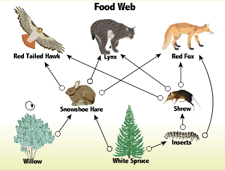
What may happen if the snowshoe hare was removed from the food web pictured?
a)
The insects in the habitat would increase.
b)
The shrew population would decrease due to being only hawk food source.
c)
The willow tree population would decrease.
d)
Foxes would dies due to no food source. 
93.

What is the carrying capacity of the graph?

a)

1000

b)

8000

c)

800

d)

600

94.

What happens if a population grows past its carrying capacity?

a)

The population keeps growing

b)

The population starts to die off

c)

The entire species will go extinct

d)

The carrying capacity just increases

95.
Which of these consumers is an omnivore?
a)
Sea Urchins
b)
Small herbivorous fishes and invertebrates
c)
Sharks
d)
Sea Otters
96.
An animal's color or pattern that helps it blend into its surroundings
a)
Environment 
b)
Mimicry
c)
Camouflage
97.
Polar bears have an adaptation that allows them to swim. What is most likely this adaptation?
a)
White coat
b)
Fat belly
c)
Small eyes
d)
Webbed Feet
98.
What adaptation most likely helps this bird fly?
a)
A strong beak
b)
Small feet
c)
Hollow bones 
d)
The color of the bird
99.

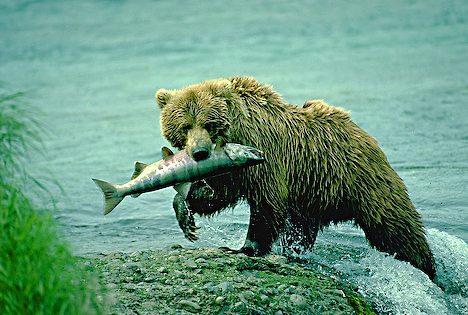
A grizzly bear survives because he is well-adapted to his environment. When he reproduces he passes on those traits to his offspring. this process is called

a)

Natural Selection

b)

Selective Breeding

c)

Random mutations

d)

Variations in a species

100.

Changes in inherited characteristics can cause a species to change into a new one. This change over time is called?

a)

Graduation

b)

Selective Breeding

c)

Revolution

d)

Evolution