wayground logo

Free Printable Worksheets

Font size

S
M
L
XL
Worksheets

TEST MATTER AND MEASUREMENT UNIT 1

Total questions: 58

Worksheet time: 2hrs 50mins

Name
Class
Date
1.

What is this tool?

a)

graduated cylinder

b)

Volumetric flask

c)

beaker

d)

Erlenmeyer flask

2.

Name the tool?

a)

buret

b)

graduated cylinder

c)

beaker

d)

Erlenmeyer flask

3.

How would you write 5.6 x 10⁻³ in standard form?

a)

560

b)

-5,600

c)

0.00056

d)

0.0056

4.

Convert to scientific notation:

520,000,000

a)

52 x 107

b)

5.2 x 10⁻⁷

c)

5.2 x 10⁸

d)

0.52 x 10⁹

5.

How many sig figs are there?


7,009.00

a)

2

b)

4

c)

5

d)

6

6.

How many sig figs are there?


0.0005002090000

a)

3

b)

10

c)

14

d)

6

7.

Which temperature scale is Celsius?

a)

B

b)

A

c)

C

d)

none are correct.

8.

Which temperature scale is Kelvin?

a)

B

b)

A

c)

C

d)

none are correct.

9.

Convert: 253 oC to K:

a)

526 K

b)

625 K

c)

0 K

d)

186 K

10.

-25 oC is ? Kelvin (K = Celsius + 273)

a)

298 K

b)

248 K

c)

273 K

d)

25 K

11.

If the exponent is a positive number the original number was...

a)

a really big number.

b)

a really small number.

12.

If the exponent is a negative number the original number was...

a)

a really large number.

b)

a really small number.

13.
What kind of energy is in a rock at the edge of a cliff?
a)
Potential
b)
Kinetic
14.
What kind of energy is in a moving skateboard?
a)
Potential
b)
Kinetic
15.
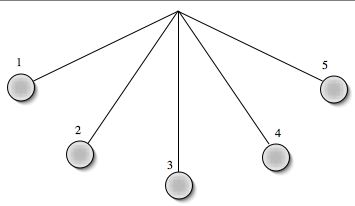
When a pendulum swings, at which point is potential energy at its greatest?
a)
1
b)
2
c)
3
d)
4
16.

When a pendulum swings, at which point is kinetic energy at its greatest?

a)

1

b)

2

c)

3

d)

4

17.
How would you write -5.6 x 10⁻³ in standard form?
a)
0.0056
b)
-5,600
c)
0.00056
d)
-0.0056
18.

How would you write 0.0005 in scientific notation?

a)

50 x 10-5

b)

5 x 10⁻⁴

c)

5 x 10³

d)

.5 x 103

19.
Which of the following is correct scientific notation?
a)
20.35 x 10⁴
b)
.2035 x 104
c)
2035 4
d)
2.035 x10⁴
20.
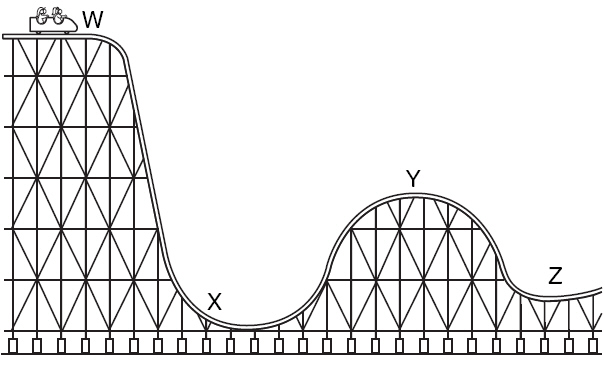
At which point is potential energy greatest?
a)
W
b)
X
c)
Y
d)
Z
21.

At which point is kinetic energy greatest?

a)

W

b)

X

c)

Y

d)

Z

22.
What type of graph is this?
a)
Bar Graph
b)
Line Plot
c)
Pictograph
d)
Tally Chart
23.
How many total people took the survey?
a)
50
b)
150
c)
100
d)
200
24.

How many more Rose flowers are there than Lily?

a)

3

b)

4

c)

9

d)

5

25.
Which sport is the least favorite? 
a)
baseball
b)
football
c)
hockey
d)
basketball
26.

What type of graph is this?

a)

Bar Graph

b)

Line Graph

c)

Double Line Graph

d)

Pie Graph

27.

What type of Graph is this?

a)

Bar Graph

b)

Science Graph

c)

Circle Graph

d)

Pie Chart

28.

Identify this type of graph:

a)

Color Graph

b)

Line Graph

c)

Bar Graph

d)

Scatter Plot

29.
Identify the equipment shown here:
a)
measuring cylinder
b)
conical flask
c)
beaker
d)
volumetric flask
30.
Identify the equipment shown here:
a)
wire gauze
b)
flame spreader
c)
sieve
d)
mesh
31.
Name the tool pictured
a)
Pipette
b)
Eye dropper
c)
Tweezer
d)
Forceps
32.

Convert 300 cm to Km:

a)

3 Km

b)

0.3 Km

c)

0.03 Km

d)

0.003 Km

33.
648 g = ____ mg
a)
6,480
b)
64,800
c)
648,000
d)
64.8
34.

Convert 9.82 x 10⁶ km to miles. 1 mile = 1.609 km

a)

6.10316 x 10⁶ miles

b)

6.10 x 10⁶ miles

c)

0.6103 x 10⁶ miles

d)

6.103 x 10⁶ miles

35.

Convert 2.07 g = __?__ pounds. 1 pound = 453.6g

a)

4.56349 x 10⁻³ pounds

b)

4.56 x 10⁻³ pounds

c)

0.456349 x 10⁻³ pounds

d)

4.563 x 10⁻³ pounds

36.

The students measured length during a science experiment, they got 12.00 cm. But the actual measurement was 14.25 cm. What was the percent error?

a)

15.79%

b)

15.789473685%

c)

15.789%

d)

15.7894%

37.
?
a)
High Accuracy & High Precision
b)
High Accuracy & Low Precision
c)
Low Accuracy & High Precision
d)
Low Accuracy & Low Precision
38.
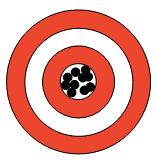
This bullseye demonstrates...
a)
High Accuracy & High Precision
b)
High Accuracy & Low Precision
c)
Low Accuracy & High Precision
d)
Low Accuracy & Low Precision
39.

A set of data are all close to each other, and they are close to the actual value. This set of data can be described as...

a)

accurate

b)

precise

c)

both precise and accurate

d)

neither precise or accurate

40.

Calculate the percent error. the experimental value was 35.9 ml, the actual value was 36.4 ml.

a)

1.37 % error

b)

1.373626374 % error

c)

2.0 % error

d)

1.50 % error

41.
Determine the number of sig figs in the following measurement: 
0.036653 m
a)
7
b)
5
c)
2
d)
0
42.
Determine the number of sig figs in the following measurement: 
72,100 g
a)
5
b)
3
c)
6
d)
4
43.
Determine the number of sig figs in the following measurement: 
0.00300
a)
3
b)
6
c)
1
d)
5
44.
Determine the number of sig figs in the following measurement: 
25.03 L
a)
4
b)
3
c)
2
d)
1
45.
Calculate the answer to the following problem and round the final answer to the correct number of sig figs:
24.567 + 0.04478 =
a)
24.61178
b)
24.612
c)
24.611
d)
24.61
46.
Calculate the answer to the following problem and round the final answer to the correct number of sig figs:
4.627 / 0.00371 = 
a)
1247.169811
b)
1250
c)
1247
d)
1240
47.
Solve & Round to Correct Sig Figs.
4.5 + 4.32 = 
a)
8.8
b)
8.7
c)
8
d)
8.0
48.

Frank has a paper clip. It has a mass of 9 g and a density of 3 g/mL. What is its volume?

a)

3 mL

b)

3 g/cm3

c)

27 mL

d)

3 g

49.

Jack has a rock. The rock has a density of 7 g/ml and a volume of 2 ml. What is the mass of the rock?

a)

7 mL

b)

14 g

c)

28 g/cm3

d)

3.5 g/mL

50.

What is the density of a metal that has a mass of 27.1g and a volume of 3.0 mL?

a)

9.0 g/mL

b)

9.033333333 g/mL

c)

9 g/mL

d)

9.033 g/mL

51.

Which value reflects volume?

a)

23 ml

b)

23 g

c)

23 g/ml

d)

23 g/cm3

52.

Which value reflects mass?

a)

23 ml

b)

23 g

c)

23 g/ml

d)

23 g/cm3

53.

Which value reflects density?

a)

23 ml

b)

23 g

c)

23 g/ml

d)

23 g/cm3

54.
a)
Student A
b)
Student B
c)
Student C
d)
Cannot be determined
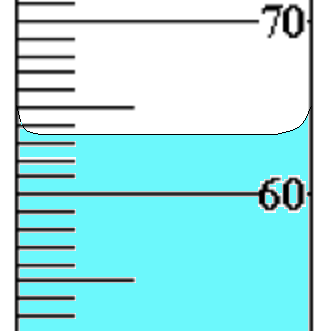
55.
Volume?
a)
63.5 mL
b)
63 mL
c)
63.55 mL
d)
6 mL
56.
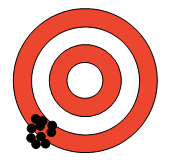
This image is an example of...
a)
precision ONLY
b)
accuracy ONLY
c)
BOTH precision and accuracy
d)
NEITHER precision and accuracy 
57.
A set of data are all close to each other, but they are not close to the actual value.  This set of data can be described as...
a)
accurate
b)
precise
c)
both precise and accurate
58.

Which Student is the most Precise?

a)

Alex

b)

Shandra

c)

Luis