wayground logo

Free Printable Worksheets

Font size

S
M
L
XL
Worksheets

Unit 4 APES

Total questions: 126

Worksheet time: 5hrs 23mins

Name
Class
Date
1.

The geological theory of _______ states that pieces of Earth’s lithosphere are in constant, slow motion.

a)

subduction

b)

plate tectonics

c)

deep-ocean trenches

d)

sea-floor spreading

2.

A place where two plates slip past each other, moving in opposite directions, is known as a _______

a)

transform boundary

b)

divergent boundary.

c)

convergent boundary.

d)

rift valley.

3.

The San Andreas Fault in California is known as an active earthquake area. What type of

boundary is it?

a)

Converging

b)

Diverging

c)

Transform

d)

Sea Floor Spreading

4.
What are Tectonic Plates?
a)
A continent 
b)
The Trees in Vietnam 
c)
ThE PlaTES That MoVE uNdERGRound :)
d)
The Plates that move the Continents
5.
Mountains form from ...
a)
plates sliding past one another
b)
collision of plates
c)
plates moving away from each other
6.
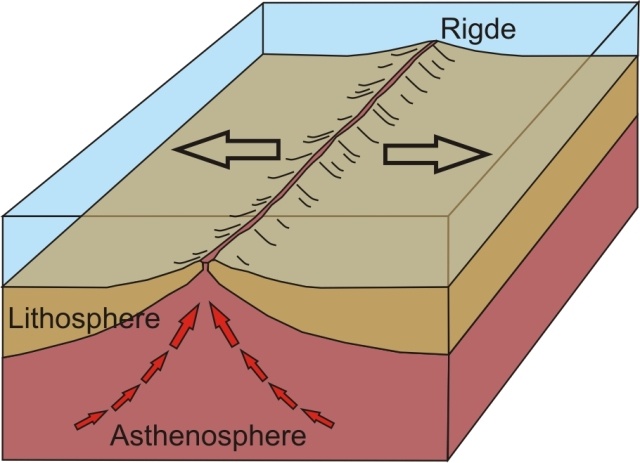
What kind of plate boundary is shown here?
a)
divergent
b)
convergent
c)
transform
d)
subducting
7.
What kind of plate boundary is shown here?
a)
divergent
b)
convergent
c)
transform
d)
submergent
8.
What kind of plate boundary is shown here?
a)
divergent
b)
convergent
c)
transform
d)
strike slip
9.
What geologic feature/event you be most likely to find at a transform boundary?
a)
Earthquakes
b)
Volcanoes
c)
Mountains
d)
Rift Valleys
10.
What geologic feature/event would you most likely to find at a divergent boundary between two pieces of oceanic crust?
a)
Rift Valley
b)
Mid-Ocean Ridge
c)
Island Arc
d)
Flat land
11.
What geologic feature/event would you most likely to find at a convergent boundary between two pieces of continental crust?
a)
Volcano
b)
Mountain
c)
Rift
d)
Island Arc
12.
In which type of boundary do the plates move away from each other?
a)
convergent
b)
normal
c)
divergent
d)
transform
13.
The area where two or more plates meet is called a __________________.
a)
fault
b)
plate boundary
c)
plate edge
d)
ring of fire
14.
Plates slide past one another at ____________ boundaries.
a)
divergent
b)
convergent
c)
transform
d)
submergent
15.
Plates move towards one another at ______________ boundaries.
a)
divergent
b)
convergent
c)
transform
d)
detergent
16.

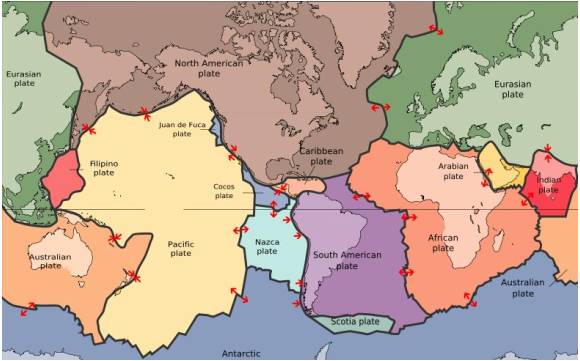
The map in the picture shows tectonic plate boundaries. This map would be useful in predicting the location of future

a)

droughts

b)

hurricanes

c)

earthquakes

d)

tornadoes

17.
If soil is permeable 
a)
water cannot flow through it
b)
water easily flows through it
c)
it contains many minerals
d)
it contains few minerals
18.
How can the type of bedrock under soil affect the characteristics of the soil? (see diagram)
a)
by preventing soil erosion
b)
by absorbing excessive rain water
c)
by contributing small rock particle to the soil
d)
by providing surface area for nutrient accumulation
19.
Which soil component has the least capacity for holding water?
a)
silt
b)
clay
c)
sand
d)
humus
20.
The diagram shows two soil samples after a heavy rainstorm.  Which property of soil is illustrated in the diagram?
a)
geographic origin
b)
relative porosity
c)
chemical composition
d)
nutrient content
21.
What most likely happens to soil when crops are not rotated from year to year?
a)
The soil nutrients are depleted
b)
The soil fertility increases
c)
The soil becomes more porous
d)
The soil erodes less rapidly
22.
Soil will pack down over time which decreases the ability of the soil to hold water.  Which animals would best help the soil hold water?
a)
earthworms making tunnels under the surface
b)
cattle making depressions with their hooves
c)
horses making trenches when they gallop
d)
sheep pulling up plants by their roots
23.
How do the nutrients necessary for plant growth get into the soil?
a)
The soil absorbs sunlight.
b)
Water filters through the soil
c)
Organic matter is decayed in the soil.
d)
The soil is exposed to air.
24.
Which property best indicates that soil contains nutrients?
a)
texture
b)
color
c)
amount of sand
d)
amount of clay
25.
What is humus?
a)
soil
b)
organic matter
c)
loam
d)
minerals
26.
What type of process forms soil?
a)
weathering
b)
erosion
c)
deposition
d)
compaction
27.
Which of the following takes up approximately 50% of soil?
a)
water and humus
b)
water and loam
c)
air and loam
d)
air and water
28.
Which of the following orders sediment particle size from smallest to largest?
a)
silt, sand, clay
b)
sand, silt, clay
c)
clay, sand, silt
d)
clay, silt, sand
29.
What are the layers in soil called?
a)
Layers
b)
Horizons
c)
Gradients
d)
Profiles
30.
What makes up a soil profile?
a)
the percentages of air, water, minerals, and humus
b)
the type of minerals in the soil
c)
the horizons in soil
d)
the type of organic matter in the soil
31.
Which of the following describes the size and proportions of particles in soil?
a)
soil texture
b)
soil fertility
c)
soil structure
d)
soil arrangement
32.
Which of the following describes how well soil can grow plants?
a)
soil texture
b)
soil fertility
c)
soil structure
d)
soil arrangement
33.
What is a synonym for soil conservation?
a)
neglect
b)
protection
c)
destruction
d)
waste
34.
Which of the following soil conservation methods involves placing materials on top of soil to protect the soil from water and wind?
a)
retaining walls
b)
terracing
c)
windbreak
d)
groundcover/mulch
35.
Which of the following soil conservation methods involves building a wall at the bottom of a hill or slope?
a)
retaining walls
b)
terracing
c)
windbreak
d)
groundcover/mulch
36.
Which of the following soil conservation methods involves changing a steep hill into smaller, flatter fields?
a)
retaining walls
b)
terracing
c)
windbreak
d)
groundcover/mulch
37.
Which of the following soil conservation methods involves planting trees along the edge of a field to prevent wind erosion?
a)
retaining walls
b)
terracing
c)
windbreak
d)
groundcover/mulch
38.
Which of the horizons in the soil profile shown represent the organic material?
a)
Horizon O (Humus)
b)
Horizon A
c)
Horizon B
d)
Horizon C
39.
Which of the horizons in the soil profile shown represents the solid rock layer?
a)
Horizon A
b)
Horizon B
c)
Horizon C
d)
Horizon R
40.
Which of the horizons in the soil profile shown represents the layer of sand, silt, clay, and organic matter?
a)
Horizon A
b)
Horizon B
c)
Horizon C
d)
Horizon R
41.

What is mineral matter

a)

inorganic material in the soil

b)

a chart used to differentiate several classes

c)

when a ribbon of soil forms easily and remains long

d)

the finenss or coarseness of a soil

42.

What is the largest mineral particle size

a)

silt

b)

clay

c)

sand

d)

soil texture

43.

What is the smallest soil particle size?

a)

clay

b)

silt

c)

sand

d)

texture

44.

Which soil particle lacks the ability to hold nutrients and are not fertile?

a)

sand

b)

silt

c)

clay

45.

Which soil particle forms hard clumps when dry an sticky when wet?

a)

sand

b)

silt

c)

clay

46.

Which soil particle feels like flour when dry and smooth like velvet when moist?

a)

sand

b)

silt

c)

clay

47.

Which soil particle feels gritty to the touch?

a)

sand

b)

silt

c)

clay

48.

What is soil texture?

a)

the chart used to differentiate several classes of soil

b)

the fineness or coarseness of a soil

c)

the in field method to classify soil texture by feel

d)

the inorganic material in soil

49.

What is the soil type for a soil sample with 50% clay, 30% sand, and 20% silt?

a)

clay

b)

clay loam

c)

sandy clay loam

d)

silty clay

50.

What is the soil type for a soil with 32% clay, 27% sand,and 41% silt?

a)

clay

b)

clay loam

c)

sandy clay loam

d)

silt

51.

What type of soil is 28% clay, 63% sand, 9% silt?

a)

silty clay

b)

clay

c)

loamy sand

d)

sandy clay loam

52.

How many basic textural classes are there when dealing with the texture triangle?

a)

5

b)

7

c)

10

d)

12

53.

What is the in field method used to classify soil texture?

a)

texture triangle

b)

ribbon method

c)

mineral matter

d)

soil structure

54.

How many textural classes are there for the ribbon method?

a)

5

b)

7

c)

10

d)

12

55.

What is soil structure?

a)

soil clusters

b)

inorganic material in soil

c)

the fineness and coarseness of soil

d)

the arrangement of soil particles into aggregates

56.

What are clumps of soil cased by tillage called?

a)

peds

b)

aggregates

c)

clods

d)

single grain

57.

In which layer of Earth’s atmosphere does weather occur?

a)

mesosphere

b)

stratosphere

c)

thermosphere

d)

troposphere

58.

The table indicates (shows) the percentages (amount) of some gases in the atmosphere of Mars. Which gas in the atmosphere of Mars is the primary (main) gas found in the atmosphere of Earth?

a)

carbon dioxide

b)

nitrogen

c)

argon

d)

methane

59.

Some jet airplanes fly in a layer of the atmosphere where temperature generally (mostly) increases with altitude. What is this layer of the atmosphere?

a)

mesosphere

b)

stratosphere

c)

thermosphere

d)

troposphere

60.
What two gases make up the majority of air?
a)
helium & argon
b)
helium & oxygen
c)
ozone & nitrogen
d)
nitrogen & oxygen
61.
Which is not an example of precipitation?
a)
wind
b)
rain
c)
snow
d)
sleet
62.

Which atmospheric layer protects Earth from getting hit by most meteoroids?

a)

Troposphere

b)

Mesosphere

c)

Stratosphere

d)

Exosphere

63.
The process of convection transfers heat energy _____.
a)
from cold areas to warm areas
b)
from warm areas to cold areas
c)
from high altitudes to low altitudes
d)
from humid areas to dry areas
64.
List the layers of Earth's atmosphere in order of increasing altitude.
a)
exosphere, thermosphere, mesosphere, stratosphere, troposphere
b)
troposphere, stratosphere, mesosphere, thermosphere, exosphere
c)
troposphere, stratosphere, ozone layer, mesosphere, thermosphere, exosphere
d)
stratosphere, mesosphere, thermosphere, exosphere, troposphere
65.

heat or light that passes through a vacuum of space is called

a)

conduciton

b)

radiation

c)

convection

d)

ocean waves

66.
energy that flows through a direct contact is called
a)
convection
b)
conduction
c)
radiation
d)
ocean waves
67.
Energy from the Sun travels to Earth as ______.
a)
conduction
b)
convection
c)
insulation
d)
radiation
68.
1.  This picture shows warm air rising and cool air falling in a cycle. This is an example of which process?
a)
Conduction
b)
Convection
c)
Radiation
69.
forms when lightning interacts with the oxygen in the air and creates a molecule of three oxygen atoms.
a)
water vapor
b)
troposphere
c)
exosphere
d)
ozone
70.
This is the outer layer of the thermosphere.
a)
ionosphere
b)
stratosphere
c)
exosphere
d)
atmosphere
71.
The coldest layer of the atmosphere is the ________.
a)
Mesosphere
b)
Thermosphere
c)
Stratosphere
d)
Troposphere
72.
In which two layers does temperature decrease with altitude?
a)
mesosphere and troposphere
b)
troposphere and stratosphere
c)
stratosphere and thermosphere
d)
thermosphere and exosphere
73.
The atmospheric gases that most greatly affect our weather are:
a)
water vapor and nitrogen
b)
water vapor and carbon dioxide
c)
water vapor and argon
d)
water vapor and oxygen
74.
As altitude increases in the troposphere, temperature __________.
a)
increases
b)
decreases
c)
stays the same
d)
none of the above
75.
What causes warm air to rise?
a)
the fact that it's less dense than cold air 
b)
The fact that it weighs more than cold air 
c)
The fact that it has higher pressure than cold
d)
the fact that its more dense than cold air 
76.
What causes wind to blow?
a)
Differences in longitude 
b)
Shock waves from clouds 
c)
Differences in air temperature and pressure 
d)
The rotation of the earth
77.
How are the winds in the northern hemisphere different from winds in the southern hemisphere? 
a)
Winds int he northern hemisphere are deflected right; winds int eh southern hemisphere are deflected left
b)
winds in the northern hemisphere are deflected south; winds in the southern hemisphere are deflected north 
c)
winds in the northern hemisphere are deflected eart; winds in the southern hemisphere are deflected west
d)
winds in the northern hemisphere are deflected left; einds in the southern hemisphere are deflected right 
78.
The reason why global winds flow from east to west and west to east, but not north to south, or south to north.
a)
Bernoulli's principle 
b)
Coriolis effect 
c)
high pressure 
d)
low pressure 
79.
When Earth's rotation causes the wind to curve 
a)
cloudy 
b)
Coriolis effect
c)
high pressure
d)
low pressure 
80.
What is a watershed?
a)
Land that collects and channels water froma small body of water to a larger body of water
b)
the shape of the land determined by elevation
c)
A natural stream of water of considerable  volume
d)
a river and all its tributaries
81.
An area of permeable layer of rock or soil that holds a large amount of water in the saturated zone is called what?
a)
Aquifer
b)
Spring
c)
Well
d)
Reservoir
82.
Water stored  in cracks and pores below the Earth's surface is called:
a)
Groundwater
b)
Bogs
c)
Water in the ground
d)
surface water
83.
A divide is 
a)
well in which water rises because of pressure
b)
Forms the boundaries of a watershed
c)
type of hot spring from which the water periodically erupts
d)
place where groundwater bubbles or flows out of cracks in the rock
84.

What is irrigation?

a)

Liquid moving down through porous surface or substrate

b)

Movement of water down through soil

c)

Supply of water to land or crops for growth

d)

Sand, Silt, clay

85.

Hydrology

a)

The study of science concerned with the earth's water

b)

Movement of water down through the soil

c)

Water moving down through a porous surface or substrate

d)

Supply of water to land or crops to help growth

86.

The boundary around a watershed is called the

a)

watershed.

b)

watershed divide.

c)

sub-watershed.

d)

transpiration.

87.

According to the chapter what factors play a role in the boundaries and characteristics of a watershed? Choose the best answer.

a)

geology and climate

b)

climate and place on earth

c)

geology, climate and vegetation

d)

none of the above

88.

All water eventually empties into

a)

an ocean

b)

a river

c)

the ground

d)

a lake

89.

Management decisions on water are made based on combinations

a)

of science, and who you know.

b)

of science, politics and values.

c)

of politics alone.

d)

of values and what you believe is right.

90.
The term equinox means....
a)
equal amount of day light and equal amount of night
b)
Equal amount of winter and summer
c)
Equal amounts of hot dogs for everyone
d)
The longest day of the year
91.
Why is the Equator warmest?
a)
Because it is closest to the sun.
b)
Because it receives the most direct sunlight
c)
Because no clouds form here.
d)
Because it is far from the sun
92.
Which season is taking place in the Southern Hemisphere in Position 1?
a)
Winter
b)
Spring
c)
Summer
d)
Fall
93.
Which season is taking place in the Northern Hemisphere in Position 1?
a)
Winter
b)
Spring
c)
Summer
d)
Fall
94.
Which season is taking place in the Northern Hemisphere in Position 3?
a)
Winter
b)
Spring
c)
Summer
d)
Fall
95.
Which season is taking place in the Northern Hemisphere in Position 3?
a)
Winter
b)
Spring
c)
Summer
d)
Fall
96.
Which season is taking place in the Northern Hemisphere in Position 4?
a)
Winter
b)
Spring
c)
Summer
d)
Fall
97.
What are the reasons for the season?
a)
Earth's tilt & rotation
b)
Earth's tilt & revolution
c)
Earth's rotation & rovolution
d)
Earth's tilt & resolution
98.
When an object orbits another object, it _________.
a)
explodes
b)
revolves
c)
vibrates
d)
rotates
99.
Day and night is caused by the _____________ of earth on its axis.
a)
revolution
b)
orbit
c)
rotation
d)
apparent motion
100.
How long does it take for Earth to rotate on its axis one time?
a)
24 hours
b)
24.25 hours
c)
365 days
d)
365.25 days
101.

What landform causes the rain shadow effect?

a)

mountains

b)

lakes

c)

plains

d)

valley

102.

As you go to the top of a mountain, what happens to the temperature?

a)

nothing

b)

it decreases

c)

it increases

d)

it fluctuates between warm and cold

103.

A rain shadow forms on the ___________ side of a mountain as a result of ___________ rainfall there.

a)

windward; more

b)

windward; less

c)

leeward; more

d)

leeward; less

104.

Warm air can carry more water vapor than cool air.

a)

true

b)

false

105.

As air rises, it expands. This expanding air also ______.

a)

warms and condenses

b)

cools and condenses

106.

On the leeward side of a mountain, you might find _____.

a)

heavy rainfall

b)

less vegetation (plants)

c)

more vegetation (plants)

d)

more snow

107.

What is the windward side of a mountain?

a)

The wet side that is upwind of the mountain.

b)

The side of the mountain with the most people.

c)

The dry side that is downwind of the mountain.

d)

The side of the mountain with the rain shadow.

108.

Which side of the mountain usually gets deserts and why?

a)

windward, because of rising, moist air

b)

leeward, because of rising, dry air

c)

windward, because of sinking, moist air

d)

leeward, because of sinking, dry air

109.

Which side of the mountain gets more rainfall?

a)

windward

b)

leeward

c)

horizontal

d)

vertical

110.

During a(n) ____ event, trade winds are much stronger than usual.

a)

El Nino

b)

La Nina

c)

Normal

d)

Partly sunny

111.

During an El Nino, it rains

a)

in the central Pacific

b)

in the FAR western Pacific

c)

in the western Pacific

d)

In all of the Pacific

112.

Both El Nino and La Nina have this in common

a)

Influence birds that migrate over the ocean

b)

Influence rainy / dry weather world wide

c)

The weather at the polar regions

d)

The directions that ships travel in the oceans

113.
What two factors are primarily used to describe climate?
a)
temperature and density
b)
temperature and precipitation
c)
precipitation and density
d)
winds and humidity
114.
As you go to the top of a mountain, what happens to temperature?
a)
Nothing
b)
It increases
c)
It decreases
d)
It does what it wants
115.
El Nino occurs when the tropical ocean waters are warmer in which ocean?
a)
Atlantic
b)
Indian
c)
Pacific
d)
Arctic
116.
Which causes the subtropical jet stream to bring cold, wet winter weather to the southeastern United States?
a)
El Niño
b)
La Nina
c)
Coriolis effect
d)
Santa Anna Winds
117.
What is the cause of rising surface temperatures of the Pacific Ocean, drought in the western United States, and flooding on the Pacific coast of South America?
a)
the Gulf Stream
b)
the Jet Stream
c)
La Nina
d)
El Nino
118.
Which lists some effects of El Niño?
a)
warmer temperatures and more rain
b)
warmer temperatures and less rain
c)
cooler temperatures and less rain
119.
Which causes North Carolina to experience an increase in winter precipitation?
a)
El Niño
b)
La Niña
c)
trade winds
d)
prevailing westerlies
120.
Which weather conditions are associated with El Niño?
a)
increased temperature, increased precipitation
b)
decreased temperature, increased precipitation
c)
increased temperature, decreased precipitation
d)
decreased temperature, decreased precipitation
121.
Which best describes El Niño?
a)
The water in the Pacific Ocean gets warmer than normal and causes fewer hurricanes to form.
b)
The water in the Pacific Ocean gets colder than normal and causes more hurricanes to form.
c)
The water in the Pacific Ocean gets colder than normal, and the flow of the jet stream is disrupted.
d)
The water in the Pacific Ocean gets warmer than normal, and the flow of the jet stream is disrupted.
122.

Where does the term El Niño come from and what does it mean?

a)

“The Child,” due to its appearance around the Christmas season

b)

"The Chile," due to its appearance around Thanksgiving

c)

"The Kid", due to its appearance around Easter

d)

"The Family", due to its appearance around 4th of July

123.

The term El Niño now refers to both a coupled oceanic and atmospheric phenomenon. This

phenomenon is characterized by all but 1 of the items below.

a)

Changes in rainfall distribution

b)

Changes in sea level pressure

c)

Abnormally warm sea water

d)

Atmospheric stagnation

124.

What does the term ENSO refer to?

a)

El Nine/ Nothern Oscillation

b)

Enchiladas Not Sweetened Horita

c)

La Nina/ Southern Oscillation

d)

El Niño/ Southern Oscillation

125.

How often to El Niño events occur and how long do they generally last?

a)

Occur every 3-5 weeks/ Usually last for 9-12 days.

b)

Occur every 3-5 years/ Usually last for 9-12 months.

c)

Occur every 9-12 years/ Usually last for 3-5 months.

d)

Occur every hour/ Usually last for 15 min.

126.

What are the effects of El Niño in California and across the southern states?

a)

El Nino results in increased precipitation across California and the southern tier of states

b)

El Nino results in decreased precipitation across California and the southern tier of states

c)

El Nino results in increased precipitation across Texas and the southern tier of states

d)

El Nino results in increased precipitation across Texas and the nothern tier of states