wayground logo

Free Printable Worksheets

Font size

S
M
L
XL
Worksheets

Final EOC Review

Total questions: 152

Worksheet time: 3hrs 44mins

Name
Class
Date
1.

Favorable traits that help an organism to survive in its environment are called:

a)

Variations

b)

Adaptations

c)

Mutations

d)

Alleles

2.

True or False? Variations that arise will only become prevalent throughout the population IF they are well suited to their environment.

a)

True

b)

False

3.

What are the 3 categories or types of adaptations an organism may possess to aid their survival and/or reproduction?

a)

Structural

b)

Behavioral

c)

Physiological/Reproductive

d)

Geographic

e)

Parapatric

4.

Bent hind legs and forward-facing eyes, like that of this cheetah, are examples of what adaptation?

a)

Structural

b)

Behavioral

c)

Physiological

5.

What type of adaptation is shown here, by the migration of these birds?

a)

Structural

b)

Behavioral

c)

Physiological

6.

Which 2 of the following correctly describes "positive phototaxis?"

a)

Toward stimulus

b)

Away from stimulus

c)

Light stimulus

d)

Chemical stimulus

7.

Which of the following adaptations may be most helpful in the shady floor of the rainforest?

a)

Empty spaces for water storage

b)

Large leaves for increased light absorption

c)

Deep root systems

d)

Floatation devices

8.

A yucca moth feeds on the nectar from the yucca flower, aiding the flower's pollination process. What type of symbiotic relationship is this?

a)

Mutualism

b)

Commensalism

c)

Parasitism

9.

Barnacles attach themselves to whales to help them collect more food from the water. The whales seem unaffected. What type of symbiotic relationship is this?

a)

Mutualism

b)

Commensalism

c)

Parasitism

10.

A tick attaches itself to a dog to feed on its blood. Not only does this steal the dog's blood, but the tick could also transmit diseases to the dog. What type of symbiotic relationship is this?

a)

Mutualism

b)

Commensalism

c)

Parasitism

11.

These structures are similar from common ancestry

a)

homologous

b)

analogous

c)

vestigial

d)

homozygous

12.

These structures share a common function but not structure ex) the wing of a bird and the wing of an insect

a)

homologous

b)

analogous

c)

vestigial

d)

homozygous

13.
Which best describes the first organisms to live on Earth?
a)
Prokaryotic and Anaerobic
b)
Prokaryotic & Aerobic
c)
Eukaryotic and Aerobic
d)
Eukaryotic & Anaerobic
14.
A paleontologist is comparing the fossilized remains of two primates. Both animals had a prehensile tail. What can be concluded from this evidence?
a)
They were not related.
b)
They lived on the ground.
c)
They evolved from a common ancestor.
d)
They had bipedal locomotion.
15.
Two organisms that are closely related would have
a)
very similar DNA sequence
b)
exactly the same DNA sequences
c)
no proteins in common
d)
completely different DNA sequence
16.
Which best describes these fossils?
a)
The oldest fossils can be found on the lower layers
b)
The oldest fossils can be found at the top layers
c)
The youngest fossils are always found on the bottom layers
d)
You can not tell the age of any of these fossils
17.
If species A and B have very similar genes and proteins, what is probably TRUE?
a)
species A and B share a relatively recent common ancestor
b)
species A evolved independently of species B for a long period
c)
species A is younger than species B
d)
species A is older than species B
18.
The population of peppered moths in England changed from white to black in 50 years
a)
stabilizing selection
b)
sexual selection
c)
directional selection
d)
disruptive selection
19.
Northern elephant seals have reduced genetic variation. Hunting reduced their population size to as few as 20 individuals at the end of the 19th century. Their population has rebounded to over 30,000 they have much less genetic variation than a population of southern elephant seals that was not so intensely hunted. Which agent of change is this ?
a)
Genetic Drift 
b)
Natural Selection
c)
Gene Flow
d)
Mutation
20.
Genetic drift is likely to be seen in a population
a)
That has a low mutation rate
b)
In which natural selection is occurring
c)
That is very small
d)
For which environmental conditions are changing
21.
Which two animals are most closely related?
a)
Fish and Amphibian
b)
Reptile and Amphibian 
c)
Reptile and Bird
d)
Mammal and Bird
22.
Darwin proposed that individuals having an advantage due to their traits or abilities will be more likely to survive and reproduce.  This mechanism is known as
a)
evolution
b)
speciation
c)
adaptation
d)
natural selection
23.
An organism's ability to survive and reproduce in its environment refers to its
a)
Fitness
b)
Variation
c)
Selection
d)
Mutation
24.
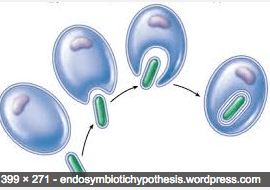
What process is shown within this diagram?
a)
Natural selection
b)
Endosymbiosis
c)
Chemical evolution
d)
Abiogenesis
25.
The theory of Endosymbiosis explains
a)
The origin of eukaryotes
b)
How species develop
c)
How bacteria live
d)
Why cells rely on one another
26.
All of the following are evidence of endosymbiosis EXCEPT
a)
mitochondria and chloroplast ribosomes are similar to bacterial ribosomes
b)
mitochondria and chloroplast are similar in size to bacteria
c)
mitochondria and chloroplast have double membranes
d)
mitochondria and chloroplast have a nucleus
27.
A  population of cockroaches was sprayed with an insecticide.  Some cockroaches survived and produced a population of cockroaches that was resistant to this spray.  What can BEST be inferred from this example?
a)
species will adapt no matter what the environment
b)
environment has no effect on the survival of an organism
c)
Individuals with favorable variations survive and reproduce
d)
Insecticides cause mutations that are passed on to the next generation
28.
What are the 8 levels of classification of living things from most general to most specific?
a)
domain, kingdom, phylum, class, order, family, genus, species
b)
domain, kingdom, phylum, class, order, family, genius, species
c)
domain, kingdom, phamily, class, order, family, genus, species
d)
domain, king, phillip, class, order, family, genus, species
29.
The scientific name for water bear is Hypsibius dujardini.  What is its genus?
a)
Hypsibius 
b)
dujardini
c)
water 
d)
tardigrade
30.
What is the science of organizing, classifying and naming living things.
a)
taxonomy
b)
taxadermy
c)
taxicab
d)
toxicology
31.
Who is the closest relative to the birds?
a)
crocodiles
b)
sharks
c)
fish
d)
amphibians
32.
Who is the closest relative to the sharks?
a)
crocodiles
b)
sharks
c)
ray-finned fish
d)
amphibians
33.
What kind of cells are made in MEIOSIS?
a)
Haploid Gametes
b)
Diploid Somatic Cells
c)
Skin Cells
d)
Liver Cells
34.
Diploid Cells are represented by
a)
2n
b)
n
c)
4n
d)
1/2 n
35.
When an area of a chromatid is exchanged with the matching area on a chromatid of its homologous chromosome, _________________ occurs
a)
crossing over
b)
mutagenesis
c)
hybridization
d)
fertilization
36.
When an area of a chromatid is exchanged with the matching area on a chromatid of its homologous chromosome, _________________ occurs
a)
crossing over
b)
mutagenesis
c)
hybridization
d)
fertilization
37.
The chromosomes that pair up during meiosis, are called __________ chromosomes.  
a)
homozygous 
b)
asexual
c)
homologous
d)
genes
38.
How many daughter cells are produced at the end of meiosis?
a)
1
b)
2
c)
3
d)
4
39.
Which sequence of DNA bases would pair with this partial strand
ATG TGA CAG
a)
ATG TGA CAG
b)
TAC ACT GTC
c)
GTA AGT GAC
d)
CAT TCA CTG
40.
Which of the following best describes a DNA molecule?
a)
double helix
b)
contains ribose
c)
made of amino acids
d)
contains Uracil
41.
Which of the following units are repeatedly joined together to form a strand of DNA?
a)
amino acids
b)
nucleotides
c)
fatty acids
d)
polysaccharides
42.
What determines the code, or information, of a DNA molecule?
a)
the shape (structure) of the nitrogen bases
b)
the order (sequence) of the nitrogen bases
c)
the color of the nitrogen bases
d)
the frequency (number) of nitrogen bases
43.
The process of making an mRNA strand from a DNA template is called
a)
Replication
b)
Transcription
c)
Translation
d)
Protein Synthesis
44.
Transcription takes place in the 
a)
cytoplasm
b)
chloroplast
c)
nucleus
d)
mitochondria
45.
What amino acid is represented by the codon UUA?
a)
Phenylalanine
b)
Tyrosine
c)
Leucine
d)
Stop codon
46.
What mutation has occurred here? 
T-G-A-C-C-A
T-G-A-G-C-A
a)
Substitution
b)
Deletion
c)
Insertion
d)
Frameshift 
47.
Any change in the sequence of DNA is...
a)
transgenic shift
b)
Single Genotype
c)
Monohybrid Trait
d)
Mutation
48.
If a cell has an abnormal number of chromosomes, usually from meiosis, what is this considered? Choose the best answer.
a)
Chromosome mutation
b)
Nondisjunction
c)
Sex-linked mutation
d)
Inversion
49.
One difference between RNA and DNA is -
a)
RNA has thymine where DNA has ademine
b)
DNA is single stranded where RNA is double stranded
c)
DNA is made in the nucleus where RNA is made in the ribosomes
d)
RNA is single stranded where DNA is double stranded
50.
What Nitrogenous Base does RNA contain that DNA does not?
a)
Thymine
b)
Uracil
c)
Adenine
d)
Love
51.
Which 2 molecules form the sides of the DNA ladder?
a)
deoxyribose and adenine
b)
deoxyribose and a hydrogen bond
c)
sugar and the nucleus
d)
deoxyribose (sugar) and phosphate
52.
In the DNA double helix, the bases (AtoT and CtoG) are held together by: 
a)
polar bonds
b)
ionic bonds
c)
covalent bonds
d)
hydrogen bonds
53.
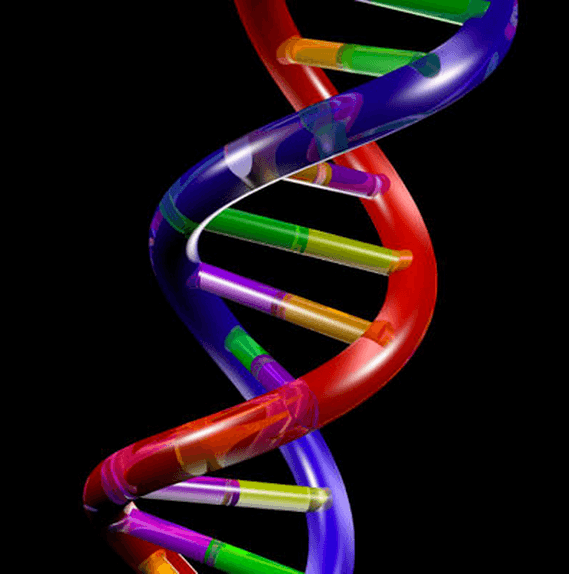
This is: 
a)
tRNA
b)
mRNA
c)
DNA
d)
a ribosome
54.
A ___________ is made up of a sequence of nitrogen bases that code for a specific protein.
a)
ribosome
b)
gene
c)
chromosome
d)
codon
55.
A codon is a ____________.
a)
triplet code found on messenger RNA
b)
triplet code found on transfer RNA
c)
nucleotide found on DNA 
d)
gene sequence
56.
What is the correct definition for the term "translation"?
a)
a process of copying DNA
b)
process of making messenger RNA
c)
process of reading the messenger RNA code to make a protein
57.
What is the correct definition for the term "ribosome"?
a)
an organelle that is the site of DNA replication and transcription
b)
area outside of the nucleus where ribosomes are found
c)
organelle that helps make proteins by translating mRNA
58.

if a mutation occurs in the ____________________, it can be passed onto offspring.

a)

body cells (somatic cells)

b)

sex cells (gametes)

c)

brain cells

d)

heart cells

59.

if a mutation occurs in the body cells, it effects...

a)

the individual and the offspring

b)

the offspring only

c)

the individual only

60.

DNA that is made by joining DNA from two different species, combined together is called

a)

new DNA

b)

selective breeding

c)

recombinant DNA

d)

genetic engineering

61.

The small ring shaped DNA that is used in gene splicing is called...

a)

plasmid

b)

restriction enzyme

c)

allowance enzyme

d)

recombinant DNA

62.

which term explains why different cells do different functions (jobs)?

a)

gene splicing

b)

selective breeding

c)

gene expression

d)

genetic engineering

63.

All the cells in an organisms body contain the same DNA.

a)

TRUE

b)

FALSE

64.

The Central Dogma states that the flow of genetic information is in the direction of:

a)

RNA → DNA → protein

b)

Protein→ RNA → protein

c)

RNA → DNA → RNA

d)

DNA → RNA → protein

e)

Protein → RNA → DNA

65.
A balance that an organism maintains by regulating what goes into and out of the cell.
a)
Hypertonic
b)
Homeostasis
c)
Plasmolysis
d)
Hypotonic
66.
The type of cellular transport that requires no energy.
a)
Active Transport
b)
Protein Pumps
c)
Passive Transport
d)
Endocytosis
67.
Which of the following modes of cellular transport does NOT require energy?
a)
Facilitated Diffusion
b)
Protein Pumps
c)
Endocytosis
d)
Exocytosis
68.
The process of engulfing food or liquid particles into the cell.
a)
Osmosis
b)
Exocytosis
c)
Endocytosis
d)
Diffusion
69.
What type of transport involves the movement of water from high to low concentrations?
a)
Diffusion
b)
Active Transport
c)
Facilitated Diffusion
d)
Osmosis
70.
What type of transport uses transport (channel) proteins to help molecules move from higher to lower concentrations?
a)
Protein Pumps
b)
Diffusion
c)
Facilitated Diffusion
d)
Osmosis
71.
What happens to a plant cell that is placed into a hypotonic solution?
a)
It shrinks
b)
Plasmolysis
c)
It swells
d)
Cytolysis
72.
A cell with a 5% salt solution is placed into a beaker with a 10% salt solution.  This solution is considered to be _____ to the cell.
a)
Isotonic
b)
Hypertonic
c)
Hypotonic
d)
None of the Above
73.
A cell with a 5% salt solution is placed into a beaker with a 10% salt solution.  What will happen to the cell?
a)
It will shrink
b)
It will swell
c)
No change
d)
Cytolysis
74.
A cell with a 10% salt solution is placed into a beaker with a 40% salt solution.  How will water move?
a)
It will leave the cell
b)
It will enter the cell
c)
It will move in and out equally
d)
There will be no movement
75.
In a nerve cell, ATP energy is used to pump sodium (Na) out of the cell and potassium (K) into the cell. This is an example of...
a)
Facilitated Diffusion
b)
Simple Diffusion
c)
Active Transport
d)
Osmosis
76.
This cell organelle helps organisms maintain homeostasis by controlling what substances may enter or leave cells.
a)
vacuole
b)
nucleus
c)
cell membrane
d)
cell wall
77.
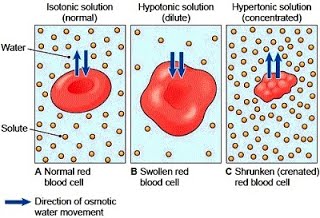
The cell below is in a _________ solution.
a)
Hypotonic
b)
Hypertonic
c)
Isotonic
78.
A cell in an isotonic solution will
a)
swell
b)
shrink
c)
stay the same size
d)
impossible to tell
79.
What type of transport is this?
a)
facilitated diffusion
b)
active transport
c)
diffusion
d)
osmosis
80.
Active transport requires ______, moves materials from __________________, and goes _______ the concentration gradient.
a)
No energy, low to high, against
b)
ATP, high to low, with
c)
ATP, low to high, with
d)
ATP, low to high, against
81.
a)
Passive Transport
b)
Active Transport
82.
What is it called when molecules move across the cell membrane from an area of high concentration to an area of low concentration through a carrier protein?
a)
Diffusion
b)
Osmosis
c)
Active Transport
d)
Facilitated Diffusion
83.
Which of these organisms relies on mitosis for reproduction?
a)
grumpy cat
b)
angry bird
c)
unicellular paramecium
d)
squishy jellyfish
84.
During interphase, the DNA is in the form of
a)
chromatin
b)
chromosomes
c)
chromatids
d)
centromeres
85.
Identify the stage of mitosis. 
a)
interphase
b)
prophase
c)
anaphase
d)
cytokinesis
86.
Mitosis is a type of ________________ reproduction.
a)
Sexual
b)
Asexual
87.
How many daughter cells are produced in mitosis?
a)
1
b)
2
c)
4
d)
6
88.
Fruit fly body cells have 8 chromosomes. After mitosis, you would expect a resulting fruit fly daughter cell to have ...
a)
16 chromosomes.
b)
46 chromosomes.
c)
8 chromosomes.
d)
4 chromosomes.
89.
Structure B is pointing to the _____. 
a)
chromosome
b)
centromere
c)
DNA
d)
chromatid
90.

How many chromosomes are normally found in human body cells?

a)

46

b)

23

c)

26

d)

44

91.
During interphase the cell ___________.
a)
divides into two cells
b)
divides its nucleus
c)
replicates its DNA
d)
replicates the organelles within the cell
92.
What is the  two daughter strands of replicated chromatin that are condensed into two rod shaped structures and connected by a centromere called?
a)
DNA
b)
chromatin
c)
chromatid
d)
chromosome
93.
What is the correct term for "develops in the middle plane of a plant cell separating it into two daughter cells during cell division"?
a)
cell
b)
cell cycle
c)
cell plate
d)
centriole
94.
What is the correct term for "form during prophase of mitosis and attach to chromosomes at the centromere to pull them apart during cell division"?
a)
centriole
b)
nucleus
c)
spindle fibers
d)
cytokinesis
95.
What is the longest phase of the cell cycle?
a)
Prophase
b)
Interphase
c)
Cytokinesis
d)
Metaphse
96.
Mitosis results in the formation of...
a)
Two identical cells with all of the original chromosomes
b)
Two different cells with half of the original chromosomes
c)
Four identical cells with all of the original chromosomes
d)
Four different cells with half of the original chromosomes
97.
What is the purpose of mitosis?
a)
To increase the surface area of a cell
b)
To allow cells to divide for growth, repair, and renewal
c)
For increasing genetic variation within a species
d)
To allow for DNA replication and protein synthesis
98.
During interphase, what important step must occur for mitosis to happen correctly?
a)
Cytoplasm & Cell membrane must separate
b)
Chromosomes must line up at opposite poles
c)
Spindle fibers must make the centrioles
d)
DNA must replicate and twist to form chromosomes
99.
Which of the following describes cancer?
a)
Nondisjunction of gamete cells
b)
Cell division without replication of DNA
c)
Mitosis without cytokinesis
d)
Uncontrolled cell division
100.
What are stem cells?
a)
Plant cells that form the plant's stem
b)
Cells that are unspecialized (undifferentiated)
c)
Cells that come from adults
d)
A fertilized egg and sperm cell
101.
Amino acids are the building blocks of... 
a)
DNA
b)
RNA
c)
Atoms
d)
Proteins
102.
This type of cell is not yet specialized, but has the ability to turn into a variety of specialized cell types. It is used in research to treat a variety of medical ailments and diseases.
a)
stem cell
b)
bone cell
c)
nerve cell
d)
gamete
103.
Sperm and egg cells are both known as what type of cell?
a)
fetus
b)
embryo
c)
stem
d)
gamete
104.

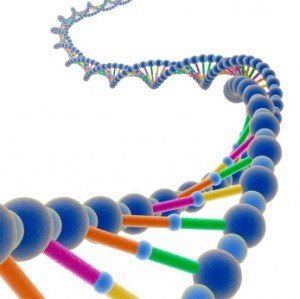
What process is going on in this model?

a)

Transcription

b)

Translation

c)

Replication

d)

All the above

105.

How does the DNA of a nerve cell and a skin cell compare?

a)

The DNA is the same, but each cell contains different genes

b)

The DNA is the same, but different genes are turned on and turned off in each cell

c)

The DNA is different, but the same genes are turned on and off in each cell

d)

The DNA is different, but each cell contains the same genes

106.
A phospholipid has 2 parts. What are they called? 
a)
Hydrophilic Head, Hydrophobic Tail 
b)
Hydrophobic Head, Hydrophilic Tail 
107.
A ______________ is composed of a phosphate and glycerol head and 2 fatty acid chain tails. 
a)
phospholipid 
b)
Carbohydrate
c)
Cholesterol 
d)
Protein 
108.
Describes the arrangement of the cell membrane as bendable and made of many parts. 
a)
The Fluid Mosaic Model 
b)
The Major Mobility Model 
c)
The Crazy Cell Model
d)
The Maze Model
109.
Something is ___________ ____________
when some molecules can cross the membrane while others cannot. 
a)
Selectively (or Semi) Permeable 
b)
Totally Transparent
c)
Liquid Licorice 
d)
Heavily Patrolled 
110.
What organelle controls and regulates cellular activity?
a)
Ribosome
b)
Nucleus
c)
Mitochondria
d)
Lysosome 
111.
The major function of ribosomes is to
a)
Make fats
b)
Synthesize protein
c)
Digest protein
d)
Make sugars
112.
Which of the following is an enzyme filled organelle that breaks down waste in the cell?
a)
lysosomes
b)
chloroplast
c)
mitochondria 
d)
Golgi apparatus 
113.
What is the name and function of the organelle displayed above?
a)
Mitochondria: breakdown glucose and produce ATP
b)
Chloroplast: converts solar energy into chemical energy
c)
Vacuole: Stores H2O, salt, food
d)
Nucleus: stores genetic information
114.
Which structure would be found in a grass cell but NOT on your cell?
a)
cell wall
b)
nucleus
c)
mitochondria 
d)
vacuoles 
115.
In what type of cells would you expect to find many mitochondria ?
a)
muscle cells
b)
nerve cells
c)
skin cells
d)
sperm cells
116.
Rough endoplasmic reticulum has ________________ attached to it. 
a)
ribosomes 
b)
chromosomes 
c)
Golgi apparatus 
d)
nucleolus 
117.
What is the function of the mitochondria?
a)
Structure that manufactures ribosomes
b)
Structures that converts nutrients to energy
c)
Stack of membranes that packages chemicals
d)
Structure that contains DNA and directs the cell
118.
What is the function of the vacuole?
a)
Sac that stores water, nutrients, and waste products
b)
Sac filled with digestive chemicals
c)
Jelly-like substance within the plasma membrane
d)
stack of membranes that packages chemicals
119.
The two kinds of cells are Prokaryotes and Eukaryotes. How are they different?
a)
Prokaryotes have a nucleus.
b)
Eukaryotes have a nucleus.
c)
Prokaryotes are plant cells.
d)
There is no difference.
120.
Only eukaryotic cells have....
a)
membrane-bound organelles 
b)
DNA
c)
ribosomes
d)
cell membranes 
121.
What does this organism use for movement?
a)
Pseudopod
b)
Cilia
c)
Flagella
d)
legs
122.
What does this organism use for movement?
a)
Pseudopod
b)
Cilia
c)
Flagella
d)
legs
123.
What is the function of the Golgi Apparatus?
a)
To produce ribosomes
b)
To transfer materials
c)
To protect the cell
d)
To hold DNA
124.
Prokaryotic cell
a)
a cell that lacks a nucleus and other membrane bound organelles; includes achaea and bacteria
b)
a cell containing a nucleus and other membrane bound organelles
c)
the idea that the mitochonria and chloroplasts were once free living and were engulfed by other prokaryotic cells.
d)
 part of the cell containing DNA and RNA and responsible for growth and reproduction
125.
What 4 structures are common between plant, animal, and bacterial cells?
a)
Golgi Apparatus, Chloroplasts, Ribosomes, Nucleus
b)
Cell Wall, Mitochondria, Cell Membrane, Cytoplasm
c)
Rough ER, Smooth ER, Nucleus, Ribosomes
d)
DNA, Cytoplasm, Ribosomes, Cell membrane
126.
____________ & _________________ are organelles that definitely arose from endosymbiosis.
a)
Rough ER & Smooth ER
b)
Mitochondria & Flagellum
c)
Chloroplast & Mitochondria
d)
Chloroplast and Golgi apparatus
128.
What did the host cell receive from its endosymbiont (cell living inside of it)?
a)
Shelter
b)
Motility
c)
Energy
d)
Reproduction
128.
What did the host cell receive from its endosymbiont (cell living inside of it)?
a)
Shelter
b)
Motility
c)
Energy
d)
Reproduction
129.
What did the endosymbiont (cell living inside another) receive from its host cell?
a)
Shelter
b)
Energy
c)
Motility
d)
Reproduction
130.
What is the purpose  of an enzyme?
a)
give permission for the reaction
b)
raise activation energy
c)
speed up reactions
d)
control how many reactions occur
131.
Where do substrates bind on an enzyme?
a)
voltage-gated channels
b)
surface receptor
c)
calcium channels
d)
active site
132.
Enzymes are capable of increasing the rate of a chemical reaction within a living cell.  Enzymes accomplish this through which of the following means?
a)
reducing the number of products   
b)
reducing the activation energy
c)
increasing the temperature of the cell
d)
increasing the concentration of reactants 
133.
Each enzyme only has 1 substrate that will fit its active site.  What is this called?
a)
reusable
b)
catalyst
c)
specific
d)
fragile
134.
Which of the following conclusions can be drawn from this graph?
a)
The optimum pH of the enzyme is 6.6.
b)
The optimum pH of the enzyme is 5.8
c)
The enzyme’s activity increases as pH increases 5.0 to 9.0
d)
The enzyme’s activity is greater around pH of 8.0 .
135.
can a change in pH alter the active site of an enzyme
a)
yes
b)
no
136.
Which of these is NOT true?
a)
Enzymes can denature (change shape) when the temperature gets too high.
b)
Enzymes can only be used once in a chemical reaction. 
c)
Extreme pH can denature enzymes.
d)
Enzymes speed up chemical reactions. 
137.
What happens when enzymes are heated to a high temperature?
a)
The enzymes die.
b)
The shapes of the enzyme are altered or denatured
c)
The enzymes' amino acid sequence changes.
d)
The enzymes remain the same
138.
Which major macromolecule is being represented in this image? 
a)
carbohydrate
b)
lipid
c)
protein
d)
nucleic acid
139.
What are the building blocks of proteins?
a)
amino acid
b)
fatty acid
c)
nucleotide
d)
lipid
140.
What are the single sugars that are the building blocks of carbohydrates?
a)
monosaccharides
b)
disaccharides
c)
polysaccharides
d)
amino acid
141.
Which macromolecule stores energy, insulates us, and makes up the cell membrane?
a)
lipids
b)
proteins
c)
carbohydrates
d)
nucleic acids
142.
Another name for fats and oils
a)
proteins
b)
sugar
c)
lipids
d)
nucleic acids
143.
What is the function of nucleic acids?
a)
Stores energy
b)
Stores genetic information
c)
Movement
d)
Physical structure
144.
What molecule is used for LONG term energy storage?
a)
carbohydrates
b)
lipids
c)
protiens
d)
nucleic acid
145.
_________ are composed out of carbon (C), hydrogen (H), oxygen (O), nitrogen (N), and phosphorus (P)
a)
Carbohydrates
b)
Lipids
c)
Proteins
d)
Nucleic Acids
146.
Glycerol and fatty acids are the monomers of
a)
Carbohydrates
b)
Lipids
c)
Proteins
d)
Nucleic Acids
147.

The organic compounds that have many structural purposes and are used in many processes (like growth and repair) within the

cell are called ____________________.

a)

Carbohydrates

b)

Lipids

c)

Proteins

d)

Nucleic Acids

148.

This is a monomer of a?

View Figure 3 (if not visible)

a)

lipid

b)

protein

c)

nucleic acid

d)

carbohydrate

149.
The ozone layer protects us from
a)
UV rays
b)
CFCs
c)
Increased atmospheric heat
d)
Decreased atmospheric heat
150.
The ozone layer is damaged by
a)
CFCs
b)
Increase in greenhouse gases
c)
Increased global temperatures
d)
Sulfuric and nitric acids
151.

Of the following sources, which produces the greatest amount of pollutants?

a)

microorganisms & pollen

b)

volcanoes & duststorms

c)

transportation & power plants

d)

wildfires & duststorms

152.

In general, algal blooms occur when

a)

toxins accumulate in shellfish.

b)

nutrients decrease in the water.

c)

nutrients increase in the water.