wayground logo

Free Printable Worksheets

Font size

S
M
L
XL
Worksheets

Term Test Review 20211st Term

Total questions: 92

Worksheet time: 1hrs 7mins

Name
Class
Date
1.
What property of water helps to moderate earth's temperature?
a)
adhesion
b)
chohesion
c)
Specific heat capacity
d)
Latent heat of vaporization
2.
Which of the following properties of water enables it to move from the roots to the leaves of plants?
a)
Water expands as it freezes.
b)
Water is an excellent solvent.
c)
Water exhibits cohesive behavior.
d)
Water moderates temperature.
3.

The most basic unit of a living organism is...

a)

A box

b)

A cell

c)

A cellular component

d)

A battery

4.
Several different tissues working together to perform a specific function
a)
organ
b)
organ system
c)
organism
d)
cells
5.
Which is NOT a characteristic that all living organisms share? 
a)
Ability to reproduce 
b)
Ability to grow 
c)
Ability to respond to their environment 
d)
Ability to dominate an ecosystem 
6.

The variable that a scientist changes

a)

Independent

b)

Dependent

c)

Control

d)

Constant

7.
The basic building block of life
a)
element
b)
compound
c)
organelles
d)
cells
8.
Maintaining a stable internal environment.
a)
adapation
b)
biology
c)
photosynthesis
d)
homeostasis
9.

Which of the following is an example of an organism maintaining homeostasis??

a)

A plant using the openings on its leaves, stomata, to exchange gases and evaporate water to allow more water to get into the plant

b)

A Runner perspiring while running on a hot summer day

c)

The human body releasing insulin to keep blood sugar steady

d)

The maintain ace of a body temperature around 98.6 degrees F

e)

All of the above

10.

An act of using one or more of your senses to gather information and take note of what occurs is

a)

Qualitative data

b)

Quantitative data

c)

an Inference

d)

an Observation

11.
What does Evidence mean? 
a)
All scientific data that supports your claim
b)
An opinion
c)
Statement you believe to be true
d)
A statement of an opposing argument
12.
What does Reasoning mean?
a)
A solid and reasonable argument
b)
A written response to a claim
c)
An explanation that connects your evidence back to the claim
d)
An opinion you believe in 
13.
This part of the experiment serves as a basis of comparison; the one variable being tested has been omitted. 
a)
experimental group
b)
control group
c)
data
d)
variables
14.
This variable in an experiment is the one being deliberately changed by the scientist. 
a)
dependent variable
b)
independent variable
c)
data
d)
control group
15.
Green plants produce their own food through the process of photosynthesis.
a)
All living things use energy
b)
All living things contain cells
c)
All living things maintain homeostasis
d)
All living things grow
16.
A baby song bird hatches from its egg with both parent songbirds watching.
a)
All living things reproduce
b)
All living things maintain homeostasis
c)
All living things use energy
d)
All living things grow
17.
Rocks are not living because
a)
they never move
b)
they aren't needed for humans
c)
they are not made of cells
d)
they don't break down
18.
A worm turns away from light is an example of a worm
a)
reproducing
b)
doing cellular respiration
c)
having cells
d)
responding to its environment
19.

An ecosystem comprising the ENTIRE EARTH and the organisms that inhabit it.

a)

Biosphere

b)

Biome

c)

Abiotic

d)

Ecoregion

20.
What is a protein: 
a)
A polymer composed of many sugars.
b)
A polymer composed of many amino acids. 
c)
A polymer composed of fatty acids. 
d)
A polymer composed of nucleotides. 
21.
Monomers combine to form ________ through the process of ________.
a)
polymers; hydrolysis
b)
polymers; dehydration synthesis
c)
monomers; hydrolysis
d)
monomers; dehydration synthesis
22.

Polymer's split apart to form ________, by __________.

a)

monomers, hydrolysis

b)

monomers, dehydration synthesis

c)

amino acids, hydrolysis

d)

amino acids, dehydration synthesis

23.
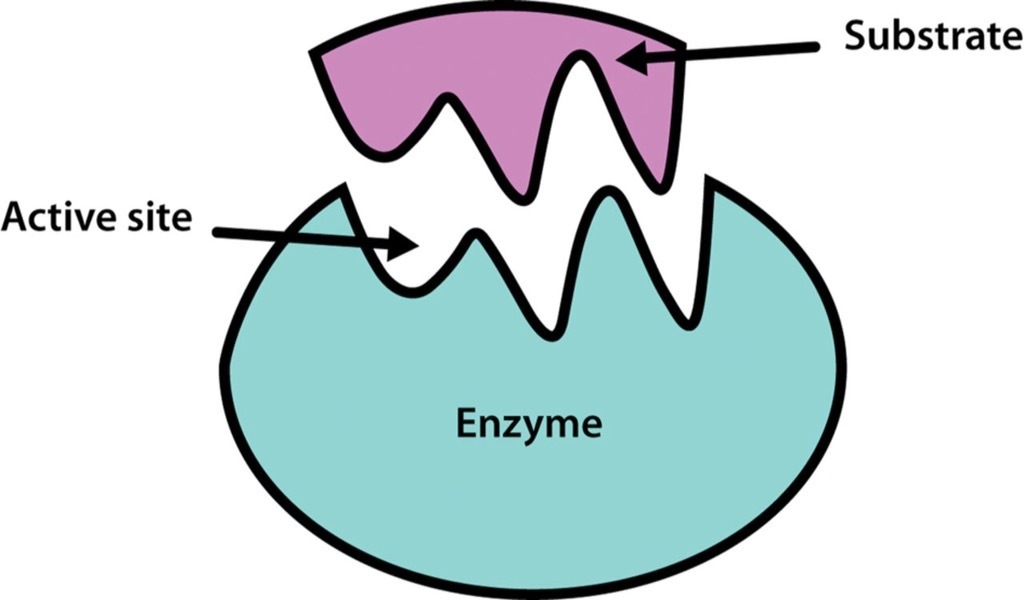
Where do substrates bind on an enzyme?
a)
voltage-gated channels
b)
surface receptor
c)
calcium channels
d)
active site
24.
What is the purpose  of an enzyme?
a)
give permission for the reaction
b)
raise activation energy
c)
speed up reactions
d)
control how many reactions occur
25.

Which 2 factors can affect the rate of enzyme activity?

a)

Light intensity

b)

Temperature

c)

pH

d)

Oxygen concentration

26.
When a piece of liver is dropped into hydrogen peroxide, the peroxide bubbles vigorously as the hydrogen peroxide (H2O2) decomposes into water (H2O) and oxygen (O2). This rapid change in reaction rate suggests 
a)
that liver contains lots of germs
b)
 the liver contains an enzyme that breaks down hydrogen peroxide
c)
 that liver is a substrate for hydrogen peroxide
d)
that hydrogen peroxide is a powerful enzyme
27.
Attractions between water molecules are called
a)
Covalent bonds
b)
Ionic bonds
c)
Polar bonds
d)
Hydrogen bonds
28.

A water strider can skate along the top of a pond because:

a)

covalent bonds result in water cohesion

b)

hydrogen bonds result in water cohesion (surface tension)

c)

water striders have adapted to take advantage of water forming ionic bonds

d)

low surface tension of water

29.
What is an advantage of sexual reproduction?
a)
Allows genetic variation
b)
Only needs one parent
c)
Happens very quickly
d)
Offspring are exact copies of parent
30.
The diagram illustrates an embryonic stage of two organisms.Which of the following can be determined by observing the embryos shown in the diagram? 
a)
The organisms share a common ancestry.
b)
The organisms belong to the same genus.
c)
The organisms are native to the same geographic areas.
d)
The organisms will grow into anatomically similar adults.
31.
 The diagram represents the relationship between beak structure and food in several species of finches found on the Galapagos Islands. The different beak structures observed in the diagram are evidence of
a)
 different species of finches adapting to different environments over many generations
b)
 finches changing their beak characteristics so that they could feed efficiently
c)
finch species with different beak structures coming to the Galapagos Islands from the mainland
d)
 finches mating with birds of other species and acquiring some of their traits
32.
Mutations are important because they bring about
a)
death of the organism in which they develop
b)
genetic variation needed for a population to evolve
c)
benefits for the individual, not for the population
d)
Hardey-Weinberg equilibrium within a population
33.

What is the term for a feature that allows an organism to survive better in its environemtn?

a)

variation

b)

adaptation

c)

homologous structure

d)

vestigial structure

34.
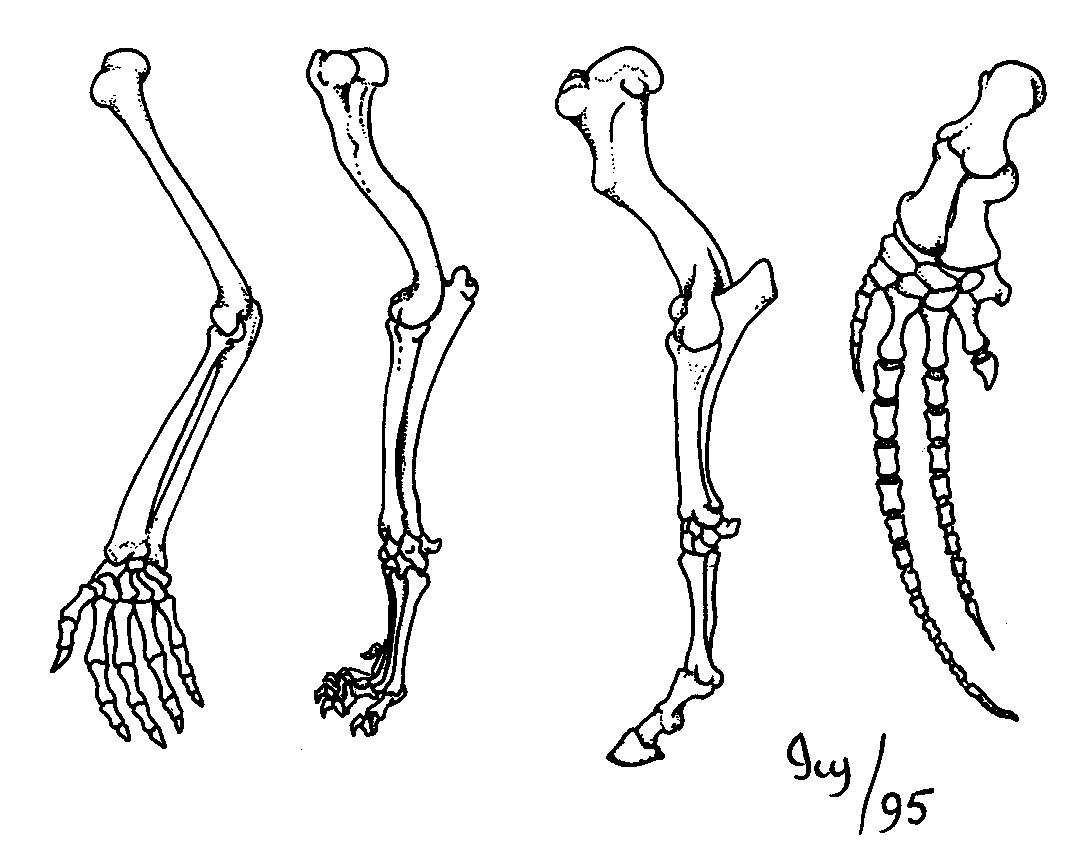
Some organisms that share a common ancestor have features that have different functions, but similar structures.  These are known as
a)
vestigial structures
b)
analogous structures
c)
homologous structures
d)
fossil structures
35.
This is a process by which organisms inherited advantageous traits that tend to reproduce more successfully than the other organisms do. 
a)
Artificial selection
b)
Natural selection
c)
Populations
d)
Environment
36.
This is a group of organisms of the same species that live in a specific geographical area.
a)
Environment
b)
Evolution
c)
Biological diversity
d)
Populations
37.
Structures with the same parts have different functions; suggests that organisms share a common ancestry
a)
vestigial structures
b)
homologous structures
c)
adaptive radiation
d)
fossil
38.
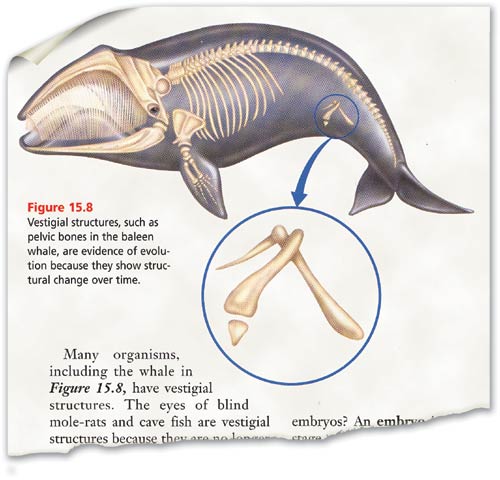
Which of the following is an example of a vestigial structure?
a)
the wings of a red-tailed hawk
b)
the hind limbs of a house cat
c)
the fins of sharks
d)
the tailbone of a human
39.

From fossils Darwin realized...

a)

that the fossils were radically different from species living today

b)

that the fossils were similar to species living today

c)

that the fossils were created by the Devil to trick him

d)

that the fossils were smaller than species living today.

40.

Why could Darwin not initially reveal his great idea that species naturally change over time?

a)

It was obvious and everyone knew it

b)

He did not have enough evidence

c)

He was not confident

d)

He would be challenging society and the accepted idea that God created everything

41.

Wallace observed ______, which made him realize species change over time.

a)

finches

b)

butterflies

c)

turtles

d)

fish

42.

True or False: Darwin and Wallace came up with the same idea that species change over time independently on their own.

a)

True

b)

False

43.

Darwin and Wallace both gathered a large number of observations and facts on what they based their theories. Which of the following types of evidence was NOT part of the evidence they gathered?

a)

fossil evidence

b)

anatomical evidence (anatomy)

c)

geographical distribution

d)

genetic evidence (DNA)

44.
Mutations are a change in what?
a)
DNA
b)
tRNA
c)
genotype
d)
phenotype
45.
Why did dark-colored rock pocket mice first appear in a population of light-colored rock pocket mice?
a)
They have a genetic mutation that affects their fur color.
b)
There is dark lava rock in the area where they live.
c)
Individuals change color to blend in with the environment.
d)
Predators eat light-colored rock pocket mice. 
46.
Why do dark-colored rock pocket mice on dark lava flows have white bellies?
a)
There is no selectin for dark bellies by visual predators. 
b)
Mutations causing dark bellies do not occur. 
c)
There is a reproductive advantage to having a dark belly. 
d)
White bellies are an important part of camouflage.
47.

Darker skin is more prevalent among indigenous people living in areas with high amounts of UV radiation. Nina Jablonski proposed a hypothesis to explain the selective pressure for darker skin in these environments. On which of the following observations did she base this hypothesis?

a)

Human populations around the globe have different versions of the MC1R gene.

b)

In general, people with more darkly pigmented skin have less folate, a nutrient important for human reproduction, circulating through their blood.

c)

The larger amount of eumelanin in darkly pigmented skin protects circulating folate from being destroyed by UV radiation.

d)

The melanin in darkly pigmented skin protects DNA from UV radiation, which can cause skin cancer.

48.

Rickets, a disease that affects bone development in children, is caused by vitamin D deficiency. Based on the risk factors discussed in the film, which of the following groups of people has the highest risk of rickets if they do not take vitamin D supplements? Assume that each group spends a lot of time outdoors.

a)

adults with dark skin who live close to the equator

b)

children with light skin who live close to the equator

c)

adults with light skin who live far south of the equator

d)

children with dark skin who live far north of the equator

49.
What is melanin?
a)
A protein pigment that absorbs and reflects light
b)
A protein that is waterproof and tough
c)
A cell found in the epidermis
d)
A vitamin that helps you sleep
50.
If a person lives in an environment with low radiation what kind of skin color would be the best adapted
a)
Darker skin tones to increase production of Vitamin D Synthesis
b)
Darker skin tones to protect DNA and Folate
c)
Lighter Skin tones to increase production of Vitamin D
d)
Lighter Skin tones to protect DNA and Folate
51.
What is the evolutionary benefit for dark skin near the equator?
a)
Skin cancer protection
b)
Folate Protection
c)
It has no evolutionary relationship
d)
Easier vitamin D production
52.

Which answer is more appropriate?

a)

Traits are good or bad.

b)

Traits can be harmful or hurtful depending on the environment.

c)

Traits are always helpful or hurtful, regardless of the environment.

d)

Traits are helpful or bad.

53.
A flash flood carried a raft of Amazon ants away from their original population. There is enough distance between the two groups, that they will never meet in nature again. What type of reproductive barrier is this?
a)
behavioral isolation
b)
temporal isolation 
c)
gametic isolation
d)
geographic isolation 
54.
The term for the formation of new and distinct species over the course of evolution is...
a)
speciation
b)
biological species concept
c)
reproductive barrier
d)
natural selection
55.

Charles Darwin hypothesized that the finches on the Galapagos Islands _____.

a)

shared a common classification with finches in North America.

b)

shared a common ancestor with other finches from the Galapagos Islands.

c)

did not share any common ancestor at all.

d)

shared a common ancestor with finches on the mainland of South America.

56.
What did the beak type of finches on different islands tell Darwin?
a)
Finch populations evolved over time to favor beaks based on food type
b)
Finch populations had not evolved over time
c)
The finch beaks had no relationship to the available food on the islands
d)
Humans artificially selected finches based on their desired beak type
57.
Identify the problem with this experiment:  
A scientist thinks that flatworms swim faster if they are in salt water.  So he drops them in salt water and finds that they do swim very fast.  He concludes that salt water makes flatworms swim fast.  
a)
No independent variable
b)
Too many independent variables
c)
No control group
d)
No experimental group
58.

An experiment is conducted to test the hypothesis that a certain type of houseplant grows best when exposed to exactly four hours of sunlight per day. Which is the dependent variable?

a)

hours of sunlight

b)

growth of plant

c)

type of soil

d)

amount of water

59.

Experiments measure how changing the __________variable affects the __________ variable.

a)

controlled, other

b)

dependent, independent

c)

primary, secondary

d)

independent, dependent

60.

A claim is ______________________________.

a)

a kind of shellfish often used in chowder.

b)

a fact.

c)

a statement or conclusion that answers the original question or problem.

d)

an opinion based on prior knowledge.
61.
Which biomolecule is made of nucleotides and contain you DNA?
a)
Carbohydrate
b)
Lipids
c)
Protein
d)
Nucleic Acid
62.
Which biomolecule has sugars and starches?
a)
Lipids
b)
Proteins
c)
Carbohydrates
d)
Nucleic Acid
63.
Which biomolecule functions include enzymes­ which speeds the rate of chemical reactions, structural components in cells, mechanical functions in muscles and cytoskeleton, cell signaling, and immune response; provides structure and helps with chemical reactions 
a)
Protein
b)
Lipids
c)
Carbohydrate
d)
Nucleic Acid
64.
Which biomolecule is important source of energy for humans; glucose for human cells, tissues, and organs; provides fiber, sugar, and starches; provides structural support, cell wall, and cell membrane maker?
a)
Nucleic Acid
b)
Lipid
c)
Carbohydrate
d)
Protein
65.
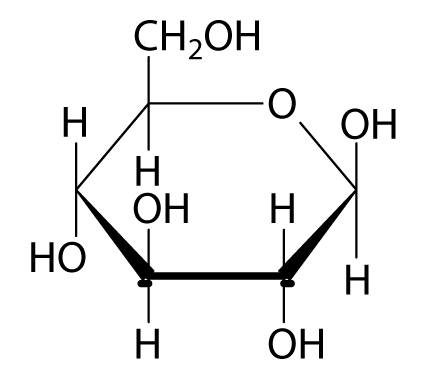
Identify the biomolecule
a)
Carbohydrate
b)
Lipid
c)
Protein
d)
Nucleic Acid
66.
Which biomolecule includes fats, such as triglycerides, oils, waxes, and steroids (cholesterol); insoluble in water; provides energy storage, insulation, part of cell membrane, and hormones 
a)
Nucleic Acid
b)
Lipids
c)
Carbohydrate
d)
Protein
67.
What is the monomer for a protein?
a)
Monosaccharide
b)
Triglyceride
c)
Amino Acid
d)
Nucleotide
68.
What is the monomer of nucleic acids?
a)
Glycerol
b)
Monosaccharides
c)
Amino Acids
d)
Nucleotides
69.
What do disaccharides, such as sucrose, and polysaccharides, such as starch, have in common?
a)
They are lipids made of fatty acids.
b)
They are proteins made of amino acids.
c)
They are nucleic acids made of nucleotides.
d)
They are carbohydrates made of simple sugars.
70.
Which of the following is NOT a biomolecule?
a)
Water
b)
Nucleic Acid
c)
Protein
d)
Lipid
71.
What biomolecule do enzymes belong to? 
a)
Carbohydrate
b)
Lipid
c)
Nucleic Acid
d)
Protein
72.

What two monosaccharides (simple sugars) are formed when lactase enzyme hydrolyzes lactose?

a)

Glucose and fructose

b)

Glucose and galactose

c)

Galactose and maltose

d)

Glucose and maltose

73.

Which discovery supports the hypothesis that evolution of the lactase persistence trait was driven by the use of milk in pastoralist cultures?

a)

The lactase gene is present both in humans and in domesticated animals

b)

Ancient pots used to hold milk are about the same age as the lactase persistence mutations.

c)

Most human cultures today drink milk and most people worldwide are lactase persistent.

d)

Scientists have identified different mutations that cause lactase persistence.

74.

Why would measuring blood glucose levels in an individual, 20 to 30 minutes after they drink a liter of milk, indicate whether they are able to digest lactose

a)

When lactose is digested by lactase in the small intestine, different cells in the body start releasing glucose into the bloodstream

b)

When lactose is digested by lactase, the glucose that is produced enters the bloodstream from the small intestine

c)

When lactose enters the large intestine, glucose is digested by bacteria and then enters the bloodstream

d)

The fats and proteins in milk are digested by the body, causing glucose levels in the blood to increase.

75.

Why could milk have provided strong favorable selection for lactase persistence?

a)

People who can digest milk can obtain calories during times when little other food was available

b)

Being lactase persistent guarantees that an individual will survive and reproduce

c)

Ancient humans could eat McFlurrys and Dairy Queen

d)

Lactose intolerant individuals were probably kicked out of their tribes because they got gas from drinking milk

76.

The majority of people worldwide are lactose intolerant

a)

True

b)

False

77.
Food is broken down to supply energy for your body in the ____________
a)
digestive system
b)
endocrine system
c)
excretory system
d)
reproductive system
78.
What happens when the food goes to the small intestine?
a)
nutrients gets into the blood
b)
the food keeps on going
c)
nothing
79.
Breaking food down with the use of enzymes is known as:
a)
Chemical Digestion
b)
Physical Digestion
80.
Saliva contains this enzyme to start the digestive process.
a)
spit
b)
amylase
c)
hydrochloric acid
d)
sodium bicarbonate
81.
The organ that stores bile.
a)
gall bladder
b)
stomach
c)
liver
d)
appendix
82.

Which are the nutrients digested in the small intestine?

a)

Carbohydrates and proteins

b)

Proteins

c)

Carbohydrates, proteins and lipids

d)

Lipids and proteins

e)

Lipids

83.

What is the function of the villi?

a)

To increase the absorption surface

b)

To digest the last nutrients

c)

To form feces

d)

To comb the small intestine

84.
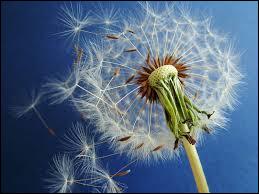
Dandelion, What kingdom does it belongs to?
a)
Plant Kingdom
b)
Animal Kingdom
c)
Fungi Kingdom
d)
Protista Kingdom
85.
Mosquito  belongs to what kingdom?
a)
Animal Kingdom
b)
Plant Kingdom
c)
Fungi Kingdom
d)
Protista Kingdom
86.
A scientific name consists of 
a)
Genus and Order
b)
Genus and Domain
c)
Genus and species
d)
Kingdon and Phylum
87.
Which term means "True Nucleus" or cell(s) with a nucleus?
a)
Eukaryotes
b)
Prokaryotes
c)
Multi-cellular
88.
The 8 levels of classification, most broad to most specific.
a)
Domain, Genus, Family, Order, Class, Phylum, Kingdom, Species
b)
Domain, Species, Kingdom, Genus, Phylum, Family, Class, Order
c)
Domain, Kingdom, Phylum, Class, Order, Family, Genus, Species
d)
Order, Kingdom, Species, Domain, Phylum, Family, Class, Genus
89.

Which two reasons are why viruses are not considered living?

a)

they cannot reproduce on their own

b)

they are not composed of cells

c)

they have no DNA

d)

they do not adapt and evolve

90.
What is cellular respiration?
a)
the breakdown of glucose  to release ATP
b)
the breakdown of glucose to release NADH
c)
the breakdown of glucose to release FADH
d)
the breakdown of glucose to release carbon
91.

Select all that are the products of cellular respiration (right side of the reaction)

a)

Glucose

b)

Water

c)

Oxygen

d)

Carbon Dioxide

92.

Biosynthesis is a process where

a)

Your body breaks down the food you eat and reuses the monomers to build new molecules

b)

Your bonds break down

c)

Your food to form into a new human being

d)

You store large amounts of fat