wayground logo

Free Printable Worksheets

Font size

S
M
L
XL
Worksheets

Biology SOL Review 1

Total questions: 154

Worksheet time: 2hrs 56mins

Name
Class
Date
1.
Suppose two organisms, each heterozygous for eye color, reproduced and had offspring. How likely are the two organisms to have heterozygous offspring?
a)
25%
b)
50%
c)
75%
d)
100%
2.
This type of process requires oxygen
a)
aerobic
b)
anaerobic
c)
cell transport
d)
None of the above
3.
This phase of mitosis occurs after metaphase and before telophase.
a)
Cytokenesis
b)
Metaphase
c)
Anaphase
d)
Interphase
4.
Gametes are formed and the chromosome number is reduced in this type of cell division
a)
Mitosis
b)
Meiosis
c)
Cytokenesis
d)
Translation
5.
Which of the following provides an accurate example of a genotype?
a)
Brown Fur
b)
BB
c)
Blue Flowers
d)
Round seeds
6.
Chromosomes that make up a pair (one chromosome from each parent) are called _________ chromosomes.
a)
Heterozygous
b)
Homozygous
c)
Homologous
d)
Tetrad
7.
The DNA code is transferred to mRNA in the ____ through a process called ____.
a)
Ribosome, Translation
b)
Nucleus, Transcription
c)
Nucleus, Translation
d)
Cytoplasm, Active Transport
8.
Bacteria adapt more quickly than elephants to environmental changes. Which best explains this difference?
a)
Bacteria reproduce more rapidly
b)
Bacteria populations are more isolated
c)
Individual bacteria have more genes
d)
Bacteria grow more steadily
9.
What do phototropism and geotropism enable plants to do?
a)
Allow bacteria to invade cells
b)
Allow cell division to take place
c)
Prevent cell division
Develop resistance toward DNA
d)
Grow toward needed resources
10.
Escherichia coli is the scientific name of a bacterium. What category of classification is Escherichia?
a)
Order
b)
Phylum
c)
Genus 
d)
Species
11.
What repackages proteins into forms the cell can use, expel, or keep stored?
a)
RER
b)
Lysosomes
c)
Golgi Bodies
d)
Ribosomes
12.
Which molecule is paired with its correct role in protein synthesis?
a)
Nucleus-forms peptide bonds
b)
Ribosomes-carry DNA instructions
c)
m-RNA joins amino acids
d)
t-RNA-Transfers the correct amino acid
13.
An ecosystem has a stable population of white-tailed deer. What is the most likely outcome if a new species of deer that competed for the same resources were introduced?
a)
The white tailed deer population would increase
b)
The producer population would decrease
c)
The deer will not be affected
d)
The predator population would decrease
14.
According to the graph the enzyme Amylase will
a)
Slow down the digestion rate
b)
Speed up the digestion rate
c)
Denature the starch
d)
Take in excessive heat
15.
According to this graph the carrying capacity of these deer is?
a)
20
b)
40
c)
70
d)
80
16.
When a group of foxes moves to a new environment, a change in which of the following is least likely to be a selective pressure on the foxes?
a)
Temperature
b)
Food Resources
c)
Decomposers
d)
Precators
17.
Which of these could not be a virus? 
a)
F
b)
G
c)
H
d)
J
18.
Which of these could be successfully treated with antibiotics?  
a)
Strep throat
b)
Common cold
c)
HIV
d)
Influenza
19.
An important difference between viruses and living cells is that viruses —
a)
cannot reproduce without host cells
b)
cannot mutate but cells can
c)
contain more nuclei than cells
d)
need an energy source but cells do not 
20.
Which characteristic do viruses possess in common with living cells? 
a)
They contain nucleic acids such as DNA or RNA.
b)
They contain a nucleus and organelles.
c)
They make their own food.
d)
They are inactive outside the body of living cells. 
21.
Which phase of mitosis would be seen next?
a)
A
b)
B
c)
C
d)
D
22.
Haploid
a)
Mitosis
b)
Meiosis
23.
Diploid
a)
Mitosis
b)
Meiosis
24.
Anaphase
a)
apart
b)
middle
c)
two
25.
Telophase
a)
apart
b)
middle
c)
two
26.
Metaphase
a)
apart
b)
middle
c)
two
27.
Physical
a)
Genotype
b)
Phenotype
28.
Genotype
a)
Genes-letters
b)
physical
29.
Compare
a)
Experimental group
b)
Control group
30.
Measured
a)
Independent
b)
Dependent
31.
Uracil
a)
DNa
b)
RNA
32.
Bacteria
a)
Prokaryote
b)
Eukaryote
33.
Quick energy
a)
Carbohydrate
b)
Lipid
34.
Insulation
a)
Lipid
b)
Carbohydrate
35.
In a water molecule, which atom(s) has/have a partial negative charge?
a)
Oxygen
b)
Hydrogen
c)
None of the atoms
d)
All of the atoms
36.
Which organic compounds are the building blocks of proteins?
a)
fatty acids
b)
amino acids
c)
monosaccarides
d)
peptides
37.
Enzymes belong to what class of organic compounds?
a)
proteins
b)
nucleotides
c)
carbohydrates
d)
lipids
38.

In scientific investigation, the hypothesis come after

a)

conclusion

b)

experiment

c)

observations

d)

independent variable

39.

Another name for carbohydrates is

a)

phospholipids

b)

sugars

c)

proteins

d)

carbon

40.

The weak bonds between the nitrogenous bases are

a)

peptide bonds

b)

hydrogen bonds

c)

covalent bonds

d)

sulfur bonds

41.

a nucleotide consists of what 3 parts

a)

rna,dna,phosphate

b)

5 carbon sugar,phosphate,nitrogenous base

c)

6 carbon sugar, phosphate, nitrogenous base

d)

carbon, sugar, oxygen

42.

Which event leads to primary succession?

a)

Human-caused Deforestation

b)

Natural Wildfires

c)

Major Flood Damage

d)

Glaciers Retreating

43.

"Evolution of a damaged ecosystem that has retained its previous soil layer" best describes -

a)

Primary Succession

b)

Secondary Succession

c)

Natural Selection

d)

Artificial Selection

44.

Fungi typically break down waste and dead matter, returning their nutrients to the ecosystem. What role do they play?

a)

decomposer

b)

producer

c)

consumer

d)

bouncer

45.

The red line in this population dynamics graph represents the ecosystem's -

a)

radioactive isotope

b)

carrying capacity

c)

selective pressure

d)

pioneer community

46.

This exponential growth curve shows a population under the following conditions -

a)

unlimited resources

b)

multiple predator types

c)

lack of mutations

d)

low carrying capacity

47.

Frogs, lily pads, mosquitoes, mushrooms, and algae are some __________ of a pond environment.

a)

primary successors

b)

secondary successors

c)

abiotic factors

d)

biotic factors

48.

Water, rocks, solar energy, and oxygen gas are some __________ of a pond environment.

a)

primary successors

b)

secondary successors

c)

abiotic factors

d)

biotic factors

49.

What best describes the trend in the graph illustrating arctic hare and Canadian lynx populations?

a)

Higher numbers of hares can support larger populations of lynxes

b)

Lower numbers of hares can support larger populations of lynxes

c)

Lynx and hare populations are inversely related

d)

Lynx and hare populations are not related

50.

The image shows the taxonomic classification of a brown stink bug. What is its scientific name?

a)

Animalia Hemiptera

b)

Halyomorpha halys

c)

Pentatomidae Halyomorpha

d)

Insecta Arthropoda

51.

Based on the cladogram, which organisms have a four-chambered heart?

a)

jawless fish and amphibians

b)

amphibians and mammals

c)

jawless fish and mammals

d)

reptiles and mammals

52.

Which statement is correct about the organism in the image?

a)

It is part of the class Insecta

b)

It is part of the order Scorpiones

c)

It is part of the order Araneae

d)

It is part of the order Amblypygi

53.

The final stage of ecosystem evolution that includes hardwood trees is referred to as a -

a)

pioneer community

b)

climax community

c)

seral community

d)

lonely community

54.
I am only found in a plant cell. What am I?
a)
cell wall
b)
mitochondria
c)
cytoplasm
d)
chloroplast
55.
Controls what enters/leaves a cell
a)
cell membrane
b)
Nuclear membrane
c)
cell wall
d)
cytoplasm
56.
Provides structure and support for plant cells.
a)
Cell membrane
b)
Chloroplast
c)
Ribosomes
d)
Cell Wall
57.
Where is DNA stored in a cell? 
a)
Lysosomes
b)
Golgi Complex
c)
Ribosomes
d)
Nucleus
58.
This organelle makes proteins. 
a)
Cell membrane
b)
Nucleus
c)
Ribosome
d)
ER
59.

packages and distributes proteins

proteins may be modified here

a)

golgi body

b)

chloroplast

c)

ribosomes

d)

lysosome

60.

breaks down glucose to produce energy (ATP) during cellular respiration

a)

mitochondria

b)

nucleus

c)

cytoplasm

d)

chloroplast

61.

site of many cellular reactions

can be rough or smooth

transports proteins

a)

endoplasmic reticulum

b)

golgi body

c)

ribosomes

d)

mitochondria

62.

jelly-like material; allows organelles to move

a)

cytoplasm

b)

chlorophyll

c)

lysosomes

d)

vacuole

63.

performs photosynthesis; only found in plant cells

a)

chloroplasts

b)

ribosomes

c)

centrioles

d)

mitochondria

64.

stores materials in a cell

a)

vacuole

b)

centrioles

c)

golgi body

d)

nucleus

65.

helps with cell division

a)

centrioles

b)

mitochondria

c)

endoplasmic retiuclum

d)

cytoplasm

66.

Breaks down material in a cell

a)

lysosomes

b)

mitochondira

c)

cell wall

d)

ribosomes

67.

This is the name for a taxonomic group whose members can interbreed.

a)

species

b)

phenotype

c)

genotype

d)

trait

68.

This is the name for what an organism actually looks like as a consequence of its genes.

a)

species

b)

phenotype

c)

genotype

d)

trait

69.

This is the name for having the best physical or chemical characteristics to survive in an environment (such as long fur to survive in the cold).

a)

adaptation

b)

punctuated equilibrium

c)

selective pressure

d)

gradualism

70.

This is the name for the development of many different species from one common ancestor.

a)

adaptive radiation

b)

punctuated equilibrium

c)

selective pressure

d)

reproductive isolation

71.

This is the name for when populations of organisms become separated and can no longer interbreed.

a)

adaptive radiation

b)

punctuated equilibrium

c)

reproductive isolation

d)

gradualism

72.

This is the name for the idea that species evolve slowly and continuously over long periods of time.

a)

adaptive radiation

b)

punctuated equilibrium

c)

reproductive isolation

d)

gradualism

73.

This is the name for related organisms that share a similar structure, but with a different function (such a bird wing and human arm).

a)

divergent evolution

b)

homologous

c)

analogous

d)

convergent evolution

74.

This is the name for unrelated organisms that share a structure with similar function, but with a different design (such a bird wing and an insect wing).

a)

divergent evolution

b)

homologous

c)

analogous

d)

convergent evolution

75.

This is the name for when two unrelated organisms develop similar adaptations because they live in similar environments.

a)

divergent evolution

b)

hibernation

c)

estivation

d)

convergent evolution

76.

This is the name for when two organisms develop from a common ancestor as a result of different environments.

a)

divergent evolution

b)

hibernation

c)

estivation

d)

convergent evolution

77.
What kind of cell organelle is this?
a)
Nucleus
b)
Golgi Body
c)
Mitochondrion
d)
Plasma Membrane
78.
What kind of cell organelle is this?
a)
Ribosome
b)
Cell Membrane
c)
Golgi Body
d)
Nucleus
79.
Chloroplasts are like which one of the following real life examples?
a)
Jello
b)
Energy Plant
c)
Solar Panels
d)
Vacuum Cleaner
80.
Vacuoles are like which one of the following real life examples?
a)
Jello
b)
Solar Panels
c)
Energy Plant
d)
Vacuum Cleaner
81.
Vacuoles are like which one of the following real life examples?
a)
Jello
b)
Solar Panels
c)
Energy Plant
d)
Vacuum Cleaner
82.
What kind of cell organelle is this?
a)
Nucleus
b)
Golgi Body
c)
Smooth ER
d)
Plasma Membrane
83.
Cell walls can be found in the following types of cells:
a)
plants, fungi & bacteria
b)
only animal cells
c)
both plant and animal cells
d)
only bacteria
84.
If we think of DNA as a ladder, which parts are the sides of the ladder?
a)
the nitrogenous base pairs
b)
the phosphate-sugar backbone
c)
the genes
d)
the phospholipid bilayer
85.
Where is DNA found in prokaryotic cells?
a)
in the cytoplasm
b)
in the nucleus
c)
in the nucleolus
d)
eukaryotic cells do not have DNA
86.
This is an image of
a)
RNA
b)
DNA
c)
tri-helix
d)
protein
87.
Which scientist(s) built the first model of DNA?
a)
Wilkins
b)
Watson and Crick
c)
Chargaff
d)
Franklin
88.
Which scientist(s) observed the rules that guide base pairing (A-T and G-C)?
a)
Wilkins
b)
Watson and Crick
c)
Chargaff
d)
Franklin
89.
According to the rules of base pairing, thymine always pairs with:
a)
thymine
b)
adenine
c)
guanine
d)
cytosine
90.
According to the rules of base pairing, guanine always pairs with:
a)
thymine
b)
adenine
c)
guanine
d)
cytosine
91.
According to the rules of base pairing, adenine always pairs with:
a)
thymine
b)
adenine
c)
guanine
d)
cytosine
92.
According to the rules of base pairing, cytosine always pairs with:
a)
thymine
b)
adenine
c)
guanine
d)
cytosine
93.
In a molecule of DNA, where is the information stored?
a)
in the order of the base pairs
b)
in the phosphate-sugar backbone
c)
in the phospholipid bilayer
d)
in the adenine
94.
One side of a strand of DNA reads "AATCGA." What is the complementary strand?
a)
AATCGA
b)
TTAGCT
c)
CCGATC
d)
GGCTAG
95.
One side of a strand of DNA reads "CATGG." What is the complementary strand?
a)
CATGG
b)
GTACC
c)
AGCAA
d)
TCGTT
96.
If we think of DNA as a ladder, which parts are the steps of the ladder?
a)
the nitrogenous base pairs
b)
the phosphate-sugar backbone
c)
the genes
d)
the phospholipid bilayer
97.
What are the building blocks of DNA?
a)
nuclei
b)
nuclear energy
c)
nucleotides
d)
neap tides
98.
What is the molecule of heredity in cells?
a)
deoxyribonucleic acid
b)
ATP
c)
chlorophyll
d)
enzymes
99.
How many male are represented in this image?
a)
6
b)
7
c)
9
d)
9
100.
Which genetic disorder is shown in this karyotype?
a)
Edward Syndrome
b)
Downs Syndrome
c)
Patau Syndrome
d)
Tay-Sachs Dyndrome
101.
Does this karyotype show a male or female?
a)
female
b)
male
102.
In generation II, what is the relationship between numbers 3 and 4?
a)
married
b)
siblings
c)
they are children of generation 1
d)
aunt and uncle
103.
Which is the most likely father of the daughter horse?
a)
Horse 1
b)
Horse 2
c)
Horse 3
d)
Horse 4
104.
This DNA fingerprint shows the victim's DNA along with 2 suspects and 2 crime scenes.  Which of the following is true?
a)
Suspect 1 matches the DNA at crime scene 1
b)
Suspect 1 matches the DNA at crime scene 2
c)
Suspect 2 matches the DNA at crime scene 1
d)
Suspect 2 matches the DNA at crime scene 2
105.
Which of the following words means the failure of homologous chromosomes to separate during meiosis?
a)
anaphase
b)
anaphase 2
c)
nondisjunction
d)
Barr body
106.
Which disorder is 100% fatal and is typically found in families of Eastern European Jewish descent?
a)
Huntingtons
b)
PKU
c)
Tay-Sachs
d)
Klinefelters
107.
Which disorder is dominant and 100% fatal?
a)
cystic fibrosis
b)
tay-sachs
c)
Down syndrome
d)
Huntington's
108.
Is hemophilia dominant or recessive, sex-linked or autosomal?
a)
dominant, sex-linked
b)
recessive, sex-linked
c)
dominant, autosomal
d)
recessive, autosomal
109.
Joe has Cystic Fibrosis which is a recessive condition.  How did Joe inherit this disorder?
a)
Joe's mom and dad were both carriers
b)
Joe's dad was a carrier, his mom was not
c)
Joe's mom was a carrier, his dad was not
d)
Neither of Joe's parents had the disorder
110.
Which of the following is a co-dominant blood disorder found in those of African descent?
a)
PKU
b)
Huntington's
c)
Sickle Cell
d)
Cystic Fibrosis
111.
What disease is prevented if you have the Sickle Cell trait?
a)
HIV
b)
Hepatitis
c)
Measle
d)
Malaria
112.
Autosomes are
a)
chromosome pairs 1-22
b)
chromosome pair number 23
c)
genes 1-23
d)
the cause of nondisjunction
113.
What am I?
a)
Mollusk
b)
Annelid
c)
Arthropod
d)
Cnidarian
114.
What am I?
a)
Arthropod
b)
Cnidarian
c)
Mollusk
d)
Porifera
115.
Invertebrates are animals
a)
with a backbone
b)
without a backbone
116.
I am an arachnid, have four pairs of legs, and a body with two sections.
a)
Echinoderm
b)
Arthropod
c)
Annelid
d)
Porifera
117.
I have a soft-body, a hard shell, and live on land and water.  What am I?
a)
Mollusk
b)
Arthropod
c)
Echinoderm
d)
Cnidarian
118.
I have a digestive cavity with one opening, and have tentacles.  I am a hydra.
a)
Echinoderm
b)
Cnidarian
c)
Arthropod
d)
Mollusk
119.
I have a hard exoskeleton, a segmented body, pairs of jointed appendages, and live on land and water.  I am a crab.  What is my phylum?
a)
Mollusk
b)
Arthropod
c)
Echinoderm
d)
Cnidarian
120.
I have four pairs of legs and a body divided into two sections.  I am an arachnid.
a)
Echinoderm
b)
Cnidarian
c)
Mollusk
d)
Arthropod
121.
I have three pairs of legs and a body divided into three sections.  As a butterfly, I have wings.
a)
Echinoderm
b)
Annelid
c)
Arthropod
d)
Mollusk
122.
In what phylum am I?
a)
Annelid
b)
Mollusk
c)
Echinoderm
d)
Cnidarian
123.
Fermentation is cellular respiration without which molecule?
a)
CO2
b)
O2
c)
C6H12O6
124.
When respiration occurs with oxygen, it is called _______
a)
anaerobic
b)
aerobic
c)
light-dependent
d)
fermentation
125.
If your body runs out of oxygen, it will begin to perform ______.
a)
alcohol fermentation
b)
photosynthesis
c)
cellular respiration
d)
lactic acid fermentation
126.
the stage in the cell cycle where cells spend the majority of their life.
a)
mitosis
b)
meoisis
c)
interphase
d)
anaphase
127.
What phase is this?
a)
Prophase
b)
metaphase
c)
anaphase
d)
telophase
128.
What phase is this?
a)
prophase
b)
metaphase
c)
anaphase
d)
telophase
129.
What phase is this?
a)
prophase
b)
metaphase
c)
anaphase
d)
telophase
130.
How many phases are in mitosis?
a)
1
b)
2
c)
3
d)
4
131.
A cell has 12 chromosomes. How many chromosomes will each daughter cell have?
a)
4
b)
6
c)
12
d)
24
132.
Name the 4 stages of Mitosis in order...
a)
Prophase, Metaphase, Anaphase, Telophase
b)
Anaphase, Telophase, Prophase, Metaphase
c)
Metaphase, Telophase, Prophase, Anaphase
d)
Prophase, Anaphase, Telophase, Metaphase
133.
What are the 3 stages of Interphase, in order?
a)
G 2, Synthesis, G 1
b)
Mitosis, Cytokinesis, G 1
c)
G 1, Synthesis, G 2
d)
G 1, G 2, Synthesis
134.
What phase of mitosis is this cell in?
a)
S phase
b)
Metaphase
c)
Prophase
d)
Prometaphase
135.
What is the name of the structure labeled X?
a)
Centriole
b)
Centrosome
c)
Chromatid
d)
Chromosome 
136.
Which of the following statements is true of cytokinesis
a)
takes place in plant cells only
b)
completes the cell cycle
c)
organizes DNA
d)
occurs in prophase
137.
How many daughter cells are produced in mitosis?
a)
4 new cells
b)
2 new cells
c)
One new cell
d)
none of these
138.
the hind leg bones in a whale are examples of
a)
homologous structures
b)
analogous structures
c)
fossils
d)
vestigals
139.
The emergence of a new species.
a)
genetic drift
b)
extinction
c)
speciation
d)
evolution
140.
The disappearance of a species.
a)
Evolution
b)
Extinction
c)
Migration
d)
Mutation
141.
Two organisms that are closely related would have
a)
very similar DNA sequence
b)
exactly the same DNA sequences
c)
no proteins in common
d)
completely different DNA sequence
142.
Who incorrectly stated that an organism can inherit an acquired trait by such as purple hair or pierced ears?
a)
Darwin
b)
Lamarck
c)
Malthus
d)
Lyell
143.
Which modern evidence for evolution is most useful due to its accuracy?
a)
Molecular/DNA
b)
Fossils
c)
Comparative Anatomy
d)
Embroyology 
144.

The process of photosynthesis takes place in the:

a)

Leaves of the Plant.

b)

Stem of the plant.

c)

Roots of the plant.

d)

All of the above.

145.

In the food web diagram, what do the arrows represent?

a)

Life Cycle

b)

Metamorphosis

c)

How food is produced by organisms

d)

The flow of energy through an ecosystem

146.

The diagram shows a pond food web. What two organisms get their energy directly from insect larvae?

a)

algae and minnows

b)

sunfish and bass

c)

minnows and sunfish

d)

snails and snapping turtles

147.

The prairie food web illustrated here has producers and consumers. In this food web, how many more consumers than producers are there?

a)

2

b)

5

c)

7

d)

9

148.

The picture below is an example of _________________.

a)

osmosis

b)

isotonic

c)

diffusion

d)

active transport

149.
An animal cell placed in a hypertonic (salty) solution will
a)
Shrink
b)
Swell
c)
Stay the same
150.

If there is 5 percent water inside a cell and 5 percent water outside a cell

a)

more water will move inside the cell

b)

more water will move outside the cell

c)

There will be no net movement of water, it moves into and out of the cell at the same time.

151.

Osmosis

a)

diffusion of water molecules through a semi-permeable mebrane from an area of low concentration to an area of high concentration
b)

the diffusion of particles from an area of high concentration to an area of low concentration

c)

diffusion of water molecules through a semi-permeable membrane from an area of high concentration to an area of low concentration

d)

the diffusion of particles from an area of low concentration to an area of high concentration

152.

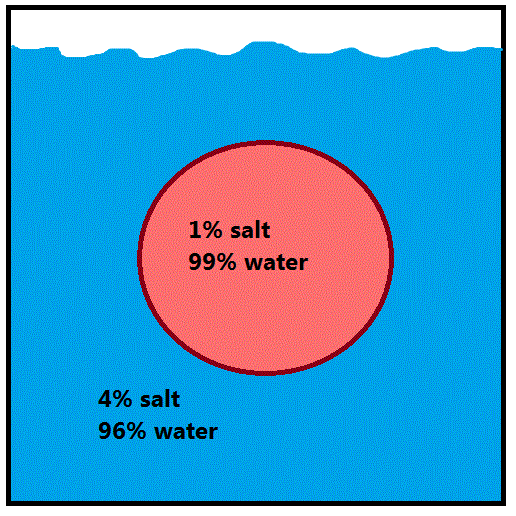
Where will the water go?

a)

Into the cell

b)

Out of the cell

c)

Equally in & out - it's isotonic

d)

There is no water

153.

A blood cell is placed into the jar, as seen. Where will the water go?

a)

Into the cell

b)

Out of the cell

c)

Equally in & out - it's isotonic

d)

The water is a lie

154.

Why can't you drink salt water?

a)

It's hypertonic to your cells

b)

It's hypotonic to your cells

c)

It's isotonic to your cells

d)

It's paratonic to your cells