
 Worksheets
Comp 1: Mid Year Science Review
Total questions: 100
Worksheet time: 2hrs 42mins
Name
Class
Date
1.
Which of the following is the smallest unit of life that can carry out all life functions?
a)
the mitochondria
b)
the vacuoles
c)
the nucleus
d)
the cell
2.
Weather patterns and water temperature affect
a)
ocean currents
b)
waves
c)
tides
d)
global warming
3.
About how much of Earth's surface is covered by water?
a)
50%
b)
30%
c)
70%
d)
40%
4.
This is soil, sand, and minerals that are washed from land into water by weathering and erosion.
a)
waves
b)
sediment
c)
trench
d)
salinity
5.
A watermelon has more matter than a grape, so it has more
a)
mass
b)
eat
c)
solid
d)
greater
6.
Gasoline is a ________________.
a)
liquid
b)
solid
c)
gas
7.
Which of the following is NOT an example of matter?
a)
Rocks
b)
Minerals
c)
Oxygen
d)
Sound
8.
Which variable do "I" change intentionally?
a)
Independent variable
b)
Dependent variable
c)
Constant
d)
s
9.

That this animal has fur is an...
a)
inference
b)
conclusion
c)
observation
d)
opinion
10.

The number of apples in this basket is ______________________ data?
a)
quantitative
b)
qualitative
c)
independent
d)
dependent
11.
A student wanted to test the effect of candy on test grades. What would be the dependent variable?
a)
candy
b)
test grades
c)
students
d)
no candy
12.
Why do we want to test one variable at a time?
a)
Because it is hard to setup a data table with more
b)
To know what is causing the changes
c)
It is what has always been done
d)
No one really knows
13.
There is a bad odor coming from the test tube.
a)
Qualitative
b)
Quantitative
c)
Both
d)
Neither
14.
A statement that uses "If"....."then" is called a -
a)
observation
b)
conclusion
c)
prediction
d)
hypothesis
15.
What would you use to measure the height of the door?
a)
Centimeters
b)
Meters
c)
Kilometers
d)
Liters
16.

What type of heat transfer does this picture represent?
a)
radiation
b)
conduction
c)
convection
d)
hot air balloons
17.
How does heat always transfer?
a)
from cold to hot
b)
from hot to cold
c)
from liquid to solid
d)
from gas to liquid
18.
What form of energy is being used when a person hits a tennis ball with a tennis racket?
a)
thermal energy
b)
sound energy
c)
light energy
d)
mechanical energy
19.

What type of energy is in this picture?
a)
Kinetic
b)
Potential
c)
Electromagnetic
20.
Energy causes ___________ to occur.
a)
change
b)
motion
c)
age
21.
Surface currents are a result of
a)
Global Wind Patterns
b)
Earth's Rotation
c)
Density
d)
All of the above
22.
The Coriolis Effect is caused by
a)
Earth rotating around the sun
b)
Earth rotating on its axis
c)
The tides
d)
Gravity
23.

Identify the type of front that is shown in the image.
a)
Occluded Front
b)
Cold Front
c)
Stationary Front
d)
Warm Front
24.
A severe storm that involves strong winds and forms over warm water is:
a)
tornado
b)
thunderstorm
c)
hurricane
d)
blizzard
25.
This weather tool measures wind speed
a)
thermometer
b)
barometer
c)
anemometer
d)
psychrometer
26.
Warm air near the Earth’s surface rises and then cools and drops, this creates a _________________ in the atmosphere.
a)
run-off
b)
Greenhouse Effect
c)
convection current
d)
water cylce
27.
What kind of weather is usually associated with a high pressure system?
a)
Sunny weather
b)
Precipitation (rain, snow, etc.)
28.
In what direction do winds always blow?
a)
From areas of high pressure to areas of low pressure
b)
From areas of low pressure to areas of high pressure
29.
What is the weather conditions in an area over a long period of time?
a)
climate
b)
temperature
c)
elevation
d)
precipitation
30.
What causes winds to form on Earth?
a)
solar energy
b)
ocean currents
c)
elevation differences
d)
uneven heating of the Earth by the sun
31.
How do consumers get their energy?
a)
laying in the sun
b)
eating other organisms
c)
providing food for other organisms
d)
surviving in an ecosystem
32.
Organisms that make up the living part of an ecosystem.
a)
abiotic
b)
biotic factors
c)
ecology
d)
ecosystems
33.
What molecule absorbs sunlight for photosynthesis?
a)
chloroplast
b)
thylakoid
c)
grana
d)
chlorophyll
34.

The main source of energy for all life comes from ____.
a)
the Earth
b)
the moon
c)
the sun
d)
the food we eat/make
35.
Which gas is removed from the atmosphere during photosynthesis?
a)
hydrogen
b)
oxygen
c)
nitrogen
d)
carbon dioxide
36.
An individual living thing is a/an __________.
a)
habitat
b)
ecosystem
c)
organism
d)
population
37.
Energy flow for an ecosystem starts with...
a)
Sun
b)
Moon
c)
Neither
38.
What is a example of a abiotic factor?
a)
Panda
b)
Turtle
c)
Butterfly
d)
weather
39.
Soil formation begins with the weathering of_______.
a)
Humas
b)
Subsoil
c)
Litter
d)
Rock
40.
What is energy?
a)
moving energy
b)
stored energy
c)
renewable energy
d)
The ability to do work.
41.
What is potential energy?
a)
moving energy
b)
stored energy
c)
renewable energy
d)
non renewable energy
42.
What is kinetic energy?
a)
moving energy
b)
potential energy
c)
stored energy
d)
renewable energy
43.
Which of these is an example of kinetic energy?
a)
a bicycle
b)
a battery
c)
a solar panel
d)
firewood
44.
GRAVITATIONAL POTENTIAL ENERGY DEPENDS ON
a)
MASS AND VELOCITY
b)
MASS AND WEIGHT
c)
WEIGHT AND HEIGHT
d)
HEIGHT AND DISTANCE
45.
WHICH OF THE FOLLOWING IS NOT AN EXAMPLE OF POTENTIAL ENERGY?
a)
A BALL TRAVELING AT 10 M/S
b)
A COMPRESSED SPRING
c)
WATER BEING STORED AT A WATER DAM
d)
A STRETCHED RUBBER BAND
46.
YOUR BODY OBTAINS ENERGY FROM THE FOOD YOU EAT. WHAT IS THE FORM OF ENERGY IN FOOD?
a)
KINETIC
b)
ELASTIC
c)
GRAVITATIONAL
d)
CHEMICAL
47.
WHEN AN ARCHER BENDS A BOW, WHAT TYPE OF ENERGY INCREASES IN THE BOW?
a)
GRAVITATIONAL
b)
ELASTIC
c)
KINETIC
d)
THERMAL
48.
WHAT ANOTHER NAME FOR THERMAL ENERGY?
a)
HEAT ENERGY
b)
ITS SIZE
c)
ITS POTENTIAL ENERGY
d)
ITS MECHANICAL ENERGY
49.
WHICH ENERGY TRANSFORMATION OCCURS WHEN A TELEVISION SPEAKER PRODUCES MUSIC?
a)
ELECTRICAL TO SOUND
b)
ELASTIC TO SOUND
c)
THERMAL TO SOUND
d)
SOUND TO ELECTRICAL
50.
WHICH OF THESE DESCRIBES THE LAW OF CONSERVATION OF ENERGY?
a)
NO MACHINE IS 100% EFFICIENT
b)
ENERGY IS NEITHER CREATED OR DESTROYED
c)
THE ENERGY RESOURCES OF EARTH ARE LIMITED
d)
THE ENERGY OF A SYSTEM IS ALWAYS DECREASING
51.
AS A ROLLER COASTER MOVES DOWN A HILL, POTENTIAL ENERGY IS CONVERTED INTO KINETIC ENERGY, THERMAL ENERGY, AND SOUND ENERGY. WHAT IS TRUE ABOUT THE TOTAL ENERGY OF THIS SYSTEM?
a)
ENERGY IS GAINED (CREATED) AS THE ROLLER COASTER MOVES
b)
ENERGY IS LOST (DESTROYED) AS THE ROLLER COASTER MOVES
c)
THE TOTAL ENERGY REMAINS THE SAME AS THE ROLLER COASTER MOVES
d)
THE TOTAL ENERGY CONSTANTLY CHANGES AS THE ROLLER COASTER MOVES
52.
WHICH OF THE FOLLOWING IS AN ENERGY CONVERSION FROM LIGHT ENERGY TO CHEMICAL ENERGY?
a)
TURNING ON A STOVE TO HEAT DINNER
b)
TURNING ON A LAMP
c)
GROWING AN APPLE TREE
d)
MAKING TOAST IN A TOASTER
53.

What kind of energy does the skateboarder represent?
a)
potential
b)
chemical
c)
nuclear
d)
kinetic
54.

What type of energy do the bowling pins have?
a)
kinetic
b)
potential
c)
nuclear
d)
chemical
55.

If the man and the ball travels 90 m in 9 seconds, what is their average speed?
a)
10 m/s
b)
99 m/s
c)
180 m/s
d)
10 meters
56.

If a lizard can run 8m across the water in 4 seconds, how fast is he travelling?
a)
32 m/s
b)
2 seconds
c)
2 m/s
d)
34 meters
57.

What will the net force on the soccer ball be?
a)
50 N to the left
b)
50 N to the right
c)
200 N to the left
d)
200 N to the right
58.

What is the net force on the car?
a)
400 N forward (left)
b)
⊘N (balanced forces)
c)
200 N forward (left)
d)
200 N backwards (right)
59.

The girls in this picture represent ________ forces.
a)
kinetic
b)
balanced
c)
unbalanced
d)
chemical
60.

Person on the left = 45 N
Person on the right = 32 N
What is the net force?
Person on the right = 32 N
What is the net force?
a)
zero N
b)
10 N
c)
77 N
d)
13 N
61.

If a dolphin can swim 100 meters in 5 seconds, what is the dolphin's speed?
a)
25 m/s
b)
20 m/s
c)
20 meters
d)
500 m/s
62.

This motion graph represents:
a)
constant speed
b)
acceleration
c)
body at rest
d)
slowing down
63.

This motion graph represents:
a)
constant speed
b)
acceleration
c)
body at rest
d)
slowing down
64.

In this distance versus time graph...
a)
The green line is "faster"
b)
The red line is "faster"
c)
The green line is slowing down
d)
The red line is speeding up
65.

Juan and Antonio competed in a 4 mi bike race. Who won?
a)
Kristen Lodge
b)
Juan
c)
Antonio
d)
Ms. Jackson
66.

How do you calculate Average Speed?
a)
speed x time
b)
distance/speed
c)
total distance/total time
d)
total speed x total time
67.
A series of steps used by scientists to solve a problem or answer a question.
a)
scientific method
b)
recipe
c)
data collection
d)
metric system
68.
Which is NOT a step in the scientific method?
a)
Make observation
b)
Form a theory
c)
Collect data
d)
Form a hypothesis
69.
Testing a hypothesis often involves a(n):
a)
answer
b)
experiment
c)
problem
d)
safety check
70.
What is a hypothesis?
a)
A hypothesis is the right answer to an experiment.
b)
A hypothesis is the wrong answer to an experiment.
c)
A hypothesis is an educated guess.
d)
I don't know.
71.
The summary at the end of an experiment that explains the results.
a)
conclusion
b)
procedures
c)
materials
d)
responding variable
72.
Dependent variable means
a)
the scientist controls what to test
b)
educated guess
c)
ask a question
d)
what is being measured
73.
Will a construction paper air plane fly faster than an airplane made from notebook paper? Choose the best hypothesis.
a)
If I make a paper airplane from notebook paper, then it will fly faster than construction paper.
b)
Yes.
c)
No.
d)
I think the construction paper air plane will fly faster.
74.
If I listen to Mr. Castro's instructions, then I will have less accidents in the lab. What is the independent variable?
a)
Yes
b)
Maybe
c)
Listening or not listening to instructions
d)
Likelihood of having an accident in lab
75.
Before beginning an experiment you must first make a ____.
a)
Hypothesis
b)
Conclusion
c)
Plan
d)
Experiment
76.
Which of these can change when new evidence is presented?
a)
theory
b)
law
77.
Which of these explain how a natural phenomenon works or happens?
a)
theory
b)
law
78.
Which of these describes a natural phenomenon or relationship that always occurs under specific conditions
a)
theory
b)
law
79.
Which of these can be represented mathematically and provide no explanation why a phenomenon occurs?
a)
theory
b)
law
80.
What is a theory?
a)
Describes what happens
b)
Explains a process
81.
What is a law?
a)
Describes what happens
b)
Explains a process
82.
A set of principles that explains and predicts a phenomena is called a _____.
a)
scientific law
b)
scientific method
c)
scientific theory
d)
scientific instructor
83.
When you are smelling a chemical, you should
a)
whiff
b)
waft
c)
take a deep breath
d)
smell it for as long as you can
84.
It is OK to start a lab before you read all the directions.
a)
True
b)
False
85.
Goggles are worn during science experiments--
a)
only if you don't have glasses
b)
to protect your eyes any time chemicals, heat or sediments are used
c)
to improve vision
d)
to avoid eye strain
86.
You have been injured in the lab (cut, burned, etc.) First you should -
a)
apply first aid yourself
b)
tell the teacher at once
c)
see a doctor after school
d)
visit the school nurse after class
87.
What should you do with chemicals leftover after an experiment?
a)
Follow the directions of the teacher
b)
Carefully pour them down the sink
c)
Throw them into the trash can
d)
Leave them on the table
88.
The most important thing during lab experiments is
a)
neatness
b)
finishing first
c)
safety
d)
getting the correct answer
89.
You picked up a dirty test tube with a sticky substance on the outside. You get some of this substance on your hand. What should you do?
a)
wash your hands and tell your teacher
b)
wipe your hands on a classmate
c)
wipe your hands on your pants
d)
try to figure out what the sticky substance is
90.
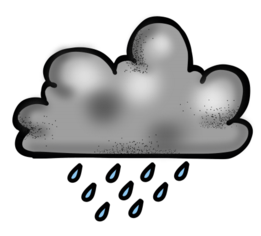
What part of the water cycle does this picture show?
a)
condensation
b)
precipitation
c)
evaporation
91.
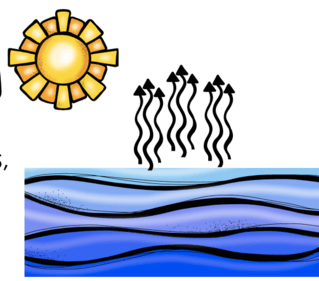
What part of the water cycle does this picture show?
a)
condensation
b)
precipitation
c)
evaporation
92.
What is evaporation?
a)
The part of the water cycle when the sun heats up water, turning it from a liquid into water vapor or steam. It rises from the ground into the air.
b)
The part of the water cycle when the water vapor in the air gets cold. The water turns back into a liquid and forms clouds.
c)
The part of the water cycle when clouds get heavy and can no longer hold the liquid water. This causes the water to fall from the sky to the earth as rain, snow, sleet, or hail.
93.
What is condensation?
a)
The part of the water cycle when the sun heats up water, turning it from a liquid into water vapor or steam. It rises from the ground into the air.
b)
The part of the water cycle when the water vapor in the air gets cold. The water turns back into a liquid and forms clouds.
c)
The part of the water cycle when clouds get heavy and can no longer hold the liquid water. This causes the water to fall from the sky to the earth as rain, snow, sleet, or hail.
94.

When water condenses, the water vapor in the air gets ___________ and changes back into liquid.
a)
cold
b)
hot
c)
warm
d)
solid
95.

Which is the opposite of condensation?
a)
runoff
b)
evaporation
c)
precipitation
d)
transpiration
96.
Which best explains why runoff is important?
a)
It returns water to other locations on Earth
b)
It increases the chance of flooding
c)
It makes evaporation occur faster
d)
It increases condensation
97.

What is it called when plants give off water vapor as a waste product?
a)
condensation
b)
evaporation
c)
sublimation
d)
transpiration
98.
When water _________, dew forms.
a)
Melts
b)
Evaporates
c)
Condenses
d)
Precipitates
99.
What is a layer of rock or sediment that holds water?
a)
glacier
b)
well
c)
aquifer
d)
natural spring
100.
How much of our planet is estimated to be covered with water?
a)
68%
b)
50%
c)
97%
d)
75%
100 %

