
 Worksheets
UNIT 5 EXAM REVIEW
Total questions: 95
Worksheet time: 2hrs 53mins

What happens during meiosis I (check ALL that apply!)
sister chromatids are separated
homologous chromosomes pairs are separated
diploid daughter cells are produced
2 genetically unique daughter cells are produced
genes are rearranged
Which of the following are sources of genetic diversity? (CHECK ALL THAT APPLY)
mutation
crossing over
independent assortment of homologous pairs
mitosis
formation of sister chromatids
Unlike mitosis, meiosis in male mammals results in the formation of
2 genetically unique haploid gamete
four genetically identical diploid gametes
four genetically unique diploid gametes
four genetically unique haploid gametes
None of these options are correct
Disorders involving unusual numbers of sex chromosomes show that "maleness" is caused by
presence of X chromosome
presence of Y chromosome
absence of X chromsome
absence of Y chromosome
Two chromosomes in the nucleus that carry loci for the same traits in the same position on chromosomes but specify different versions of some traits constitute a pair of
homologous chromosomes
heterologous chromosomes
complimentary chromosmes
polyploid chromosomes
Which of the following carry the same genetic information?
sister chromatids
X and Y chromosomes
all autosomes
all haploid cells

In a human at the end of Meiosis I which of the following is true of the resulting 2 cells.
Each daughter cell has 46 chromosomes, each composed of 2 chromatids
Each daughter cell has has at least one of the pair of homologous chromosomes from the parent cell.
Each daughter cell has 23 chromosomes, each composed of 2 chromatids
Each daughter cell has 23 chromosomes, each composed of a single chromatid
Each daughter cell has 46 chromosomes, each composed of 4 chromatids
Which of the following is a difference between mitosis and meiosis?
in mitosis 4 daughter cells are produced, whereas in meiosis two daughter cells are produced
in mitosis 2 daughter cells are produced, whereas in meiosis 4 daughter cells are produced
cells produced by mitosis are diploid, cells produced by meiosis are haploid
Which of the following is the most significant difference between mitosis and meiosis?
chromosomes are duplicated before mitosis
Meiosis is not followed by cytokinesis
homologous pairs of chromosomes are split up in meiosis
crossing over occurs in mitosis
Which of the following aspects of reproduction enhances genetic diversity?
random fertilization
independant assortment of chromosmes
mitosis

Which process is shown in the image?
crossing over
independent assortment
segregation
mutation
Which may result because of the failure of homologous chromosomes to separate during meiosis?
cancer
a new species
Down Syndrome
extra finger and toes
How could a male inherit the chromosomes XXY?
Mitosis occurred two times in a single sperm cell.
An egg was fertilized by two different sperm cells.
Sex chromosomes failed to separate during meiosis.
Autosomal chromosomes crossed over during meiosis.
Which best explains why two nuclear divisions are required in meiosis, and only one nuclear division is required in mitosis?
Meiosis produces cells identical to the parent cell, while mitosis
produces cells that are genetically unique.
Meiosis must maintain the chromosome number in body cells, while
mitosis reduces the chromosome number in gametes.
Meiosis occurs at a much faster rate since it requires two divisions,
while mitosis takes much longer to divide into two cells.
Meiosis reduces the chromosome number in gametes, while mitosis
maintains the chromosome number to create identical body cells.

Which of the following descriptions describes Meiosis?
A, B, C, E, G
E, G, C, B
B, D, E, G
A, C, F, H
What is the Mendel’s Magic Ratio for this dihybrid? ____: ____: ____: ____
1-3-6-16
9-3-3-1
1-2-3-4
A-B-C-D
6- 3- 3- 1


Crossing over occurs at a point called the:
Synapse
Centromere
Chiasmata
Telomere

In the figure above, the image is best described as:
independent assortment
sister chromatids
tetrads
crossing over

In the Figure above, the cell is in prophase I or meiosis. In this stage, homologous chromosomes form ___ and exchange genetic material by ___.
tetrads; crossing over
triads; crossing over
tetrads; independent assortment
triads; independent assortment
Which if the following would occur first
Synapsis
completion of crossing over
DNA/ chromosome condensation
Separation of homologs
DNA Replication
Which if the following would occur next after Replication?
Synapsis
completion of crossing over
DNA/ chromosome condensation
Separation of homologs
DNA Replication
Homologous chromosomes separate before crossing over in prophase I
True
False

(E= 3 eyes, e= 1 eye)

(RRYY x rryy)
R = round seeds, r = wrinkled seeds Y = yellow seeds, y = green seeds
What percent will have Round and Yellow seeds?


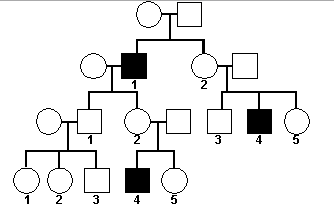
(hint: check your notes - "modes of inheritance")

If this pedigree shows a recessive disorder, what MUST the genotype of individual 4 be?
HH
Hh
hh
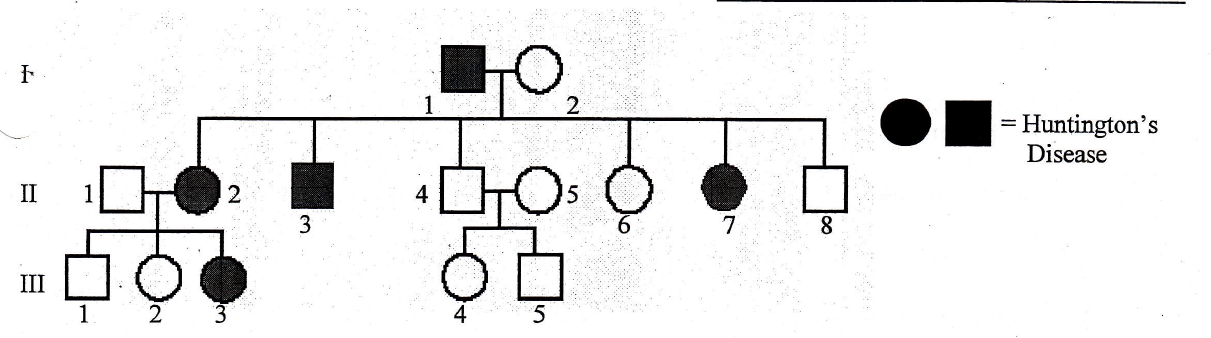


Organism inherit 2 copies of each gene, one from each parent, AND
The height of an adult horse is a polygenic trait. This means that the trait is
controlled only by the form of the gene inherited from the mother.
controlled by more than one gene.
completely controlled by a single gene.
controlled only by the form of the gene inherited from the father.
What are three laws of Probability?
The Rule of Dominance
The Rule of Multiplication
The Rule of Independent Events:
The Law of Segregation
The Rule of Addition:
What are the 3 laws of 3 inheritances?
The law of Multiplication
The law of Independent Events
The Law of Segregation
The Law of Independent Assortment
The Law of Dominance


Which of the following contributes to genetic variation in sexually reproducing species?
crossing over, internal fertilization, independent assortment
independent assortment, spindle formation, random fertilization
random fertilization, DNA synthesis, independent assortment
random fertilization, independent assortment, crossing over
internal fertilization, spindle formation, crossing over
The major contribution of sex to evolution is that __________.
it is the only mechanism for species to reproduce.
it provides a method to increase genetic variation.
it provides a way in which somatic mutations can be inherited.
it provides a method to increase genetic variation and it provides a way in which somatic mutation can be inherited.
it is the only mechanism for species to reproduce and it provides a method to increase genetic variation.


In the following diagram, which pair represents homologous chromosomes?
1 and 2
3 and 4
2 and 5
4 and 6
What are homologous chromosomes?
Identical chromosomes
Non-identical chromosomes with different genes
Non-identical chromosomes with the same genes in the same sequence but not necessarily the same alleles
Non-identical chromosomes with the same genes in a different sequence and not necessarily the same alleles

The diagram below shows a pair of chromosomes immediately after pairing in prophase I of meiosis in a cell.
What combinations of alleles are possible in haploid cells produced by meiosis in this cell?
A
B
C
D
Human ___ are diploid, and human ___ are haploid.
sex chromosomes...autosomes
autosomes...sex chromosomes
somatic cells...gametes
gametes...somatic cells


You get half of your genes from your mother and half from your father
The King Crab has 208 chromosomes in its somatic cells. The HAPLOID number for the King Crab is:
208
416
104
I. An X chromosome
II. A Y chromosome
III. Mitochondrial DNA
centromere

Hemophilia is a sex-linked trait. Which of the following would show a cross between a carrier female and a man with hemophilia?
XHXh x XhXh
XHXH x XhY
XHXh x XHY
XHXh x XhY

What is this an example of?
codominance
incomplete dominance
phenotype
dominance
mitosis vs meiosis
mitosis produces two identical somatic cells; meiosis produces four unique haploid cells
mitosis produces four identical somatic cells; meiosis produces two unique haploid cells
mitosis produces two different somatic cells; meiosis produces four identical cells
mitosis produces two different gamete cells; meiosis produces two identical somatic cells

