Wayground logo

Free Printable Worksheets

Font size

S
M
L
XL
Worksheets

Biology 9 SE Revision 2

Total questions: 120

Worksheet time: 3600secs

Name
Class
Date
1.

Which two arrows make up the stamen?

a)

Orange and pink

b)

Green and blue

c)

Red and yellow

d)

Yellow and green

2.

What is the blue arrow pointing to?

a)

Stigma

b)

Style

c)

Ovary

d)

Carpal

3.

What is pollination?

a)

When a pollen grain lands on a stigma

b)

When a pollen grain fuses with an ovule

c)

When a seed is formed

d)

When a seed grows into a plant

4.

What happens after pollination?

a)

The ovule is fertilised

b)

A seed develops

c)

The ovary swells up

d)

A pollen tube grows

5.

Which of these is not a fruit?

a)

Tomato

b)

Eggplant

c)

Carrot

d)

Zucchini

6.

Which of these is not a tuber?

a)

Turnip

b)

Broccoli

c)

Sweet potato

d)

Taro

7.

We have all seen bees fly around flowers. When a bee drinks nectar from one flower they sometimes brush up against the stamen. When they go to another flower, they can drop some pollen on the pistil. What process are the bees helping with?

a)

pollination

b)

germination

c)

fertilization

d)

seed dispersal

8.

In which part of the flower does fertilization take place? Be specific.

a)

the stamen

b)

the pistil

c)

the ovary

d)

the petals

9.

The primary function of these parts of the flower is

a)

reproduction

b)

photosynthesis

c)

germination

d)

metamorphosis

10.

The petals job is not only to protect the reproductive parts of the plant, but also to

a)

keep wind away from the stamen

b)

attract pollinators with their colors

c)

absorb sunlight

d)

fall off and become food for bugs

11.

We studied the life cycle of an orange tree. What is most likely the way fruit seeds like the ones found in oranges are dispersed?

a)

blow in the wind

b)

float in the water

c)

stick to animal fur

d)

eaten by animals and then released

12.

Which of the following best describes germination?

a)

pollen being carried from the stamen of one flower to the pistil of another

b)

seeds being carried from one place to another

c)

a sperm cell joining with an egg cell to form a seed

d)

a seed sprouting roots and leaves as it begins to grow

13.

Which of the following lists the processes in the order they need to occur, even though there is no start and no end.

a)

pollination, fertilization, seed dispersal, germination

b)

fertilization, pollination, seed dispersal, germination

c)

germination, fertilization, pollination, seed dispersal

d)

germination, seed dispersal, pollination, fertilization

14.

The ___________ of one flower receives pollen grains from another flower.

a)

anther

b)

ovary

c)

style

d)

stigma

15.

The _______________ produces pollen grains.

a)

ovary

b)

anther

c)

stigma

16.

The plant male sex cell is also called the _______________.

a)

anther

b)

pollen grain

c)

ovary

d)

ovule

17.

Pollination is the process of transferring pollen from the anther of one flower to the ______________ of another flower.

a)

filament

b)

style

c)

stigma

d)

ovary

e)

ovule

18.

After fertilization, each _______forms a seed, while each _________forms a fruit.

a)

ovary ... ovule

b)

ovule ... ovary

c)

egg ... ovary

d)

pollen ... ovary

e)

ovary ... pollen

19.

Fruit X is fleshy and bright-red in colour. The likely dispersal method for its seeds is by ____________.

a)

animal

b)

wind

c)

water

d)

splitting

20.
What is the process called when an egg and sperm fuse?
a)
Fertilisation
b)
Zygote
c)
Embryo
d)
Mating
21.
Where in the female body do the egg and sperm fuse?
a)
Cervix
b)
Uterus
c)
Ovary
d)
Fallopian tube
22.
What is implantation?
a)
Zygote adheres to the uterus lining
b)
Early embryo adheres to the uterus lining
c)
Foetus adheres to the uterus lining
d)
Zygote feeds off the uterus lining
23.
What happens to the egg if no pregnancy occurs?
a)
It is re-used
b)
Is comes out with the next period
c)
It disintegrates
d)
It is reabsorbed by the ovary
24.
What happens if an early embryo splits just before implantation?
a)
Non-identical twins
b)
Identical twins
c)
This cannot occur and would harm the embryo
d)
Semi-identical twins
25.
What could happen if a woman releases two eggs at once?
a)
Non-identical twins
b)
Identical twins
c)
This cannot occur naturally
d)
Semi-identical twins
26.
The placenta is made of cells that are genetically the same as whom?
a)
Mother
b)
Father
c)
Mixture of both parents
d)
Developing foetus
27.
a)
A
b)
B
c)
C
d)
D
28.

What is an allele?

a)

an organisms genome

b)

different versions of the same gene

c)

same versions of different genes

d)

different chromosomes

29.

What was the first cloned mammal?

a)

goat

b)

cat

c)

sheep

d)

cow

30.

What do you call the cell that forms from fertilization?

a)

fertilized egg

b)

sperm cell

c)

zygote

d)

egg cell

31.

What do you call the type of reproduction in which the genetic materials from two different cells combine, producing an offspring?

a)

pollination

b)

sexual reproduction

c)

fertilization

d)

asexual reproduction

32.

What do you call the female sex cell?

a)

egg cell

b)

sperm cell

c)

diploid

d)

haploid

33.

What do you call the cells that have pairs of chromosomes?

a)

Diploid

b)

Haploid

c)

Sperm cell

d)

egg cell

34.

In this cell division, one diploid cell divides and makes four haploid sex cells. What do you call this special kind of cell division?

a)

mitosis

b)

meiosis

c)

fertilization

d)

pollination

35.

Which of the following is an advantage of sexual reproduction?

a)

Genetic variation

b)

Down syndrome

c)

Mutation

d)

New trait formed

36.

What type of reproduction takes place when one parent organism produces offspring without meiosis and fertilization?

a)

pollination

b)

sexual reproduction

c)

asexual reproduction

d)

fertilization

37.

What do you call the type of asexual reproduction wherein a new organism grows by mitosis and cell division on the body of its parent?

a)

fission

b)

regeneration

c)

budding

d)

cloning

38.

Cell division in prokaryotes that forms two genetically identical cells is known as ______

a)

fission

b)

bud

c)

regeneration

d)

cloning

39.

What type of asexual reproduction wherein it occurs when an offspring grows from a piece of its parent?

a)

budding

b)

fission

c)

regeneration

d)

vegetative reproduction

40.

What do you call the form of asexual reproduction in which offspring grow from a part of a parent plant?

a)

fission

b)

budding

c)

regeneration

d)

vegetative reproduction

41.

What do you call the type of asexual reproduction performed in a laboratory that produces identical individuals from a cell or from a cluster of cells taken from a multi cellular organism?

a)

budding

b)

fission

c)

cloning

d)

regeneration

42.

Which of the following is a disadvantage of asexual reproduction?

a)

All organisms have genetic variation

b)

Parents produces identical off spring which is not suitable for survival in a changing environment

c)

Finding a mate is not needed

d)

It can produce a lot of offspring

43.

Which is an example of asexual reproduction by regeneration?

a)

cloning sheep

b)

lizard regrowing a tail

c)

sea star arm producing a new organism

d)

strawberry plant producing stolons

44.
The diagram shows the female reproductive system. The part labelled B is called  
a)
sperm 
b)
the egg  
c)
the womb  
d)
the ovary 
45.
In the diagram representing the menstrual cycle shown, when does ovulation take place?
a)
between day 6 and 11
b)
between day 17 and 20
c)
between day 1 and 5
d)
between day 12 and 16
46.
The diagram shows the female reproductive system. The part labelled A is called
a)
 the egg
b)
the womb
c)
the ovary
d)
sperm
47.
During intercourse the penis is placed in the vagina. Which one of the following statements is not correct?
a)
The sperm travel towards the egg.
b)
The man releases millions of sperm during intercourse.
c)
The tail of the sperm enters the egg first.
d)
Sperm is released into the vagina.
48.
This usually occurs between days 6 and 12 of the menstrual cycle.
a)
Shedding of the lining of the uterus
b)
An egg is released from the ovaries
c)
The lining of the uterus remains in place in preparation for the possible arrival of an early embryo.
d)
 The lining of the uterus builds up
49.
Where in the female reproductive system will you find thousands of eggs?
a)
Uterus
b)
Ovaries
c)
Fallopian tube
d)
Vagina
50.
The period during which a girl sexually matures is called
a)
menstrual cycle
b)
puberty
c)
childhood
d)
teens
51.
The time in a woman’s life when menstruation usually no longer occurs
a)
Late 50s
b)
Mid 40s 
c)
Early 20s 
d)
Teens
52.
The term "uterus" is another name for ?
a)
the womb
b)
ovary 
c)
placenta 
d)
vagina
53.
After fertilisation the zygote increases in size and travels down the Fallopian tube to become embedded in the walls of the womb. This process is known as
a)
implantation
b)
ovulation
c)
menstruation
d)
conception
54.
When puberty takes place in girls, which one of the following does not happen?
a)
 Womb grows bigger
b)
Shoulders broaden
c)
 Eggs start producing
d)
Breasts enlarge
55.
Another name for the neck of the uterus
a)
The womb
b)
The vagina
c)
The womb
d)
The cervix
56.
This carries the egg to the uterus. 
a)
Fallopian tube
b)
Vagina
c)
cervix
d)
 Ovary
57.
This occurs on days 1 to 5 of the menstrual cycle.
a)
The lining of the uterus remains in place in preparation for the possible arrival of an early embryo.
b)
Shedding of the lining of the uterus
c)
An egg is released from the ovaries
d)
The lining of the uterus builds up
58.

Which statement describes why genetic variation is beneficial to populations of organisms?

a)

individuals look different from one another

b)

only one parent is needed to produce offspring

c)

populations of the organism increase more rapidly

d)

species can better survive environmental changes

59.
What is an advantage of sexual reproduction?
a)
Allows genetic variation
b)
Only needs one parent
c)
Happens very quickly
d)
Offspring are exact copies of parent
60.
What number of chromosomes are handed down by a egg cell?
a)
46
b)
12
c)
23
d)
96
61.
Which of the following cell types is formed by meiosis?
a)
muscle cells
b)
skin cells
c)
sperm cells
d)
blood cells
62.
A male shark has 40 chromosomes in each of its sex cells. How many would be present in its BODY cells?
a)
20
b)
40
c)
80
d)
160
63.
How many cells are produced at the END of meiosis?
a)
1
b)
2
c)
3
d)
4
64.
Which cellular process is shown?
a)
meiosis
b)
endocytosis
c)
mitosis
d)
phagocytosis
65.
Meiosis makes sperm and egg cells. In humans, sperm and egg cells each have _____ chromosomes. Therefore a fertilized human egg cell (sperm and egg cell combined) would create a cell with _____ chromosomes.
a)
23, 46
b)
46, 23
c)
2, 4
d)
50, 100
66.
What type of cells only contain 23 Chromosomes? 
a)
Bone cells
b)
Skin cells
c)
Sex cells 
d)
Liver cells 
67.
When comparing the offspring of sexually and asexually reproducing organisms, we would expect the genetic material (DNA) of the sexually reproducing organism to -
a)
contain fewer mutations
b)
be lesser in quantity
c)
be simpler overall
d)
show more variation
68.

In sexual reproduction each parent contributes a __________ gamete (a sex cell)

a)

Diploid

b)

Hiploid

c)

Ovum

d)

Haploid

69.

What phase of mitosis does the following describe:


Chromosomes pack together. Nucleus begins to break down.

a)

Metaphase

b)

Anaphase

c)

Telophase

d)

Prophase

70.

What phase of mitosis does the following describe:


Chromosomes line up in the middle

a)

Metaphase

b)

Anaphase

c)

Telophase

d)

Prophase

71.

What phase of mitosis does the following describe:


Chromosomes are pulled apart

a)

Metaphase

b)

Anaphase

c)

Telophase

d)

Prophase

72.

What phase of mitosis does the following describe:


Cells split in two with two separate nuclei

a)

Metaphase

b)

Anaphase

c)

Telophase

d)

Prophase

73.
If two organisms reproduce sexually, then their offspring will exhibit a genetic makeup that is -
a)
identical to only one parent
b)
identical to all of its siblings
c)
a unique combination of traits
d)
the recessive traits of each parent
74.
What type of cells undergo mitosis?
a)
Sex Cells
b)
Gametes
c)
Egg cells
d)
Somatic Cells
75.
Mitosis results in . . .
a)
4 identical haploid daughter cells
b)
2 identical diploid daughter cells
c)
4 different haploid daughter cells
d)
2 different diploid daughter cells
76.
If green is dominant over purple, then what is the genotype for this individual?
a)
Purple
b)
Green
c)
GG
d)
gg
77.
What is the phenotype of the heterozygous parent in the punnett square?
a)
green
b)
yellow
c)
hybrid
d)
purebred
78.
Snapdragon flowers come in red, pink and white.  What type of inheritance is this?
a)
Complete Dominance
b)
Incomplete Dominance
c)
Codominance
d)
Polygenic Inheritance
79.
A couple has two children, both of whom are boys.  What is the change that the parent's next child will be a boy?
a)
0%
b)
25%
c)
50%
d)
75%
80.
Which is the correct phenotype for this organism?
a)
BB
b)
blue
c)
green
d)
bb
81.
What are small stretches of DNA that code for traits
a)
Nucleus
b)
Chromosomes
c)
Gene
d)
Centromeres
82.
Where is all the genetic information in a cell?
a)
Nucleus
b)
Nucleotides
c)
Chromosomes
d)
Cytoplasm
83.
What does DNA stand for?
a)
Deoxyribonucleic Acid
b)
Deoxyribose Enzymes
c)
Deoxyribose Messenger 
d)
Retro deoxyribose Acis
84.

What are the four bases of DNA?

a)

ATGC

b)

ATDC

c)

GCAS

d)

DNAB

85.
Who was the father of genetics 
a)
Sagan 
b)
Issac Newton 
c)
Gregor Mendel 
d)
C.jenkins 
86.

What is the function of the X and Y chromosomes?

a)

Eye colour

b)

Hair colour

c)

Height

d)

Sex

87.
Which of the following genotypes belongs in the red box in the Punnett square?
a)
XBXb
b)
XbXb
c)
XbY
d)
XBY
88.

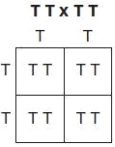
In pea plants, tall plant height (T) is dominant and short plant height (t) is recessive. Based on the Punnett squares, what are the chances that the offspring will be short?

a)

0 in 4 OR 0%

b)

1 in 4 OR 25%

c)

2 in 4 OR 50%

d)

3 in 4 OR 75%

e)

4 in 4 OR 100%

89.
This type of inheritance pattern is a MIXTURE of both traits.
a)
incomplete dominance
b)
co-dominance
c)
complete dominance
90.
This is an example of ___________?
a)
Incomplete dominance
b)
Co-Dominance
91.
This is an example of ___________.
a)
Incomplete Dominance
b)
Codominance
92.
What is the definition of Homozygous?
a)
When one allele is dominant and one is recessive
b)
When an individual has two sets of the same allele.
c)
when it is neither dominant or recessive
93.
The genotype is the ______________.
a)
physical appearance
b)
Genetic makeup
c)
Alleles gained from one parent
94.
The phenotype is the _______________.
a)
physical appearance of an organism
b)
Genetic makeup 
c)
Alleles acquired from a specific parent.
95.
The passing of characters from parents to offspring is called?
a)
Monohybrid cross
b)
Heredity
c)
True breeding
d)
Genetics
96.
An allele whose trait only shows up when no dominant allele is present.
a)
hidden allele
b)
dominant allele
c)
recessive allele
d)
present allele
97.
How much of your DNA do you inherit from your mom?
a)
10%
b)
25%
c)
50%
d)
it varies
98.
Which of the following genotypes is heterozygous?
a)
Bb
b)
BB
c)
bb
d)
B
99.
Two brown eyed parents (Bb) have a baby. What is the chance the baby is blue eyed?
a)
0 %
b)
25%
c)
50%
d)
75%
100.
Which of the following alleles is homozygous recessive?
a)
Tt
b)
tt
c)
TT
d)
T
101.
Having two different genes for a trait (sometimes called hybrid).
a)
protein
b)
homozygous
c)
heterozygous
d)
genotype
102.
What is the genotype of a person with type A blood, who had a father with type O blood?
a)
AB
b)
AO
c)
AA
d)
OO
103.
What is the phenotype of a person with the genotype AO?
a)
type A
b)
type O
c)
AA
d)
OO
104.
What pattern of inheritance is shown in this image?
a)
Codominance
b)
Incomplete dominance
c)
Polygenic traits
105.
What pattern of inheritance is shown in this image?
a)
Codominance
b)
Incomplete dominance
c)
Polygenic traits
106.

Sperms can have

a)

Only X chromosome

b)

Only Y chromosome

c)

Either X or Y chromosome

d)

Either XX or XY chromosomes

107.

Ova (eggs) can have

a)

Only X chromosome

b)

Only Y chromosome

c)

Either X or Y chromosome

d)

Only XX chromosomes

108.

What is the percentage of a woman having a male child?

a)

25%

b)

50%

c)

75%

d)

100%

109.

A brown eyed man of genotype Bb marries a blue eyed woman. What is the chance that their third child is brown eyed?

a)

25%

b)

50%

c)

75%

d)

100%

110.
An allele whose trait only shows up when no dominant allele is present.
a)
hidden allele
b)
dominant allele
c)
recessive allele
d)
present allele
111.

In guinea pigs, the allele for short hair (H) is dominant and the allele for long hair (h) is recessive. When a dominant homozygous male and a heterozygous female are bred together, what is the predicted phenotypic ratio for the offspring?

a)

1:1 short hair to long hair

b)

All have short hair

c)

1:3 short hair to long hair

d)

1:3 long hair to short hair

112.

......................... inherit one X and one Y chromosome.

a)

Males

b)

Female

113.
What type of RNA carries the DNA message out of the nucleus to the ribosomes?
a)
mRNA
b)
tRNA
c)
rRNA
114.
Amino acids are the building blocks of...
a)
atoms
b)
DNA
c)
proteins
d)
a loving relationship
115.
when DNA is transcribed to RNA.... 
a)
A pairs with U
b)
G pairs with U
c)
C pairs with T
d)
A pairs with C
116.
Which amino acid pairs with the codon CAU
a)
Ala
b)
His
c)
Ser
d)
Thr
117.
Which amino acid pairs with the codon CUG
a)
Met
b)
STOP
c)
Leu
d)
Cys
118.
All compounds that end in ASE are..
a)
Sugars
b)
Enzymes
c)
DNA
d)
Fats
119.

T: White fur

t: Black fur

Maternal genotype: Tt

Paternal genotype: tt

What is the probability that the offspring will have white fur?

a)

1/4 (25%)

b)

1/2 (50%)

c)

3/4 (75%)

d)

You can not identify the probability with this information

120.

T: Blue eyes

t: Green eyes

Maternal genotype: Tt

Paternal genotype: Tt

What is the probability that the offspring will have blue eyes?

a)

1/4 (25%)

b)

1/2 (50%)

c)

3/4 (75%)

d)

You can not identify the probability with this information