wayground logo

Free Printable Worksheets

Font size

S
M
L
XL
Worksheets

Chemistry Unit 1

Total questions: 130

Worksheet time: 4hrs 31mins

Name
Class
Date
1.
What is the name of this element?
a)
Helium
b)
Hydrogen
c)
Argon
d)
Silver
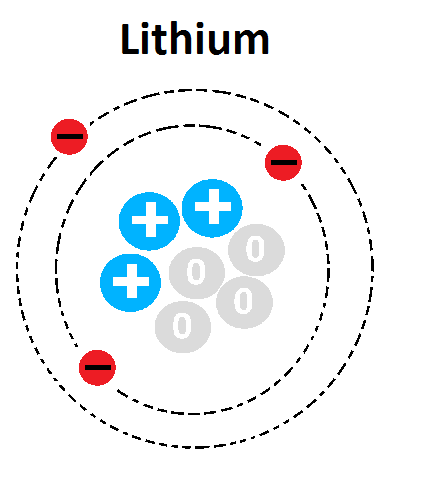
2.
What is the name of this element?
a)
Lithium
b)
Boron
c)
Carbon
d)
Neon
3.
What is the mass number of this atom?
a)
1
b)
3
c)
4
d)
7
4.
What is the atomic number of this atom?
a)
2
b)
4
c)
6
d)
none of the above
5.
What group does this element belong to?
a)
Group 1: Alkali metals
b)
Group 18: Noble Gases
c)
Group 2: Alkaline-Earth Metals
d)
Group 17: Halogens
6.
How many valence electrons?
a)
2
b)
3
c)
5
d)
10
7.
What's a valence electron?
a)
electrons in the second energy level
b)
electrons in the outermost energy level
c)
the atomic number
d)
electrons in the first level
8.

On the periodic table, Groups are

a)

Horizontal rows

b)

Vertical columns

9.

On the periodic table, Periods are

a)

Horizontal rows

b)

Vertical columns

10.

The innermost energy level has a maximum of how many electrons?

a)

1

b)

2

c)

6

d)

8

11.

What is this element?

a)

Beryllium (atomic #4)

b)

Boron (atomic #5)

c)

Carbon (atomic #6)

d)

Nitrogen (atomic #7)

12.

How many valence electrons?

a)

2

b)

3

c)

4

d)

5

13.

What group does this element belong to?

a)

1

b)

2

c)

17

d)

18

14.

How many valence electrons?

a)

2

b)

4

c)

6

d)

8

15.

Which Bohr model represents Neon?

a)
b)
c)
d)
16.
Isotopes are elements with a different amount of
a)
protons
b)
neutrons
c)
electrons
d)
atoms
17.
an element will always have the same number of 
a)
neutrons
b)
protons
c)
isotopes
d)
atoms
18.
How are electrons arranged in an atom?
a)
In groups of five
b)
In energy levels
c)
By color
d)
By shape
19.
How many electrons are in the outer (valence) shell of Chlorine (Cl)?
a)
1
b)
3
c)
6
d)
7
20.
What is the name of the group that never reacts--ever ever they are stable with a full outermost ring!!!
a)
noble gases
b)
transition
c)
halogens
d)
borons
21.
What is the name of the group that has the MOST reactive METALS in it?
a)
Alkaline earth
b)
Alkali
c)
transition
d)
actinides
22.
The period for Bromine is ___________.
a)
3
b)
2
c)
4
23.
Which group of the periodic table is composed of inert (not reactive)  gases?
a)
alkali metals
b)
alkaline earth metals
c)
halogens
d)
noble gases
24.
Which element in period four is a metalloid?
a)
Silicon
b)
Gallium
c)
Arsenic
d)
Titanium
25.
Which types of elements have intermediate properties of metals and nonmetals?
a)
metals
b)
nonmetals
c)
metalloids
d)
gases
26.
What's a valence electron?
a)
electrons in the second energy level
b)
electrons in the outermost energy level
c)
the atomic number
d)
electrons in the first level
27.
How many Valance electrons does Iodine Have?
a)
6
b)
16
c)
7
d)
17
28.
How many electrons should Flourine have around its Lewis dot model?
a)
5
b)
6
c)
7
d)
8
29.
How many electrons should Carbon have around its Lewis dot model?
a)
1
b)
3
c)
4
d)
5
30.
?
a)
Helium
b)
Hydrogen
c)
Argon
d)
Silver
31.
What is this element? 
1s22s22p63s23p6
4s23d104p6
a)
Argon
b)
Krypton
c)
Selenium
d)
Bromide
32.

Each element produces its own pattern of emission spectra lines because each element has its own distinct

a)

Speed of light

b)

Electron configuration

c)

Number of neutrons

d)

None of these

33.

The color of emitted light with the LONGEST wavelength is

a)

violet

b)

green

c)

red

d)

indigo

34.

The color of emitted light with the SHORTEST wavelength is

a)

violet

b)

green

c)

red

d)

indigo

35.
Emission of light from an atom occurs when an electron
a)
drops from a higher to a lower energy level.
b)
   jumps from a lower to a higher energy level.   
c)
   moves within its atomic orbital.
d)
falls into the nucleus.
36.
Which drawing represents the process by which an absorption line is formed?
a)
A
b)
B
c)
C
d)
D
37.
For an electron to change from ground state to an excited stated it must...
a)
Absorb energy
b)
Release energy
38.
The ground state is the highest energy state of an atom.
a)
True
b)
False
39.
When talking about energy levels in an atom, what is an "excited state"?
a)
The highest energy state of an atom.
b)
Any level higher than the ground state.
c)
The lowest energy state of an atom.
d)
When an atom loses an electron
40.
Why are line emission spectra of elements called "atomic fingerprints"?
a)
They are all the same
b)
They are all unique
c)
They are all similar
d)
They all contain colored light
41.

A line spectrum is produced when an electron moves from one energy level

a)

into the nucleus

b)

to a higher energy level

c)

to another position in the same sublevel

d)

to a lower energy level

42.

If an electron moves from n=4 to n=2 it ____

a)

absorbs energy

b)

releases energy

43.

If the frequency of electromagnetic radiation is high, then the wavelength will be (a)  

44.

The lowest energy configurations for electrons in an atom is called the

a)

neutral state

b)

home state

c)

ground state

d)

base state

45.

When a photon is absorbed by an electron and the electron changes energy level, the electron is described as being (a)  

46.
Which of the following will have a larger radius than Zinc?
a)
Gallium
b)
Aluminum
c)
Magnesium
d)
Strontium
47.
Which of the following will have a higher electronegativity than arsenic (As)?
a)
Carbon (C)
b)
Neon (Ne)
c)
Antimony (Sb)
d)
Germanium (Ge)
48.
Which of the following will have a lower ionization energy than Scandium (Sc)?
a)
Helium (He)
b)
Titanium (Ti)
c)
Calcium (Ca)
d)
Magnesium (Mg)
49.
As atoms of elements in group 16 are considered in order from top to bottom, the electronegativity of each successive element....
a)
decreases
b)
increases
c)
remains the same
d)
none of the above
50.
Which atom has the largest atomic radius?
a)
potassium
b)
rubidium 
c)
francium
d)
cesium
51.
As you move down the periodic table atoms get bigger.  This is because ____________.
a)
The atoms have more mass.
b)
The atoms have more protons.
c)
The atoms have more energy levels
d)
The atoms have more nuetrons
52.
As you move across the periodic table atoms tend to get smaller because, ______________.
a)
the atoms have more mass.
b)
the atoms have less mass
c)
the atoms have more protons.
d)
the atoms have less electrons.
53.
Atoms that have a high electronegativity, _______________.
a)
give up their electrons more easily.
b)
hold on to their electrons more tightly.
c)
have more electron shells.
54.
Electronegativity is...
a)
how good an atom is at attracting electrons
b)
the ability of an atom to lose electrons
c)
the energy required to remove an electron from a specific atom
d)
how easy it is to make friends. 
55.
Ionization energy is...
a)
the energy required to add an electron to a specific atom
b)
how much energy it takes to remove an electron from an atom
c)
the energy required to shield the outer electrons from the nucleus
d)
a measure of the ability of an atom to attract electrons
56.
The atom with the largest atomic radius in Group 18 is - 
a)
Ar
b)
He
c)
Kr
d)
Rn
57.
Which statement correctly and completely identifies a trend?
a)
Atomic radius decreases across a period and increases down a group.
b)
Electronegativity decreases across a period and decreases down a group.
c)
Ionization energy increases across a period and increases down a group.
d)
Ionic radius increases across a period and increases down a group.
58.
The element with the largest electronegativity in the halogens is - 
a)
At
b)
F
c)
Cl
d)
Br
59.

The element with the lowest electronegativity in Period 3 is -

a)

Na

b)

Cl

c)

Ar

d)

Mg

60.
Which periodic group has the smallest atomic radius?
a)
Alkali metals
b)
Halogens
c)
Noble Gases
d)
Transition metals
61.
Atomic radius generally increases as we move __________.  
a)
down a group and from right to left across a period 
b)
up a group and from left to right across a period 
c)
down a group and from left to right across a period 
d)
up a group and from right to left across a period 
62.
Electronegativity __________ from left to right within a period and __________ from top to bottom within a group.
a)
decreases, increases 
b)
increases, increases
c)
increases, decreases 
d)
stays the same, increases
63.
Which of the following will have a lower ionization energy than Scandium (Sc)?
a)
Helium (He)
b)
Titanium (Ti)
c)
Calcium (Ca)
d)
Magnesium (Mg)
64.
Which of the following will have a higher electronegativity than arsenic (As)?
a)
Carbon (C)
b)
Neon (Ne)
c)
Antimony (Sb)
d)
Germanium (Ge)
65.
What term is used to describe "The energy required to remove an electron from gaseous atoms"
a)
excitation energy
b)
ionization energy
c)
polarization energy
d)
electrolytic energy 
66.
What term is used to describe "an atom's tendency to attract electrons to itself when is is chemically combined with another element"
a)
electronation
b)
electron affinity
c)
electronegativity
d)
electrolysis
67.

The nucleus of an atom contains which subatomic particles?

a)

protons and electrons

b)

protons and neutrons

c)

electrons and neutrons

d)

protons, electrons, and neutrons

68.

Typically in an atom, which two subatomic particles are equal in number?

a)

protons and neutrons

b)

all subatomic particles are equal in number

c)

neutrons and electrons

d)

protons and electrons

69.

Which subatomic particle is counted to determine the type of element the atom represents?

a)

proton

b)

neutron

c)

electron

d)

boron

70.
Particles in an atom that are neutral and have no charge are 
a)
negatrons 
b)
electrons 
c)
neutrons 
d)
protons 
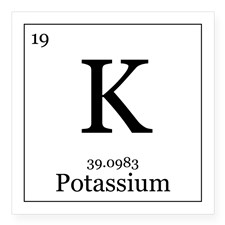
71.

How many neutron are in the atom "K"?

a)

29

b)

19

c)

58

d)

20

72.
The atomic number is equal to _.
a)
the number of protons and electrons
b)
the number of neutrons only
c)
the total number of protons and neutrons
d)
the number of protons neutrons and electrons
73.
Adding or subtracting neutrons (charge = 0, mass = 1) makes the element change into an...
a)
ion
b)
mixture
c)
isotope
d)
neutral atom
74.
The atomic mass is equal to _.
a)
the number of protons only
b)
the number of neutrons only
c)
the total number of protons and neutrons
d)
the number of protons, neutrons, and electrons.
75.
An atom becomes _________ when it gains electrons.
a)
Positive
b)
Negative
c)
Neutral
d)
Invinsible
76.
An atom that has gained or lost electrons is called ...
a)
a winner
b)
an isotope
c)
an ion
d)
a loser
77.

When an atom loses an electron, it becomes a

a)

positive ion

b)

negative ion

c)

neutral ion

d)

neutral atom

78.
Alpha particles.....
a)
a) are positively charged.
b)
b) consist of two protons and four neutrons.
c)
c) can penetrate any thickness of matter
d)
d) All of the above 
79.
The process of nuclear change in an atom of radioactive material is called... 
a)
nuclear decay
b)
nuclear mass
c)
isotopes
d)
radon
80.
During beta decay, a nucleus .... 
a)
gives up two protons and two neutrons.
b)
  maintains the same number of protons and neutrons.
c)
  loses a proton and gains a neutron.
d)
gains a proton and loses a neutron. 
81.
Radioactive materials have unstable...
a)
electrons
b)
protons
c)
nuclei
d)
neutrons
82.
The type of radioactive particle that can be stopped by a sheet of paper is the ____.
a)
alpha particle
b)
beta particle
c)
gamma ray
d)
uranium
83.
The most penetrating type of radiation is the ____.  
a)
alpha particle
b)
gamma ray
c)
beta particle
d)
uranium
84.
A helium nucleus with two protons and two neutrons is called a(n) ____.  
a)
alpha particle
b)
electroscope
c)
beta particle
d)
gamma ray
85.
Negatively charged particles emitted from a nucleus at a high speed are ____.  
a)
alpha particle
b)
gamma rays
c)
beta particles
d)
X rays
86.
The three types of nuclear radiation in increasing order of penetrating power are ____.  
a)
  alpha, beta, gamma 
b)
X ray, beta, gamma
c)
alpha, gamma, beta 
d)
X ray, gamma, beta 
87.

What type of decay is shown here

23892U ---> 23490Th + 42He.

a)

alpha

b)

beta

c)

gamma

88.

What type of nuclear decay is shown here

13756Ba →→ 13756Ba + γ rays

a)

alpha

b)

beta

c)

gamma

89.

Finish this equation

20983Bi--> _______ + 20581Tl

a)

42He

b)

0-1e

c)

y

90.

Identify the type of nuclear decay shown here

21483Bi 0-1e + 21484Po

a)

alpha

b)

beta

c)

gamma

91.

Identify the type of nuclear decay shown here

21483Bi 0-1e + 21484Po

a)

alpha

b)

beta

c)

gamma

92.

finish the equation


22688Ra --> ____ + 22688Ra

a)

42He

b)

0-1e

c)

y

93.

finish the equation


18173Ta --> ____ + 18174W

a)

42He

b)

0-1e

c)

y

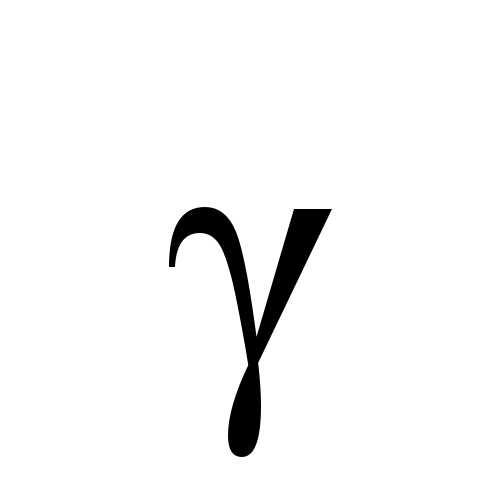
94.
Has the symbol
a)
Alpha
b)
Beta 
c)
Gamma
d)
electron
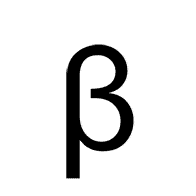
95.
Has the symbol
a)
Alpha
b)
Beta
c)
Gamma
d)
neutron
96.
If Thorium-234 undergoes a beta decay, What element will be left in its place?
a)
Actinium-234
b)
Thorium-233
c)
Protactinium-234
d)
Radium-230
97.
If we start off with element 5024X after an alpha decay we get another element Y that looks like
a)
5022Y
b)
 4622Y
c)
4820Y
d)
5426Y
98.
If we start off with element 5024X after an beta decay we get another element Y that looks like
a)
5023Y
b)
4622Y
c)
5025Y
d)
5024Y
99.
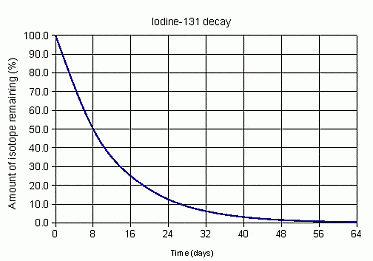
After the third half-life, how much of the sample is left?
a)
1/2
b)
1/3
c)
1/16
d)
1/8
100.
If 10 mg of iodine 131 is given to a patient, how much is left after 24 days? The half-life of iodine-131 is 8 days.
a)
1.25mg
b)
1.25g
c)
10g
d)
10mg
101.
The half-life of strontium-90 is 25 years. How much strontium-90 will remain after 100 years if the initial amount is 4.0 g?
a)
3.0g
b)
0.25mg
c)
0.3g
d)
0.25g
102.
If the half-life of uranium-232 is 70 years, how many half-lives will it take for 10 g of it to be reduced to 1.25 g?
a)
1 half-life
b)
2 half-lives
c)
3 half-lives
d)
4 half-lives
103.
What is the half-life of iodine-131?
a)
32 days
b)
8 days
c)
16 days
d)
24 days
104.

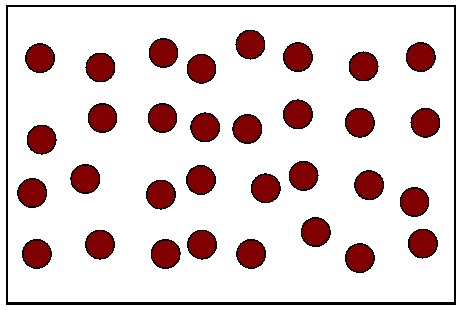
The % of the parent isotope remaining after 1 Half Life.

a)

50%

b)

25%

c)

12.5%

d)

6.25%

105.

The % of the parent isotope remaining after 2 Half Lives.

a)

50%

b)

25%

c)

12.5%

d)

6.25%

106.

The diagram shows 32 atoms

32 of the Red are the parent isotope

0 of the atoms are daughter isotopes

How many half-lives have occurred?

a)

0

b)

1

c)

2

d)

3

107.

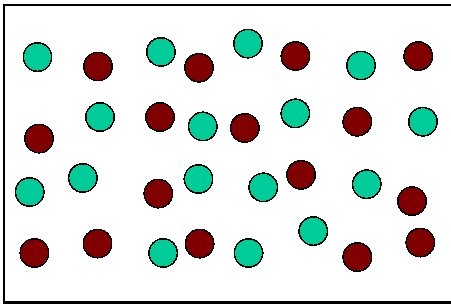
The diagram shows 32 atoms.

16 of the Red are parent isotopes

16 of the Green are daughter isotopes

How many half-lives have occurred?

a)

0

b)

1

c)

2

d)

3

108.
Imagine you have 50,000 atoms of uranium-238. If U-238 has a half-life of 4.5 billion years, how many U-238 atoms will be left after 4.5 billion years? 
a)
25,000
b)
50,000
c)
12,500
d)
0
109.
You have 100 grams of radioactive C-14. The half life of C-14 is 5730 years. 
How many grams are left after 1 half life? 
a)
100 grams
b)
25 grams
c)
2 grams
d)
50 grams
110.
What atom matches this electron configuration?
1s22s22p63s23p64s23d10
a)
Zinc
b)
Copper
c)
Nickel
d)
Germanium
111.
What electron configuration matches an oxygen atom?
a)
1s22s22p63s2, 3p64s23d104p5
b)
1s22s22p4
c)
1s22s22p6
d)
1s22s22p63s23p64s23d1
112.
What is the electron configuration of Sulfur  using noble gas method
a)
[Ne]3s1
b)
[Ne]3s23p3
c)
[Ne]3s23p4
113.

What is the electron configuration of Iodine?

a)

[Kr]5s24d105p6

b)

[Kr]5s24d106p6

c)

[Kr]5s25d106p6

d)

None of the above

114.
The electron configuration of an atom is 1s22s22p6.  The number of electrons in the atom is 
a)
3
b)
6
c)
8
d)
10
115.

What atom matches this electron configuration?

[Xe] 6s24f145d9

a)

Mercury

b)

Gold

c)

Platinum

d)

Thallium

116.
Which element is pictured?
a)
neon
b)
fluorine
c)
magnesium
d)
argon
117.

There are __ energy levels

a)

1

b)

2

c)

7

d)

8

118.
How many atomic orbitals are there in the p sublevel?
a)
2
b)
3
c)
4
d)
5
119.
What atom matches this electron configuration?
1s22s22p63s23p64s23d10
a)
Zinc
b)
Copper
c)
Nickel
d)
Germanium
120.
Which electron configuration belongs to Chlorine (Cl)?
a)
1s2s2p3s3p5
b)
1s2s2p3s3p6
c)
1s2s2p3s3p7
121.
Identify the Electron Configuration for Aluminum (Al)
a)
1s2s2p3s3p1
b)
1s2s2p3s3p3
c)
1s2s2p3s4p1
122.
What is the shorthand electron configuration for Sulfur atom?
a)
[Ar] 3p4
b)
[He] 3s23p4
c)
[Ne] 3s23p4
d)
[Na] 3s23p3
123.
What is the noble gas configuration for phosphorus?
a)
[Ar] 3p5
b)
[He] 3s2 3p5
c)
[Ne] 3s2 3p3
d)
[Na] 3s2 3p5
124.
[Ne]3s23p5 is the noble gas configuration for which element?
a)
chlorine
b)
fluorine
c)
sulfur
d)
aluminum
125.
What atom matches this electron configuration?
1s2s2p3s2
a)
Neon
b)
Magnesium
c)
Aluminum
d)
Potassium
126.
Which is the electron configuration for an oxygen atom?
a)
1s22s22p63s23p64s2
b)
1s22s22p4
c)
1s22s22p6
d)
1s22s22p63s23p6
127.
What is the maximum number of electrons that an orbital can have?
a)
1 electron
b)
2 electrons
c)
3 electrons
d)
4 electrons
128.
How many d orbitals are there in a given sublevel?
a)
1
b)
3
c)
5
d)
7
129.
How many electrons can the d sublevel hold?
a)
8
b)
10
c)
2
d)
4
130.
How many electrons can the first energy level hold?
a)
1
b)
2
c)
8
d)
0