
 Worksheets
Year 9 - ESS
Total questions: 122
Worksheet time: 2hrs 40mins
Iceland is able to use the large amount of volcanoes to its advantage. The underground magma is used to heat and supply electricity for a large portion of the country. The use of this type of energy has great advantage over burning coal because
renewable resources are being used
all answer choices are correct
the cost is much less than coal
it does not create CO2 which may contribute to climate change
Which of the following statements is not true of temperature in Earth's layers?
The heat in the interior of the Earth is maintained by internal pressure and density
The lithosphere has a higher temperature than the asthenosphere
Radioactive substances inside the Earth release energy which creates heat
heat increases with depth from the Earth's surface
The intense heat from Earth's interior that warms the magma beneath the Earth's surface is called
geothermal energy
hydrogen energy
tidal power
solar energy
Waves travel at different speeds through the Earth's interior. What property distinguishes the Earth's crust, mantle, and core?
mass
pressure
composition
temperature

The pie chart illustrates the fuel sources for electricity in the country. Which of the following statements is true according to the pie chart?
Renewable resources are the main source for electricity in the country
Nuclear energy accounts for a large part of the non-renewable resources in the country
Fossil fuels are the main energy source for electricity in the country.
Non-renewable resources are used as often as renewable resources in the country
Which diagram best represents the type of plate movement that results in FOLDED mountains?


Like the layers of the ocean, the Earth's crust is divided into part based on physical properties. Which of the following statements best describes a layer of the Earth?
The asthenosphere has the greatest density
The mesosphere has the least density
The outer core has the least density
The inner core has the greatest density
In which of these ways can volcanoes help build up new land?
by adding water vapor to the atmosphere
by adding heat to Earth's surface
by adding gases to the atmosphere
by adding lava to Earth's surface

As you move northwest through the Hawaiian Islands, the age of the islands increases. The older islands are northwest of the new islands because they
age faster than those to the east
formed from old, recycled, silica-rich magma
were made of less lava than the southwestern islands
formed first and were moved away from the hot spot
Where on the ocean floor is new ocean crust being created?
the continental shelf
the continental slope
the deep ocean trenches
the mid-ocean ridges
Which occurrence is NOT caused by the motion of Earth's plates?
ocean tides
mountain formation
earthquakes
volcanoes

The movement of the two continents as shown in picture can best explained by
plate tectonics
coastal flooding
magnetic changes
volcanic eruptions
Most earthquakes and volcanoes occur in areas of the Pacific Ocean called the "Ring of Fire." Scientists agree that the reason for this is
That part of the Earth is hotter than all other parts of Earth.
A large number of people live in these areas.
The ocean weighs so much that it forces magma up.
plate boundaries are located in those areas

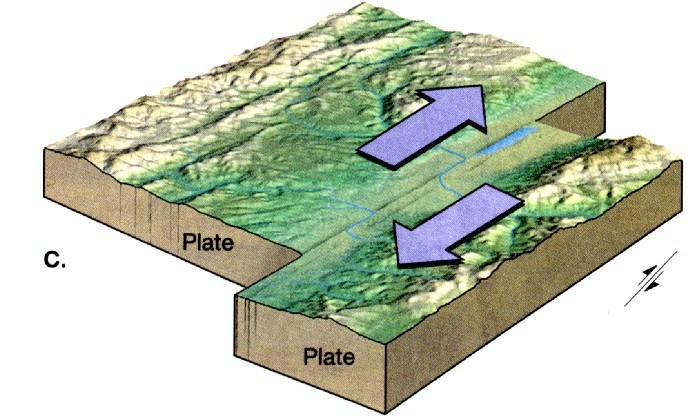
The image represents the type of plate movement found on the San Andreas fault line. What type of motion would you expect to find this region?
convergent motion
divergent motion
transform motion
sea floor spreading
Which of the following would be the least likely cause of volcanic eruption?
gas pressure within Earth's crust
new magma flowing into an already full magma chamber
tectonic plates sliding past each other
tectonic plates colliding

Look at the picture of the table. According to this information, the earthquake that produced this damage had a magnitude of about
3.0
5.0
2.5
6.5
Which of these statements does NOT support the theory of plate tectonics?
The continents appear to fit together like pieces of a puzzle
South American mountain ranges align with African mountain ranges
Similar fossils are found on different continents
Antarctica seems to have always been covered with glaciers
Earthquakes are most likely to occur where
the density cracks thin areas of Earth's crust
heat causes the mantle to expand
there are plate boundaries
bubbles of magma rise to the surface
What is the core made of?
steel
magnesium
aluminum
iron

The element that has the highest density found throughout the composition of the Earth is _____.
Iron
Aluminum
Magnesium
If the pressure is greater than the temperature, the layer will be _________.
solid
liquid
semi-liquid rock
If the temperature is greater than the pressure, the layer will be _________.
solid
liquid
semi-liquid rock
____________ is the outermost system which is an invisible layer of gases that surround the planet.
biosphere
hydrosphere
geosphere
atmosphere
What is the atmosphere made of?
Nitrogen, Oxygen, and Trace gases
Nitrogen, Oxygen, and Helium
Hydrogen, Oxygen, and Trace gases
Nitrogen and Oxygen
If you climbed a mountain, what would you expect the temperature to do?
decrease (get colder)
increase (get warmer)
stay the same
Where is most of Earth's water located?
Oceans
Lakes
Ponds
Swamps
What is a reservoir?
A natural location where water is stored
An underground hide out
A plant eating dinosaur
A layer of the hydrosphere
Where is most of Earth's freshwater located?
Oceans
Lakes
Glaciers and Ice Caps
Groundwater
Which of the following is NOT a type of rock?
Igneous
Metamorphic
Isoceles
Sedimentary
Asthenosphere

Describe the most likely relationship between these mountains and nearby tectonic plates.
The mountains are probably formed by earthquakes
The mountains are probably formed by the movement of glaciers
The mountains are probably located near the edge of 2 tectonic plates.
The mountains are probably formed by running water.

Tectonic plates float on top of the ________
Crust
Mantle
Inner Core
Outer Core


Alfred Wegener used __________ to prove that Pangea once existed ?
graham crackers and frosting
math
a metal detector
fossils


Is there a pattern to the locations of earthquakes and volcanoes around the globe?
No, earthquakes and volcanoes are random.
Yes, earthquakes and volcanoes usually occur near the boundaries of tectonic plates.
yes, earthquakes and volcanoes usually occur in the middle of tectonic plates.
No, earthquakes and volcanoes usually occur under water.

Most earthquakes tend to occur at which location?
The central regions of very large continents
Groups of islands farthest from any continents
The boundaries between continents and oceans
The steep slopes of the very oldest mountains

A map is provided that presents information on a certain region of the Earth. Based on the information on the map, at which location are mountains most likely to form?
A
B
C
D

A map is provided that shows the location of the Aleutian Islands in comparison to some of Earth’s tectonic plates is provided. Based on the information provided, which of the following is most likely a feature of the Aleutian Islands?
The climate is getting older.
They were formed by volcanic activity.
These islands are the oldest on Earth.
Earthquakes do not occur there

The Ring of Fire is an area where a large number of earthquakes and volcanic eruptions occur. What claim can be made about the Ring of Fire from this information?
It is the only place on Earth where earthquakes can happen.
The edges of the tectonic plates are moving in this area.
It represents the areas where tectonic plates are the thickest.
It has been getting larger since Earth first formed.

Peru and Chile are part of South America, which sits on the South American tectonic plate. The Nazca plate is moving toward the South American plate. It is pushed downward, which causes it to slide under the South American plate. Based on this information, what feature could we expect to see off the coast of Peru and Chile?
new Continent formation
Poor fishing conditions
Deep ocean trench
Severe tropical storms
What major events cause islands to form in the Pacific Ocean?
tsunamis
severe storms
volcanic eruptions
erosion
Two plates come together or collide at what boundary?
Convergent
Divergent
Transform
Two plates spread or move apart at what boundary?
Convergent
Divergent
Transform
Two plates slide past each other at what boundary?
Covergent
Divergent
Transform

New oceanic crust (sea floor) is created at this boundary.
Divergent Oceanic
Divergent Continental
Convergent Oceanic
Transform

Oceanic crust (sea floor) is destroyed at this boundary.
Convergent Oceanic
Divergent Oceanic
Convergent Continental-Continental
Divergent Continental

The process where oceanic crust slides under another plate and is melted is called ___________.
seafloor spreading
subduction
continental drift
recycling

What two crustal features occur near every subduction zone?
Volcanoes and Trenches
Rift Valleys and Mid Ocean Ridges
Volcanoes and Rift Valleys
Mid Ocean Ridges and Trenches
A divergent boundary on land creates what feature?
Mid Ocean Ridge
Rift Valley
Subduction Zone
Deep Ocean Trench
A divergent boundary in the ocean creates what feature?
Mid Ocean Ridge
Rift Valley
Deep Ocean Trench
Subduction Zone
When two continental plates converge (collide) what type of crustal feature is formed?
Mid Ocean Ridge
Subduction Zone
Rift Valley
Folded Mountains
The process that occurs at a divergent oceanic boundary that creates new crust (sea floor) is called?
Subduction
Seafloor Spreading
Continental Drift
Volcanism
What is the 'magic' that is happening in the mantle that helps move the 'lithospheric plates'?
Convection
Subduction
Seafloor Spreading
If an earthquake occurs at the bottom of the ocean floor what could form as result?
Volcano
Tsumani
Tidal Wave
Hurricane
Aside from Earthquakes, what is the only thing you will find at transform boundaries?
Volcanoes
Subduction Zones
Folded Mountains
Fault lines
What is the only event associated with ALL plate boundaries?
Volcanoes
Earthquakes
Subduction
Deep Trenches
The only type of crust that will subduct if two plates converge is...
Oceanic
Continental
These are NOT plate boundary features. They are areas where hot mantle plumes push up through the lithospheric plates to create volcanic islands such as Hawaii.
Hotspots
Convergent Boundary
Divergent Boundary
Transform Boundary
Tsunamis are formed from what two types of convergent boundaries?
Continental-Continental
Oceanic-Continental
Oceanic-Oceanic


Type of fold: downfolds or troughs
anticlines
synclines
monoclines
benchmarks


An upward fold in the rock that makes an arch
anticline
syncline
folded mountain
fault block
What do we use to measure earthquakes?
Richter scale and mercalli scale
ruler and digital scale
book and a wave machine
Magnitude and longitude
On the Richter scale what does the measurement increase by when the measurement goes up one whole number?
factor of 30
factor of 10
factor of 100
factor of 900
How is magnitude calculated?
From a logarithmic measurement of the waves
From the intensity and the damage caused to the land
by an isoeismal map
by interviews of people who experienced the earthquake
Which is more useful to measure the impact of an earthquake?
Magnitude
intensity
What is the range for the Mercalli intensity scale?
l to Xll
l-X
1-10
infinity
What is intensity?
the measure of impact and damage the earthquake had
the measurement of energy released from the earthquake
the measurement of waves from an earthquake
The source of new oceanic crust being produced at the mid-ocean ridge is known as __________________.
Mid-Ocean Ridge
Subduction
Deep-Ocean Trench
Sea-Floor Spreading
Magnetic Striping
Evidence that the Earth's magnetic poles have flipped and is linked to sea-floor spreading is called _________?
Mid-Ocean Ridge
Subduction
Deep-Ocean Trench
Sea-Floor Spreading
Magnetic Striping
Which scientist proposed the theory of sea-floor spreading?
Isaac Newton
Rube Goldberg
Alfred Wegener
Harry Hess
What do you call the device used to detect underwater objects?
sonar
seismograph
ultrasound
infrasound

