Wayground logo

Free Printable Worksheets

Font size

S
M
L
XL
Worksheets

Biology Fall Final Study Guide

Total questions: 104

Worksheet time: 1hrs 3mins

Name
Class
Date
1.
Survival of the Fittest and Evolution were proposed by what scientist?
a)
Charles Darwin
b)
Albert Einstein
c)
Steven Hawking
d)
Isaac Newton
2.
Behavioral changes of individuals of a species that allow for better survival. (Acquired traits)
a)
Variation
b)
Adaptation
c)
Behavior
d)
Environment
3.
When every organism of a species has died.
a)
Evolution
b)
Natural Selection
c)
Extinction
d)
Artificial Selection
4.
Where the better adapted organisms survive to pass traits along to offspring.
a)
Evolution
b)
Natural Selection
c)
Extinction
d)
Artifical Selection
5.
Why are advantageous traits more likely to be passed onto offspring?
a)
Because they are more likely to survive and reproduce.
b)
Because they come from dominant alleles.
c)
Because they come from recessive alleles.
d)
Because the trait is an acquired phenotype.
6.
The theory of evolution by natural selection means that what is changing over time?
a)
The inherited traits of a population.
b)
The acquired traits of a population.
c)
Hair color and eye color
d)
Attractive features.
7.

What word describes a trait that helps an organism survive in its environment?

a)

natural selection

b)

mutation

c)

camouflage

d)

adaptation

8.
The differences among a species, like different bird beaks, are called
a)
genes.
b)
variations.
c)
traits.
d)
theories.
9.
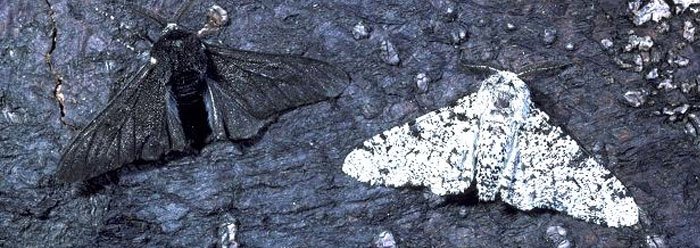
The trees these moths used to live on were white, but have been covered in soot from coal factories. Which moth will be more successful in this environment?
a)
Dark moth
b)
Light moth
c)
Both will be equally successful
d)
Neither will be successful
10.
What process is being shown in this image?
a)
Variation
b)
Natural Selection
c)
Selective Breeding
d)
Homeostasis
11.
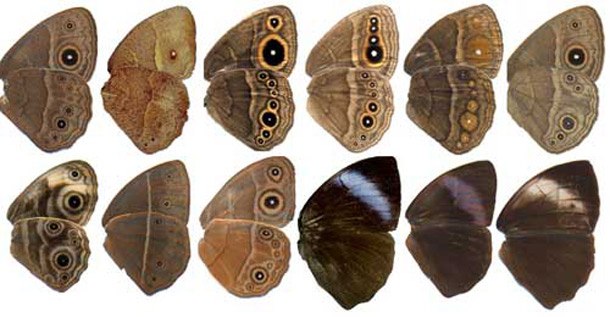
These moths are all the same species. The differences between their wings is an example of ________________
a)
Natural Selection
b)
Variation
c)
Homeostasis
d)
Extinction
12.
Selective breeding is where ___________ decides which traits should be passed on
a)
Nature
b)
 A human
c)
Mr. Holt
d)
The illuminati
13.

Without other changes to a population, which of the following will cause a population to increase in size?

a)

The birth rate equals the death rate.

b)

The birth rate is less than the death rate.

c)

The birth rate is greater than the death rate.

d)

The birth rate and the death rate both equal 0.

14.
When individuals join a population
a)
Aliens
b)
migration
c)
Immigration
d)
Emigration
15.

Which of the following is an example of an abiotic limiting factor on population size?

a)

water availability

b)

Availability of food

c)

disease

d)

predation

16.
Carrying Capacity is
a)
the capacity of what one person can carry per day 
b)
how many animals you have in your daily bag limit at the end of the year
c)
wildebeest at a watering hole with zebras
d)
the maximum number of individuals that the environment can support
17.
A population is 
a)
a group of communities that exist in different places
b)
a group of organisms of one species that lives in the same area at the same time
c)
a group of people that populate one place at the same time on different planets
18.
If the wolf population goes extinct on the island, what tropic cascade is likely 
a)
Moose will die due to lack of predators
b)
The moose population will grow and eat all the vegetation 
c)
The other species that rely on the vegetation will take over for the wolves
d)
New predators will begin hunting Moose
19.
If wolves were re-introduced what would happen to the moose population
a)
The moose would go extinct from over hunting
b)
The wolf population would take over the island
c)
The moose population would decline to normal levels
d)
The moose would adapt to other environments
20.
The role of an organism in its habitat, or how it makes its living, is called its
a)
community
b)
niche
c)
habitat
d)
population
21.
An environment that provides the things that organisms need to live, grow, and reproduce is called a....
a)
community
b)
niche
c)
habitat
d)
population
22.
An individual belonging to a specific species
a)
Biotic
b)
Community
c)
Organism
d)
Reptile
23.
All of the living and nonliving things in an area that interact with each other are called a/an ______.
a)
community
b)
habitat
c)
population
d)
ecosystem
24.
Two or more members of a particular species living and interacting in the same area
a)
Community
b)
Population
c)
Organisms
d)
Biosphere
25.
The area between the highest mountain and the deepest ocean where life can be found
a)
Biosphere
b)
Biome
c)
Farm
d)
Ecosystem
26.
Largest number of individuals of a population that the environment can support...  
a)
carrying capacity
b)
population crash
c)
lag phase
d)
mutualism
27.
Food, water, sunlight, shelter, and space are resources that are often __________.
a)
limiting factors
b)
wet
c)
messy
d)
found in rocks
28.
Where humans have bred organisms together based on traits we like.
a)
Evolution
b)
Natural Selection
c)
Extinction 
d)
Artificial Selection
29.

What is this an example of?

a)

Homologous structure

b)

Analogous structure

c)

Vestigial organs

d)

Functional adaption

30.

Some organisms that share a common ancestor have features that have different functions, but similar structures. These are known as

a)

vestigial structures

b)

analogous structures

c)

homologous structures

d)

embryology

31.
Which word is defined as a reduced form of a functional structure in 1 organism that shows up as fully functional in another?
a)
homologous structures
b)
vestigial structures
c)
analogous structure
d)
DNA
32.

Example of Evolution

a)

Biochemical Analysis

b)

Fossils

c)

Vestigial Organ

d)

Homologous Structure

33.
Using this picture, what defense is this Hawk Moth displaying?
a)
camouflage
b)
emitting smells
c)
mimicry
d)
panting
34.
The rabbit in this food web would be considered a:
a)
Decomposer
b)
Producer
c)
Secondary Consumer
d)
Primary Consumer
35.
The living part of an ecosystem
a)
Biotic
b)
Abiotic
c)
Mother Earth
d)
Flowers
36.
The non-living part of an ecosystem
a)
Ocean
b)
Lava Flow
c)
Birds
d)
Abiotic
37.
The seasonal movement of an organism from one place to another
a)
camouflage
b)
migration
c)
hibernation
d)
function
38.
As resources in a population become less available, population growth
a)
declines rapidly
b)
increases slowly
c)
reaches carrying capacity
d)
enters a phase of exponential growth
39.
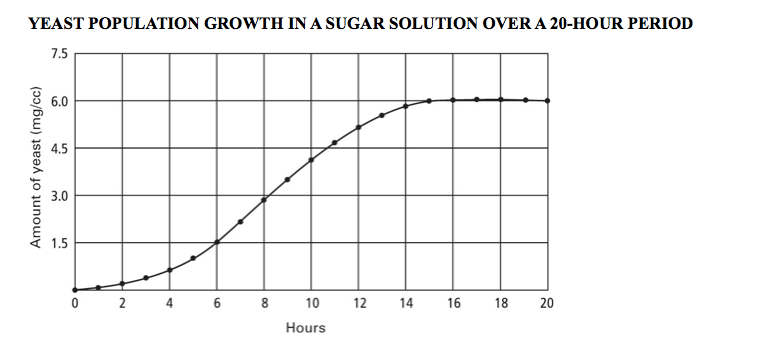
What type of growth model is this?
a)
exponential growth model
b)
logistic growth model
c)
Type I curve
d)
Type III curve
40.
Which of the following will increase the size of a population?
a)
emigration and births
b)
immigration and deaths
c)
immigration and births
d)
emigration and deaths
41.
Which of the following is a density-dependent limiting factor?
a)
human activities 
b)
unusual weather
c)
competition
d)
natural disaster
42.
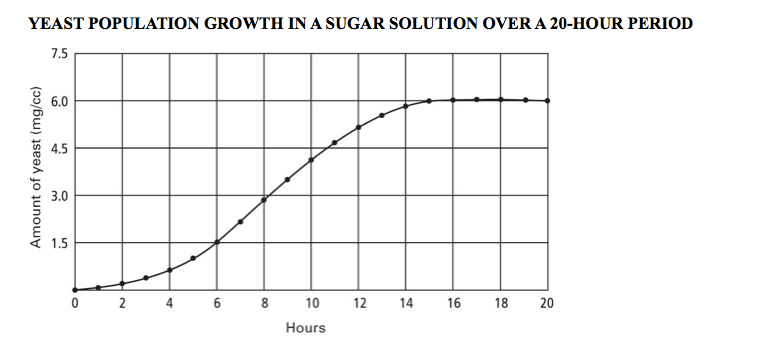
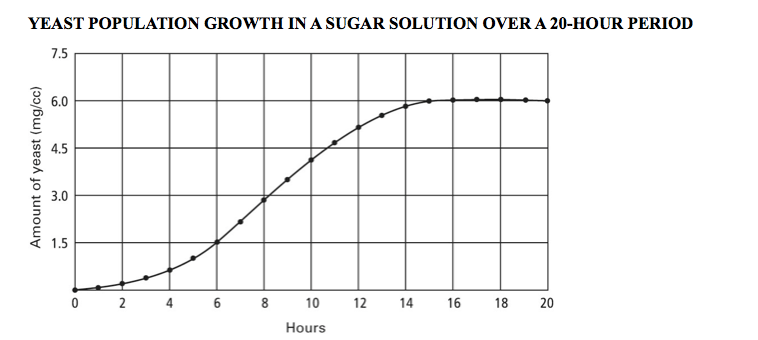
What type of growth is shown on this graph?
a)
logistic
b)
exponential
c)
average
d)
density-independent
43.
 What is the name for this leveling off shown in the graph?
a)
logistic line
b)
carrying capacity
c)
climax point
d)
mediocre
44.
Diseases may spread more rapidly when an area is crowded, so disease is considered to be a
a)
type I survivorship curve
b)
population crasher
c)
density-dependent limiting factor
d)
population enhancer
45.
After how many hours does the yeast population shown in the graph reach its carrying capacity?
a)
15 hours
b)
10 hours
c)
6 hours
d)
At the start
46.
What 2 factors decrease population size?
a)
Immigration, Births
b)
Emigration, Births
c)
Emigration, Deaths
d)
Immigration, Deaths
47.

A(n) __________ includes all living and non-living things in an environment.

a)

population

b)

niche

c)

abitotic

d)

ecosystem

48.
The part of Earth where organisms can live.
a)
biotic factors
b)
biosphere
c)
ecology
d)
biology
49.

Which of the following is a density independent factor?

a)

competition for resources

b)

predation

c)

disease

d)

natural disasters

50.

Which of the following populations is most likely to go extinct?

a)

a very small population in an unstable environment

b)

a moderate-sized population of r strategists

c)

a large population with lots of genetic variability

d)

all would be equally likely to go extinct

51.
What step does every scientific experiment begin with?
a)
hypothesis
b)
question/problem
c)
procedures
d)
conclusion
52.
A claim is ______________________________.
a)
a kind of shellfish often used in chowder. 
b)
a fact.
c)
a statement or conclusion that answers the original question or problem
d)
a bad thing to make about something.
53.
Evidence is ___________________
a)
A statement or conclusion that answers a question
b)
Scientific data that supports the claim
c)
A justification that connects the claim to the evidence
d)
Not vital when using an argument
54.
Reasoning is __________________.
a)
A statement of conclusion that answers the original question/problem
b)
Scientific data that supports the claim
c)
A justification that connects the evidence to the claim
d)
Empirical Evidence
55.
What does Reasoning mean?
a)
A solid and reasonable argument
b)
A written response to a claim
c)
An explanation that connects your evidence back to the claim
d)
An opinion you believe in 
56.
How many milliliters is this? 
a)
500mL
b)
700mL
c)
650mL
d)
550mL
57.
A series of steps used by scientists to solve a problem or answer a question. 
a)
scientific method
b)
recipe
c)
data collection
d)
metric system
58.
A testable explanation to a problem that has not yet been tested. 
a)
data
b)
theory
c)
hypothesis
d)
fact
59.
Testing a hypothesis often involves a(n):
a)
answer
b)
experiment
c)
problem
d)
safety check
60.

What is the first step in the scientific method?

a)

Data

b)

Conclusion

c)

No Horse Play

d)

Observe a problem

61.
The summary at the end of an experiment that explains the results. 
a)
conclusion
b)
procedures
c)
materials
d)
responding variable
62.
Which of the following is an observation of the picture?
a)
The person is wearing a T-shirt
b)
It is a sunny day
c)
The person is going to a birthday party
d)
The gift is a DVD player
63.
What is an inference? 
a)
Just a guess.
b)
A statement based off of your observations. 
c)
The same as an observation. 
d)
Examples of something. 
64.
Which statement is an inference about this picture?
a)
The van is tan.
b)
The  van ran into KFC. 
c)
The driver was hungry. 
d)
An ambulance may be on the way. 
65.
What is an observation for this picture?
a)
The man is scared
b)
The man is going to get eaten
c)
There is a man in a kayak
d)
The man is paddling fast
66.
Mrs. G set up an experiment to see how the type of ball affects the distance it rolls off a ramp.  Identify the Independent Variable in this experiment.
a)
distance traveled by the ball
b)
height of the ramp
c)
the type of ball
67.
The variable we measure to get our results the:
a)
Dependent Variable
b)
Independent Variable
c)
Constant
68.
The variables in an experiment that stay the same are the:
a)
IV
b)
DV
c)
Constants
69.
Why do we want to test one variable at a time?
a)
Because it is hard to setup a data table with more than one
b)
It keeps the experiment fair and you can see what caused the change
c)
It is what has always been done
d)
It makes the results better in an experiment
70.
This variable in an experiment is the one being deliberately changed by the scientist. 
a)
dependent variable
b)
independent variable
c)
data
d)
control group
71.
the type of evolution that is now believed to have occurred 
a)
gradualism
b)
punctuated equilibrium
c)
stationary
d)
commensalism
72.
species that have similar embryonic development show that they may have 
a)
common ancestors
b)
not been related
c)
not had similar development
d)
once been that animal
73.

Structures that share a common ancestry or are similar because they are modified versions of structures from a common ancestor are

a)

Homologous Structures

b)

Analogous Structures

c)

Vestigial Structures

d)

Embryos

74.

Structures with no function that are remnants of an organism’s evolutionary past are

a)

Homologous Structures

b)

Vestigial Structures

c)

Analogous Structures

d)

Embryos

75.

The hypothesis that evolution of a species occurs in spurts of change separated by periods of little or no change is called

a)

divergence

b)

isolation

c)

gradualism

d)

punctuated equilibrium

76.
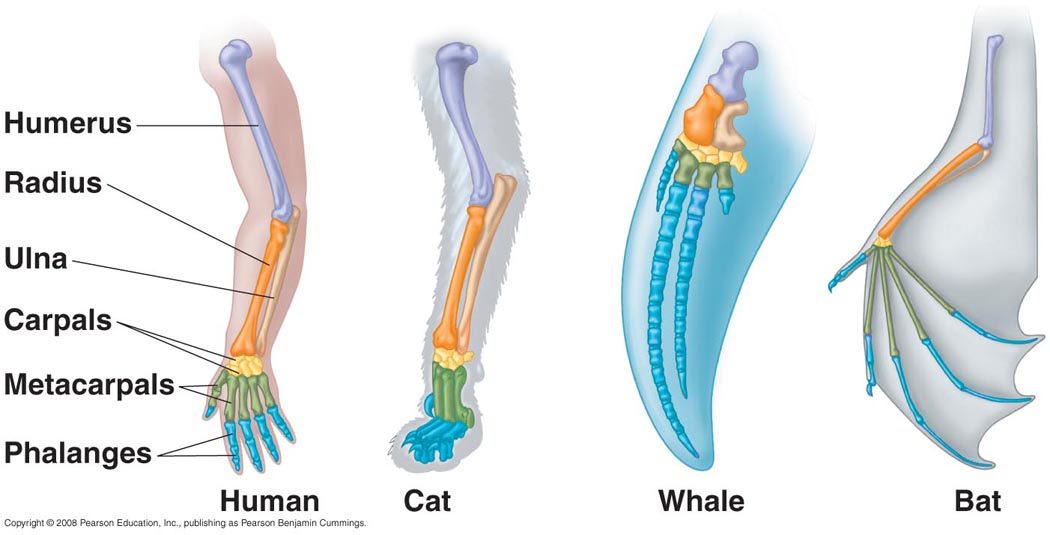
What does this image suggest? 
a)
Law of Superposition 
b)
Specations 
c)
Common Descent 
d)
Five Finger Discount 
77.
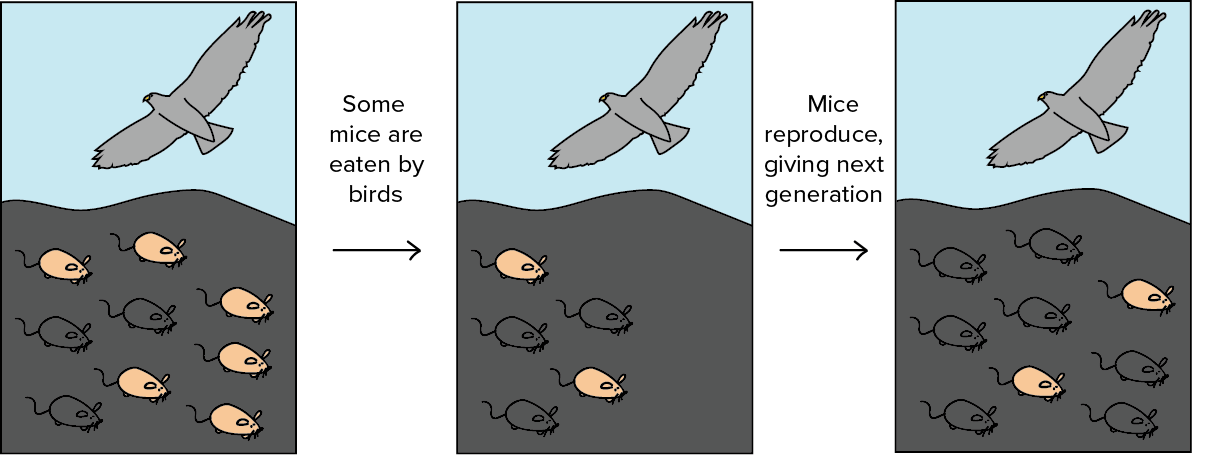
Why is the mouse population changing over time?
a)
The light mice can reproduce more successfully than the dark mice
b)
The hawks eat more dark mice than light mice because the dark mice taste better
c)
The hawks eat more light mice than dark mice because they can see the light mice more easily
d)
The hawks eat more dark mice than light mice because they can see the dark mice more easily
78.

Structures with the same parts but have different functions, suggesting that organisms with a backbone share common ancestry is called…

a)

Not related

b)

Not homologous

c)

Homologous

d)

Young in origin

79.
a)
The image shows convergent evolution. 
b)
The image shows divergent evolution. 
c)
The image shows adaptive radiation.
d)
The image shows analogous structures.
80.
a)
The image shows convergent evolution.
b)
The image shows divergent evolution.
c)
The image shows adaptive radiation.
d)
The image shows homologous structures.
81.
Flying fish, flying birds, and bats are examples of which of the following?
a)
convergent evolution & homologous structures
b)
convergent evolution & analogous structures
c)
divergent evolution & homologous structures
d)
divergent evolution & analogous structures
82.

What type of evolution is described in the following scenario: Porcupines in the United States have quills (spines) that are attached to their skins. When they feel threatened, they can tense up their bodies, causing the quills to “shoot out.” These spiny quills can pierce the skin of attacking animals, causing injury and pain. Although not closely related to the porcupine, hedgehogs that live throughout parts of Europe also have protective spines that they use to defend themselves from attacking animals.

a)

Coevolution

b)

Divergent Evolution

c)

Convergent Evolution

83.

What type of evolution is described in the following scenario: King Snakes are a family of snakes that usually eat other snakes in the wild. Even though many of the snakes they eat are very poisonous, King Snakes have adapted the ability to not be affected by their poisons. In response, some of these poisonous snakes, like rattlesnakes, have adapted other defensive behaviors (other than biting) to try and “scare off” the King Snakes.

a)

Coevolution

b)

Divergent Evolution

c)

Convergent Evolution

84.

What type of evolution is described in the following scenario: In the ocean surrounding Antarctica, there are fish that survive the cold water by using a molecule made of glycoproteins that circulates the blood and keeps it from freezing. Certain kinds of worms that live in the Arctic ocean also make antifreeze proteins that help them live in icy water

a)

Coevolution

b)

Divergent Evolution

c)

Convergent Evolution

85.

What type of evolution is described in the following scenario: A kit fox lives in the desert and has large ears with greater surface area that keep the fox from getting overheated. The red fox lives in the forest and has a red coat that keeps it camouflaged.

a)

Coevolution

b)

Divergent Evolution

c)

Convergent Evolution

86.
Process by which individuals that are better suited to their environment survive and reproduce most successfully; also called survival of the fittest.
a)
Extinction
b)
Speciation
c)
Natural Selection
d)
Artificial Selection
87.
Differences between members of the same species are called
a)
predators
b)
traits
c)
selections
d)
variations
88.

Organisms with traits that are best suited for their environments are likely to have a greater chance for survival. These helpful traits, which arise due to genetic mutations, are known as _____________________.

a)

Mutation

b)

Adaptations

c)

Natural Selection

d)

Evolution

89.
Which terms best describe heterotrophs?
a)
Plants; producers
b)
Animals; producers
c)
Plants; consumers
d)
Animals; consumers
90.

What type of organism makes it's own food?

a)

Autotroph

b)

Heterotroph

c)

Consumer

d)

Omnivore

91.

What is the arrow pointing at?

a)

carrying capacity

b)

biotic potential

c)

density-independent

d)

density dependent

92.

Why don't populations grow indefinitely?

a)

limiting factors

b)

only biotic factors

c)

only abiotic factors

d)

none of the above

93.

Immigration is ...

a)

the movement into an area.

b)

the movement out of an area.

c)

the migration process.

d)

an exponential graph.

94.

Emigration is

a)

the movement out of an area

b)

the movement into an area

c)

movement in and out of an area

d)

migration

95.

Match the following

a)

Decomposer

1.

feeds on dead organisms and waste

b)

Commensalism

2.

Remora fish eats food not eaten by shark

c)

Consumer

3.

Organisms that eat other animals

d)

Producer

4.

Organisms that make their own food

e)

Omnivores

5.

Organisms eat both plants and animals

96.

What is the correct order for this food chain?

a)

Owl, Mouse, Grasshopper, Grass

b)

Grass, Mouse, Owl, Grasshopper

c)

Grass, Owl, Grasshopper, Mouse

d)

Grass, Grasshopper, Mouse, Owl

97.
An animal that gets energy from eating both plants and animals is a 
a)
herbivore
b)
carnivore
c)
omnivore
d)
autotroph
98.
What is a carnivore?
a)
an animal that gets energy by eating other animals
b)
An animal that gets energy by eating only plants
c)
an animal that gets energy by eating both plants and animals
d)
an animal that makes its own energy through photosynthesis
99.
What is a producer?
a)
an organism that gets energy from eating other organisms
b)
an organisms that uses sunlight to make its own food
c)
an organism that gets energy from eating dead organisms, non-living material or waste
d)
an organism that uses chemical energy to make its own food
100.

A bee and a flower work together to benefit each other. This is an example of a ______. The bee helps the flower by pollinating it and the flower helps the bee by providing it with nectar.

a)

commensalistic relationship

b)

parasitic relationship

c)

mutualistic relationship

101.
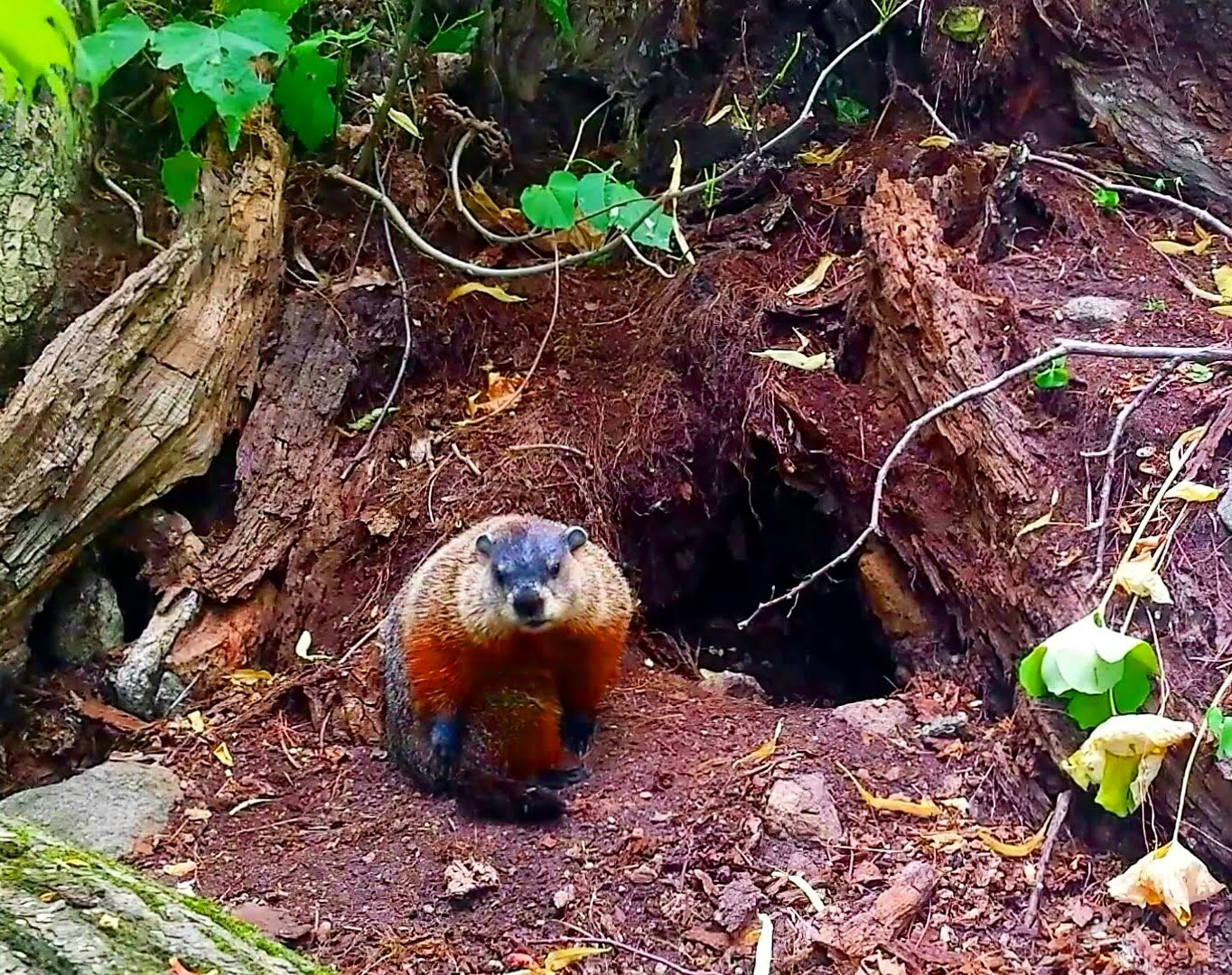
What type of symbiosis?  Skunks often live in burrows that have been dug and abandoned by woodchucks.  
a)
commensalism
b)
mutualism
c)
parasitism
d)
predation
102.
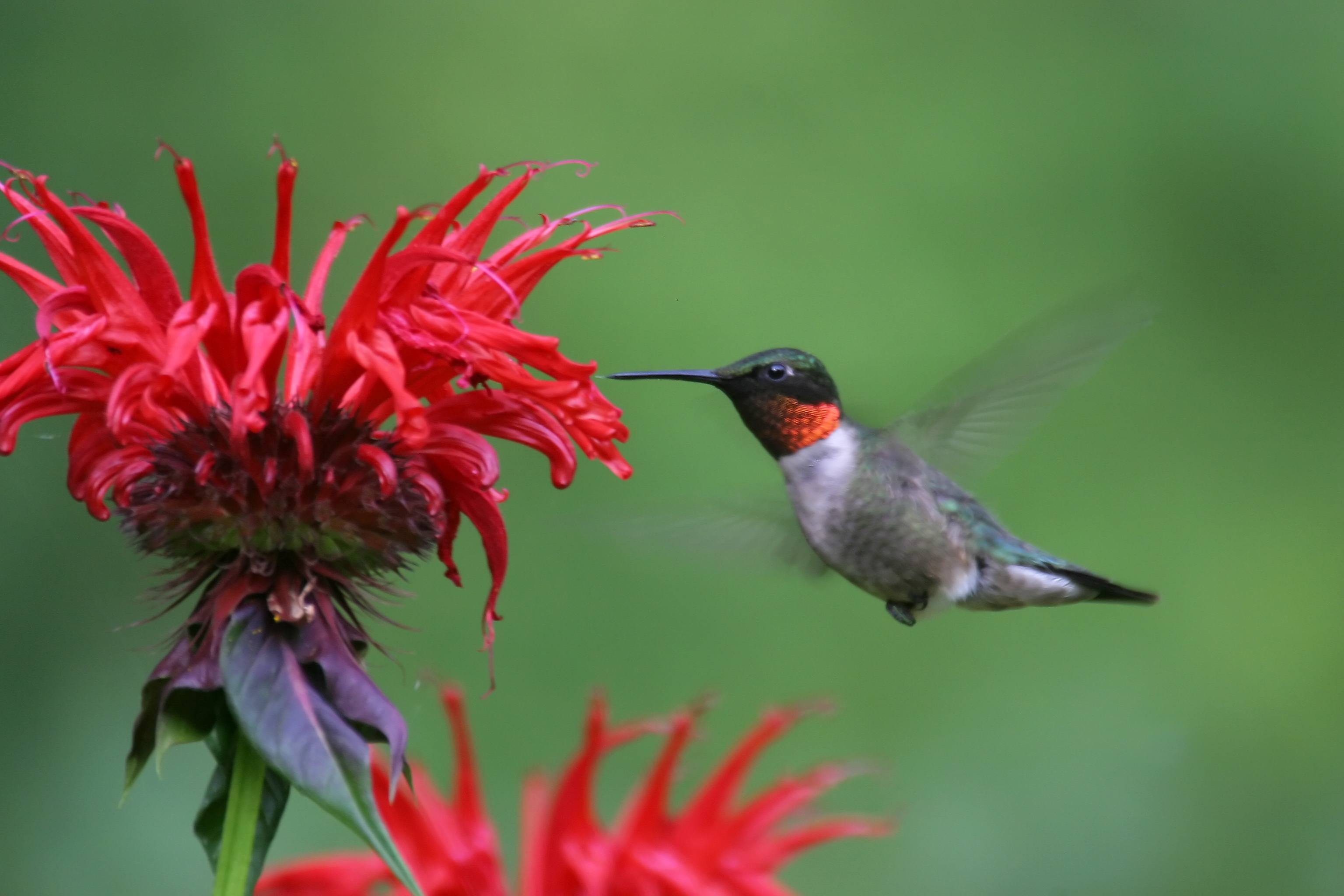
What type of symbiosis?  Hummingbirds feed on nectar from flowers.  The flowers are pollinated by hummingbirds as they move from flower to flower.
a)
commensalism
b)
mutualism
c)
parasitism
d)
predation
103.

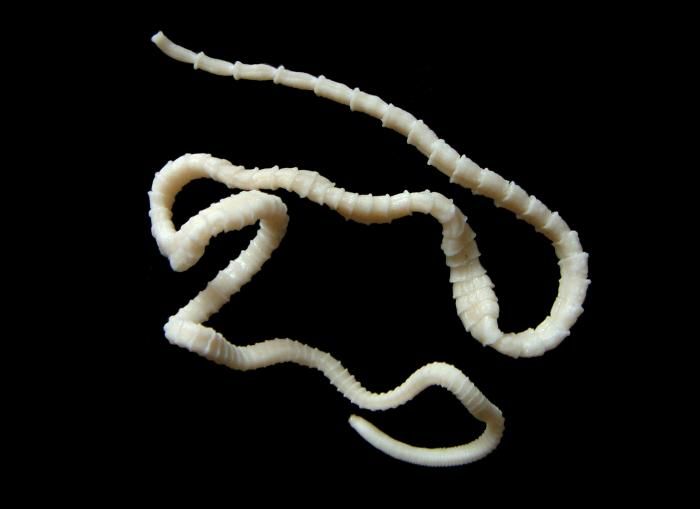
A tapeworm lives in the intestine of a cat absorbing nutrients through its skin. A tapeworm and a cat have this type of relationship.

a)

mutualism

b)

parasitism

c)

commensalism

d)

competition

104.
What does a food web represent?
a)
All connections of energy flow throughout all organisms in a habitat.
b)
The specific ways that mutualism is carried out.
c)
A single pathway or energy flow between organisms. 
d)
How carnivores get their food.