wayground logo

Free Printable Worksheets

Font size

S
M
L
XL
Worksheets

100 question atomic review

Total questions: 100

Worksheet time: 1hrs 29mins

Name
Class
Date
1.

What is the charge oxygen's nucleus?

a)

+16

b)

+8

c)

-8

d)

-16

2.
Which particle has a positive charge?
a)
electron
b)
orbital
c)
proton
d)
neutron
3.
Choose the particle that has no charge.
a)
nucleus
b)
neutron
c)
proton
d)
electron
4.
This particle determines what element you have - the elements identity.
a)
electron
b)
proton
c)
neutron
d)
valence shell
5.
An electron has a _____ charge.
a)
negative
b)
positive
c)
neutral
6.
Which particles make up the nucleus of an atom?
a)
protons and neutrons
b)
electrons and protons
c)
electrons, protons, and neutrons
d)
electrons and neutrons
7.
What are valence electrons?
a)
electrons on the first orbital always
b)
nucleus
c)
the outermost shell
d)
the number of electrons on the outermost orbital
8.
What is the mass number and name of an element with 8 protons and 8 neutrons?
a)
16 - Carbon
b)
16 - Oxygen
c)
24 - Oxygen
d)
8 - Neon
9.
An element with a mass number of 10 and an atomic number of 6 has how many protons?
a)
5
b)
8
c)
6
d)
10
10.
An atom has 13 protons, 15 neutrons and 13 electrons, what is its mass number?
a)
13
b)
26
c)
28
d)
15
11.
An element with a mass number of 11 and an atomic number of 5 has how many neutrons?
a)
11
b)
5
c)
6
d)
16
12.
What is the number that gives you the element and the number of protons contained in each elemental atom?
a)
atomic mass
b)
mass number
c)
symbol
d)
atomic #
13.
Which particles contribute the most to the mass of an atom?
a)
Protons, Neutrons, Electrons
b)
Protons only
c)
Protons and Electrons
d)
Protons and Neutrons
14.
An element has 12 protons, 14 neutrons, and 13 electrons.  What is the elements charge?
a)
26
b)
1
c)
-1
d)
+26
15.
Ions are: 
a)
atoms with a positive or negative charge
b)
atoms with no charge
c)
atoms with ONLY a positive charge
d)
atoms with ONLY a negative charge
16.
If an element has 6 protons, 7 neutrons, and 6 electrons, what type of charge does the element have?
a)
positive
b)
negative
c)
neutral
d)
imaginary
17.
When objects have equal numbers of protons and electrons, they are
a)
positively charged
b)
negatively charged
c)
electrically neutral
d)
unbalanced
18.
A vertical column is called...
a)
group
b)
tower
c)
period
d)
crew
19.
The atomic number tells you what?
a)
number of electrons
b)
number of protons
c)
number of neutrons
d)
both electrons and protons in an atom.
20.
What does the atomic mass tell you?
a)
Basically,the number of electrons and protons
b)
The number of neutrons
c)
Basically, the number of protons and neutrons
d)
The number of protons.
21.

In 1911 I discovered that atoms have a positive particle called proton.

a)

Dalton

b)

Rutherford

c)

Chadwick

d)

Bohr

22.

The smallest particle of an element that still retains all the properties of that element.

a)

atom

b)

cathode ray tube

c)

an electron

d)

a compound

23.

This particle is found in the nucleus and has no charge

a)

Neutron

b)

Proton

c)

Electron

d)

Atom

24.

This is a negatively charged particle found outside the nucleus

a)

Electron

b)

Proton

c)

Neutron

d)

Atoms

25.

The first person to ever talk about an atom was

a)

Democritus

b)

Rutherford

c)

Dalton

d)

Thomson

26.

Electrons can be found in

a)

The Electron Orbit

b)

The Nucleus Cloud

c)

The Electron Cloud

d)

The Outside Cloud

27.
Neutrons are found in the...
a)
Nucleus
b)
Electron Cloud
c)
Electrons
d)
Protons
28.
The _____________ is the number of protons and neutrons in an atom.
a)
Atomic Mass
b)
Atomic Symbol
c)
Atomic Number
d)
Atomic charge
29.
The _____________ determines the identity of an object.
a)
# of Protons
b)
# of Electrons
c)
# of Neutrons
d)
Atomic Mass
30.
Who believed that electrons were scattered amongst positively charged material.
a)
JJ Thomson
b)
Ernest Rutherford
c)
John Dalton
d)
Niels Bohr
31.
Believed that atoms are small, hard particles that were "indivisible"
a)
Democritus
b)
Aristotle
c)
Schrodinger
d)
Greek Philosophers
32.
Discovered that the atom has a small, dense, positively charged nucleus.
a)
Ernest Rutherford
b)
Heisenberg
c)
Democritus
d)
JJ Thomson
33.
Believed that electrons traveled around the nucleus in definite paths.
a)
Niels Bohr
b)
John Dalton
c)
Modern Atomic Theory
d)
Ernest Rutherford
34.
Determined that electron paths cannot be predicted and exist inside the Electron Cloud.
a)
Schrodinger & Heisenberg
b)
Ernest Rutherford
c)
John Dalton
d)
Democritus
35.
How many protons does an atom with an atomic number of 28 and a mass number of 40 have?
a)
28
b)
68
c)
12
d)
40
36.
Subatomic particles with a positive charge
a)
neutrons
b)
atomic mass
c)
protons
d)
isotopes
37.

Subatomic particles with a negative charge

a)

Electrons

b)

Neutrons

c)

Protons

d)

Quarks

38.
This is how you find the number of neutrons in an atom. 
a)
Subtract the atomic number from the atomic mass
b)
Subtract the atomic mass from the atomic number 
c)
Add the atomic mass to the atomic number 
d)
Divide the atomic mass by the atomic number 
39.
If an atom has 3 electrons, how many protons does it have?
a)
1
b)
2
c)
4
d)
3
40.

Person that discovered electrons using the cathode ray experiment. He created the plum pudding model

a)

Neils Bohr

b)

Ernest Rutherford

c)

JJ Thomson

d)

Dmitri Mendeleev

41.

Rutherford's experiment that he used to discover protons and the nucleus.

a)

gold foil experiment

b)

cathode ray experiment

c)

neither of these is correct

42.

An isotope has a different number of ________________________.

a)

electrons

b)

protons

c)

neutrons

d)

all of the above

43.
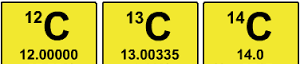
What do these isotopes of carbon all have in common?
a)
neutrons & mass number
b)
atomic number and neutrons
c)
atomic number and electrons
d)
protons, atomic number, and mass number
44.
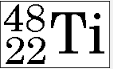
How many protons does this isotope of titanium have?
a)
48
b)
22
c)
26
d)
70
45.
How many neutrons does a Sodium 24 isotope have?
a)
12
b)
13
c)
14
d)
15
46.
How many neutrons does a Calcium 48 isotope have?
a)
16
b)
20
c)
28
d)
12
47.
How many neutrons does an Oxygen-19 isotope have?
a)
19
b)
8
c)
11
d)
10
48.

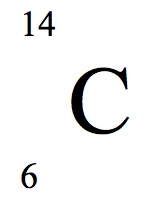
The photo above shows the isotopic notation for which isotope?

a)

Carbon 12

b)

Carbon 13

c)

Carbon 14

d)

Carbon 15

49.

An element has three isotopes. Given the abundances and relative masses, calculate the average atomic mass and determine (from the periodic table) which element it is.


Abundances | Relative masses

0.005% | 234.04 amu

0.720% | 235.04 amu

99.275% | 238.05 amu

a)

Uranium (#92, Atomic Mass: 238.03 amu)

b)

Fluorine (#9, Atomic Mass: 19.00 amu)

c)

Mercury (#89, Atomic Mass: 200.59 amu)

d)

Polonium (#84 209 amu)

50.
Four isotopes of lead include lead-204, lead-206, lead-207, and lead-208.  The average atomic mass of lead is 207.2.  Which isotope of lead is likely to be the most abundant.
a)
204
b)
206
c)
207
d)
208
51.

Rubidium has two naturally occurring isotopes, 85Rb (relative mass 84.9118 amu) and 87Rb (relative mass 86.9092 amu). The abundance of 87Rb is 27.8%, If rubidium has an average atomic mass of 85.47 amu, what is the % abundance of 85Rb (in percent)?

a)

27.9%

b)

72.1%

c)

74.63%

d)

34.29%

52.
What is the charge of an atom that has lost one electron?
a)
-1
b)
-2
c)
+1
d)
+2
53.
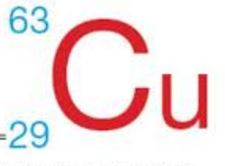
What is the atomic mass of Copper?
a)
63
b)
29
c)
34
d)
92
54.
What is the charge on a lithium atom that looses 1 electron?
a)
+1
b)
0
c)
-1
d)
-2
55.

A positively charged ion that has lost electrons to satisfy the octet rule

a)

Anion

b)

Cation

c)

Neutral Atom

d)

Isotope

56.

A negatively charged ion that has gained electrons to satisfy the octet rule

a)

Anion

b)

Cation

c)

Neutral Atom

d)

Isotope

57.

How many protons, neutrons, and electrons?

a)

proton = 6, neutron = 4, electron = 1

b)

proton = 4, neutron = 4, electron = 5

c)

proton = 1, neutron = 6, electron = 10

d)

proton = 4, neutron = 2, electron = 3

58.

How many protons, neutrons, and electrons?

a)

proton = 16, neutron = 8, electron = 10

b)

proton = 8, neutron = 16, electron = 8

c)

proton = 8, neutron = 8, electron = 10

d)

proton = 6, neutron = 2, electron = 6

59.

In the notation 8035 Br the number 35 is the

a)

atomic mass

b)

atomic number

c)

number of neutrons

d)

number of electrons

60.

Na ionizes to a charge of _______

a)

+1

b)

+2

c)

-1

d)

-2

61.

Be ionizes to a charge of ________.

a)

+1

b)

+2

c)

-1

d)

-2

62.

Sr ionizes to a charge of _________.

a)

+1

b)

+2

c)

-1

d)

-2

63.

O ionizes to a charge of ________.

a)

+1

b)

+2

c)

-1

d)

-2

64.

Cl ionizes to a charge of _________.

a)

-2

b)

-1

c)

+1

d)

+2

65.

I ionizes to a charge of _______.

a)

-1

b)

-2

c)

+1

d)

+2

66.
When an atom loses a valence electron, it becomes a(n) _____________ ion.
a)
positive
b)
negative
c)
neutral
d)
polyatomic
67.

What is the correct name for this polyatomic ion: CN

a)

carbonate

b)

cyanide

c)

chromate

d)

chromite

68.

What is the correct name for this polyatomic ion: OH

a)

hydrogen carbonate

b)

oxonium

c)

hydroxide

d)

acetate

69.

What is the correct name for this polyatomic ion: CrO42–

a)

chromate

b)

dichromate

c)

carbonate

d)

ammonium

70.

What is the correct name for this polyatomic ion: PO43–

a)

phosphorus tetroxide

b)

phosphate

c)

sulphate

d)

hydroxide

71.

What is the correct formula for the polyatomic ion called chlorate?

a)

ClO

b)

ClO2

c)

ClO3

d)

ClO4

72.

What is the correct formula for the polyatomic ion called hydrogen carbonate?

a)

HCO3

b)

CO32–

c)

CrO42–

d)

CN

73.
The energy of an electron __________ as it moves further away from the nucleus
a)
increases
b)
decreases
74.

Flame tests can be used to identify an element. Each element emits characteristic waves of light when it is heated in a flame. What describes how the light is produced?

a)

Protons in the ground state lose energy and give off light.

b)

Protons in the ground state gain energy and are emitted from the nucleus, giving off light.

c)

Electrons in the ground state lose energy and move to an excited state, giving off light.

d)

Electrons in the ground state gain energy, move to an excited state, and give off light when they return to the ground state.

75.

Ground state means that an electron is...

a)

at its lowest possible potential energy

b)

in the first shell of an atom

c)

laying low for the weekend

d)

removed from an atom

76.

When electrons in an atom go from the excited state to the ground state they release energy in the form of...

a)

heat

b)

light

c)

sound

d)

potential

77.

Which of the following shows an excited state electron configuration?

a)

2-7-1

b)

2-4

c)

2-8-4

d)

2-8-1

78.

Light is emitted when electrons ...

a)

return from high energy state to low energy state

b)

jump from low energy state to high energy state

c)

either of these

d)

none of these

79.
When an electron moves from a lower to a higher energy level, the electron ________________.
a)
gains a certain amount of energy
b)
gains any amount of energy
c)
loses energy
d)
moves closer to the nucleus
80.
Emission of light from an atom occurs when the electron ________.
a)
moves within its atomic orbital
b)
jumps from a lower to a higher energy level
c)
falls into the nucleus
d)
drops from a higher to a lower energy level
81.
For an electron to change from ground state to an excited stated it must...
a)
Absorb energy
b)
Release energy
82.

In an atom, an orbital represents

a)

the most probably location of a proton

b)

the most probable location of an electron

c)

the least probably location of a neutron

d)

photons emitted as electrons move to lower energy levels

83.

During a flame test, sodium chloride produces an intense yellow flame. This yellow color is produced when electrons in excited atoms

a)

are gained by the atoms

b)

are lost by the atoms

c)

move to higher energy states within the atoms

d)

move to lower energy states within the atoms

84.

An atom that has 8 protons and 10 neutrons is an isotope of the element

a)

nitrogen

b)

oxygen

c)

fluorine

d)

neon

85.

What is the overall charge of an ion that has 9 protons, 11 neutrons, and 10 electrons?

a)

+1

b)

-1

c)

+2

d)

-2

86.

Which electron configuration represents the atoms of a bromine atom in the excited state?

a)

2-8-18-7

b)

2-8-18-8

c)

2-8-17-8

d)

2-8-18-7-1

87.
Mg2+ and Cl- create...
a)
Mg2Cl
b)
MgCl2
c)
Mg2Cl2
d)
MgCl
88.
Ca2+ and N3- create...
a)
Ca2N3
b)
Ca3N2
c)
CaN3
d)
Ca2N
89.

Potassium and Sulfur create...

a)

KS

b)

KS2

c)

K2S

d)

K2S2

90.
Na +  and  S -2
a)
Na2S
b)
NaS2
c)
Na2S2
d)
NaS
91.
+  and  N-3
a)
KN
b)
KN3
c)
K3N3
d)
K3N
92.
How do the following two elements bond together?
Al3+  O2-         
a)
AlO
b)
Al2O3
c)
Al3O6
d)
Al3O2
93.
Name the following ionic compound: BeCl2
a)
beryllium chlorine
b)
beryllium II chloride
c)
beryllium chloride
d)
beryllium dichloride
94.
How many valence electrons are in an atom of phosphorus (P)?
a)
5
b)
4
c)
3
d)
2
95.
Metals tend to _____ electrons to form _______; nonmetals tend to _____ electrons to form ________.
a)
lose, cations ;   lose, anions
b)
gain, cations ;    lose, anions
c)
gain, anions ;    gain, cations
d)
lose, cations ;     gain, anions
96.

The unknown emissions spectra belongs to the element

a)

Hydrogen

b)

Mercury

c)

Neon

d)

Sodium

97.

The unknown emissions spectra belongs to the element

a)

Hydrogen

b)

Mercury

c)

Neon

d)

Sodium

98.
What gases are in the unknown mixture?
a)
Gas B & Gas D
b)
Gas C & Gas B
c)
Gas A & Gas D
d)
Gas D & Gas C
99.
Which elements are in the unknown sample?
a)
A and B
b)
B and C
c)
A and D
d)
B and D
100.

The unknown emissions spectra belongs to the element

a)

Hydrogen

b)

Mercury

c)

Neon

d)

Helium