
 Worksheets
Trimester 2 Final Review
Total questions: 76
Worksheet time: 1hrs 16mins

The scientific term explaining how the surfer changes position from where he is now to where he'll land below.
velocity
reference point
speed
motion

The arrows in the image best represents which of the following terms?
position
speed
reference point
vector

Assuming that all the vehicles in the image are moving at the same speed, which of the following is a good reference point that can be used to prove this?
The airplane
The bus
The sky
The road

You create an experiment to see which which size skateboard wheel goes the fastest. Which of the following is the dependent variable?
The type of skateboard used
The type of surface the skateboard is rolling on
The speed of the skateboard
The size of the skateboard wheel

You are interested in how fast Marcel the shell can walk. In order to find her speed you must do which of the following calculations?
Take the time Marcel walks and divide it by the distance she travels.
Take the distance Marcel walks and divide it by the time she takes.
Take the time Marcel walks and multiply it by the distance she travels.
Take the distance Marcel walks and add it to the time she takes.

Using the image provided, which of the following best describes the velocity of the basketball?
10 meters
3 seconds
4 m/s
4 m/s upward

Point A to point B on the map represents a change in...
speed
velocity
position
reference point

Forces that are equal in size but opposite in direction are called ___________________ forces.
Balanced
Equal
Newton's
Unbalanced

According to Newton's second law of motion, a larger force acting on an object causes a greater __________________ of that object.
Mass
Acceleration
Gravity
Friction

Acceleration depends on which two factors?
Mass and position
net force and mass
mass and velocity
position and net force
Lizzie is pushing Alex on a scooter. Lizzie is pushing with 75N of force to the left, and Alex is helping with 20 N to the left. What is the net force on the scooter?
95 N, to the right
95 N, to the left
55 N, to the right
55 N, to the left

Friction always acts in a direction ________________ to the direction of motion.
perpendicular
similar
opposite
parallel

Forces acting on a object that cause the object to accelerate.
Unbalanced forces
Balanced forces
Newton's forces
Mass forces
If a net force acts on an object, the object may change speed, change direction or do neither.
True
False

What is the net force on the object in the image.
20 N, to the left
20 N, to the right
4 N, to the right
4 N, to the left

Which of the following is NOT considered a way an object can accelerate.
Remain stationary
Slow down
Speed up
Change direction

Which example below describes Newton's First Law of Motion:
A large skateboarder requires more force to accelerate to 25 mph.
A skateboarder will bounce off the wall when they run into it
A skateboarder will continue to roll down a hill until a force stops them down.
A small skateboarder accelerates faster than a large skateboarder.

Which example below describes Newton's Second Law of Motion?
A football player sits on the bench until the coach calls upon him
When the kicker applies a force to the football, the football flies through the air.
A football player with the larger mass hits harder than a smaller player
A football player continues to run until tackled by another player

Which of the following defines Newton's 3rd law?
Objects in motion remain in motion unless acted upon by an outside force.
Acceleration depends on the mass of an object and the force applied to it.
When an object applies a force on another object, the second object applies a force of the same strength on the first object, but in the opposite direction.
The weight of an object depends on it's mass and the gravitational pull.

The forces in a force pair are in the _______ direction
opposite
same

Forces always act in equal and opposite pairs.
Newton's 1st Law
Newton's 2nd Law
Newton's 3rd Law

Which of the following demonstrates Newton's 3rd law?
A drone with a strong engine is able to accelerate faster than a drone with a weak engine.
If a drone runs out of battery, it will fall until something, like the ground, stops it.
A light drone is able to go faster than a heavy drone.
In order to fly, a drone pushes air down while the air pushes the drone up.

A player hits a ball with a bat. The action force is the impact of the bat against the ball. The reaction force is...
The grip of the player's hands on the ball
the air resistance of the ball
the force of the ball against the bat

A baseball player bats a ball with a force of 1,000 N. The ball exerts a reaction force (without any additional forces action on it) against the bat of...
Less than 1, 000 N
1,000 N in the same direction
More than 1,000 N
1,000 N in the opposite direction

What is the reaction force to a foot pushing down on the floor?
The foot going through the floor
The floor pushing back against the foot
The floor breaking to the foot

When a bug hits the windshield of a car, the force of the car on the bug equals the force of the bug on the car.
True
False
A force where one object applies a force to another object without touching it.
Noncontact force
Magnetism
Gravity

All of the above

The attractive force that exists between all objects that have mass.
Magnetism
Friction
Gravity
Net force

A region of space that surrounds the Earth allowing for gravity to work even when objects are not touching the surface of Earth.
Magnetism
Field
Force pairs
wizardry
The amount of matter in an object.
Weight
Gravity
Volume
Mass

What type of proportional relationship exists between mass and gravity?
Direct
Inverse
Converse
Dialect
As the distance between two objects increases, the attraction between them __________________.
increases
decreases
stays the same

What type of proportional relationship exists between distance and gravity?
Direct
Inverse
Converse
Inverted

Which of the following would most likely occur if the gravitational pull between the Sun and Earth suddenly stopped?
Earth would explode
The Sun would become cool
The Earth would stop spinning
The Earth would continue traveling in a straight line through space

Your weight is determined by which two variables?
friction and mass
mass and gravity
gravity and friction
gravity and Newtons

Why you would weigh less on the Moon than you do on Earth.
You have more mass on the Earth than you do on the Moon
There is less gravity on the Moon than there is on Earth.
You have more mass on the Moon than you do on Earth.
There is more gravity on the Moon than there is on Earth.

There is gravitational force between you and your desk. This gravitational force is very small because...
the masses are tiny compared to Earth's mass
it doesn't need to be large
the distance between the objects is small
it is a noncontact force
Mass and weight are different. Mass depends on __________. Weight depends on ____________.
gravitational force, the amount of matter
placement, force
force, placement
the amount of matter, gravitational force
If the mass of one of two spheres increases, how does it affect the gravity between the two spheres?
The gravity increases
The gravity decreases
The gravity fluctuates
The gravity is not affected

The gravitational force from Planet A on the star is shown in the model. How should the arrow that represents the gravitational force from the star on Planet A be represented?
It should point from Planet A toward the star and will be longer because the star has more mass.
It should point from Planet A toward the star and will be the same size because it is an equal and opposite force.
It should point from Planet A toward the star and will be the smaller because Planet A has less mass.
There is no arrow to represent because gravitational force is only in one direction.
As mass increases, kinetic energy...
increases
decreases
stays the same
Which has a greater impact on kinetic energy?
mass
velocity (speed)
As the velocity (speed) of an object decreases its kinetic energy will...
increase
decrease
stay the same
Why is it harder to stop a four-person bobsled than a three-person bobsled?
the four-person sled has more kinetic energy
the four-person sled has less kinetic energy
energy of motion
kinetic energy
potential energy
movement
work
The speed of a shopping cart is increased by a factor of 2 once it's pushed into the parking lot. The kinetic energy has been increased by a factor of what?
2
4
unable to determine
no change to the kinetic energy
The mass of a shopping cart is increased by a factor of 3 once it's been filled with groceries. The kinetic energy has been increased by a factor of what?
3
6
9
no change to the kinetic energy
What is potential energy?
The energy an object has due to its atomic structure.
The energy an object has due to its chemical composition.
The energy an object has due to its motion.
The energy an object has due to its position or condition.
Which object has the most potential energy?
A ball resting on the ground.
A ball being thrown at 100 miles per hour.
A ball on top of a refrigerator.
A ball resting on the edge of a cliff.
Which is the best synonym for potential energy?
Stored energy
Energy of motion
Energy due to gravity
Mechanical energy
A kite stuck in a tree has ______ energy due to its position.
Potential
Kinetic
Chemical
Thermal

A rubber ball is dropped and bounces back up. The ball's potential energy _______.
Is greater at C than at A
Is the same at its kinetic energy at A
Is at its maximum at A
Is zero at B
Energy stored because of gravity is called:
Gravitational Potential Energy
Kinetic Energy
Mechanical Advantage
Chemical Energy
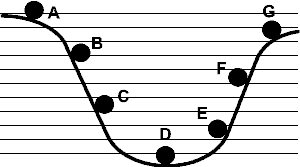
At which point does the ball has the greatest gravitational potential energy (GPE)?
A
G
D
C
Which would have the LEAST gravitational potential energy (GPE)?
A ball sitting on the ground
Moon viewed from the Earth
An airplane flying 30,000 feet above the ground
A rock sitting on top of Mt. Everest
How could you increase the gravitational potential energy of an object without changing its mass and gravity?
Make the object larger
Lower the object towards the ground
Raise the object farther off the ground
Allow the object to roll on the ground
If an object is on top of a hill or in a position raised above the ground, it must have __________.
Kinetic energy
Gravitational potential energy
Elastic potential energy
Chemical potential energy
Gravitational potential energy depends on which two factors?
mass and height above the ground
distance and speed
speed and height above the ground
mass and speed

Four cars are positioned at the top of a hill. Which car has the most potential energy?
A
B
C
D

What kind of energy is in a moving skateboard?
Potential
Kinetic

What energy does a rock at the edge of a cliff have?
Potential
Kinetic
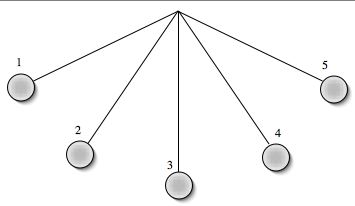
When a pendulum swings, at which point is kinetic energy greatest?
1
2
3
4
The Law of Conservation of Energy states that energy cannot be ________ or ________, but it can change from one form to another.
created, destroyed
gravity, force
heat, created
Which of the following is an example of kinetic energy decreasing as the gravitational potential energy increases?
a person parachuting out of a plane
a car racing around an oval track
a person skiing down a hill
a person walking up a hill

At which point is potential energy greatest?
W
X
Y
Z
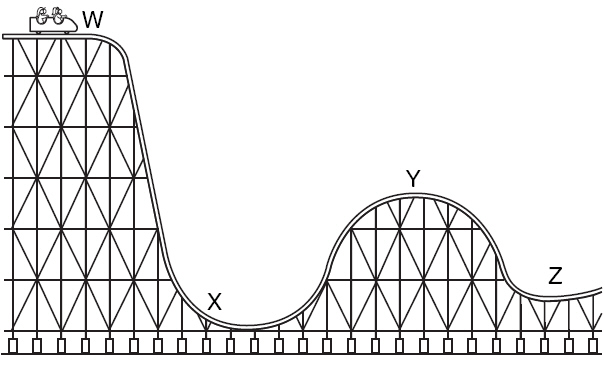
At which point is the kinetic energy the greatest?
W
X
Y
Z

What position has the least amount of potential energy?
W
X
Y
Z

The sum of potential energy and kinetic energy equals
work
transformation
total energy
mechanical energy

The picture is demonstrating an example of ______ .

The picture is an example of _____ .

