Wayground logo

Free Printable Worksheets

Font size

S
M
L
XL
Worksheets

BIOLOGY SELF-ASSESSMENT

Total questions: 120

Worksheet time: 2hrs 34mins

Name
Class
Date
1.
a)
Cell membranes are fluid and able to stretch and move as needed. 
b)
Cell membranes are composed of cellulose which make them rigid.
c)
Cell walls control the movement of materials into and out of the cell.
d)
Cell walls are constructed of a lipid bilayer with proteins embedded. 
2.
a)
The cell wall performs photosynthesis.
b)
The cell wall stores DNA.
c)
The cell wall provides structural support.
d)
The cell wall manufactures proteins. 
3.
a)
ribosome; assembles amino acids to make proteins
b)
chloroplast; captures sunlight and converts it to chemical energy
c)
vacuole; stores water, salts, proteins, and carbohydrates
d)
mitochondrion; converts chemical energy into useable energy
4.
a)
The cell's ability to make proteins.
b)
The cell's ability to release energy.
c)
The cell's ability to control what enters and leaves.
d)
The cell's ability to store excess water and nutrients. 
5.
a)
chloroplast
b)
mitochondrion
c)
ribosome
d)
vacuole
6.

What surrounds the cytoplasm of all cells and controls what goes in and out of the cell?

a)

Cell Membrane

b)

Cell Wall

c)

Cellophane

d)

Cellulose

7.

What fluid can be found in cells that holds organelles?

a)

Blood

b)

Plasma

c)

Chlorine

d)

Cytoplasm

8.

Which of the following are components of cell theory?

a)

Cells must contain DNA

b)

All living things are made of cells

c)

Cells only come from other cells

d)

Cells are the basic unit of life

9.

What is the process in which a plant makes usable energy?

a)

ATP

b)

Cellular Respiration

c)

Oxygen

d)

Transmission

10.

Where does photosynthesis occur?

a)

Chloroplast

b)

Glucose

c)

Nucleus

d)

Mitochondria

11.

During cellular respiration sugar is turned into (a)   .

12.

What do plants make during photosynthesis?

a)

Water

b)

CO2

c)

Sugar

d)

Oxygen

13.
What is the cell cycle?
a)
The gradual development of something, especially from a simple to a more complex form.
b)
The study of heredity and the variation of inherited characteristics.
c)
The branch of biology that deals with the relations of organisms to one another and to their physical surroundings.
d)
The series of events that take place in a cell leading to its division and duplication of its DNA to produce two daughter cells.
14.
Which part of the Cell Cycle takes the longest?
a)
Interphase
b)
Mitosis
c)
Prophase
d)
Cytokinesis
15.
What happens in the first part of Interphase?
a)
Mitosis
b)
Cell Growth
c)
DNA Replication
d)
Anaphase
16.
What part of the cell cycle results in the splitting of the new cells?
a)
Interphase
b)
Mitosis
c)
Metaphase
d)
Cytokinesis
17.
What does DNA Replication mean?
a)
DNA is made.
b)
DNA makes new cells. 
c)
DNA copies itself.
d)
DNA starts the cell cycle.
18.
True or False. 
After a cell goes through cytokinesis, it starts mitosis all over again.
a)
True
b)
False
19.
True or False.
Mitosis is a continuous process.
a)
True
b)
False
20.
What phase is this cell in?
a)
Cytokinesis
b)
Mitosis
c)
Prophase
d)
Metaphase
21.
What phase is this cell in?
a)
Mitosis
b)
Interphase
c)
Anaphase
d)
Telophase
22.
What phase is this cell in?
a)
Mitosis
b)
Cytokinesis
c)
Prophase
d)
Telophase
23.
What phase is this cell in?
a)
Mitosis
b)
Interphase
c)
Prophase
d)
Telophase
24.
What is the longest phase in MITOSIS?
a)
Prophase
b)
Metaphase
c)
Interphase
d)
Anaphase
25.
In what phase does chromatin condense to form chromosomes?
a)
Mitosis
b)
Interphase
c)
Prophase
d)
Anaphase
26.
In what phase do the organelles disperse out into the daughter cells, and the cell prepares for cytokinesis?
a)
Prophase
b)
Interphase
c)
Mitosis
d)
Telophase
27.
In what phase do the chromosomes get pulled apart into sister chromatid to opposite sides of the cell?
a)
Prophase
b)
Interphase
c)
Metaphase
d)
Anaphase
28.
What can the cell cycle also be called?
a)
Cell growth
b)
DNA Replication
c)
Preparation for Mitosis
d)
Cell Divison
29.

Which of the following is a result of a nondisjunction?

a)

Klinefleter syndrome

b)

Sickle cell anemia

c)

Cystic fibrosis

d)

Hemophilia

30.

Which of the following best describes the cause of cystic fibrosis?

a)

a mutated blood clotting protein

b)

a mutated transport protein

c)

an extra 21st chromosome

d)

an extra 13th chromosome

31.

Which of the following is an autosomal recessive disorder?

a)

Huntington's disease

b)

sickle cell anemia

c)

colorblindness

d)

Hemophilia

32.

Which of the following is a autosomal dominant disorder?

a)

Huntington's

b)

Cystic fibrosis

c)

Hemophilia

d)

Sickle cell anemia

33.

Which of the following is a sex-linked disorder?

a)

Hemophilia

b)

Sickle cell anemia

c)

Cystic fibrosis

d)

Huntington's

34.

Which of the following is a chromosomal mutation?

a)

insertion

b)

frameshirt

c)

substitution

d)

nondisjunction

35.

Which of the following is NOT caused by a gene mutation?

a)

Turner's syndrome

b)

Sickle cell anemia

c)

Cystic fibrosis

d)

Hemophilia

36.
Which statement best describes the cell membrane?
a)
The protective outer layer that controls what enters and leaves the cell.
b)
Stores information on DNA molecules / Directs and controls the activities of the cell.
c)
A folded membrane that moves materials around inside cells / Also acts as the site of manufacturing materials needed by the cell.
d)
The smallest organelle with a huge job / Makes proteins, which are the building blocks of the body.
37.
What is NOT TRUE about the cell membrane?
a)
It controls what enters and leaves the cell
b)
Semipermeable
c)
Phospholipid bilayer
d)
Contains digestive enzymes
38.
What forms the channels and pumps in the phospholipid bilayer?
a)
Carbohydrates
b)
Proteins
c)
Hydrophilic heads 
d)
Lipids
39.
True or False:  Regulating what enters and leaves the cell helps the cell maintain homeostasis. 
a)
True
b)
False
40.
Hydrophobic region of the cell membrane?
a)
E
b)
B
c)
C
d)
A 
41.
The picture is an example of...
a)
active transport
b)
passive transport
c)
diffusion
d)
osmosis
42.
What does a cell need to transport particles by active transport?
a)
Sun
b)
Wind
c)
Energy
d)
Channels
43.
What does the "fluid mosaic model" mean about the cell membrane?
a)
It can dissolve into fluid.
b)
The cell is mostly made of mosaic molecules.
c)
It looks like a flexible pattern made up of different parts.
d)
Somebody else should name these things.
44.
Osmosis uses a channel protein called AQUAPORIN.  What type of transport is this? *Think!
a)
Diffusion
b)
Facilitated Diffusion
c)
Active Transport
d)
Endocytosis
45.
What is one major difference between passive and active transport?
a)
Passive transport uses energy; active transport does not.
b)
Both types of transport use energy.
c)
Active transport uses energy; passive transport does not.
d)
No difference. They are both the same.
46.
Small, non-polar molecules like CO2 and O2 and NO can pass through the cell membrane using what type of transport?
a)
Diffusion
b)
Osmosis
c)
Facilitated Diffusion
d)
Endocytosis
47.

Which of these compounds is not an acid?

a)

HCl

b)

NaOH

c)

HNO3

d)

H2SO4

48.

The Product is...

a)

H2CO3

b)

H2CrO4

c)

H2C2O4

d)

HCO3

49.

Which of the following is carried by a red blood cell throughout the body?

a)

Glucose

b)

Carbon Dioxide

c)

Oxygen

d)

Both Carbon Dioxide AND Oxygen

50.

Which of the following substance does a muscle cell need in order to function?

a)

Glucose

b)

Oxygen

c)

Carbon dioxide

d)

Both glucose and oxygen only

51.

Which of the following is NOT TRUE about our body's systems?

a)

The digestive system provides the energy that the muscular system needs to move and function

b)

The circulatory system brings the red blood cells to the lungs so that carbon dioxide can be dropped off and oxygen picked up

c)

The skeletal systems sends signals throughout the entire body.

d)

The muscular system helps us walk, move and sit up

52.
Which major macromolecule is being represented in this image? 
a)
carbohydrate
b)
lipid
c)
protein
d)
nucleic acid
53.
Which of the following contains the genetic code for protein synthesis?
a)
carbohydrate
b)
lipid
c)
protein
d)
nucleic acid
54.
What type of macromolecule is being represented in this image? 
a)
carbohydrate
b)
lipid
c)
protein
d)
nucleic acid
55.
What are the building blocks of proteins?
a)
amino acid
b)
fatty acid
c)
nucleotide
d)
lipid
56.
What are the single sugars that are the building blocks of carbohydrates?
a)
monosaccharides
b)
disaccharides
c)
polysaccharides
d)
amino acid
57.
Which of the four major biological macromolecules can be easily identified by the nitrogen base and phosphate found in its structure?
a)
carbohydrate
b)
lipid
c)
protein
d)
nucleic acid
58.
What are the reactants of cellular respiration?
a)
glucose & carbon dioxide
b)
glucose & oxygen
c)
water & oxygen
d)
water & carbon dioxide
59.
In which way are photosynthesis and cellular respiration different?
a)
Cellular respiration stores ATP, while photosynthesis releases ATP.
b)
Cellular respiration produces oxygen, while photosynthesis uses oxygen.
c)
Photosynthesis releases energy, while cellular respiration stores energy.
d)
Photosynthesis uses carbon dioxide, while cellular respiration produces carbon dioxide.
60.
The purpose of cellular respiration is to 
a)
make water
b)
make ATP
c)
make glucose
d)
make  oxygen
61.
What is the correct equation for cellular respiration?
a)
6O2 + C6H12O6 -> 6CO2 + 6H2O + Energy
b)
6O2 + C6H12O6 + Energy -> 6CO2 + 6H2O
c)
6CO2 + 6H2O -> 6O2 + C6H12O6 + Energy
d)
6CO2 + 6H2O + Energy -> 6O2 + C6H12O6
62.
If oxygen is not present what process will occur in yeast cells?
a)
Alcoholic fermentation
b)
Respiration
c)
Photosynthesis
d)
Lactic acid fermentation
63.

Which of these is a product of cellular respiration?

a)

ATP

b)

Carbon dioxide

c)

Water

d)

All of these are a product of cellular respiration

64.
Which process produces the most ATP per molecule of glucose?
a)
lactic acid fermentation
b)
aerobic respiration
c)
alcoholic fermentation
d)
all are about the same
65.
In cellular respiration, the electron transport chain takes place in
a)
the membrane of the mitochondrion
b)
the folds of the mitochondrion
c)
the cytoplasm
d)
the cell nucleus
66.
When a phosphate group is removed from an ATP molecule, 
a)
a substantial amount of energy is released
b)
an enzyme is formed
c)
energy is stored
d)
activation energy is increased
67.
When glycolysis occurs,
a)
a molecule of glucose is split
b)
two pyruvate are made
c)
some ATP is produced
d)
all of these
68.
In the presence of oxygen, cellular respiration takes place in two stages. They are
a)
glycolysis and fermentation
b)
electron transport chain, then fermentation
c)
glycolysis, then aerobic respiration
d)
glycolysis, then the Calvin cycle
69.
Cells produce ATP most efficiently in the presence of
a)
water
b)
carbon dioxide
c)
oxygen
d)
radiant energy
70.
Which of the following processes creates the most ATP during aerobic cellular respiration?
a)
glycolysis
b)
fermentation
c)
electron transport chain
d)
Kreb's cycle
71.
Fermentation enables glycolysis to continue under 
a)
anaerobic conditions
b)
aerobic conditions
c)
photosynthetic conditions
d)
hydrophobic conditions
72.
After intense activity, your muscles feel sore because of 
a)
the accumulation of NAD+
b)
the accumulation of lactic acid 
c)
the accumulation of ATP
d)
the accumulation of carbon dioxide
73.

(a)   is an example of biodiversity with different communities where organisms live close

74.

What is/are example of prokaryotic organism

a)

Bacteria

b)

Blue-green algae

c)

Red algae

d)

Plasmodium

75.

What groups of organisms are most in danger of extinction?

a)

those with small populations

b)

those that migrate or need special habitats

c)

those with large populations that breed quickly

76.

A beneficial relationship between 2 organisms/species.

a)

symbiotic (mutualism)

b)

parasitic

c)

commensalism

d)

predatory

77.

Cattle egrets forage (feed) in fields among cattle. The egret gets easy access to flying insects stirred up by the cattle, and the cattle don't care if they are there or not.

a)

mutualism

b)

commensalism

c)

competition

d)

parasitism

78.

What level of biodiversity is most commonly equated with the overall concept of biodiversity?

a)

genetic

b)

ecosystem

c)

species

79.

Why is biodiversity important to ecosystems?

a)

It helps populations adapt to ecological changes.

b)

It increases at each level of the food chain.

80.

Food Web B is an example of...

a)

Low biodiversity and low sustainability. If the producer dies then all the food web will suffer.

b)

High biodiversity and high sustainability. If an organism is removed the food web will continue with no effect.

81.

Who described DNA as a double helix?

a)

Rosalind Franklin

b)

Watson and Crick

c)

Friedrich Meischer

d)

Erwin Chargaff

82.
Which do DNA and RNA have in common?
a)
Both are double stranded.
b)
Both contain ribose molecules.
c)
Both contain phosphate groups.
d)
Both contain uracil.
83.
What is the complimentary mRNA sequence to the DNA sequence A-T-T-G-C-A.
a)
T-A-A-C-G-T
b)
U-A-A-C-G-T
c)
U-A-A-C-G-U
d)
T-A-A-G-C-U
84.
Which defines a codon in DNA or mRNA?
a)
pair of nucleic acid and sugar
b)
pair of phosphate and sugar
c)
three-base code
d)
two-base code
85.
Any change in the sequence of DNA is...
a)
transgenic shift
b)
Single Genotype
c)
Monohybrid Trait
d)
Mutation
86.
In RNA, the nitrogen base____ replaces ____ that was present in DNA. 
a)
A, U (adenine, uracil)
b)
C, G (cytosine, guanine)
c)
U, T (uracil, thymine)
d)
U, A (uracil, adenine)
87.
A molecule of DNA is made up of _________.
a)
amino acids and proteins
b)
ATP and enzymes
c)
paired nucleotides
d)
receptor enzymes
88.
If the structure of DNA were likened to a ladder, what would make up the “supporting structure” (not the “rungs”) of the ladder?
a)
amino acids and sugars
b)
nucleotide bases, including thymine
c)
nucleotide bases, including uracil
d)
sugar-phosphate molecules
89.
What mutation has occurred here? 
T-G-A-C-C-A
T-G-A-G-C-A
a)
Substitution
b)
Deletion
c)
Insertion
d)
Frameshift 
90.

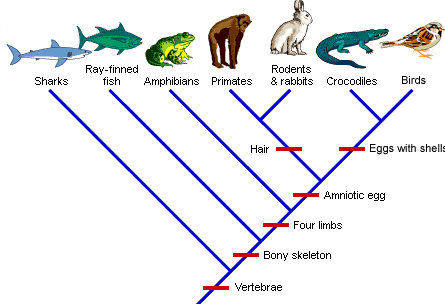
According to this cladogram, sharks are MOST closely related to which organism?

a)

Amphibians

b)

Ray-Finned Fish

c)

Primates

91.

You look at two species and see very similar DNA. What does this likely tell you?

a)

These are the same animal.

b)

These animals are not likely related.

c)

These animals have a common ancestor.

92.

An inherited characteristic that increases an organisms ability to survive and reproduce in its specific environment is called a(n)

a)

vestigial structure

b)

analogous structure

c)

adaptation

93.

What number is the common ancestor of C and D

a)

1

b)

2

c)

4

94.

_________________ is an evolutionary tree is a branching diagram or "tree" showing the inferred evolutionary relationships among various biological species or other entities.

a)

Line graph

b)

Cladistics

c)

Phylogenetic tree

95.

Which two orgainsms have hair?

a)

Sharks & Ray Finned Fish

b)

Primates & Rodents

c)

Birds & Crocodiles

96.
The genotype of the affected son and daughter at the bottom of this pedigree...
a)
could be homozygous dominant
b)
could  be homozygous recessive
c)
could be heterozygous
d)
Can't tell
97.
What is the genotype of the great-grandfather? (Individual 2)
a)
A_
b)
aa
c)
Aa
d)
AA
98.
What is the mode of inheritance shown here?
a)
Sex Linked Recessive
b)
Autosomal Dominant
c)
Autosomal Recessive
d)
Sex Linked Dominant
99.
Cystic fibrosis is an autosomal recessive trait.  What must be the genotypes of Carla's parents?
a)
CC and cc
b)
Cc and Cc
c)
Cc and cc
d)
CC and CC
100.

A change in a gene pool due to chance.

a)

Genetic drift

b)

gene pool

c)

Founder effect

d)

Bottleneck effect

101.
Which of the following is an example of the founder effect?
a)
Bald Eagles are hunted until near extinction, population recovers.
b)
Small group of iguanas floats to an island, starts a new population.
c)
Red fox pups are more likely to survive in a snowy environment if they are born white.
d)
Farmer chooses seeds from largest apples to plant next year.  This results in larger apples from year to year.
102.
Which of the following is an example of the bottle neck effect?
a)
Bald Eagles are hunted until near extinction, population recovers.
b)
Small group of iguanas floats to an island, starts a new population.
c)
Red fox pups are more likely to survive in a snowy environment if they are born white.
d)
Farmer chooses seeds from largest apples to plant next year.  This results in larger apples from year to year.
103.
A wide range of phenotypic variations occur in the trait for human height.  Which of the following accounts for these variations?
a)
Polygenic Inheritance
b)
Codominance
c)
Incomplete dominance
d)
Multiple Alleles
104.
Miller/Urey and other scientists have shown that:
a)
 Life on early Earth required material from space
b)
Cells survived in the primitive atmosphere
c)
Amino acids could be produced from inorganic molecules 
d)
Simple cells can be produced in a laboratory
105.
The idea that Earth's early oceans had organic molecules that became the first life is called the...
a)
Primordial soup hypothesis
b)
Bubble hypothesis
c)
Miller-Urey Experiment
d)
Radioactive dating theory
106.
Which of the following supports the hypothesis of an “RNA world” on early Earth?
a)
Some RNA molecules are important catalysts in modern cells.
b)
The oldest known fossils contain trace amounts of RNA.
c)
Single-stranded RNA molecules are linear and do not form three-dimensional shapes.
d)
RNA is the primary genetic material of many viruses.  
107.

these plants have a system of tubes to carry water and nutrients from the roots to the leaves

a)

mosses

b)

vascular

c)

non-vascular

d)

tropisms

108.

these plants are non-vascular and seedless

a)

mosses

b)

ferns

c)

conifers

d)

flowering plants

109.

ALL plants are

a)

eukaryotic

b)

prokaryotic

c)

unicellular

d)

mutlicellular

110.

Plants respond to stimuli such as light, touch, water or gravity. This is called a

a)

tropism

b)

dispersal

c)

hormone

d)

photosynthesis

111.

This group of plants is vascular and seedless. They reproduce with spores under their fronds.

a)

mosses

b)

ferns

c)

gymnosperms

d)

angiosperms

112.

This group of plants is vascular and has seeds in cones. The name means "naked seeds."

a)

mosses

b)

ferns

c)

gymnosperms

d)

angiosperms

113.

Gymnosperms all have 2 important characteristics that make them very unique. They are:

a)

flowers

b)

cones

c)

needles

d)

seed coats

114.

Which group does NOT have roots?

a)

mosses

b)

ferns

c)

gymnosperms

d)

angiosperms

115.

Animal having a water canal system and spicules

a)

Pleurobrachia

b)

Antedon

c)

Spongilla

d)

Aurelia

116.

Homeotherms are called

a)

Cold blooded animals

b)

Warm blooded animals

c)

Polar animals

d)

Tropical animals

117.

Pouch formation from gut is in

a)

Enterocoelom

b)

Schizocoelom

c)

Pseudocoelom

d)

Acoelom

118.

The parasite that cause elephantiasis

a)

Filarial worm

b)

Round worm

c)

Tapeworm

d)

Hookworm

119.
All protists are __________________________.
a)
Prokaryotic
b)
Eukaryotic
c)
Unicellular
d)
Multicellular
120.
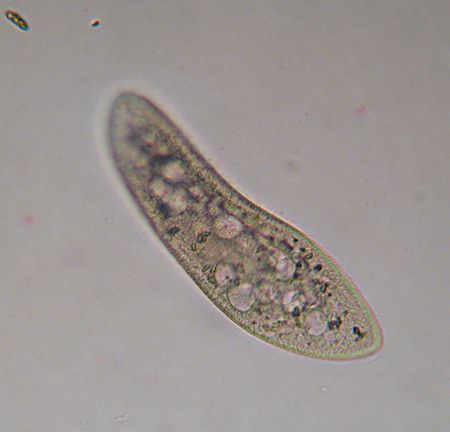
The image shows a paramecium. What structure is utilized by the paramecium for movement?
a)
Cilia
b)
Flagella
c)
Pseudopods
d)
Pili