wayground logo

Free Printable Worksheets

Font size

S
M
L
XL
Worksheets

General Review 1 - Advance Genetics and Evolution Playlist

Total questions: 110

Worksheet time: 1hrs 21mins

Name
Class
Date
1.

"T" is dominant, "t" is recessive. If an organism has the genes "Tt."

Which will trait will result?

a)

"T" dominant

b)

"t" recessive

2.

"G" is dominant, "g" is recessive. If an organism has the genes "gg."

Which will trait will result?

a)

"G" dominant

b)

"g" recessive

3.

Emily has brown hair.

Which most likely explains why Emily has brown hair?

a)

Emily’s favorite color is brown.

b)

Emily has a parent with brown hair.

c)

Emily’s older brother has brown hair.

4.

What should you use to predict the traits of offspring when you know the genes of two parents?

a)

a graph

b)

a flow chart

c)

a data table

d)

a Punnett square

5.

Which statement best supports why many offspring look similar to their parents?

a)

Offspring inherit traits from only one parent.

b)

Offspring inherit traits from both parents.

c)

Parents choose which traits to pass on to their offspring.

6.

A single gene has 3 or more alternative forms. These are called

a)

heterozygotes

b)

multiple alleles

c)

epistatic

d)

polygenic

7.
In mice, the homozygous mice are black and white. The heterozygous mice are gray. What pattern of inheritance is expressed in fur color in mice?
a)
complete dominance and recessiveness
b)
co-dominance
c)
incomplete dominance
d)
pleiotropy
8.
If this image were real, it would represent what type of inheritance?
a)
incomplete dominance
b)
codominance
c)
polygenic inheritance
d)
compete dominance
9.
AB blood type is an example of what type of inheritance?
a)
complete dominance
b)
incomplete dominance
c)
codominance
d)
polygenic inheritance
10.
A red flowered plant (RR) breeds with a White flowered plant (WW). The gene for petal color in these plants expresses incomplete dominance.  What percentage of the offspring will have pink (RW) flowers?
a)
0%
b)
25%
c)
50%
d)
100%
11.
Aa, DD, bB, yy are all examples of
a)
genotypes
b)
phenotypes
12.
What you see, or the physical appearance.
a)
Genotype
b)
Phenotype
c)
Homozygous
d)
Heterozygous
13.
This is an example of ___________?
a)
Incomplete dominance
b)
Co-Dominance
14.
What type of inheritance is shown?
a)
complete
b)
incomplete
c)
codominance
d)
sex-linked
15.
What do you call the non-Mendelian inheritance pattern that states that neither trait is dominant and the traits appear to blend together?
a)
Codominance
b)
Incomplete dominance
c)
Polygenic traits
16.
Homozygous is when...
a)
the alleles are the same
b)
the alleles are different
c)
the alleles are absent
d)
the alleles are present
17.
Heterozygous is when...
a)
the alleles are the same
b)
the alleles are different
c)
the alleles are absent
d)
the alleles are present
18.
Blood types are an example of co dominance and
a)
incomplete dominance
b)
sex linked traits
c)
multiple alleles
d)
polygenics
19.
This is when a trait is controlled by more than one gene.
a)
Multiple alleles
b)
Polygenetic inheritance
c)
Codominance
d)
Incomplete Dominance 
20.

Why do scientist use Punnett Squares?

a)

A tool scientist use to to see alleles

b)

A tool scientist use to see which alleles are dominant

c)

A tool scientist use to determine possible genotypes for offspring

21.

Which of the following is a Homozygous Dominant Genotype?

a)

Yy

b)

XX

c)

zz

22.

Which of the following is a homozygous recessive genotype?

a)

HH

b)

dd

c)

Aa

23.

Which of the following is a heterozygous genotype?

a)

Gg

b)

UU

c)

pp

24.

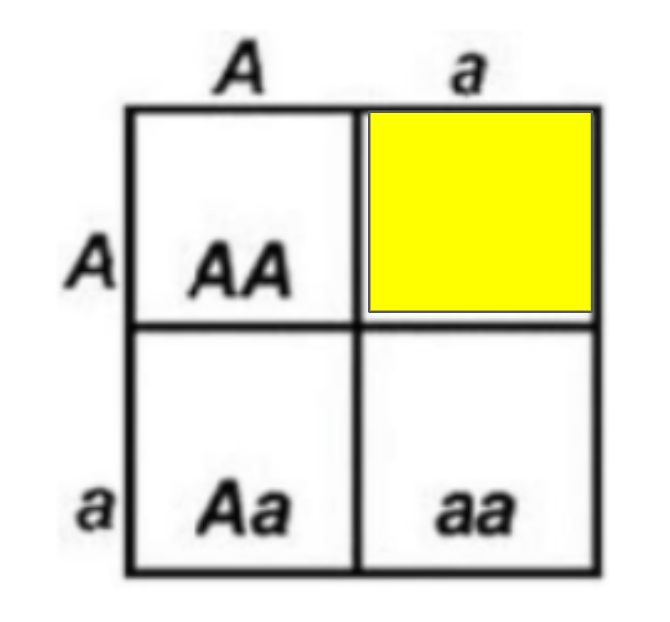
Fill in the Yellow Box

a)

AA

b)

Aa

c)

aa

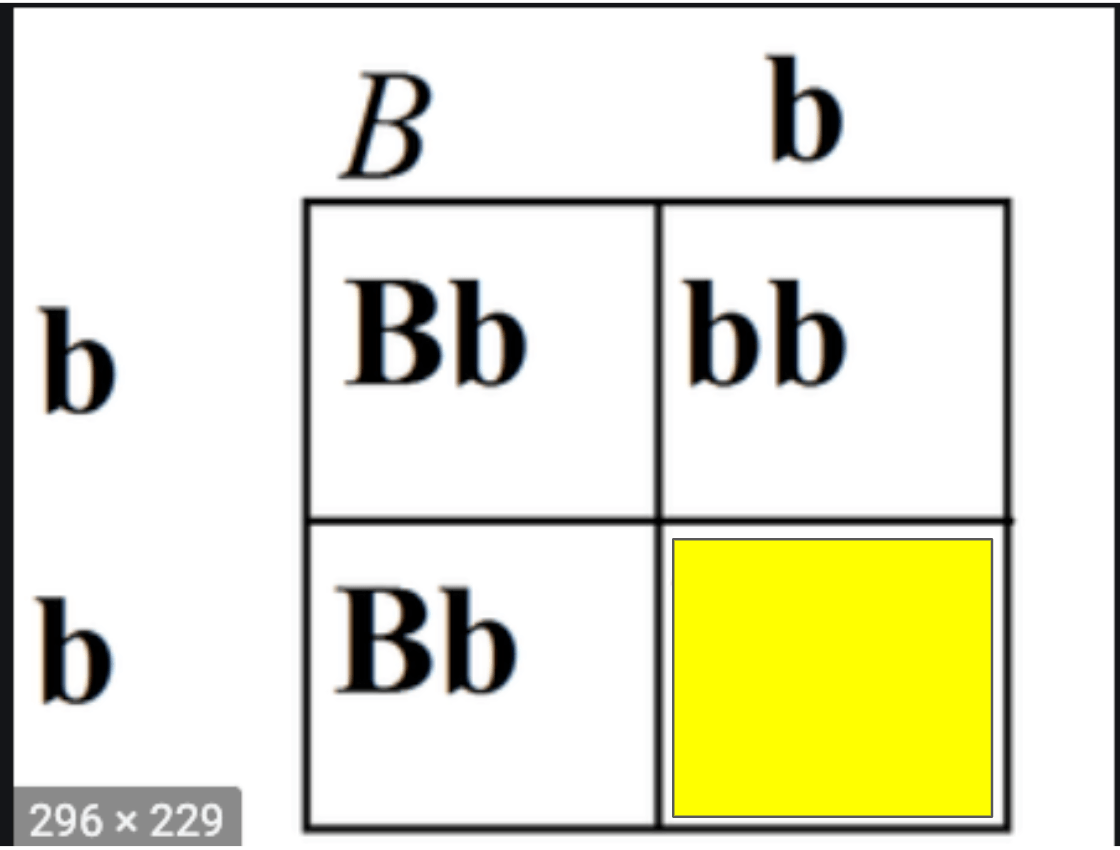
25.

Fill in the Yellow Box

a)

Bb

b)

BB

c)

bb

26.

How chance the offspring born from this cross will have a homozygous dominant genotype?

a)

25%

b)

50%

c)

75%

d)

100%

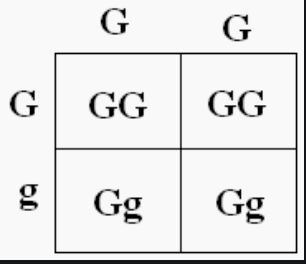
27.

The punnett square is used to tell the color of a frogs skin. "G" means green skin and "g" means brown skin. What is the chance the baby frogs will have brown skin?

a)

0%

b)

25%

c)

50%

d)

100%

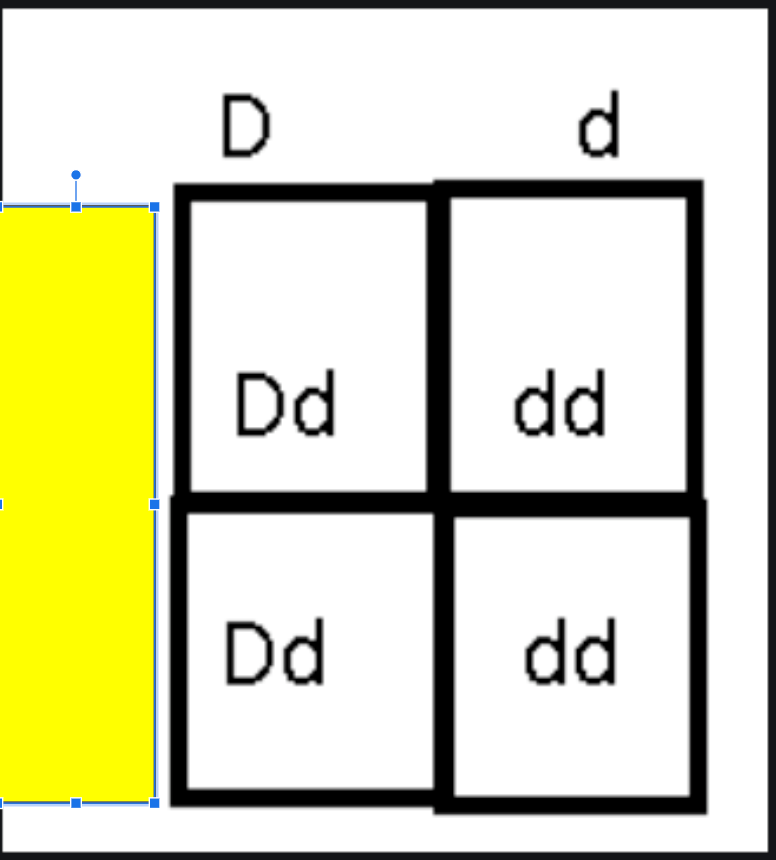
28.

What is the mother's genotype?

a)

DD

b)

Dd

c)

dd

29.

G = green, g = yellow

The genotype for a yellow plant is...

a)

GG

b)

Gg

c)

gg

d)

all of the choices result in yellow

30.

In plants, tall (T) is dominant to short (t). Perform the following cross: Tt x Tt. What is the probability of producing a short plant?

a)

0%

b)

25%

c)

50%

d)

75%

31.

Which of the following alleles is purebred recessive?

a)

Tt

b)

tt

c)

TT

32.

Each one of the boxes on the Punnett square represents what probability of an offspring's genotype?

a)

25%

b)

1%

c)

10%

d)

0%

33.

Brown eyes are dominant over blue eyes. What is the probability that the offspring will have brown eyes in this cross?

a)

25%

b)

50%

c)

75%

d)

100%

34.
Dominant or recessive?
tt
a)
Dominant 
b)
Recessive
35.
Dominant or recessive?
Dd
a)
Dominant
b)
recessive
c)
neither
d)
homozygous
36.
What are the possible combinations of a pea plant with the alleles PP and a male pea plant with the alleles pp.
P= purple
p= white
a)
all Pp
b)
all PP
c)
Pp,PP,Pp,PP
d)
all pp
37.
What is a genome?
a)
The complete haploid amount of genetic material present in a cell or organism
b)
A garden ornament 
c)
The sum of all human material.
d)
A totally unique set of genetic material not shared with anything else
38.
The study of the genome is known as
a)
Biology
b)
Genomics
c)
Genes
d)
Heredity
39.
What year was the Human Genome Project (HGP) started?
a)
1990
b)
1999
c)
2003
d)
1987
40.
The main goal of the Human Genome Project (HGP) was to:
a)
Identify the unique parts of each person's DNA.
b)
Identify genes responsible for human diseases.
c)
Identify genes responsible for human behavior.
d)
Determine the entire sequence of human DNA.
41.
What is DNA sequencing?
a)
The total of genes carried by an individual or cell
b)
Coding genes in order to identify single nucleotide polymorphisms
c)
Deciphering the functions of various parts of the human genome
d)
The process of identifying the order of the bases in DNA
42.
Which best describes the impact that the Human Genome Project (HGP) has had on society?
a)
It has helped scientists determine that certain genes can cause diseases 
b)
It has led to discrimination against genetically flawed individuals
c)
It has led to the appearance of new diseases
d)
It has cost society billions of dollars without any major benefits
43.
The genomes of two unrelated humans are ___% the same.
a)
90.0
b)
0.1%
c)
78%
d)
99.9%
44.
Identify an application of genetic sequencing below:
a)
Improved and more accurate diagnosis of inherited disorders due to single genes
b)
Providing personalised medication and treatment depending on the genetic combination
c)
Determine evolutionary relationships between species
d)
All of the above
45.

The complete genomes of many organisms have been sequenced. The table shows the number of genes and base pairs in the genome of several species, as well as their haploid chromosome number (n). Which organism has the largest number of base pairs (bp) in their genome?

a)

Rice

b)

Capsicum

c)

Human

d)

Horse

46.
A way to cure genetic disorders by inserting normal genes into cells with mutant genes.
a)
gene therapy
b)
genomics
c)
life enhancing drugs
d)
magic
47.
A characteristic that is encoded in DNA.
a)
genome
b)
sex-linked gene
c)
genetic trait
d)
down syndrome
48.
Inserting normal genes into cells with mutant genes, result in treatment or cures for some genetic disorders
a)
gene therapy
b)
genetic trait
c)
nondisjunction 
d)
animal cells
49.
Who is the father of evolution?
a)
Darwin
b)
Mendel
c)
Newton
d)
Einstein
50.
When all of the organisms of a species have died it is called
a)
evolution
b)
extinction
c)
adaptation
d)
natural selection
51.
Which layer is the oldest?
a)
1
b)
2
c)
3
d)
4
52.
A remnant or trace of an organism from the past is called a _______.
a)
Ancestor
b)
Skeleton
c)
Fossil
d)
Imprints
53.
Over time, adaptions can lead populations to experience 
a)
environmental changes
b)
genetic changes
c)
geological changes
d)
extinction
54.
To adjust to a changing environment
a)
Mutation
b)
Adapt
55.
Which statement is true about the fossil record?
a)
It is a record of all living things
b)
It shows how our climate has remained the same over time
c)
It provides evidence for history of life on Earth
d)
It does not support the theory of evolution
56.
In what type of rock would you typically find fossils?
a)
igneous
b)
metamorphic
c)
sedimentary
d)
rocky
57.
The goal of every species on earth is...
a)
to survive and reproduce 
b)
divide and conquer 
c)
survive and conquer 
d)
reproduce and die 
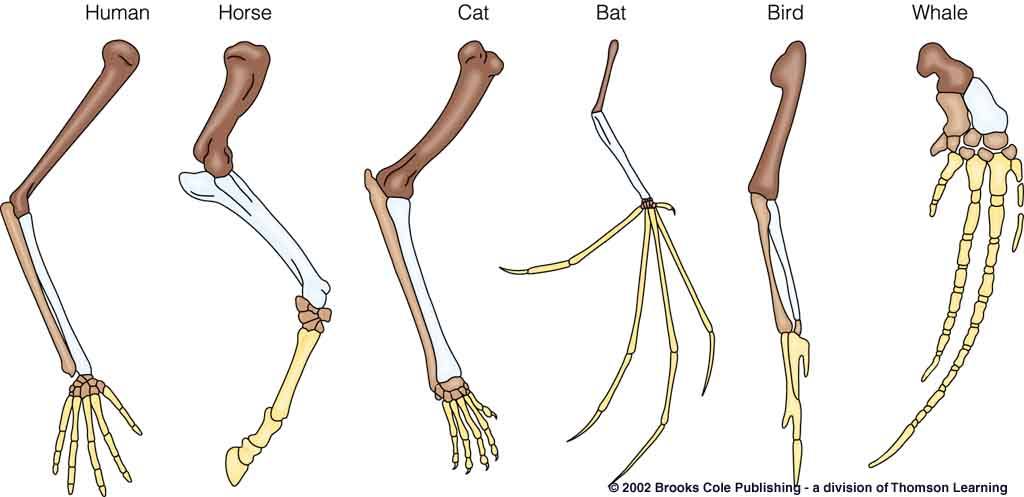
58.
An example of a homologous structure 
a)
human arm and bird wing
b)
rat appendix  and human appendix
c)
wing of butterfly and bird wing
59.
Charles Darwin’s observation that finches of different species on the Galápagos Islands have many similar physical characteristics supports the hypothesis that these finches 
 
a)
have the ability to interbreed.
b)
acquired traits through use and disuse.
c)
all eat the same type of food.
d)
descended from a common ancestor.
60.
The process by which organisms that are best suited to a particular environment survive and reproduce
a)
natural selection
b)
evolution
c)
adaptation
61.

If birds with short thick beaks are better at getting food in a specific environment, what do you expect the population to look like in 50 years?

a)

there will be no change in beak shape

b)

all of that species of birds will have died off

c)

most birds will have short thick beaks

d)

every bird will have short thick beaks

62.
What is embryology?
a)
         Adaptation.
b)
The study of fetus and embryo development, and fertilization.
c)
           Evolution.
d)
 The study of fossils.
63.
How does embryology support the Theory of Evolution?
a)
It shows that they have a common ancestor because of their similarities.
b)
         I'm not sure.
c)
Animals change over time. 
64.

An inherited trait or behavior that makes one

organism different from others of the same species is called a(an)

_____________.

a)

natural selection

b)

variation

c)

coevolution

d)

evolution

65.
The webbed feet of ducks developed over time in a process called ______________.
a)
natural selection
b)
selecting agent
c)
variation
d)
evolution
66.
Which of the following pieces of evolution evidence deals with comparing similar structures in various species?
a)
fossil record
b)
comparing embryology
c)
comparing biochemistry
d)
comparing anatomy
67.
The structures shown are_________
a)
homologous
b)
heterologous
c)
analogous
d)
vestigial
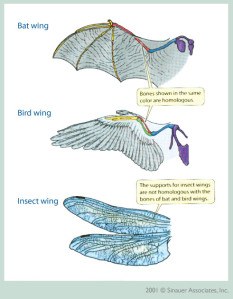
68.
  The diagram shows an image of a Pterosaur wing, bat wing, and bird wing.  These are all different organisms, but share similar wing structures.  If these structures are similar due to common ancestry, which of the following best describes them?
a)
a.  Vestigial Organ
b)
b.  Embryological Similarities
c)
c.  Homologous Structures
d)
d.  Analogous Structures
69.
Bird wings and butterfly wings are an example of
a)
Homologous structure
b)
Analogous structure
c)
Mimicry
d)
Camoflague
70.
Analogous structures show common ancestry.
a)
True
b)
False
71.

An anatomical feature that no longer seams to have a purpose in the current form of an organism

a)

Homologous structure

b)

Analogous structure

c)

Vestigial structure

d)

None of the above

72.
Given the information in the table, the closest evolutionary relationship most likely exists between the:
a)
Human and the gorilla
b)
Human and the chimpanzee
c)
Chimpanzee and the gorilla
d)
Horse and the zebra
73.
Which answer best describes macroevolution?
a)
Largest-scale evolutionary changes via speciation or extiniction that occur over time
b)
A scientist who classifies organisms into groups and makes a hypothesis on whether they are a different species based on the evidence
c)
Identification of species by differences in their appearances
d)
AP biological trait evolves in two unrelated species as a result of exposure to similar environments
74.
The death of every member of a species
a)
The flu
b)
epidemic
c)
extinct
d)
population
75.
What is a mass extinction?
a)
When all the species in a particular area on earth suddenly go extinct
b)
When multiple species from all over the earth suddenly go extinct 
c)
When one species goes extinct due to habitat changes
d)
When all life on earth is wiped out 
76.
The idea that evolution seems to occur in spurts of time.
a)
stabilizing selection
b)
directional selection
c)
disruptive selection
d)
puntuated equilibrium
77.
The hypothesis that evolution of a species occurs gradually over time as a slow and constant process is known as
a)
speciation
b)
punctuated equilibrium
c)
gradualism
d)
microevolution
78.
The hypothesis that evolution of a species occurs in periods of rapid change separated by periods of little or no change is called
a)
divergence
b)
gradualism
c)
punctuated equilibrium
d)
isolation
79.
The evolution of an ancestral species into an array of species that occupy different niches
a)
convergent evolution
b)
coevolution
c)
speciation
d)
adaptive radiation
80.
A single species that has evolved into several different forms that live in different ways has undergone
a)
adaptive radiation.
b)
coevolution.
c)
punctuated equilibrium.
d)
mass extinction.
81.
What is convergent evolution?
a)
evolution toward similar traits in unrelated species
b)
evolution toward different traits in closely related species
c)
elimination of a species from Earth
d)
the rise of two or more species from one existing species
82.
Sharks and dolphins both have streamlined bodies that allow them to move through water efficiently, this is an example of which type of evolution?
a)
Divergent
b)
Coevolution
c)
Convergent
d)
Artificial
83.
In convergent evolution, organisms share physical similarities because they 
a)
have a common ancestor
b)
live in similar environments
c)
develop homologous structures
d)
are closely related 
84.
 What type of evolution is demonstrated in this photo?
a)
Coevolution
b)
Convergent evolution
c)
Punctuated evolution
d)
Gradualistic evolution
85.

Cichlid fishes in lakes of the East African Rift. The lakes in this area are believed to support and sustain about 2,000 different species of these fish, each with different ecological and morphological characteristics such as body size. These lakes form a fragmented landscape that bio-geographically isolates the different species of cichlid fish from one another, allowing them, and many of the organisms they live with, to evolve separately.

a)

Phyletic Speciation

b)

Adaptive Radiation

c)

Convergent Evoltion

d)

Co-evolution

86.
a)

Phyletic Speciation

b)

Adaptive Radiation

c)

Convergent Evoltion

d)

Divergent Evoltuion

e)

Co-evolution

87.

The Rough-skinned newt produces a potent neurotoxin that concentrates in their skin. Garter snakes, have evolved resistance to this toxin through a series of genetic mutations, and prey upon the newts. The relationship between these animals has resulted in an evolutionary arms race that has driven toxin levels in the newt to extreme levels.

a)

Phyletic Speciation

b)

Adaptive Radiation

c)

Convergent Evoltion

d)

Divergent Evoltuion

e)

Co-evolution

88.

The Apple Maggot Fly infests the fruit of a native North American Hawthorn Apple tree. In the 1860s some maggot flies began to infest apples. Now there are two populations of the fly feeding on the two food sources. The populations rarely interbreed and are showing genetic differences and therefore are becoming two separate species.

a)

Phyletic Speciation

b)

Adaptive Radiation

c)

Convergent Evoltion

d)

Divergent Evoltuion

e)

Co-evolution

89.

The three species pictured do not share a common ancestor, yet have evolved to have a similar anatomy and life style. This is an example of ?

a)

Homologous Structures

b)

Divergent Evolution

c)

Vestigial Organs

d)

Convergent Evolution

90.

The three species pictured share a common ancestor and have adapted so that each lives in a different environment. This is an example of

a)

Law of Superposition

b)

Evolutionary Arms Race

c)

Divergent Evolution

d)

Convergent Evolution

91.

By what mechanism did the anoles on Puerto Rico diverge to occupy species specific niches?

a)

Adaptive Radiation

b)

Artificial Selection

c)

Stabilizing Natural Selection

d)

Coevolution

92.

The change that occurs over long periods of time in the characteristics and diversity of organisms

a)

natural selection

b)

artificial selection

c)

evolution

d)

acquired characteristics

93.

The theory that organisms acquire traits during their lifetimes that help them adapt to their environments

a)

theory of natural selection

b)

artificial selection

c)

evolution

d)

theory of acquired characteristics

94.

The theory proposes that variability exists in a population and that the environment acts on this variation so that only the most fit individuals survive and reproduce

a)

theory of natural selection

b)

artificial selection

c)

evolution

d)

theory of acquired characteristics

95.

The breeding of organisms for a specific and desirable trait

a)

natural selection

b)

artificial selection

c)

evolution

d)

acquired characteristics

96.

What is this an example of?

a)

theory of natural selection

b)

theory of acquired characteristics

97.

What is this an example of?

a)

theory of natural selection

b)

theory of acquired characteristics

98.

What is "survival of the fittest"?

a)

Being the strongest

b)

Being able to survive and produce offspring

c)

Being the smartest

d)

Being able to collect as much resources as possible

99.

Inherited characteristics that increase an organism's chance of survival, or beneficial inherited variations

a)

acquired characteristics

b)

genes

c)

adaptations

d)

mutations

100.

When nature selects and species with beneficial adaptation survive and produce offspring

a)

natural selection

b)

artificial selection

101.

When humans select desirable traits to be passed down to offspring

a)

natural selection

b)

artificial selection

102.

What is this an example of?

a)

natural selection

b)

artificial selection

103.

What is this an example of?

a)

natural selection

b)

artificial selection

104.

What is this an example of?

a)

natural selection

b)

artificial selection

105.

What is another name for "artificial selection"?

a)

breeding with articulation

b)

natural selection

c)

selective breeding

d)

in vitro fertilization

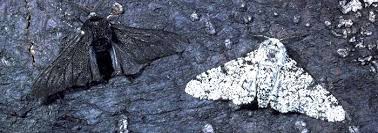
106.
Predict which moth would increase in population
a)
light 
b)
dark
107.
An example of a behavioral adaptation is
a)
The long neck of a giraffe
b)
Penguins huddling together for warmth
c)
A camel's hump used to store water
d)
A polar bear's white fur used for camouflage
108.
An example of a physical adaptation is...
a)
a turtle hiding inside its shell
b)
The spikes on a porcupine fish
c)
a rabbit burrowing underground
d)
a viper biting when threatened
109.

What is the theory of natural selection?

a)

An inherited trait that helps an organism to survive.

b)

The process by which individuals that are better adapted to their environment survive and reproduce more successfully than less well adapted individuals.

c)

The practice by which humans select plants or animals for breeding based on desired traits.

d)

It occurs in all members of a species.

110.

The process which humans select plants or animals for breeding based on desired traits is _____________.

a)

Natural Selection

b)

Evolution

c)

Artificial Selection

d)

Overpopulation