Wayground logo

Free Printable Worksheets

Font size

S
M
L
XL
Worksheets

Nervous System

Total questions: 88

Worksheet time: 1hrs 17mins

Name
Class
Date
1.
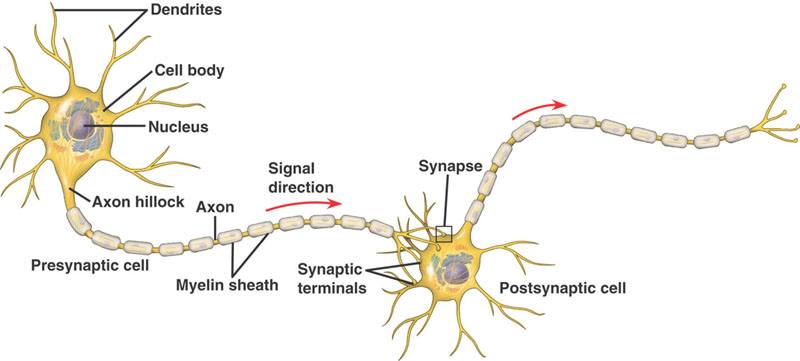
The part of the neuron that receives signals is the:
a)
Axon
b)
Dendrite
c)
Axon Terminal
d)
Cell Body
2.
The part of the neuron that transmits signals to muscles is the:
a)
Axon
b)
Dendrite
c)
Axon Terminal
d)
Cell Body
3.
What causes the movement of vesicles towards the post-synaptic membrane?
a)
Influx of Ca++ 
b)
Influx of Na++
c)
Movement of K+ out of the cell
d)
Movement of Ca++ out of the cell
4.
What molecule removes neurotransmitters from the synaptic cleft?
a)
Acetylcholinesterase
b)
Dopamine
c)
GABA
d)
Acetylcholine
5.
The neurotransmitter enters the post-synaptic cell to cause depolarization.
a)
True
b)
False
6.
The neurotransmitter cause depolarization by opening up Na+ channels in the post-synaptic membrane.
a)
True
b)
False
7.
The neurotransmitter most associated with rewards and motivation is:
a)
Dopamine
b)
Serotonin
c)
GABA
d)
Adrenaline
8.
The neurotransmitter most associated with learning & memory is:
a)
Dopamine
b)
Serotonin
c)
GABA
d)
Glutamate
9.
The depolarization phase of an action potential is caused by:
a)
Na+ rushing into the axon
b)
K+ rushing out of the axon
c)
Ca++ rushing into the axon
d)
Activation of Na/K pumps
10.
Na/K Pumps are most active during which phase of Action Potential events?
a)
Hyperpolarization
b)
Depolarization
c)
Repolarization
d)
Resting Membrane Potential
11.
Which event characterizes repolarization?
a)
Na+ rushing into the axon
b)
K+ rushing out of the axon
c)
Ca++ rushing into the axon
d)
Activation of Na/K pumps
12.
Which photo-receptor cells in the human eye would be sensing light wavelengths in the red range?
a)
Rods
b)
Cones
c)
Melanopsin Producing Cells
d)
SupraChiasmatic Nuclei
13.
The ultra-HD area of the human eye is the:
a)
Fovea
b)
Retina
c)
Optic Fundus
d)
Lachrymal Gland
14.
Heartbeat would be accomplished by which branch of the nervous system?
a)
Sensory
b)
Autonomic
c)
Motor
d)
Pineal
15.
This nervous system branch causes increases in heart rate and breathing.
a)
Sympathetic
b)
Parasympathetic
c)
Motor
d)
Sensory
16.
The CNS is contained by a membrane and bathed in:
a)
Blood
b)
Cerebro-Spinal Fluid
c)
Lymph
d)
Cytoplasm
17.
Sensory stimuli that generate reflexes generally are processed by the brain before signals are sent to effectors.
a)
True
b)
False
18.
What is the central nervous system (CNS) made of?
a)
brain and spinal cord
b)
brain and cranial nerves
c)
spinal cord and spinal nerves
d)
cranial nerves and spinal nerves
19.
What are the 2 major divisions of the peripheral nervous system (PNS)?
a)
Sensory & Motor
b)
Peripheral & Central
c)
Somatic & Autonomic
d)
Brain & Spinal Cord
20.
What is the purpose of the myelin sheath on the axon?
a)
To maintain temperature
b)
To improve conductivity
c)
To protect the axon
d)
To release neurotransmitters
21.
Sensory neurons carry nerve impulses from the sense organs and internal organs (like your stomach) to the
a)
peripheral nervous system (PNS)
b)
central nervous system (CNS)
c)
muscles
d)
sense organs
22.
a signal molecule that transmits nerve impulses across synapses
a)
neuron
b)
neurotransmitter
c)
nerve
d)
action potential
23.
nerve impulse
a)
action potential
b)
resting potential
c)
membrane potential
d)
synapse
24.
Location at which a neuron can transfer an impulse to another cell with the use of neurotransmitters is called __________.
a)
myelin sheath
b)
axon
c)
threshold
d)
synapse
25.
The part of the neuron that takes information away from the cell body is called a(n) _____________.
a)
dendrite
b)
axon
c)
cell body
d)
Schwann cell
26.
Label the Neuron-What does the letter "H" represent?
a)
Myelin Sheath
b)
Axon
c)
Axon Terminal
d)
Dendrite
27.
Label the Neuron-What does the letter "F" represent?
a)
Myelin Sheath
b)
Axon
c)
Axon Terminal
d)
Dendrite
28.
Label the Neuron-What does the letter "C" represent?
a)
Dendrite
b)
Axon
c)
Axon Terminal
d)
Cell Body
29.
These carry signals from tissues and organs to the brain and spinal cord
a)
Sensory Neurons
b)
Motor Neurons
c)
Efferent Neurons
d)
Glial Cells
30.
The long, fiber like part of a neuron which the cell sends information to receiving neurons
a)
axon 
b)
dendrite
c)
axon terminal
d)
gene
31.
These neuron processes transmit information from the sensory organs to the central nervous system
a)
efferent
b)
afferent
32.
These neuron processes transmit information from the central nervous system to the muscles and glands
a)
efferent
b)
afferent
33.
This part of the nervous system regulates involuntary actions such as heart function, blood pressure, breathing, digestion.
a)
Autonomic Nervous System
b)
Sensory Nervous System
c)
Motor Nervous System
d)
Peripheral Nervous System
34.

The following table shows the concentration of the main ions inside and outside of the nerve cell during resting phase. What would happen when the nerve cell receives the correct stimulus?

a)

Na+ ions will enter the cell

b)

K+ ions will enter the cell

c)

Na+ ions will leave the cell

d)

K+ ions will leave the cell

35.

Which of the following will occur when the stimulus depolarize the axon membrane?

a)

Sodium ion will diffuse out of neurone

b)

Sodium pump is stimulated

c)

Sodium channel and potassium channel are closed

d)

Membrane potential changes from resting potential to action potential

36.

The table shows the difference between the nervous systems and their effects. Which of the following correctly matches each type of nervous system and its action?

a)

I (a) II (a) III (b) IV (b)

b)

I (a) II (b) III (a) IV (b)

c)

I (a) II (b) III (b) IV (a)

d)

I (b) II (a) III (b) IV (a)

37.

The graph below shows the action potential that is produced by the stimulation of an electrical impulse on neurone. What happens at part X?

a)

Potassium ions enter the neurone

b)

Sodium ion enters the neurone

c)

Potassium ions leave the neurone

d)

Sodium ions leave the neurone

38.

Which of the following are the characteristics of an impulse?

I It follows the all or nothing law

II Speed of impulse transmission is faster in myelinated axon

III Speed of impulse transmission is faster in unmyelinated axon with a smaller diameter

IV In the absolute refractory period, a new impulse cannot be generated even if a strong stimulus is received

a)

I, II and III

b)

I, II and IV

c)

I, III and IV

d)

II, III and IV

39.

The propagation of an action potential in non-myelinated axon in three regions X, Y and Z is shown in the diagram. Which is true about X, Y and Z?

a)

Resting (X) Repolarised (Y) Depolarised (Z)

b)

Resting (X) Repolarised (Z) Depolarised (Y)

c)

Resting (Y) Repolarised (X) Depolarised (Z)

d)

Resting (Y) Repolarised (Z) Depolarised (X)

40.

Which division of the nervous system is highlighted in orange?

a)

Efferent

b)

Peripheral

c)

Afferent

d)

Central

41.

Which division of the nervous system is highlighted in yellow?

a)

Afferent

b)

Central

c)

Peripheral

d)

Efferent

42.

What division of the nervous system is responsible for sensory input?

a)

Afferent

b)

Somatic

c)

Efferent

d)

Autonomic

43.

Which division of the nervous system is responsible for involuntary functions?

a)

Parasympathetic

b)

Sympathetic

c)

Somatic

d)

Autonomic

44.

Which division of the nervous system is responsible for the rest & digest response?

a)

Afferent

b)

Efferent

c)

Parasympathetic

d)

Sympathetic

45.

What is the membrane's resting potential?

a)

-70 mV

b)

-60 mV

c)

-55 mV

d)

40 mV

46.

What type of neuroglial cell participates in the production and circulation of cerebrospinal fluid?

a)

oligodendrocytes

b)

microglia

c)

ependymal cells

d)

astrocytes

47.

What type of neuroglial cell myelinates axons in the peripheral nervous system?

a)

Schwann cells

b)

microglia

c)

satellite cells

d)

astrocytes

48.

Which type of active channels in the plasma membrane open or close when they bind certain chemicals, such as neurotransmitters?

a)

passive channels

b)

ligand gated channels

c)

mechanically gated channels

d)

voltage-gated channels

49.
What is the insulating membrane that surrounds parts of the axon that helps to protect & propagate action potential?
a)
Axon
b)
Dendrites
c)
Node of Ranvier
d)
Myelin Sheath
50.
In resting potential, neurons have more _________ on the outside of the cell membrane.
a)
K+
b)
NaCl
c)
Na+
d)
Cl-
51.
In resting potential, neurons have more ____________ on the inside of the cell membrane.
a)
NaCl
b)
Na+
c)
K+
d)
Cl-
52.
What number on the graph represents the Depolarization phase?
a)
1
b)
2
c)
3
d)
4
53.
What number on the graph represents the Hyperpolarization phase?
a)
1
b)
2
c)
3
d)
4
54.
The sodium-potassium pump....
a)
Sends (Na+) into the cell
b)
Sends (K+) into the cell
c)
Exchanges (K+) & (Na+) during depolarization
d)
Exchanges (K+) & (Na+) during hyperpolarization
55.
Why is -55 mV a significant number?
a)
This is the largest charge achieved during an action potential
b)
This is the threshold required to complete an action potential
c)
This is the resting charge of a neuron
d)
This is the charge when all the sodium is inside the cell
56.
At what stage are both ions present in large concentrations INSIDE the neuron?
a)
Depolarizarion
b)
Repolarization
c)
Hyperpolarization
d)
Resting Potential
57.
At what stage does Potassium end outside the neuron, and Sodium ends inside the neuron?
a)
Depolarizarion
b)
Repolarization
c)
Hyperpolarization
d)
Resting Potential
58.
What is the normal resting potential of a neuron cell membrane?
a)
+40mV
b)
-30mV
c)
+55mV
d)
-70mV
59.
The sodium potassium pump restores the resting potential. By which process does this work? 
a)
Osmosis
b)
Diffusion
c)
Facilitated diffusion
d)
Active transport
60.
When a neuron is not engaged in an impulse.
a)
Resting potential
b)
Action potential
c)
Neural potential
d)
Synaptic potential
61.
When a neuron is resting, the inside of the axon has a ____________ charge.
a)
positive
b)
negative
62.
In resting potential, neurons have more _________ on the outside of the cell membrane.
a)
K+
b)
NaCl
c)
Na+
d)
Cl-
63.
In resting potential, neurons have more ____________ on the inside of the cell membrane.
a)
NaCl
b)
Na+
c)
K+
d)
Cl-
64.

Which one of the following is involved in maintaining a resting membrane potential?

a)

Na+/K+ ATPase pump moves 3Na+ in for every 2K+ out

b)

Na+/K+ ATPase pump moves 3K+ in for every 2Na+ out

c)

Na+/K+ ATPase pump moves 3Na+ out for every 2K+ in

d)

Na+/K+ ATPase pump moves 3K+ out for every 2Na+ in

65.

When a neurone has not been activated, it is resting, the membrane is said to be...

a)

polarised

b)

depolarised

c)

hyperpolarised

66.

True or False: A resting neurone isn't using any ATP

a)

True

b)

False

67.

Which of the following is NOT true of the Sodium-Potassium Pump?

a)

3 sodiums are pumped out

b)

2 potassiums are pumped out

c)

energy is used

d)

ions are moved against the gradient

68.

This system controls all body functions

a)

Circulatory system

b)

Nervous system

c)

Muscular system

69.

The nervous system is formed by

a)

The brain and the central nervous system.

b)

The spinal cord and the brain.

c)

The cerebrum, cerebellum and spinal cord.

d)

The central nervous system and the peripheral nervous system.

70.

The orders from the central nervous system produce:

a)

sensitive nervous and motor nerves.

b)

Carry information to the muscles.

c)

Voluntary and involuntary movements.

71.

A

a)

Dendrite

b)

Axon

c)

Axon Terminal

d)

Cell Body

72.

Produces myelin sheaths

a)

microglia

b)

astrocytes

c)

oligodendrocytes

d)

Ependymal cells

73.

Neuron health monitors.

a)

microglia

b)

astrocytes

c)

oligodendrocytes

d)

Ependymal cells

74.

Most abundant and versatile neuroglia. They are delicate and branching.

a)

astrocytes

b)

Ependymal cells

c)

microglia

d)

oligodendrocytes

75.

The inability of a cell to divide

a)

mitosis

b)

meiosis

c)

amitotic

d)

amniocentesis

76.

A type of neuron

a)

sensory

b)

motor

c)

interneuron

d)

all of these are neuron types

77.

There are ______________ of neurons in the human body.

a)

millions

b)

billions

c)

trillions

d)

there are so many no one knows for sure

78.

This process is monitoring changes both inside and outside the body:

a)

sensory input

b)

integration

c)

motor output

d)

motor input

79.
What number(s) on the graph represents the Resting Potential?
a)
1 and 2
b)
1 and 5
c)
2 and 3
d)
3 and 4
80.
When a neuron is depolarized, what are the first channels to open?
a)
Sodium
b)
Potassium
c)
Calcium
d)
ACTH
81.
When a neuron is resting, the inside of the axon has a ____________ charge.
a)
-55 mV
b)
-70 mV
c)
40 mV
d)
-75 mV
82.
When a neuron is not engaged in an impulse.
a)
Resting potential
b)
Action potential
c)
Neural potential
d)
Synaptic potential
83.
What number on the graph represents the Depolarization phase?
a)
1
b)
2
c)
3
d)
4
84.
Which ions are involved in the electrical nerve impulse?
a)
Iodine and Sodium
b)
Potassium and Sodium
c)
Iron and Sodium
d)
Calcium and Iodine
85.
What number on the graph represents the Depolarization phase?
a)
1
b)
2
c)
3
d)
4
86.
What number on the graph represents the Hyperpolarization phase?
a)
1
b)
2
c)
3
d)
4
87.
Why is -55 mV a significant number?
a)
This is the largest charge achieved during an action potential
b)
This is the threshold required to complete an action potential
c)
This is the resting charge of a neuron
d)
This is the charge when all the sodium is inside the cell
88.
At what stage are both ions present in large concentrations INSIDE the neuron?
a)
Depolarizarion
b)
Repolarization
c)
Hyperpolarization
d)
Resting Potential