
Font size
S
M
L
XL
 Worksheets
7th Science TCAP Review
Total questions: 110
Worksheet time: 4hrs 22mins
Name
Class
Date
1.
Heredity is the passing of traits from _____________________ to _____________________
a)
predators to prey
b)
water to rain
c)
parents to offspring
d)
fungi to protists
2.
___________________________ is the study of how traits are passed on, or inherited.
a)
dominant traits
b)
ratio
c)
phenotype
d)
genetics
3.
If a child has red hair, they inherited a certain _______________ from their parents.
a)
ratio
b)
trait
c)
probability
d)
sex chromosome
4.
One trait that is ALWAYS present and causes the other traits to disappear is a ________________________
a)
recessive trait
b)
aggressive trait
c)
absent trait
d)
dominant trait
5.
True or False: Recessive traits are ALWAYS present
a)
True
b)
False
6.
A ___________________ is a relationship between two numbers
a)
genetic
b)
trait
c)
ratio
d)
cycle
7.
Offspring receives two sets of _____________ (one from each parent)
a)
blue jeans
b)
genes
c)
machines
d)
pedigree
8.
_____________________ is the appearance of an organism, or how it looks
a)
phenotype
b)
ratio
c)
recessive trait
d)
heredity
9.

A ________________________ is used to predict the possible genotype from certain parents
a)
Mendel Grid
b)
Genetic Tic Tac Toe
c)
Punnett Square
d)
Pedigree Plot
10.
Aa, DD, bB, yy are all examples of
a)
genotypes
b)
phenotypes
11.
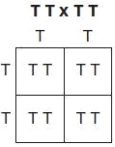
What ratio of the offspring from the cross shown will be homozygous recessive for the trait of tallness?
a)
0 in 4
b)
1 in 4
c)
2 in 4
d)
4 in 4
12.
Which of the following genotypes is heterozygous?
a)
Bb
b)
BB
c)
bb
d)
B
13.
In a flowering plant species, red flower color (R) is dominant over white flower color (r). What is the genotype of any red-flowering plant resulting from this species?
a)
rr
b)
R
c)
RR
d)
RR or Rr
14.
In a heterozygous genotype, the ___________ allele takes over in the phenotype.
a)
recessive
b)
dominant
c)
lower case letter
d)
both
15.
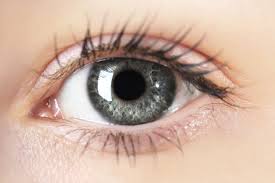
What you see, or the physical appearance.
a)
Genotype
b)
Phenotype
c)
Homozygous
d)
Heterozygous
16.
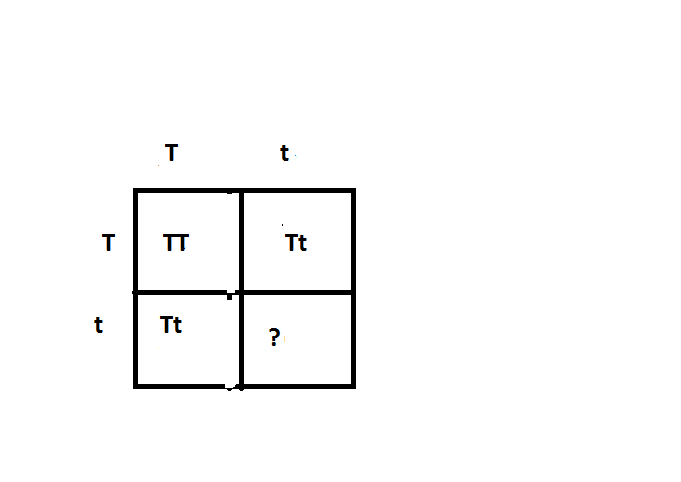
T = tall and t = short
In the punnett square below, what belongs in the missing square
In the punnett square below, what belongs in the missing square
a)
tt
b)
Tt
c)
Bb
d)
TT
17.
What happens during photosynthesis?
a)
cell uses oxygen to make food
b)
cell uses energy in sunlight to make food
c)
cell uses glucose to make oxygen
d)
cell uses solar energy to make carbon dioxide
18.
What are the products of photosynthesis?
a)
carbon dioxide and water
b)
carbon dioxide and sugars
c)
oxygen and sugars
d)
oxygen and water
19.
What captures energy from sunlight during photosynthesis?
a)
carbohydrates
b)
solar cells
c)
chlorophyll
d)
stomata
20.
Which statement BEST describes one step in the process of photosynthesis?
a)
mitochondria release oxygen
b)
mitochondria transform solar energy into sugar
c)
chloroplasts absorb solar energy
d)
chloroplasts release energy by breaking down food molecules
21.

The oxygen made by living organisms is produced where?
a)
In the cytoplasm
b)
In chloroplasts
c)
In mitochondria
d)
In the nucleus
22.

What cellular organelle is best represented by diagram?
a)
mitochondria
b)
chloroplast
23.
Which of the following molecules is used to produce ATP in the mitochondria?
a)
Carbon Dioxide
b)
Glucose
c)
Sunlight
d)
Water
24.
What is the MAIN purpose of cellular respiration?
a)
to convert sugar into a form usable by our cells
b)
to convert energy from light energy into energy
c)
to produce carbon dioxide and water from glucose and oxygen
d)
to allow the breathing process of inhaling and exhaling
25.
The stage of respiration that releases most of the energy in glucose occurs in the
a)
mitochondria
b)
chloroplast
c)
nucleus
d)
cytoplasm
26.
How are photosynthesis and respiration related?
a)
They are opposite processes
b)
They both produce carbon dioxide
c)
They have the same equation
d)
They both produce oxygen
27.
Which of the following is the correct equation for PHOTOSYNTHESIS?
a)
6CO2 + 6H2O --> 6O2 + C6H12O6
b)
6CO2 + C6H12O6 + 6H2O --> O2
c)
6O2 + 6H2O --> 6CO2 + C6H12O6
d)
C6H12O6 + 6O2 ---> 6H2O + 6CO2
28.
Which is the correct chemical equation for CELLULAR RESPIRATION?
a)
Glucose (Sugar) + Oxygen --> Carbon Dioxide + Water + ATP (Energy)
b)
ATP (Energy) + Oxygen --> Carbon Dioxide + Water + Glucose (Sugar)
c)
Glucose (Sugar) + Carbon Dioxide --> Oxygen + Water + ATP (Energy)
Glucose (Sugar) + Carbon Dioxide --> Oxygen + Water + ATP (Energy)
Glucose (Sugar) + Carbon Dioxide --> Oxygen + Water + ATP (Energy)
d)
Glucose (Sugar) + Water + Oxygen --> Carbon Dioxide + Oxygen + ATP (Energy)
29.
What is cellular respiration?
a)
the breakdown of glucose to release ATP
b)
the breakdown of glucose to release NADH
c)
the breakdown of glucose to release FADH
d)
the breakdown of glucose to release carbon
30.

Which way will the water molecules move during osmosis?
a)
Out of the cell, so the cell shrinks.
b)
Out of the cell, so the cell swells.
c)
Into the cell, so the cell shrinks.
d)
Into the cell, so the cell swells.
31.

How many diamond molecules need to move to reach equilibrium?
a)
2 molecules will move inside the cell.
b)
2 molecules will move outside the cell.
c)
There is no movement because the molecules are at equilibrium.
32.

Which diagram best shows the end result of diffusion?
a)
F
b)
G
c)
H
d)
J
33.

The picture is an example of...
a)
active transport
b)
passive transport
34.
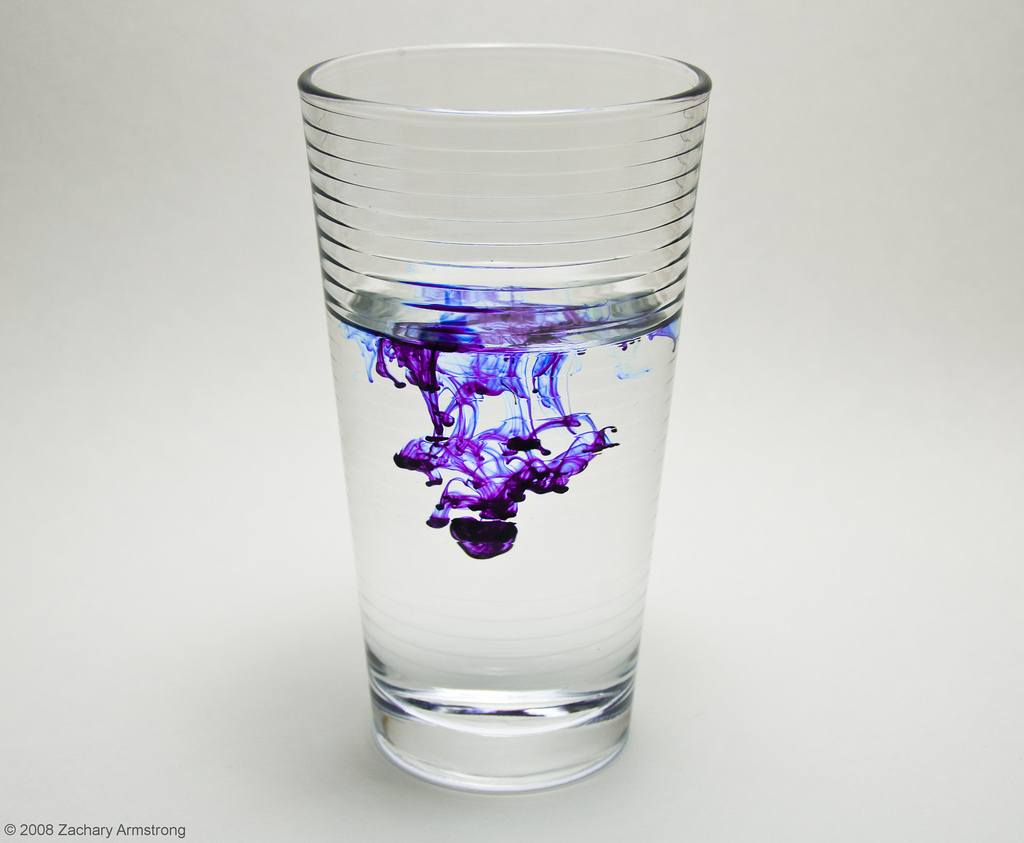
Where is there a low concentration of dye?
a)
at the bottom of cup
b)
in the color
c)
at the top of cup
35.

The cell below will ____ over time
a)
shrink
b)
expand
c)
stay the same size
36.

The cell below will _____ over time
a)
shrink
b)
expand
c)
stay the same size
37.
Osmosis is the movement of _____ across a membrane.
a)
food
b)
energy
c)
oxygen
d)
water
38.
During osmosis
a)
water moves from high to low concentration
b)
large or oddly shaped molecules move across a cell membrane
c)
water moves when energy is used
d)
proteins are built
39.
Permeable means
a)
things can pass through
b)
the concentration levels are different
c)
it is permanent
d)
things are stuck
40.
What does selectively-permeable mean?
a)
The cell controls what passes in and out of the cell
b)
Nothing gets through
c)
The cell lets only large substances through
41.

a)
Prophase
b)
Interphase
c)
Anaphase
d)
Telophase
42.

a)
Anaphase
b)
Cytokinesis
c)
Telophase
d)
Metaphase
43.

a)
Cytokinesis
b)
Interphase
c)
Anaphase
d)
Metaphase
44.

a)
Anaphase
b)
Cytonkinesis
c)
Interphase
d)
Prophase
45.

a)
Cytokinesis
b)
Anaphase
c)
Telophase
d)
Prophase
46.
The phase in mitosis where chromosomes move away and are pulled apart by spindles to opposite sides of the cell.
a)
prophase
b)
anaphase
c)
metaphase
d)
telephase
47.
Chromosomes condense from long stands into rod like structures and pair up.
a)
Prophase
b)
Interphase
48.

Which is Metaphase?
a)
A
b)
E
c)
C
d)
F
49.

In mitosis, the two resulting cells are
a)
different from the starting cell and identical to each other.
b)
different from the starting cell and different from each other.
c)
identical to the starting cell and different from each other.
d)
identical to the starting cell and identical to each other.
50.
The time between cell divisions in the life cycle of the cell is called
(Also when the cell is just hanging out)
(Also when the cell is just hanging out)
a)
anaphase
b)
interphase
c)
prophase
d)
metaphase
51.
Where does a cell contain it's genetic material?
a)
nucleus
b)
nucleolus
c)
cytoskeleton
d)
golgi
52.
This system breaks down food into nutrients that the body can absorb.
a)
digestive
b)
excretory
c)
reproductive
d)
immune
53.
This system transports oxygen and nutrients around the body.
a)
circulatory
b)
respiratory
c)
skeletal
d)
digestive
54.
One of the functions of this system is to allow you to use your 5 senses to make observations about the environment.
a)
Excretory
b)
Nervous
c)
Digestive
d)
Muscular
55.
Which system sends electrical messages that helps control the body's responses to internal and external changes?
a)
nervous
b)
endocrine
c)
reproductive
d)
integumentary
56.
Lungs are the primary organs of this system.
a)
muscular system
b)
nervous system
c)
circulatory system
d)
respiratory system
57.
Transports oxygen, hormones, and nutrients to all the body cells. Moves wastes and carbon dioxide away from cells.- Think.... *transportation system*
a)
Circulatory
b)
Digestive
c)
Nervous
d)
Muscular
58.
a body part (such as a heart or brain) made up of two or more different tissues joined together to perform a *specific* function
a)
cell
b)
tissue
c)
organ
d)
Organ System
59.
A living thing that is composed of many systems working together.
a)
Organ
b)
Organ System
c)
Organism
d)
Tissue
60.
A group of cells that work together.
a)
Tissue
b)
Organ
c)
Cells
d)
Organ System
61.
A group of cells that work together.
a)
Tissue
b)
Organ
c)
Cells
d)
Organ System
62.
The ___________ is the basic unit of life
a)
organ
b)
cell
c)
atom
d)
tissue
63.
What is the correct order of organization
a)
tissues-cells-organs-organ systems-organism
b)
cell-tissue-organs-organ systems-organism
c)
organism-cells-tissues-organ systems-organism
d)
tissues-cells-organs-organ sytems-organism
64.
This organelle takes food and turns it into ENERGY for plant and animal cells.
a)
Chloroplast
b)
Mitochondria
c)
Lysosome
d)
Ribosome
65.
The site of photosynthesis
a)
ribosome
b)
mitochondria
c)
chloroplast
d)
nucleus
66.

Directs all cell activities through the DNA located there.
a)
Lysosomes
b)
Nucleus
c)
ribosomes
d)
Mitochondria
67.
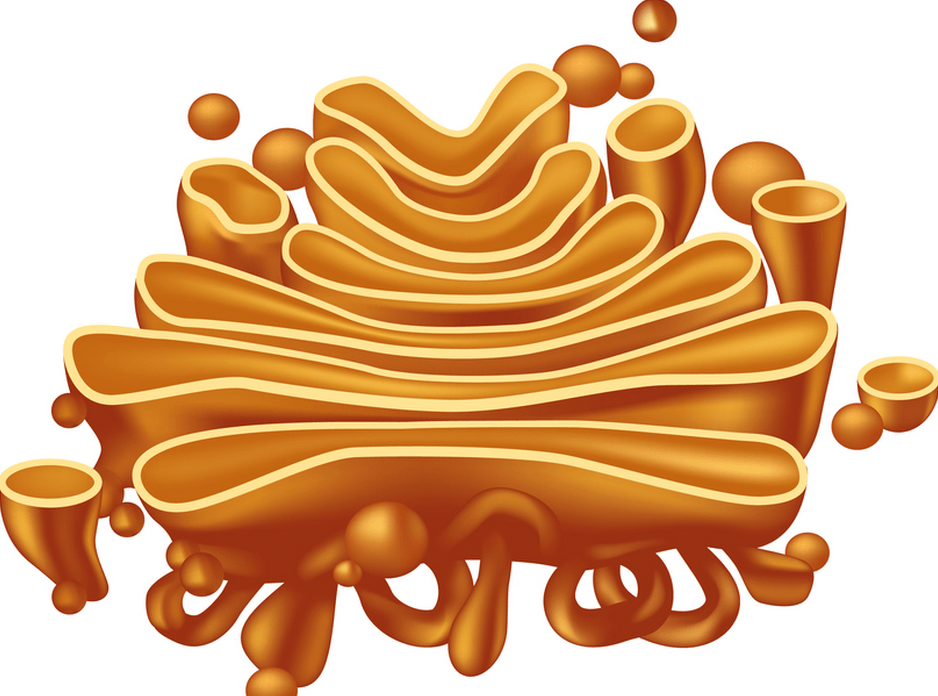
I am a packaging and shipping machine! Who am I?
a)
vacuole
b)
ribosome
c)
mitochondrion
d)
golgi apparatus
68.
Which of the following is directly involved in the transportation of materials inside/within the cell?
a)
Endoplasmic Reticulum
b)
Vacuole
c)
Lysosome
d)
Mitochondria
69.
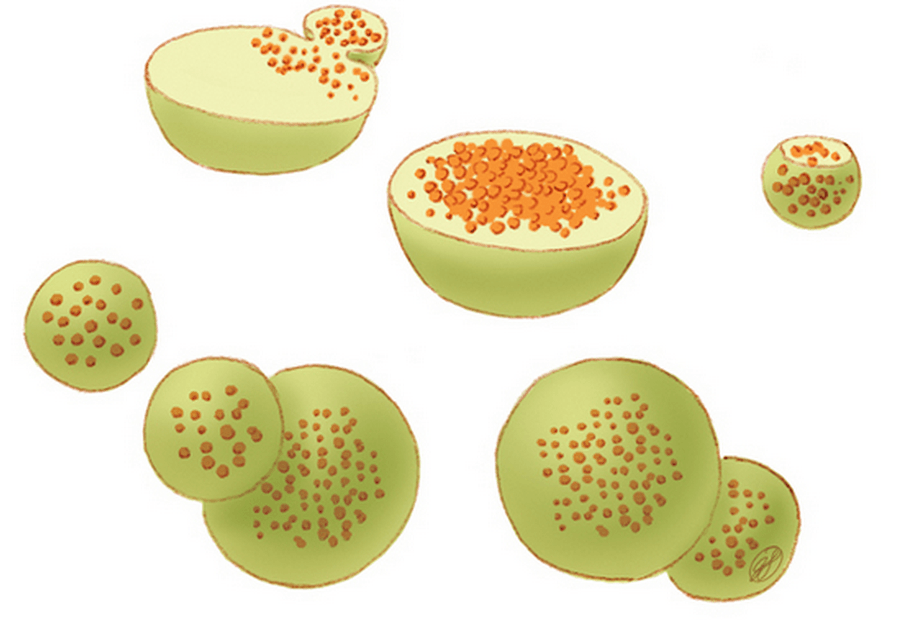
You might think of me as the trash collector, but recycler is maybe more accurate. What am I?
a)
mitochondria
b)
lysosome
c)
vacuole
d)
ribosome
70.
What is found in both plant and animal cells but is much larger in plant cells?
a)
Nucleus
b)
Mitochondria
c)
Chloroplast
d)
Vacuole
71.
Where are proteins made?
a)
Golgi body
b)
Mitoichondria
c)
Chromosomes
d)
Ribosomes
72.
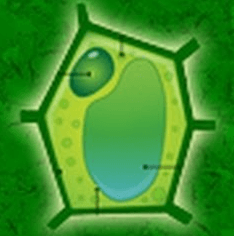
A rigid layer that lies outside the cell's membrane is...
a)
Cytoskeleton
b)
Cilia
c)
Cell Wall
d)
Flagella
73.
What organelle is called the "powerhouse" of a cell?
a)
Endoplasmic Reticulum
b)
Nucleus
c)
Mitochondria
d)
Nucleolus
74.
What is the gel-like substance inside of cells called?
a)
photoplasm
b)
photosynthesis
c)
cytoskeleton
d)
cytoplasm
75.

I am only found in a plant cell. What am I?
a)
cell wall
b)
mitochondria
c)
cytoplasm
d)
chloroplast
76.

What is the difference between rough and smooth ER?
a)
There is no difference.
b)
Plants have rough ER, animals have smooth ER.
c)
What type of injuries the Doctors treat.
d)
Rough has ribosomes, smooth does not.
77.
Which statement best describes the importance of sexual reproduction?
a)
sexual reproduction produces variation in offspring
b)
sexual reprosuction provides regeneration of body parts
c)
sexual reproduction occurs between individuals of the same species
d)
sexual reproduction produces offspring that are identical
78.
Which of the following cell types is formed by meiosis?
a)
skin cells
b)
sperm cells
c)
blood cells
d)
muscle cells
79.
Which of the following statements correctly describes meiosis?
a)
Meiosis does not occur in reproductive cells.
b)
The cells produced at the end are identical
c)
the cells produced at the end contain half the # of chromosomes
d)
cells divide only once during meiosis
80.
What process is necessary for the inherited traits of an organism to be passed along by sexual reproduction?
a)
meiosis
b)
mutation
c)
mitosis
d)
fission
81.
What is one advantage of sexual reproduction?
a)
The offspring are identical to the parents
b)
the offspring are resistant to viruses
c)
the offspring are born live, instead of from eggs
d)
The offspring inherit a wider variety of genetic information
82.
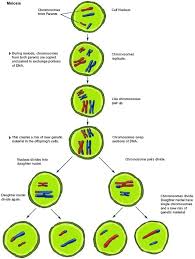
This diagram shows which cellular process that occurs in organisms?
a)
endocytosis
b)
mitosis
c)
meiosis
d)
phagocytosis
83.
When an area of a chromatid is exchanged with the matching area on a chromatid of its homologous chromosome, ____ occurs.
a)
mutagenesis
b)
hybridization
c)
crossing over
d)
fertilization
84.

My cell is prokaryotic, what kingdom do I belong to?
a)
Fungi
b)
Moneran
c)
Plant
d)
Protoctist
85.

I have tissues and I am autotrophic, what kingdom do I belong to?
a)
Monera
b)
Protoctista
c)
Plants
d)
Animals
86.

I am multicellular, I have no tissues and I am heterotrophic, what kingdom do I belong to?
a)
Fungi
b)
Plant
c)
Animal
d)
Protoctista
87.

A cell with nucleus is
a)
Autotrophic
b)
Prokaryotic
c)
Eukaryotic
d)
Heterotrophic
88.

Kingdom with the following characteristics: eukaryotic cells, unicellular or multicellular, autotrophic or heterotrophic
a)
Fungi
b)
Monera
c)
Protoctista
d)
Plant
89.

Nutrition that consists of obtaining organic nutrients from other living being
a)
Autotrophic
b)
Photosynthesis
c)
Interaction
d)
Heterotrophic
90.

Unicellular fungi used to make bread
a)
Yeast
b)
Mushroom
c)
Flour
d)
Mould
91.

Type of nutrition that produces its own organic matter
a)
Food
b)
Autotrophic
c)
Heterotrofic
d)
carnivorous
92.

Autotrophic Protoctista that usually lives in the sea
a)
Protozoa
b)
Fish
c)
Shark
d)
Algae
93.

Kingdom with the following characteristics: eukaryotic cells, with tissues and autotrophic
a)
Protoctista
b)
Fungi
c)
Monera
d)
Plant
94.

Type of cell with no nucleus
a)
Chloroplast
b)
Bacteria
c)
Eukaryotic
d)
Prokariotic
95.

Type of multicellular fungi
a)
Plant
b)
Mushroom
c)
Yeast
d)
Moss
96.
Type of reproduction that consists of one individual producing offsprings that are identical to it
a)
Interaction
b)
Sexual
c)
Asexual
d)
Reproduction
97.
A giraffe has a long neck in order to better reach leaves to eat. This is an example of _____.
a)
an adaptation
b)
environment
c)
response
d)
stimulus
98.

Polar bears have an adaptation that allows them to swim. What is most likely this adaptation?
a)
White coat
b)
Fat belly
c)
Small eyes
d)
Webbed Feet
99.
What are adaptations?
a)
traits that help an organism to survive and reproduce
b)
traits that help an organism hide
c)
traits that help an organism to seek protection
d)
traits that help an organism to see.
100.
Why do some organisms hibernate?
a)
To get some rest
b)
To escape harsh winters and maintain homeostasis
c)
To be the bearer of bad news
d)
To strive for greatness with rest
101.
What is a reason why people want to engage in selective breeding?
a)
To generate desired traits in the organism's offspring
b)
To generate wealth and freedom
c)
To generate freedom only
d)
To generate more offspring for themselves
102.
Why do birds need the adaptation of hollow bones?
a)
to fly
b)
to live
c)
to reproduce
d)
to run
103.
All of these are advantages of asexual reproduction except....
a)
faster time
b)
no competition
c)
uniform offspring
d)
more offspring
104.
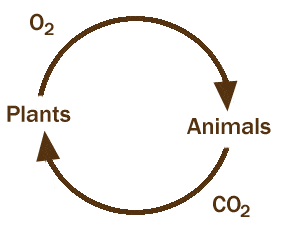
Which statement is true about the carbon dioxide-oxygen cycle?
a)
animals breathe in nitrogen and release oxygen which is used by plants
b)
animals breathe in oxygen and release carbon dioxide which is used by plants
c)
animals breathe in nitrogen and release carbon dioxide which is used by plants
d)
animals breathe in carbon dioxide and release oxygen which is used by plants
105.

The class decided to have a terrarium. The teacher says it is important to include both plants and animals. Why is it necessary to include both plants and animals?
a)
plants provide food for the animals and animals provide water for the plants
b)
plants provide water for the animals and animals provide food for the plants
c)
plants provide carbon dioxide for the animals and animals provide oxygen for the plants
d)
plants provide oxygen for animals and the animals provide carbon dioxide for the plants
106.

Which of the following is the best conclusion that can be made from this graph?
a)
atmospheric carbon dioxide levels have been decreasing since 1960
b)
Hawaii has a lot of carbon dioxide
c)
humans have been working hard to decrease carbon dioxide levels
d)
atmospheric carbon dioxide levels have increased steadily since 1960
107.
The main human activity that releases greenhouse gases is
a)
using public transportation and there by reduce the affects of greenhouse gases.
b)
burning fossil fuels
c)
texting on cellphones
d)
eating meat
108.
Which of the following is contributing to an INCREASE in carbon dioxide in the atmosphere?
a)
deforestation
b)
photosynthesis
c)
oceans
d)
all of the above
e)
the loss of animal species
109.
What is the greenhouse effect?
a)
The warming of a planet due to trapped radiation.
b)
The cooling of Earth due to air pollution.
c)
The heating of a solid, such as a rock.
110.
What gas from the list below is a cause for global warming?
a)
Urethane
b)
Oxygen
c)
Carbon Dioxide
Reset

