Wayground logo

Free Printable Worksheets

Font size

S
M
L
XL
Worksheets

Biology Final Exam Spring 2020-21

Total questions: 110

Worksheet time: 9hrs 10mins

Name
Class
Date
1.

I am the control center of a cell.

a)

Nucleus

b)

Mitochondria

c)

Ribosome

d)

Plasma membrane

2.

Which of the following is NOT a product of the light reactions?

a)

Oxygen

b)

NADPH

c)

ATP

d)

Glucose (Sugar)

3.
Where do the light reactions happen?
a)
mitochondria membrane
b)
thylakoid membrane
c)
stroma
d)
central vacuole
4.

What part of the plant cell performs photosynthesis?

a)

The Mitochondrion

b)

The Nucleus

c)

The Chloroplast

d)

The Cell Wall

5.
What gas does the process of photosynthesis release into the atmosphere?
a)
oxygen
b)
carbon dioxide
c)
water
d)
nitrogen
6.

Autotrophs (producers) can perform photosynthesis because they have -

a)

Mitochondria

b)

Ribosomes

c)

A Nucleus

d)

Chloroplasts

7.
The principal chemical compound that living things use to store energy is
a)
DNA
b)
ATP
c)
H2O
d)
CO2
8.
ATP gets formed in the light dependent reaction by which process?
a)
Chemiosmosis
b)
Photosmosis
c)
Diffusion
d)
Active Transport
9.

Which of the following equations represents the overall chemical reaction for photosynthesis?

a)

6O2+ 6H2O → C6H12O6+ 6O2

b)

C6H12O6 + 6H2O→ 6O2+ 6O2

c)

6CO2+ 6H2O→ C6H12O6+ 6O2

d)

6O2 + 6H2O→ C6H12O6 + 6CO2

10.

Sunlight is used during photosynthesis to-

a)

Break down the xylem

b)

Break down the stomata

c)

Break down the water

d)

Capture the water

11.
What are the products of photosynthesis?
a)
water and carbon dioxide
b)
oxygen and glucose
c)
oxygen and carbon dioxide
d)
oxygen and water
12.
What do plants need for the photosynthesis process?
a)
a camera and tripod
b)
light, carbon dioxide, and water
c)
roots, flowers, and bees
d)
soil, air, and oxygen
13.
The two main stages of photosynthesis are the
a)
light reactions and respiration
b)
dark reactions and the Calvin cycle 
c)
light reactions and the Calvin cycle
d)
dark reactions and fermentation
14.
What is the name of the simple sugar that is produced in photosynthesis?
a)
Sucrose
b)
Dextrose
c)
Glucose
d)
Lactose
15.
After reaching an excited state, electrons jump from the chlorophyll molecules to the __________.
a)
Stroma
b)
Electron transport chain
c)
Photosystem 2
d)
H+ ion reservoir 
16.
Most plants carry out this form of photosynthesis:
a)
C3 photosynthesis
b)
C4 photosynthesis
c)
CAM photosynthesis
17.
The sacs of chlorophyll surrounded by a phospholipid bilayer are called:
a)
cytochromes
b)
thylakoids
c)
stroma
d)
cristae
18.
The oxygen we breathe originates from:
a)
water
b)
carbon dioxide
c)
glucose
d)
proteins
19.
This drives the ATP synthase enzyme:
a)
oxygen
b)
glucose
c)
ATP
d)
Hydrogens moving across thylakoid membrane
20.

CAM plants have a different adaptation to what climate

a)

cold and wet

b)

hot and dry

c)

both

d)

none of the above

21.

Photosynthesis goal is to

a)

convert light energy into glucose energy

b)

use light energy to make oxygen gas

c)

convert sugar energy into ATP

d)

convert sugar energy into oxygen gas

22.

What does a C4 plant do?

a)

stores CO2 in a separate cell from its photosynthetic cell during the day

b)

stores CO2 in a vacuole during the night.

c)

can't store CO2 so it sufferes photorespiration

d)

can't store CO2 so it speeds up cellular respiration in order to make more CO2

23.

The process where the better adapted organisms survive to pass traits along to offspring.

a)

Evolution

b)

Natural Selection

c)

Extinction

d)

Artifical Selection

24.

Why are advantageous traits more likely to be passed onto offspring?

a)

Because they are more likely to survive and reproduce.

b)

Because they come from dominant genes.

c)

Because they come from recessive genes.

d)

Because the trait is an acquired trait.

25.
What is the correct equation for cellular respiration?
a)
6O2 + C6H12O6 -> 6CO2 + 6H2O + Energy
b)
6O2 + C6H12O6 + Energy -> 6CO2 + 6H2O
c)
6CO2 + 6H2O -> 6O2 + C6H12O6 + Energy
d)
6CO2 + 6H2O + Energy -> 6O2 + C6H12O6
26.
Cellular Respiration's goal is to
a)
make water
b)
make ATP
c)
make glucose
d)
make  oxygen
27.
What gas is released into the air during cellular respiration?
a)
oxygen
b)
carbon dioxide
c)
water 
d)
glucose
28.
______________ produces the most ATP.
a)
photosnthesis
b)
aerobic respiration
c)
anaerobic respiration
d)
glycolysis
29.
Which type of respiration occurs in the presence of oxygen?
a)
Aerobic
b)
Anaerobic
30.
After intense activity, your muscles feel sore because of 
a)
the accumulation of NAD+
b)
the accumulation of lactic acid 
c)
the accumulation of ATP
d)
the accumulation of carbon dioxide
31.
What does DNA stand for?
a)
DeNatured Acid
b)
DomiNant Acid
c)
DeoxyriboNucleic Acid
d)
DiriboNucleic Acid
32.
Which 2 molecules form the sides (backbone) of the DNA ladder?
a)
deoxyribose sugar and adenine
b)
deoxyribose sugar and a hydrogen bond
c)
deoxyribose sugar and the nucleus
d)
deoxyribose sugar and phosphate
33.
What are the three components of a nucleotide?
a)
sugar, hydrogen, nitrogen base
b)
sugar, oxygen, nitrogen base
c)
sugar, phosphate, nitrogen base
d)
sugar, phosphate, protein
34.

In what process is mRNA synthesized?

a)

Transcription

b)

Translation

c)

DNA Replication

d)

Mitosis

35.
The function of _____ is to transport amino acids in the cytoplasm to the ribosome.
a)
rRNA
b)
tRNA
c)
mRNA
d)
DNA
36.

Where does TRANSCRIPTION occur?

a)

Nucleus

b)

Ribosome

c)

Cytoplasm

d)

Mitochondria

37.
What is the sugar in DNA called?
a)
Deoxyribose
b)
Dantein
c)
Diglyceride
d)
Dalvin
38.
Which of the following bases would not be found in DNA?
a)
Adenine
b)
Uracil
c)
Cytosine
d)
Guanine
39.
Adenine pairs with...
a)
Thymine
b)
Cytosine
c)
Guanine
d)
It does not pair with any of them
40.
Which part of DNA is considered the "genetic code"?
a)
Bases
b)
Sugar
c)
Phosphate
d)
Hydrogen bonds
41.
A copy of DNA, called RNA, heads to the ribosome, where it's read to produce...
a)
proteins
b)
carbohydrates
c)
lipids
d)
more nucleic acids
42.
DNA, in eukaryotes, is found within the...
a)
Nucleus
b)
Golgi apparatus
c)
Cytosol
d)
Outside the plasma membrane
43.

What are the complementary bases of the followingDNA strand: AATCATGGA

a)

AATCATGGA

b)

TTAGTACCT

c)

UUAGUACCU

d)

GGATAUCUA

44.
Before new cells are produced, what process needs to happen?
a)
Transcription
b)
Translation
c)
DNA Replication
d)
Protein synthesis
45.
DNA is a polymer made of monomers called
a)
Nucleotides
b)
Proteins
c)
Amino Acids
d)
Lipids
46.
Nucleotides are made up of a sugar, phosphate, and..?
a)
nitrogenous base
b)
nucleic acid
c)
cholesterol
d)
fatty acid
47.
Which of the following best describes a DNA molecule?
a)
double helix
b)
contains ribose
c)
made of amino acids
d)
contains Uracil
48.
In a molecule of double-stranded DNA, the amount of Adenine present is always equal to the amount of
a)
cytosine
b)
guanine
c)
thymine
d)
uracil
49.
Watson and Crick were the first to suggest that DNA is _____
a)
a short molecule
b)
the shape of a double helix
c)
a protein molecule
d)
the genetic material
50.
Why is DNA important?
a)
it is very small and very complicated
b)
it's in everything
c)
it serves as the blueprint for traits of all living things
d)
because we eat it every day for energy
51.
What determines the code, or information, of a DNA molecule?
a)
the shape (structure) of the nitrogen bases
b)
the order (sequence) of the nitrogen bases
c)
the color of the nitrogen bases
d)
the frequency (number) of nitrogen bases
52.
In what way is the DNA of a nerve cell different from the DNA of a muscle cell?
a)
The DNA is the same but each cell contains different genes
b)
The DNA is the same but different genes are turned on and turned off in each cell
c)
The DNA is different, but the same genes are turned on and off in each cell
d)
The DNA is different, but each cell contains the same genes
53.
Which enzyme is responsible for adding nucleotides?
a)
Topoisomerase
b)
DNA Polymerase
c)
Ligase
d)
Primase
54.
What are the functions of genes?
a)
instructions for producing proteins
b)
instructions for producing DNA
c)
instructions for producing lipids
d)
they have no function
55.
What does rRNA do?
a)
provides information from DNA to ribosomes
b)
transfers amino acids to the ribosomes
c)
makes up ribosomes
d)
builds proteins
56.
What does tRNA do?
a)
provides information from DNA to ribosomes
b)
transfers amino acids to the ribosomes
c)
makes up ribosomes
d)
builds proteins
57.

If a strand of DNA had bases in the following order - ATCCGTC, what would be the transcribed mRNA sequence?

a)

TAGGCAG

b)

UAGGCAG

c)

TUGGCUG

d)

None of the above are correct

58.

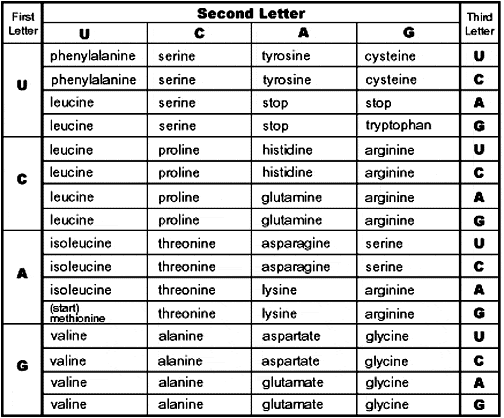
Use the codon chart to determine the amino acid sequence: (Hint: mRNA must be used to determine the AA sequence!)


ATT CGC ATC

TAA GCG TAG

AUU CGC AUC

UAA GCG UAG

a)

tyrosine, alanine, stop

b)

stop, alanine, tyrosine

c)

start, arginine, methionine

d)

Isoleucine, arginine, isoleucine

59.

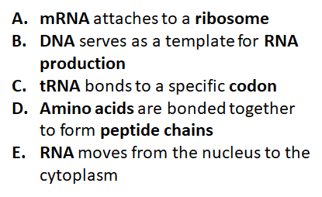
What is the correct order for the following events that occur during protein synthesis?

a)

B,E,A,C,D

b)

B,A,E,C,D

c)

D,A,E,C,B

d)

C,B,A,E,D

60.
What type of RNA carries the DNA message out of the nucleus to the ribosomes?
a)
mRNA
b)
tRNA
c)
rRNA
d)
aRNA
61.
Which phase of which process does this picture show?
a)
Transcription
b)
Translation
c)
Replication
d)
Cloning
62.
What is the correct sequence?
a)
RNA --> DNA --> Protein
b)
Protein --> RNA --> DNA
c)
DNA --> RNA --> Protein
d)
DNA --> Protein --> RNA
63.
a tool to organize all of the possible combinations of offspring from particular parents
a)
Punnett square
b)
gene
c)
fertilization
d)
mitosis
64.
the combination of genes for one or more specific traits (the actual genetic makeup)
a)
genotype
b)
phenotype
c)
Punnett square
d)
pedigree
65.
an organism’s appearance or other detectable characteristics
a)
phenotype
b)
genotype
c)
pedigree
d)
Punnett square
66.
The union of egg and sperm to form a new offspring is
a)
zygote
b)
fertilization
c)
homologous pairing
d)
meiosis
67.

What are alleles?

a)

a gene pair where each allele in the pair is the same version

b)

a gene pair where each allele in the pair is a different version

c)

Since human cells carry 2 copies of each chromosome (one from each parent), they have 2 versions of each gene

68.
How many chromosomes are shown in a normal human karyotype?
a)
2
b)
12
c)
25
d)
46
69.

The structures made of protein and DNA that carry our genetic information are called:

a)

genes

b)

alleles

c)

amino acids

d)

chromosomes

70.

Genes that determine traits are carried on chromosomes. You inherit one gene from each parent. We call the gene that is expressed or shows it's trait this:

a)

recessive gene

b)

dominant gene

c)

incomplete gene

d)

complete gene

71.

When you have genes in a pair that are different and one is hidden while the other shows it's trait, we call the hidden gene the ___________________ gene.

a)

recessive

b)

dominant

c)

codominant

d)

polygenic

72.

The scientific name for the process of cell division is:

a)

diffusion

b)

osmosis

c)

mitosis

d)

cellular respiration

73.

These molecules form the structure of organisms and carry out the life functions in organisms:

a)

nucleic acids

b)

carbohydrates

c)

proteins

d)

lipids

74.

We call the sequence of bases within our DNA our:

a)

instructions

b)

genetic code

c)

life code

d)

translation code

75.

The process of creating an exact duplicate of something is called:

a)

manipulating

b)

dividing

c)

genetics

d)

cloning

76.

The cell type that can become any cell type is:

a)

reproductive cell

b)

stem cell

c)

embryo cell

d)

egg cell

77.

If a DOMINANT and a recessive allele are both present, which one will be expressed? (which one will win?)

a)

A mixture of both traits is the result.

b)

The recessive trait wins.

c)

The dominant trait wins.

d)

They cancel each other out.

78.

Capybaras are the largest rodents on the planet. They can have small ears (e) or large ears (E). This capybara has small ears. Does this capybara express the dominant or recessive trait?

a)

Dominant

b)

recessive

79.

Approximately 15,000 years ago in China people started to domesticate wolves. They took desired qualities from each wolf and bred them with wolves with similar qualities to get the desired qualities they wanted. Some of these qualities may have been hair type, size, disposition, skills, etc. We can use this process for plants and animals to get the desired outcome. This process of breeding is called what?

a)

Hybrid

b)

Selective Breeding

c)

Selective mutationism

d)

Karyotyping

80.

As a woman gets older her chances of miscarriage and genetic disorders increase or decrease?

a)

increase

b)

decrease

81.

In which ways can genetic engineering can improve crops

a)

Make them pest or drought resistant

b)

Make them more nutritious

c)

Make them larger

d)

All answers are correct

82.

DNA fingerprinting can help police

a)

Identify crime scene DNA

b)

Identify suspects

c)

Idenitify victims

d)

All choices are correct.

83.
What is plant biotechnology?
a)
Adding chemicals to foods to preserve them.
b)
Making synthetic foods using artificial, man-made proteins.
c)
Inserting a gene or genes with beneficial traits into a plant cell.
d)
Taking immature plants and adding steroids to make them grow bigger and stronger.
84.

What is a GMO?

a)

An organism that has had its DNA modified by humans

b)

An organism missing a chromosome

c)

Epigenetics

d)

A genetically identical organism

85.
Putting the gene for bioluminescence into a fish is an example of...
a)
Genetic Engineering
b)
Selective Breeding
c)
Artificial Selection
d)
Gene Mutation
86.
Advantages of genetically modified crops include(s)
a)
insect resistance
b)
drought/freeze resistance
c)
higher yield
d)
all of these are reasons for using GMOs
87.

First cell inhabitants of the earth:

a)

eukaryotes

b)

prokaryotes

c)

fungi

d)

plants

88.
Organelle that links amino acids together to make proteins. 
a)
ribosome
b)
endoplasmic reticulum 
c)
vacuole 
d)
nucleus 
89.
Layered stack of flat membrane-enclosed spaces containing enzymes that process, sort, and deliver proteins. 
a)
Golgi apparatus 
b)
vacuole 
c)
cell wall
d)
none of these 
90.
Bean-shaped organelle that supplies energy to the cell and has its own ribosomes and DNA. 
a)
mitochondria
b)
nucleus
c)
cell wall 
d)
smooth endoplasmic reticulum 
91.
Organelle composed of many membranes used to convert solar energy into chemical energy; contains chlorophyll and is where photosynthesis occurs. 
a)
chloroplast
b)
smooth endoplasmic reticulum
c)
nucleus
d)
vesicle 
92.
A double-layer of phospholipids that forms a boundary between the cell and surrounding environment and controls the passage of materials into and out of the cell.
a)
cell membrane 
b)
cell wall
c)
cytoplasm 
d)
lysosome 
93.
An interconnected network of thin, folded membranes that produce, process, and distribute proteins. Is covered in ribosomes. 
a)
rough endoplasmic reticulum 
b)
cell wall
c)
smooth endoplasmic reticulum 
d)
centriole 
94.
Organelle that contains enzymes. It helps with the immune system and breaks down dead or damaged cell parts.
a)
lysosomes
b)
nucleus
c)
cell wall
d)
chloroplast
95.
Which of the following is the smallest unit of life that can carry out all life functions?
a)
the mitochondria
b)
the vacuoles
c)
the nucleus
d)
the cell
96.
Cells with a nucleus and membrane-bound organelles are called ____________________.
a)
prokaryotes
b)
eukaryotes
c)
bacteria
d)
protists
97.
Where are proteins made?
a)
Golgi body
b)
Mitoichondria
c)
Chromosomes
d)
Ribosomes
98.

When figuring the total magnification with a light microscope you:

a)

divide the objective lens power by the ocular lens power

b)

add the objective lens power to the ocular lens power

c)

subtract the objective lens power from the ocular lens power

d)

you multiply the ocular lens power by the objective lens power

99.

The micrscope type that allows biologists to see things at extremely high magnifications is this type:

a)

electron microscope

b)

light microscope

c)

dissecting scope

d)

stereomicroscope

100.
Find total magnification for:
Eyepiece = 10X 
Objective lens = 4X
 
a)
4x
b)
6x
c)
14x
d)
40x
101.

The energy currency of the cell is referred to as:

a)

DNA

b)

Glucose

c)

ATP

d)

ADP

102.

The molecule made up of adenosine and 3 phosphates is:

a)

DNA

b)

STP

c)

RuBP

d)

ATP

103.

Aerobic respiration yields on average around 38 of these molecules with each glucose molecule break down:

a)

DNA

b)

RuBP

c)

Carbon dioxide

d)

ATP

104.

This molecule is made by the electron transport chain which uses the concentration gradient of Hydrogen ions to activate the ATP synthase enzyme:

a)

ATP

b)

Oxaloacetic acid

c)

Citric Acid

d)

RuBP

105.

Glycolysis requires oxygen

a)

True

b)

False

106.

Finish the phrase: “As the bonds in glucose are _______ and rearranged, energy is __________.”

a)

broken, released

b)

built, trapped

c)

broken, trapped

d)

built, released

107.
Fermentation involves
a)
aerobic respiration
b)
anaerobic respiration 
108.
Fermentation is cellular respiration without which molecule?
a)
CO2
b)
O2
c)
C6H12O6
109.
Lactic acid fermentation occurs in your muscles after a workout because your cells are struggling to get
a)
Glucose
b)
Sunlight
c)
Oxygen
d)
Water
110.
If your body runs out of oxygen, it will begin to perform ______.
a)
alcohol fermentation
b)
photosynthesis
c)
cellular respiration
d)
lactic acid fermentation