wayground logo

Free Printable Worksheets

Font size

S
M
L
XL
Worksheets

GS Review

Total questions: 144

Worksheet time: 2hrs 24mins

Name
Class
Date
1.
Identify the equipment shown here:
a)
measuring cylinder
b)
conical flask
c)
beaker
d)
volumetric flask
2.
Identify the equipment shown here:
a)
beakers
b)
flasks
c)
decanters
d)
measuring cylinders
3.
Identify the equipment shown here:
a)
beaker
b)
conical flask
c)
test tube
d)
graduated cylinder
4.

What is used to measure (but not precise), heat, and mix large amounts of liquids?

a)

beaker

b)

flask

c)

test tube

d)

graduated cylinder

5.

What equipment allows you to measure liquid's volume and measures in milliliters?

a)

test tube

b)

beaker

c)

flask

d)

graduated cylinder

6.

Which equipment holds, measures, and mixes liquids (not a precise measurement), and measures in milliliters?

a)

flask

b)

test tube

c)

beaker

d)

graduated cylinder

7.
Which is NOT a step in the scientific method?
a)
Make observation
b)
Form a theory
c)
Collect data
d)
Form a hypothesis
8.
Will a construction paper air plane fly faster than an airplane made from notebook paper? Choose the best hypothesis.
a)
If I make a paper airplane from notebook paper, then it will fly faster than construction paper.
b)
Yes.
c)
No.
d)
I think the construction paper air plane will fly faster.
9.
This is the group that we will compare our experimental group to. This group stays "normal."
a)
Control Group
b)
Experimental Group
c)
 Normal Group
d)
Weird Group
10.

This is the group that is affected by the variable or the group that is changed.

a)

Control Group

b)

Experimental Group

c)

Changed Group

d)

Cool Group

11.
What step does every scientific experiment begin with?
a)
hypothesis
b)
question/problem
c)
procedures
d)
conclusion
12.
Research question: does the distance a person kicks a soccer ball effect how well they will do on their math test.  What is the dependent variable?
a)
How far they kick the soccer ball
b)
who the person is
c)
how well they do on the math test
d)
Type of soccer ball.
13.
When experimenting with the growth of a plant, a scientist uses three (of the same type of) plants, two different fertilizers, equal light, and equal water. What type of variable is the fertilizer?
a)
Dependent
b)
Independent
c)
Control
d)
Compound
14.
What would the INDEPENDENT variable be in an experiment testing which types of paper airplane goes furthest?
a)
the paper used
b)
the type of paper airplane
c)
the distance of each plane's flight
d)
how hard the plane is thrown
15.
Research Question: Does the type of gasoline put in a car effect how fast the car can drive. What is the independent variable?
a)
Type of gasoline
b)
which car the gas is put into
c)
how fast the car can drive
d)
how much gas is put into the car
16.
An experiment is performed on plants to see how different liquids affect plant growth. Each plant in the experiment is given a different liquid; water, apple juice, or milk. Each plant has the same amount of soil, sunlight, and listens to the same music. In this investigation, what is the dependent variable?
a)
Type of plant
b)
Water, apple juice, milk
c)
Plant growth
d)
Color of the plant's leaves
17.
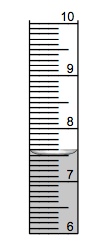
What is the volume of the liquid in this graduated cylinder?
a)
8.5 mL 
b)
7.5 mL 
c)
8 mL 
d)
.1 mL
18.
What is the scale on this graduated cylinder?
a)
.1 mL per line
b)
.2 mL per line
c)
.5 mL per line
d)
1 mL per line
19.
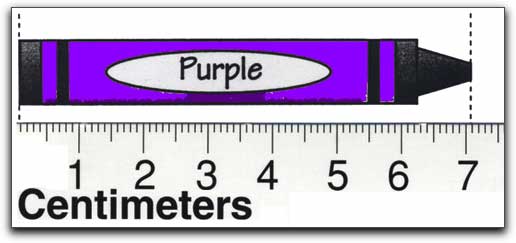
What is the length of this crayon to the nearest tenth of a centimeter?
a)
7 cm
b)
7.1
c)
7.0 cm
d)
7.1 cm
20.
What unit of measurement would be appropriate when measuring the length of your textbook?
a)
millimeters
b)
centimeters
c)
meters
d)
kilometers
21.
Measurement A =
a)
7/8"
b)
1  7/8"
c)
1  1/4"
d)
1  3/8"
22.
Measurement B=
a)
2"
b)
2  1/16"
c)
2  1/4"
d)
2  3/4"
23.
A collection of organisms that belong to different populations but all live in the same area and interact with one another.
a)
Population
b)
Ecosystem
c)
Community
d)
Ecosphere
24.
A collection of organisms that make up a community as well as all of the nonliving aspects of the environment.
a)
Population
b)
Community
c)
Habitat
d)
Ecosystem
25.
Two organisms that are so similar they can interbreed in nature and produce fertile offspring
a)
biotic factor
b)
herbivore
c)
ecosystem
d)
species
26.
Nonliving factor that affects an ecosystem...
a)
biotic factor
b)
abiotic factor
c)
food chain 
d)
biome
27.
What are the ecological levels of organization from smallest to the largest?
a)
organism, population, community, ecosystem, biome, biosphere
b)
organism, community, population, ecosystem, biome, biosphere
c)
organism, population, community, biome, ecosystem, ecosphere.
d)
organism, community, population, biome, ecosystem, ecosphere
28.

Jacob is going out to his grandparents farm. On the farm is a stream that he likes to fish in. While he is fishing he sees many different species of fish as well as maple and oak trees and dragonflies. What Jacob is seeing is an example of what level of organization?

a)

organism

b)

population

c)

community

d)

ecosystem

29.
Abby is walking to school with her best friend Jaylyn. They begin talking about everything they see including the ash trees, grass, weeds, ants, and people. They also notice how cold it is, how there are several large puffy clouds out, and how the sun is just starting to come up.  What level of organization are they discussing?
a)
community
b)
ecosystem
c)
biome
d)
biosphere
30.

What is the smallest level of ecological organization

a)

community

b)

ecosystem

c)

organism

d)

population

31.
Water temperature would be an example of ...
a)
a biotic factor.
b)
an abiotic factor.
32.
Which of the following best describes a community?
a)
sharks, groupers, anemones and shrimp on a coral reef
b)
decorator crabs on the seafloor
c)
loggerhead sea turtles in Atlantic
d)
prairie grassland in Wyoming
33.
An ecosystem contains living and nonliving things.
a)
True
b)
False
34.

Living factors or organisms that affect an ecosystem...

a)

abiotic factors

b)

species

c)

trophic level

d)

biotic factors

35.
Andrea is on the grils cross country tream. She is heading out for a run when she comes across 20 Canadian geese.  What level of organization is this group of Canadian geese?
a)
organism
b)
population
c)
community
d)
biome
36.

What are three examples of a biotic factors?

a)

skunk

b)

rocks

c)

bacteria

d)

water

e)

coral

37.
Inherited trait that helps an organism survive is a(n) __________.
a)
Fossil
b)
Adaptation
c)
Ancestor
d)
Natural selection
38.
Survival of the fittest or when favorable adaptations reproduce faster is called what?
a)
Evolution
b)
Adaptation
c)
Natural selection
d)
Fossilization
39.
Why are advantageous traits more likely to be passed onto offspring?
a)
Because they are more likely to survive and reproduce.
b)
Because they come from dominant alleles.
c)
Because they come from recessive alleles.
d)
Because the trait is an acquired phenotype.
40.

When organisms are better adapted to their environment they will survive and reproduce more successfully than organisms less adapted. This process is called what?

a)

Selective breeding

b)

Natural Selection

c)

Cloning

d)

Evolution of all species

41.

A physical or behavioral trait that helps an organism survive and reproduce in its environment is called a what?

a)

An adaptation

b)

A response to a stimulus

c)

A mutation

d)

Evolution

42.

MUSHROOMS ARE IN WHAT KINGDOM

a)

PLANT

b)

ANIMAL

c)

FUNGI

d)

PROTIST

43.

APES BELONG TO WHAT KINGDOM

a)

PLANT

b)

ANIMAL

c)

FUNGI

d)

PROTIST

44.
Heterotroph is when an organism...
a)
Has to eat other things
b)
has to make it's own food
45.
Autotroph is when..
a)
An organism makes it's own food
b)
An organism has to eat other things
46.
Organisms that break down dead animals and plants and their wastes are known as ______.
a)
scavengers
b)
autotrophs
c)
bacteria
d)
decomposers
47.
Examples are tomato plants and oak trees
a)
Fungi
b)
Plantae
c)
Protista
d)
Animalia
48.
Archeabacteria...
a)
are eukaryotic
b)
live in extreme environments
c)
are non-living
d)
live in the soil
49.
What levels of classification are used in the scientific name?
a)
Kingdom + Phylum
b)
Kingdom + Species
c)
Genus + Species
d)
Phylum + Genus
50.
Bacteria are all prokaryotic. What does it mean to be prokaryotic?
a)
Has a nucleus 
b)
Sometimes has a nucleus 
c)
Does not have a nucleus 
d)
Has a cell membrane 
51.
Eukaryotic cells always have a _______________.
a)
Nucleus 
b)
Plant
c)
no nucleus 
d)
heart 
52.
What kingdoms are PROKARYOTIC?
a)
plant and animal
b)
protist and fungus
c)
archaebacteria and eubacteria
d)
archaebacteria and protist
53.
Antibiotics are used for ____.
a)
bacteria
b)
viruses
54.
Eubacteria
a)
have a nucleus
b)
are true bacteria
c)
live in extreme locations
d)
are large
55.

Name 2 types of seed plants.

a)

angiosperms and gymnosperms

b)

mosses and liverworts

c)

roses and mosses

d)

liverworts and apple trees

56.

Plants with seeds in cones are called ___________.

a)

angiosperms

b)

gymnosperms

c)

flowers

d)

mosses

57.

A flower producing vascular plant in which the seed is enclosed in a fruit.

a)

Conifer

b)

Gymnosperm

c)

Angiosperm

d)

Fern

58.

All herbivores are _____.

a)

producers

b)

primary consumers

c)

secondary consumers

d)

tertiary consumers

59.

If an organism uses photosynthesis to make its energy, it is a _____.

a)

tertiary consumers

b)

producer

c)

primary consumer

d)

secondary consumer

60.

An owl who eats snakes is a _________.

a)

tertiary consumers

b)

primary consumer

c)

producer

d)

secondary consumer

61.

A rat that eats seeds ins an example of a _________.

a)

primary consumer

b)

producer

c)

secondary consumer

d)

tertiary consumers

62.

A snake that eats a mouse which feeds primarily on seeds is an example of a

a)

tertiary consumers

b)

primary consumer

c)

secondary consumer

d)

producer

63.

All the living things in an ecosystem are the _______ of an ecosystem.

a)

ecosystem

b)

abiotic factors

c)

biotic factors

d)

plants

64.

A _________ is a diagram of all of the food chains in a single ecosystem.

a)

food web

b)

food chain

c)

energy pyramid

d)

primary consumer

65.

A diagram that shows one possibility of energy flow in an ecosystem.

a)

food web

b)

energy pyramid

c)

food chain

d)

secondary consumer

66.

As energy makes its way up the food pyramid only ______ of energy from one organism gets passed on to the next organism.

a)

10%

b)

20%

c)

30%

d)

40%

67.
What is the definition of the word consumer?
a)
An animal that eats only plants
b)
An animal that eats other animals
c)
An organism that obtains energy by feeding on other organisms.
d)
The transfer (movement) of energy.
68.
What is the definition of the word carnivore?
a)
An organism that obtains energy by feeding on other organisms.
b)
An animal that eats only plants
c)
An animal that eats other animals
d)
An animal that eats both plants and animals
69.
What is the definition of the word omnivore?
a)
An animal that eats only plants
b)
An animal that eats both plants and animals
c)
An animal that eats other animals
d)
An organism that can make its own food.
70.
What is the definition of the word herbivore?
a)
An organism that obtains energy by feeding on other organisms.
b)
An animal that eats only plants
c)
An animal that eats other animals
d)
An animal that eats both plants and animals
71.
What is the definition of the word decomposer?
a)
Shows what eats what and consists of many food chains in an ecosystem
b)
The transfer (movement) of energy.
c)
An animal that eats other animals
d)
An organism that breaks down wastes and dead organisms.
72.
A __________________ is a type of animal that hunts other animals to eat. 
a)
prey
b)
herbivore
c)
predator
d)
producer
73.
This diagram shows the amount of energy that moves from one feeding level to another in a food web.
a)
Energy Pyramid
b)
Food Web
c)
Ecosystem
d)
Food Chain
74.
What are the products of photosynthesis?
a)
water and carbon dioxide
b)
oxygen and glucose
c)
oxygen and carbon dioxide
d)
oxygen and water
75.
Which gas is removed from the atmosphere during photosynthesis?
a)
hydrogen
b)
oxygen
c)
nitrogen
d)
carbon dioxide
76.
The main source of energy for all life comes from ____.
a)
the Earth
b)
the moon
c)
the sun
d)
the food we eat/make
77.
Which sentence correctly describes photosynthesis. (assume there is enough sunlight)
a)
CO2 and water combine and make O2 and glucose
b)
O2 and water combine to make glucose and CO2
c)
O2 and CO2 combine to make water and glucose
d)
CO2 and glucose combine to make O2 and water
78.
What is the organelle that contains the chlorophyll used in photosynthesis ?
a)
mitochondria
b)
ribosome
c)
chloroplast
d)
nucleus
79.
Which of the following is the correct equation for PHOTOSYNTHESIS?
a)
CO+ light + H2O --> O+ glucose
b)
CO+ glucose + H2O --> O+ light
c)
O2 + light + H2O --> CO+ glucose
d)
CO+ O2 + H2O --> Light+ glucose
80.
Why is photosynthesis important?
a)
creates oxygen for animals to breath
b)
creates energy for heterotrophs to use
c)
creates food for plants to use
d)
all of these are correct
81.
The purpose of cellular respiration is to produce ?
a)
energy
b)
oxygen
c)
sugar
d)
protein
82.
The waste gas given off by cellular respiration is?
a)
oxygen
b)
carbon dioxide
c)
nitrogen
d)
methane
83.

Which organism go through cellular respiration?

a)

animals

b)

plants

c)

both animals and plants

d)

none

84.

What is the correct equation for cellular respiration?

a)

6O2 + C6H12O6 -> 6CO2 + 6H2O + Energy

b)

6O2 + C6H12O6 + Energy -> 6CO2 + 6H2O

c)

6CO2 + 6H2O -> 6O2 + C6H12O6 + Energy

d)

6CO2 + 6H2O + Energy -> 6O2 + C6H12O6

85.
A relationship between two species where one benefits while the other is harmed.
a)
Mutualism
b)
Commensalism
c)
Parasitism
d)
Naturalism
86.
A frog eats a fly. The frog and fly are demonstrating ________.
a)
mutualism
b)
competition
c)
predator/prey
d)
parasitism
87.
A relationship between two organisms in which one organism benefits and the other is unharmed
a)
Mutualism 
b)
Competition
c)
Parasitsm 
d)
Commensalism 
88.
A relationship between two organisms in which both organisms benefit. 
a)
Mutualism 
b)
Competition
c)
Parasitsm 
d)
Commensalism 
89.
What type of species interaction is the following: two bears fighting over the same mate. 
a)
predation 
b)
mutualism 
c)
competition 
d)
parasitism 
90.
_______ is when 2 or more species live in close association. 
a)
predation 
b)
competition 
c)
symbiosis 
d)
food web 
91.
Name the species interaction: A decorator crab camouflages itself with sponges. Sponges are unaffected. 
a)
competition 
b)
predation
c)
commensalism
d)
mutualism 
92.

A keystone species that creates or maintains habitat for other species.

a)

Foundation Species

b)

Pioneer Species

c)

Indicator Species

d)

Exotic Species

93.

Competition among members of the same species.

a)

intraspecific competition

b)

interspecific competition

94.

Competition between members of different species.

a)

intraspecific competition

b)

interspecific competition

95.

Which experiences the least change over time?

a)

Pioneer Species

b)

Primary Succession

c)

Aquatic Succession

d)

Climax Community

96.

What is a common characteristic among pioneer species?

a)

roots that break apart rocks

b)

long thick roots

c)

exposed surface roots

d)

soak up water quickly

97.

Which of the following best describes primary succession?

a)

Volcano wipes out ecosystem that gradually grows back from ash covered soil

b)

Volcano creates a new island of rock that must break down to form an ecosystem

c)

Forest fire burns down forest that must bounce back over time

d)

Tornado destroys a crop that must slowly grow back over time.

98.

What term best relates to equilibrium?

a)

pioneer species

b)

primary succession

c)

secondary succession

d)

climax community

99.

If farmers use a controlled burn to prevent forest fires, what would most likely be the first plants to return?

a)

trees

b)

shrubs

c)

mosses

d)

grasses

100.

Which progression best explains secondary succession?

a)

lichens>grass>shrubs>small trees> big trees

b)

mosses>creates soil>grasses>small trees> big trees

c)

Volcano destroys ecosystem>grasses>shrubs>small trees>big trees

d)

Volcano forms new island> lichens>grasses>shrubs>small trees>big trees

101.

Which would result in primary succession?

a)

volcano destroying habitat leaving only soil and ash

b)

Tornado destroying a crop leaving very little soil

c)

Glacier retreating exposing bare rock

d)

limiting factors

102.

How do pioneer species compare in primary and secondary succession?

a)

primary starts with grass and weeds, secondary starts with mosses

b)

primary starts with forest fire, secondary starts with volcano

c)

primary starts with a volcano, secondary starts with a forest fire

d)

Lichens and moss in primary, and grasses/ ferns in secondary

103.

Primary succession occurs in areas with:

a)

very little soil

b)

lots of soil

c)

no soil

d)

soil that has been disturbed

104.

What best describes the term succession?

a)

rapid changes that create an ecosystem overnight

b)

gradual changes over time to fully create or restore and ecosystem

c)

forest with the tallest trees

d)

the rate species produce offspring

105.

Plants and animals in the tundra must be able to adapt to the extremely ___________ weather

a)

small

b)

cold

c)

perennials

d)

shallow

106.

Many of the animals in the desert are ______________ to avoid the extreme heat during the day.

a)

cacti

b)

chia

c)

water

d)

nocturnal

107.
Very little sun reaches this part of the rainforest.
a)
equal
b)
earth
c)
floor
d)
carnivorous 
108.

The two main abiotic factors that determine where organisms live are

a)

temperature and latitude

b)

altitude and precipitation

c)

temperature and precipitation

d)

soil type and precipitation

109.
As altitude or latitude increase, temperature ______
a)
stays the same
b)
rises
c)
drops
d)
drops, then rises
110.
What are the two main factors that determine the climate of an area?
a)
precipitation and humidity
b)
temperature and air pressure
c)
wind conditions and humidity
d)
temperature and precipitation
111.
Which two biomes have the least precipitation?
a)
tropical rain forest and temperate grasslan
b)
savanna and tropical dry forest
c)
tundra and desert
d)
boreal forest and temperate woodland
112.
What is this biome?
a)
Coniferous Forest
b)
Desert
113.
What is this biome?
a)
Deciduous Forest
b)
Tropical Rainforest
114.

Where is the proton found in an atom?

a)

nucleus

b)

orbiting around the nucleus

c)

protons don't exist o_O

d)

Justmir is hiding it.

115.

Where is the neutron found in the atom?

a)

protons don't exist o_O

b)

in the nucleus

c)

orbiting the nucleus

d)

Carleah has it!

116.

Where are electrons found in an atom?

a)

in the nuclues

b)

electrons don't exist o_O

c)

orbiting the nucleus

d)

Only Josie knows where they are.

117.

What charge is the proton?

a)

positive

b)

no charge (neutral)

c)

negative

d)

Senaida-charged

118.

What charge is the electron?

a)

Logan-charged

b)

negative

c)

positive

d)

no charge (neutral)

119.

What charge is the neutron?

a)

no charge (neutral)

b)

positive

c)

negative

d)

Katlyn-charged

120.

The atomic # tells us the # of ____________________ in an atom.

a)

protons

b)

electrons

c)

neutrons

d)

Cassietrons

121.

The mass # tells us the mass of the atom. Which two subatomic particles make up the mass of the atom?

a)

protons and electrons

b)

neutrons and electrons

c)

Kyrontrons and Kytrons

d)

protons and neutrons

122.

What can you do to find the number of neutrons in an atom?

a)

It's the same as the atomic #.

b)

Ask Sierra!

c)

Subtract the atomic # (protons) from the mass # (protons and neutrons)

d)

Multiply the mass # (protons and neutrons) and the atomic # (protons)

123.

The number of electrons is usually the same as the number of protons.

a)

True

b)

False

c)

Only Abraham knows...

124.

What do we call protons, electrons, and neutrons as a group?

a)

Billy Bob Emilys

b)

subatomic particles

c)

Spiral-shaped yeast buns

d)

periodic table of the elements

125.

How many electrons can "live" on the first electron shell?

a)

2

b)

8

c)

16

d)

infinite

126.

How many electrons can "live" on the 2nd electron shell?

a)

2

b)

8

c)

16

d)

infinite

127.

What is the atomic mass of Neon?

a)

10

b)

20.18

c)

10.18

d)

9.82

128.
How many protons are in Beryllium?
a)
4
b)
9
c)
5
d)
2
129.
How many neutrons are in a Gold atom?
a)
79
b)
196
c)
118
d)
275
130.
a)
2
b)
8
c)
3
d)
13
131.

USE THE PERIODIC TABLE

How many valence electrons does Phosphorus have?

a)

31

b)

5

c)

15

d)

4

132.
Elements in the same column of the periodic table always have the same # of _______ as one another.
a)
Protons
b)
Neutrons
c)
Electrons
d)
Valence Electrons
133.
How many valence electrons are found in atoms of group 14?
a)
4
b)
3
c)
14
d)
16
134.
Which group has the greatest number of valence electrons?
a)
1
b)
14
c)
18
d)
16
135.
Valence electrons are: 
a)
Electrons farthest away from the nucleus
b)
Electrons closest to the nucleus
c)
Electrons that just come and go - they don't stay with the atom
d)
Electrons in the second shell
136.
How many valence electrons are in an atom of Ba?
a)
2
b)
8
c)
4
d)
1
137.

What is the correct Lewis Dot Structure for ammonia NH3

a)
b)
c)
d)
138.
What is the right ratio of chemicals for the BCE (Balanced Chemical Equation)?__Na + __H2O --> __NaOH + __H2
a)
2,2 --> 2,1
b)
4,4 --> 4,1
c)
1,2 --> 2,4
d)
1,2 --> 2,1
139.
What is the right ratio of chemicals for the BCE (Balanced Chemical Equation)?__CO + __Fe2O3--> __Fe + __CO2
a)
3,1 --> 2,3
b)
3,2 --> 1,1
c)
3,2 --> 2,4
d)
3,2 --> 2,1
140.
What is the right ratio of chemicals for the BCE (Balanced Chemical Equation)?__CH4 + __O2 --> __CO2+ __H2O
a)
2,1 --> 2,1
b)
1,2 --> 1,1
c)
1,2 --> 1,2
d)
1,2 --> 2,1
141.
What is the right ratio of chemicals for the BCE (Balanced Chemical Equation)?__H2 + __S --> __H2S
a)
1,1 --> 1
b)
2,2 --> 2
c)
1,2 --> 1
d)
1,2 --> 2
142.
What is the right ratio of chemicals for the BCE (Balanced Chemical Equation)?__Al + __O2--> __Al2O3
a)
4,1 --> 2
b)
4,3 --> 4
c)
3,4 --> 1
d)
4,3 --> 2
143.

Which element is this?

a)

Nickel

b)

Neon

c)

Sodium

d)

Nitrogen

144.

What does the Bohr Model represent?

a)

The structure of molecules

b)

The structure of the Solar System

c)

The structure of an atom

d)

The structure of East Hills